
Most homeowners pay roughly $250 to $850 for professional asbestos testing. That covers an inspector visiting, collecting samples and sending them to a lab. This Old House puts testing and inspection at $250 to $800, and that is before any removal work. The final number depends mostly on how many samples you need, how fast you need results, and whether you are testing material or air.
This guide breaks down the price by type of test, explains what moves the bill up or down, and tells you when paying for a test makes sense. It also covers when it doesn’t, which matters if you are buying a home and watching your budget.
TL;DR
- Expect about $250 to $850 for a professional home inspection with sampling. A basic air test runs roughly $250 to $450.
- Extra samples are usually cheap compared with the visit itself, often $25 to $75 each when added to an existing inspection.
- EPA says material that is intact and will not be disturbed generally does not need testing. Test when it is damaged or when renovation will disturb it.
- Do not scrape samples yourself. EPA warns that incorrect sampling can release fibers.
- Buying an older home? Add asbestos to your inspection plan early, so the result arrives before your contingency period ends.
Table of Contents
- What asbestos testing costs by type
- What affects the price of an asbestos test
- When testing is worth paying for
- Why a professional should collect the sample
- How the testing process works
- Ways to keep the cost sensible
- Our perspective
- Get asbestos testing alongside your inspection
- FAQ
- Sources
What asbestos testing costs by type
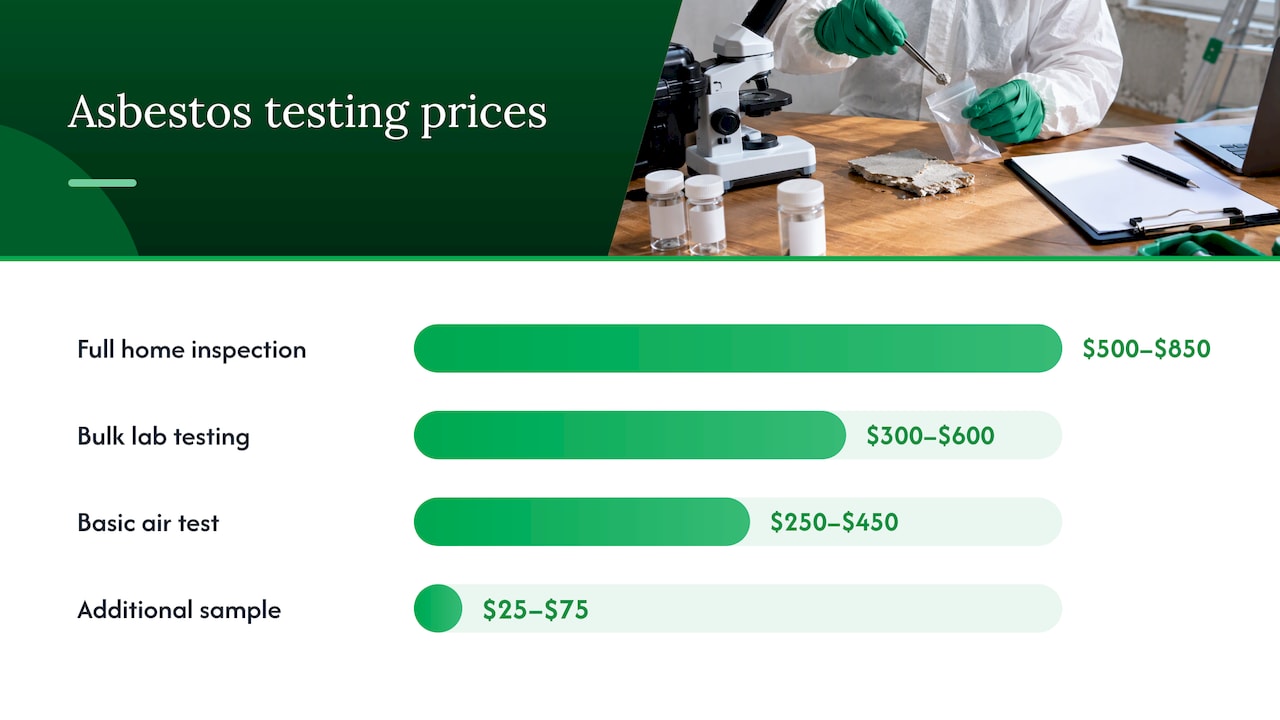
Prices vary by region and by who does the work, but the published ranges line up reasonably well. Here is how the main options compare, using figures from The Asbestos Institute’s 2025 cost breakdown.
| Type of service | Typical price |
|---|---|
| Full asbestos inspection of a home | $500 to $850 |
| Bulk sample lab testing, 1 to 3 areas | $300 to $600 |
| Basic air test | $250 to $450 |
| Each additional sample | $25 to $75 |
| DIY test kit | $30 to $80, plus $40 to $150 in lab fees |
The same source’s later roundup of national cost sites shows how much the averages differ. It cites Thumbtack near $375 to $394, HomeAdvisor and Angi both averaging about $483 to $484, and Fixr around $500. Across all of them the typical spread runs from about $231 to $778.
So a fair budget for a single house with a handful of suspect materials is a few hundred dollars. It is rarely a four-figure expense unless the property is large or the scope is a full survey.
Is asbestos testing expensive?
Compared with what comes after, no. Removal or encapsulation averages $1,170 to $3,120 nationwide, and that is just the average. Testing is the step that tells you whether you face that cost at all. For a buyer, a few hundred dollars to learn what is in a ceiling, a floor or a pipe wrap is small next to a renovation plan built on a wrong assumption.
What affects the price of an asbestos test
Four things do most of the work.
Number of samples. Every distinct suspect material needs its own sample. Popcorn ceiling, vinyl floor tile, pipe insulation, roofing and duct wrap are different materials, even in one room. A house with five materials to check costs more than one with two. The base visit covers the trip and the inspector’s time, and each added sample is a smaller increment.
Sampling versus air testing. Bulk sampling asks what a material is made of. Air testing asks whether fibers are in the air right now. They answer different questions, and the right one depends on your situation. Before renovation, you usually want to know about the material. After a disturbance or cleanup, air testing is more relevant.
Turnaround time. Standard lab results take days. Rush results cost more. If you are buying a house, ask about turnaround when you book, not after you hit a deadline.
Property size and location. A larger home or a hard-to-reach crawl space, attic or basement takes longer. Prices in dense metro areas tend to differ from rural ones, and travel can be added to the visit.
One more factor is whether testing is bundled. Adding asbestos sampling to a visit that already includes an inspection is usually simpler than scheduling a separate trip. If you are weighing the whole budget, our home inspection cost guide shows how the pieces add up, and our piece on reducing inspection costs legally covers what to prioritize.
When testing is worth paying for
Not every older home needs a test. EPA’s guidance is that suspect material should be sampled when it is damaged, for example fraying or crumbling, or before a renovation that would disturb it. If it is in good condition and will not be disturbed, EPA says testing is not needed.
That gives you a practical decision rule.
- Material looks damaged or is crumbling. Test, and keep people away from the area until you have an answer.
- You plan to renovate. Test the specific materials that your project will cut, sand, drill or remove, before work starts.
- You are buying and plan updates. Test the materials in the renovation zone during your inspection period, so the result can inform your negotiation.
- Material is intact and you plan to leave it alone. Testing is generally not needed, according to EPA.
For buyers the second and third cases are the common ones. Older homes often have the kinds of finishes that were popular in past decades, and the question is not whether they exist but whether your plans will touch them.
Why a professional should collect the sample
DIY kits look cheap at $30 to $80, but the kit price is only part of it, since the lab fee is separate. The bigger issue is safety. EPA warns that incorrect sampling can release fibers and highly recommends that sampling be done by a trained and accredited asbestos professional.
That is the logic behind professional collection: a person who knows how to wet the material, limit dust and seal the sample is less likely to create the very exposure you are trying to avoid. You are paying for method as much as for the lab.
If damaged material is already shedding, leave it alone and contact a professional rather than handling it.
How the testing process works
The usual sequence is short.
- Walkthrough. The inspector identifies suspect materials and notes their condition.
- Sampling. Small portions are collected from each distinct material, with the area kept as undisturbed as possible.
- Lab analysis. Samples go to a laboratory. Missouri’s Department of Natural Resources recommends accredited laboratories, through NVLAP or AIHA programs.
- Report. You get results material by material, which tells you what you can leave, what to monitor and what needs a plan before work begins.
What the 3-5-7 rule means
You may see the 3-5-7 rule mentioned in search results. It is a sampling guideline for deciding the minimum number of samples needed before a suspect material can be classified as not containing asbestos. Missouri DNR recommends it, and the same document explains that inspections before renovation need only cover the areas the work will affect, while inspections before demolition should be thorough and include destructive sampling and access to all areas.
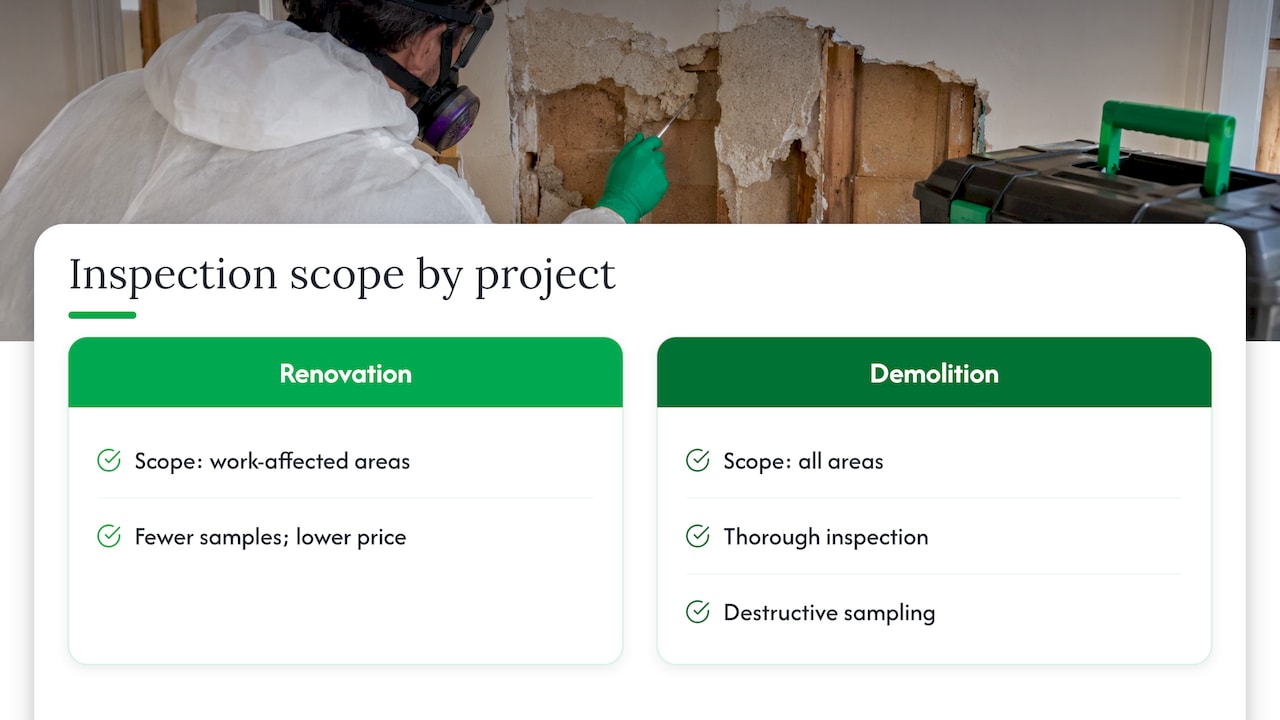
For your wallet, that matters: a renovation-scope inspection covers fewer areas than a demolition survey, so the sample count and the price are lower. Tell whoever you hire exactly what you plan to do.
Ways to keep the cost sensible
- Define the scope before booking. “I am replacing the kitchen floor and removing a wall” is a better brief than “test everything.”
- Add samples to one visit. Additional samples are far cheaper than a second trip.
- Test before you commit to contractors. Knowing the result before you collect bids avoids change orders mid-project.
- Bundle environmental checks. If you are already looking at radon or lead, plan them together. Our guide to environmental home testing explains which tests buyers should prioritize, and what an environmental hazard inspection covers helps you see the whole picture.
- Do not pay to test material you will never touch. EPA’s own advice supports leaving intact material alone.
Our perspective
We see asbestos questions come up most with first-time buyers who are looking at an older house on a tight budget. They have already stretched for the down payment, and a surprise in a ceiling or a floor can derail the plan.
Our view is simple: test with a purpose. If you plan to renovate, or something is visibly damaged, a few hundred dollars for answers is money well spent, because it lets you price the project honestly before you close. If the material is intact and you will leave it alone, there is no need to turn a purchase into a science project.
That is why we treat environmental testing, including asbestos, lead and water, as part of the buying decision rather than an afterthought. We return reports within 24 hours, offer evening and weekend scheduling, and give discounts to veterans and first-time buyers, so the timing and the cost fit the way real people buy homes.
JOHN
Get asbestos testing alongside your inspection
If you are buying or selling in the St. Louis Metro area or Southern Illinois, we can handle environmental inspections and testing, including asbestos, as part of the same process as your home inspection. You can attend in person or follow along by video, and your report comes back within 24 hours.
See the full list of services on our inspection services page, or contact us to ask about timing and pricing for your property.
FAQ
How much does an asbestos test cost for a house?
Most professional tests land between $250 and $850, depending on the number of samples and the type of test. A basic air test is typically $250 to $450, and extra samples on an existing visit often add $25 to $75 each. Larger homes or rush results can push the total higher.
Can I test for asbestos myself?
Kits exist, but EPA recommends that sampling be done by a trained and accredited asbestos professional, because incorrect sampling can release fibers. If you suspect a material, avoid touching or cutting it and have it sampled properly.
Do I need an asbestos test when buying a home?
Not automatically. EPA says intact material that will not be disturbed generally does not need testing. If you plan renovation, or you see damaged material, test during your inspection period so you know the cost before you close.
What is the difference between asbestos sampling and air testing?
Sampling identifies what a material is made of. Air testing measures fibers in the air at a given moment. Sampling is the usual first step before renovation, while air tests are more often used to check conditions after a disturbance or cleanup.
Sources
- This Old House: How Much Does Asbestos Abatement Cost?
- The Asbestos Institute: How Much Does It Cost To Test For Asbestos?
- The Asbestos Institute: Costs of Asbestos Testing
- EPA: Asbestos Frequently Asked Questions
- EPA: Protect Your Family from Exposures to Asbestos
- Missouri DNR: Asbestos Inspection Report Requirements
Recent Comments