

A construction draw inspection is an independent, on-site check that ties a lender’s disbursement to work that has actually been completed and materials that are actually on-site. Its main job is protecting collateral: the lender confirms verified progress before releasing money, which cuts overbilling risk and, done right, gets funds to the builder faster rather than slower.
TL;DR:
- A construction draw inspection verifies on-site progress and materials to prevent overbilling and ensure proper disbursement based on actual work completed.
- Inspections include a site walkthrough, photographs, material verification, and comparison against the schedule of values, producing a detailed, signed report.
- Qualified inspectors should have construction experience, relevant licenses, insurance, and provide clear, detailed reports with tamper-proof photo evidence.
- Inspection frequency typically aligns with monthly or milestone-based schedules, with report turnaround time ranging from 24 hours to a week depending on project complexity.
- Proper preparation, such as sharing schedules and staged materials, reduces delays caused by discrepancies and helps ensure faster approval of disbursements.
Table of Contents
- What Is a Construction Draw Inspection and How Does It Work?
- Why Do Lenders Require Draw Inspections?
- What Does a Draw Inspection Include? A Practical Checklist
- Who Performs Draw Inspections and What Qualifications Matter?
- How Often Are Draws Inspected, and Who Pays for It?
- Why Does Photo Evidence Need to Be Legally Defensible?
- What Technology and Software Actually Move the Needle?
- How Should Borrowers and Builders Prepare for a Draw Inspection?
- Hunt Home Inspection’s Approach to Draw Inspection Reporting
- An Editorial Take on Draw Inspection Rigor
- Book a Draw Inspection With Hunt Home Inspection
- Sources
- FAQ
What Is a Construction Draw Inspection and How Does It Work?
Three parties sit at the table in every draw inspection: the lender who releases funds, the borrower or owner whose collateral is at stake, and the builder or general contractor who submitted the draw request. The inspector works for the lender’s interest but has to be neutral enough that the report holds up if anyone challenges it later. That independence is the whole point. An inspector with no financial stake in the outcome has no reason to inflate or shortchange a completion percentage.
The inspection maps directly to the schedule of values, the line-by-line budget breakdown attached to the construction loan. Every trade and phase gets its own allocation, and the inspector’s job is confirming what percentage of each line is genuinely finished, not just what the contractor claims on the pay application.
Milestone checks tend to follow the build sequence:
- Foundation and site work, including footings, waterproofing, and backfill
- Framing and structural elements, checked against approved plans
- Mechanical, electrical, and plumbing rough-in before drywall closes it up
- Building envelope, including windows, roofing, and exterior sheathing
- Interior finishes, fixtures, and final punch-list items
The deliverable at the end is a signed report with a dated photo set and a percent-complete figure for every line item on the schedule of values. That report becomes the document the lender’s underwriting team actually reads before wiring money, so its accuracy matters more than almost anything else in the draw cycle.
Why Do Lenders Require Draw Inspections?
Lenders require draw inspections because construction loans carry a risk that permanent mortgages don’t: the collateral doesn’t exist yet. A house or commercial building under construction is worth exactly as much as the work in place, and if a contractor bills for framing that’s still sitting in a lumber yard, the lender is now secured by nothing.
Overbilling and phantom work are the two failure modes inspections are built to catch. A dishonest or simply overoptimistic pay application might claim 60% complete on electrical when an inspector on site counts closer to 35%. Budget-to-complete checks catch the scarier version of that problem: a project that’s burned through 70% of its loan proceeds while only 50% built, which puts the whole deal on a collision course with running out of money before it’s finished.
The scale here isn’t small. U.S. commercial and multifamily construction lending backs roughly $150 billion in annual starts, and a typical project triggers somewhere between 8 and 15 separate draw events from groundbreaking to certificate of occupancy. Multiply that across the market and draw inspections aren’t a paperwork formality. They’re the mechanism that keeps billions of dollars in disbursed capital tethered to verified reality.
What Does a Draw Inspection Include? A Practical Checklist
A lender-ready draw inspection has two parts: the on-site verification and the report that documents it. Skipping either one is how disputes start.
On-site, the inspector works through a sequence most experienced reviewers keep close to this order:
- Walk the site against the current pay application, line by line
- Photograph completed work at each milestone, with wide shots and close-ups of critical connections or finishes
- Verify stored materials physically present and check documentation showing they’re allocated specifically to this project, not just sitting in a yard
- Compare the visual percent-complete against the percent claimed on the pay application
- Note any discrepancies, safety issues, or code concerns that could affect fund release
Stored materials trip up more draws than people expect. A pay application can legitimately claim payment for materials purchased but not yet installed, but the correct verification isn’t a receipt. It’s physical presence on-site plus proof the materials are earmarked for that specific contract. An inspector who accepts an invoice alone without confirming the lumber or fixtures are actually staged on the property is skipping a step that protects the lender from paying for materials that end up on a different job.
The report itself, once the walkthrough is done, typically contains:
- Percent-complete by scope, reconciled against the schedule of values
- A dated, organized photo log tied to each line item
- Line-item reconciliation showing what was billed versus what was verified
- Written recommendations, including any items that should hold up disbursement
That reconciliation between billed and verified work is the document’s real function. Everything else supports it.
Who Performs Draw Inspections and What Qualifications Matter?
Three types of providers show up in this space, and they’re not interchangeable. Third-party inspection firms are the most common on larger commercial and residential construction loans, valued precisely because they have no relationship with the builder. Lender staff inspectors work directly for the bank or credit union, which keeps costs down but can raise questions about independence on disputed draws. Licensed professionals, architects, engineers, or general contractors moonlighting as inspectors, bring construction expertise but vary widely in reporting consistency.
What actually matters when vetting any of them:
- Direct construction background, not just an inspection certificate with no field experience
- Relevant credentials, such as ICC certifications or state-specific inspector licensing where applicable
- A track record of turnaround times that match the lender’s draw schedule, not just a promise
- Liability insurance and errors-and-omissions coverage, since a bad report can trigger real financial exposure
Pro Tip: Ask a candidate inspector for two sample reports from unrelated projects before hiring. A report that’s vague on percent-complete or thin on photos will cause the exact delays you’re trying to avoid.
Borrowers and builders working with commercial projects specifically should confirm the inspector has handled commercial inspection work before, since commercial draw schedules and code requirements differ meaningfully from residential ones.
How Often Are Draws Inspected, and Who Pays for It?
Draw inspections generally happen monthly or at each major draw request, whichever cadence the loan agreement specifies. Most residential construction loans align inspections with monthly draws; larger commercial projects sometimes tie inspections to defined construction milestones instead of a fixed calendar.
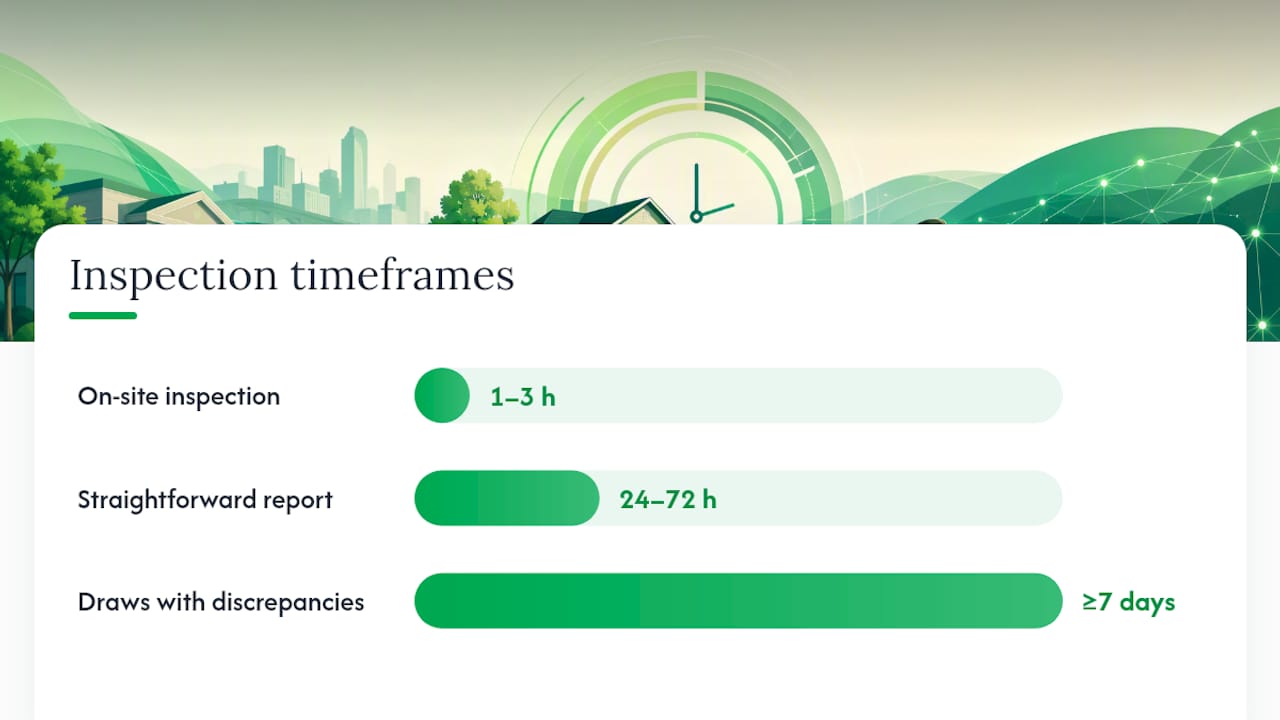
The on-site portion itself doesn’t take long. Most inspections run 1 to 3 hours depending on project size and how many discrepancies the inspector needs to document. Report turnaround is where timelines diverge:
- Straightforward draws with clean documentation: report delivery in 24 to 72 hours
- Draws with discrepancies requiring forensic photo review or additional verification: longer, sometimes a week or more
- Complex commercial projects with multiple subcontractor pay applications: turnaround tends to run longer by default
Fees are typically built into the construction loan budget as a line item, though some lenders bill the borrower directly per inspection rather than folding it into the loan. Costs vary by project size and region, and borrowers should ask upfront how their specific lender structures the fee rather than assuming it’s bundled. Some inspection providers offer payment at closing to align inspection costs with the transaction timeline rather than requiring payment at time of service.
Why Does Photo Evidence Need to Be Legally Defensible?
An ordinary smartphone photo is weaker evidence than most people assume. EXIF metadata can be edited after the fact, GPS coordinates can be spoofed, and timestamps can be altered with tools anyone can download. In a draw dispute where the builder claims one completion percentage and the lender’s file shows another, an easily-edited photo doesn’t settle anything. It just gives both sides something to argue about.
Photo evidence becomes self-authenticating when it has four specific properties:
| Property | What it does |
|---|---|
| Forensic acquisition at source | Captures the image inside a secure system, not a phone’s camera roll, so it can’t be swapped or edited before upload |
| Bit-level hash | Creates a cryptographic fingerprint that changes if the file is altered in any way |
| Qualified timestamp | Applies a verified, tamper-resistant time record from a trusted source rather than the device’s own clock |
| Chain of custody | Logs every point the file passed through, from capture to storage to delivery |
These four properties connect directly to Federal Rules of Evidence 901 and 902(14), which govern how electronic evidence gets authenticated in court. Rule 902(14) specifically allows certified electronic records to self-authenticate, meaning the party offering the evidence doesn’t need a live witness to testify about how it was captured and stored. For draw disputes that end up in litigation or arbitration, that distinction can be the difference between resolving a disagreement with a document and resolving it with a deposition.
The operational payoff shows up before any dispute happens. Lenders using digital-first capture with cryptographic proof report compressing approval cycles to 48 to 72 hours, compared with longer timelines when manual forensic review is required to sort out questionable photo evidence. Faster, cleaner evidence means fewer holds on the underwriting side.
What Technology and Software Actually Move the Needle?
Three categories of tools show up in draw inspection workflows, and they solve different problems. Field capture apps handle the basic job of getting photos and notes from the site into a digital file. Evidence-authenticity platforms add the forensic layer, hashing and timestamping images so they hold up under scrutiny. Loan-administration suites sit on top of both, managing the draw schedule, pay applications, and disbursement approvals in one system.
The features worth asking about before adopting any of them:
- Forensic capture that bypasses the device’s standard camera roll
- Automatic cryptographic hashing at the moment of capture, not after upload
- Qualified timestamping tied to a verified time source
- Chain-of-custody audit logs that show every step from field to file
- Integration with existing loan files or escrow systems, so photos don’t live in a separate silo
The gap between a manual review workflow and a self-authenticating one isn’t cosmetic. A lender’s underwriting team reviewing unverified photos has to build in time for questions, follow-up calls, and sometimes a second site visit. A properly hashed and timestamped photo set skips most of that friction entirely.
How Should Borrowers and Builders Prepare for a Draw Inspection?
Most draw delays trace back to preparation, not disputes. Here’s the sequence that keeps inspections moving:
- Send the inspector the current schedule of values and the contractor’s pay application before the site visit, not on arrival
- Have the contractor present, or at least reachable, since contractor availability during inspection resolves questions in real time instead of after the fact
- Stage stored materials in a clearly identifiable, accessible location, with invoices or delivery tickets on hand showing they’re allocated to that project
- Flag any known discrepancies between the pay application and actual progress before the inspector finds them independently
That fourth step matters more than it sounds. An inspector who discovers an unexplained gap between billed and verified work has to note it as a discrepancy, which can pause disbursement until resolved. A builder who flags it first, with an explanation, usually gets a faster resolution than one who lets the inspector find it cold.
Pro Tip: Keep a simple running log matching each stored-materials receipt to its specific project location on-site. When the inspector arrives, walking straight to the materials with paperwork in hand saves real time compared to searching for documentation during the visit.
Hunt Home Inspection’s Approach to Draw Inspection Reporting
A local inspection firm handles loan draw inspections alongside commercial inspection and video-enabled inspection options for builders, lenders, and borrowers in the relevant service area. Reports return within 24 hours, which keeps draw cycles moving instead of stalling in a queue.
Communication between buyers, agents, and lenders can run through proprietary tools designed to keep everyone working from the same documentation. HUD compliance certification work and commercial inspection experience can round out offerings for those dealing with FHA, VA, or larger commercial draw schedules. Scheduling may include both in-person and video walkthroughs. This option matters when a lender or out-of-town owner can’t be on-site for every milestone.
An Editorial Take on Draw Inspection Rigor
The lenders who treat draw inspections as a bureaucratic checkbox are the ones who end up in six-week disputes over a single discrepancy. Rigor upfront, precise photos, honest percent-complete numbers, a clean chain of custody, is what keeps a project moving when money and trust are both on the line. Skip the rigor and you’re not saving time. You’re borrowing it against a future argument.
— JOHN
Book a Draw Inspection With Hunt Home Inspection
Those managing a construction loan in the relevant regional area may consider a direct alternative to waiting on a generic third-party inspection queue: reports that return within 24 hours, with both in-person and video walkthroughs potentially available to match project schedules.

Loan draw inspection is one of more than a dozen services listed on the inspection services page, alongside commercial inspection support and HUD compliance certification work for FHA and VA-backed projects. The Create Request List™ tool keeps borrowers, contractors, and lenders working from the same documentation, so nobody’s chasing down a missing photo three days before a disbursement deadline. Visit the inspection services page to check scheduling availability and book your next draw inspection.
Sources
- How Lenders Manage Construction Draw Inspections
- Construction draw inspections: legally valid photo reports for faster disbursements
- A Guide to Construction Draw Inspections
FAQ
What Is a Construction Draw Inspection?
It’s an independent, on-site verification that confirms work claimed in a builder’s draw request actually matches physical progress before a lender releases loan funds. The inspector checks completion percentage against the schedule of values and documents everything with dated photos.
How Much Does a Draw Inspection Cost?
Fees vary by project size, location, and lender policy, and are typically either built into the construction loan budget or billed separately to the borrower. Hunt Home Inspection’s loan draw inspection pricing is available directly through its services page since costs depend on project scope.
How to Become a Construction Draw Inspector?
Most inspectors come from a construction background, general contracting, architecture, or engineering, combined with relevant certifications such as ICC credentials or state-specific licensing where required. Lenders also look for liability insurance and a demonstrated ability to deliver consistent, detailed reports on schedule.
How Often Should a Construction Site Be Inspected?
Draw inspections typically happen monthly or at each major draw milestone, depending on what the construction loan agreement specifies. On-site visits usually take 1 to 3 hours, with report delivery following within 24 to 72 hours for straightforward draws.
Recent Comments