
Most homes need a smoke alarm inside every bedroom, outside each sleeping area, and on every level, including the basement. Carbon monoxide (CO) alarms belong outside sleeping areas and on every level too. The exact legal minimum depends on your state, city and the code edition your area has adopted, so national guidance sets the target and your local fire authority sets the rule you must meet.
This guide covers the placement rules that fire-safety bodies agree on, the clearance distances, the alarm types that meet code, how Illinois law differs from the rest of our region, and what buyers and sellers should look for before closing.
TL;DR
- Put smoke alarms in every bedroom, outside every sleeping area, and on every level of the home, basement included.
- Keep alarms 10 feet from cooking appliances, and mount wall alarms no more than 12 inches below the ceiling.
- Place CO alarms outside each sleeping area and on every level. Illinois requires one within 15 feet of every sleeping room.
- Replace any smoke alarm older than 10 years, test monthly, and change batteries at least yearly unless the unit has a sealed 10-year battery.
- Requirements vary by state and city, so confirm with your local fire department or code office before you buy, sell or renovate.
Table of Contents
- Who sets the smoke detector rules?
- How many smoke alarms does a home need?
- Clearance and mounting: where exactly on the wall or ceiling
- Where do CO alarms go?
- What the law says in Illinois and Missouri
- Types of alarms that meet requirements
- Testing, batteries and replacement
- What buyers and sellers should check
- Common mistakes that fail a check
- Our perspective
- Book an inspection that covers the basics
- FAQ
- Sources
Who sets the smoke detector rules?
There is no single national smoke detector law for private homes. Rules come from a patchwork: model codes such as those from the National Fire Protection Association (NFPA) and the International Code Council, state statutes, and local amendments. NFPA’s research review of CO alarm rules explains that states adopt different code families and editions, and local jurisdictions may amend or enforce them separately. Some states follow the International Fire Code, some follow NFPA codes, some write their own rules, and some have no statewide fire code at all.
In practice that means two houses a few miles apart can face different obligations. A city in the St. Louis area may have adopted a newer code edition than a rural county in Southern Illinois. Before you make any decisions, call your local fire district or building department and ask which edition applies.
The guidance below reflects what federal agencies and NFPA recommend. Following it will put you at or above the standard almost anywhere.
How many smoke alarms does a home need?
NFPA’s guidance is to install alarms inside each bedroom, outside each sleeping area, and on every level of the home, including the basement. On levels without bedrooms, the alarm goes in the living room, den or family room, near the stairway to the upper level, or in both places. Larger homes need more alarms.
The U.S. Fire Administration (USFA) gives the same layout and adds that alarms should be interconnected so that when one sounds, they all sound. It also explains why alarms go both inside and outside sleeping areas: a closed bedroom door can slow smoke, heat and fire, so an alarm in the hallway alone may sound later than you would want.
A quick count for a typical house
Take a two-story, three-bedroom home with a finished basement:
| Location | Alarms |
|---|---|
| Inside each bedroom | 3 |
| Hallway outside the bedrooms | 1 |
| Main level, living area or near the stairs | 1 |
| Basement, ceiling at the bottom of the stairs | 1 |
| Total | 6 |
NFPA recommends placing the basement alarm on the ceiling at the bottom of the stairs leading to the next level. A home with a second sleeping hallway, a bonus room or a large open plan will need more.
Clearance and mounting: where exactly on the wall or ceiling
Placement details are where most failed checks happen. The numbers below come from NFPA, the Consumer Product Safety Commission (CPSC) and a state fire marshal sheet.
Ceiling and wall height
- Ceiling mount: CPSC guidance describes a spot near the center of the ceiling, or on a wall 6 to 12 inches below the ceiling.
- Wall mount: NFPA says the alarm should be no more than 12 inches from the ceiling, measured to the top of the device.
- Pitched or sloped ceilings: NFPA says to place the alarm within 3 feet of the peak but not in the apex itself. The Rhode Island State Fire Marshal sheet gives a similar rule: within 36 inches of the peak, with at least 4 inches of separation from the peak or adjoining wall.
The reason for the apex rule is that the very top of a peak can hold a pocket of dead air that smoke reaches late.
Distance from the kitchen
NFPA says cooking appliances should be at least 10 feet from the nearest smoke alarm. If you cannot reach 10 feet because of a small floor plan, the Rhode Island sheet says devices within a 20-foot horizontal path of a cooking appliance should have an alarm-silencing feature or be photoelectric. That helps stop the nuisance alarms that lead people to pull batteries, which is the most dangerous habit in home fire safety.
Bathrooms and other trouble spots
Steam from showers sets off many alarms. A widely used handout from a California city requires alarms to sit at least 3 feet horizontally from the door of a bathroom with a tub or shower, unless the room layout prevents it. Other places to avoid are right beside supply vents, ceiling fans and windows, where moving air can carry smoke past the sensor.
When you are unsure, read the instructions printed on the alarm. Codes require installation according to the manufacturer’s instructions, and those instructions override any rule of thumb.
Where do CO alarms go?
CO is odorless and invisible, so the alarm is the only warning you get. USFA recommends a CO alarm in a central location outside each separate sleeping area and on every level of the home.
Some codes go further. A 2026 city handout from California says CO alarms are generally required in dwellings with a fuel-burning appliance, a fireplace, or an attached garage that connects to the living space. It adds that bedroom placement is needed if a fuel-burning appliance sits in the bedroom or its attached bathroom. Check your own local code for the same triggers, because the wording differs by state.
As a practical matter, any home with a gas furnace, gas water heater, gas range, wood stove or attached garage should treat CO alarms as non-negotiable, whatever the local minimum says.
Combination alarms
Combination smoke and CO units save wall space and installation time. They are acceptable where they carry both listings. Smoke alarms are listed to UL 217 and CO alarms to UL 2034, and the 2026 California handout cites those two standards. Look for the listing marks on the box and on the device.
What the law says in Illinois and Missouri
Buyers in the St. Louis metro area often cross the river, so the rules on each side matter.
Illinois
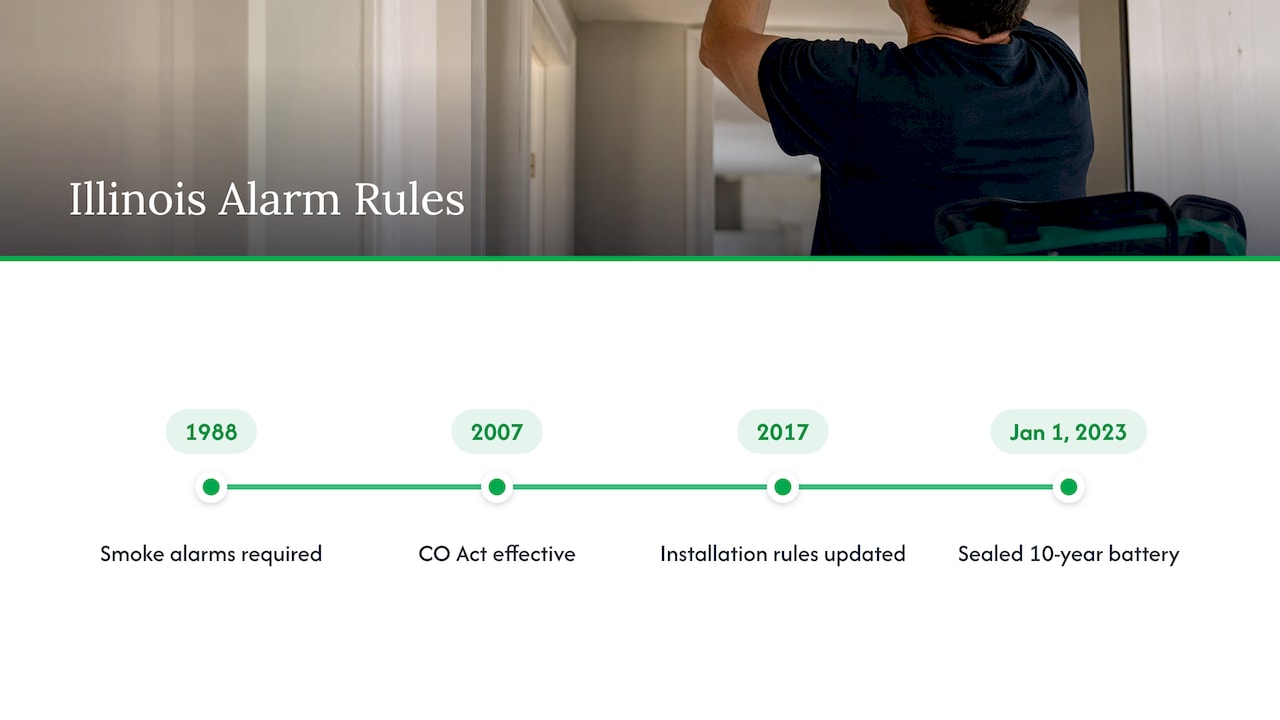
According to a village summary of state law, Illinois has required smoke alarms in dwellings since 1988. A 2017 update (Public Act 100-0200) changed the rules for new installations. Since January 1, 2023, new smoke alarms installed in single- or multi-family homes must have a sealed 10-year battery. Alarms installed before that date can stay until they pass 10 years from their manufacture date, fail an operability test, or otherwise malfunction.
For CO, the same source says the state’s Carbon Monoxide Alarm Detector Act, effective in 2007, requires every dwelling unit to have at least one UL listed or FM approved CO alarm in working condition within 15 feet of every room used for sleeping. The owner of the structure must supply and install the required alarm.
If you are selling an Illinois home with older plug-in or removable-battery alarms, replacing them before listing is a low-cost way to avoid a repair request later.
Missouri
Missouri leaves much of the detail to local fire districts and municipalities, and code editions differ from one jurisdiction to the next. Look up your city or fire protection district, ask which fire and residential code edition it enforces, and ask whether it requires smoke alarm or CO alarm compliance at sale or rental. Many St. Louis County municipalities handle this through an occupancy inspection at sale, so it pays to ask early rather than the week before closing.
Existing homes versus new construction
New construction usually has to meet the current code in full, including hardwired, interconnected alarms. Existing homes are often treated more gently, but not always. The 2026 California handout notes that permit-required alterations, repairs or additions can trigger alarm upgrades, subject to code exceptions. If you are finishing a basement, adding a bedroom or replacing a furnace, assume the permit office may ask you to bring alarms up to date.
Types of alarms that meet requirements
There are a few things to know when you are shopping.
- Ionization versus photoelectric. Ionization sensors tend to respond faster to flaming fires, while photoelectric sensors tend to respond faster to smoldering ones. Many manufacturers sell dual-sensor units that combine both. Photoelectric models are also the usual answer for alarms near kitchens, since they are less prone to nuisance trips.
- Battery-powered with a sealed 10-year battery. Easy to install, needs no wiring, and satisfies the Illinois rule for new installations.
- Hardwired with battery backup. Wired into household power with a backup battery, and usually interconnected. Required in most new construction. USFA says hardwired alarms should be installed only by qualified electricians.
- Wireless interconnected. Battery-powered units that talk to each other by radio, useful in older homes where running wire would be costly.
- Heat detectors. These respond to temperature rather than smoke, and are used in places like garages or kitchens where smoke alarms misfire. Some products pair smoke and heat sensing with a relay contact for a security panel, such as this smoke and heat detector with NO/NC contact. A heat detector supplements the required smoke alarms and does not replace them.
Whatever you choose, make sure it carries the UL 217 listing for smoke alarms. That is the baseline listing standard that code references.
Testing, batteries and replacement
A legal alarm that does not work is the same as no alarm. CPSC recommends replacing smoke alarms older than 10 years, testing them monthly, and replacing batteries at least annually.
A simple routine keeps you covered:
- Press the test button on every alarm on the first day of each month.
- Change removable batteries on a date you will remember, and replace them immediately when a unit chirps.
- Find the manufacture date on the back of each alarm. Anything past 10 years comes down, whatever it looks like.
- Write the replacement year on the new alarm with a marker.
- Replace the whole unit if it fails to sound on test with a fresh battery.
Alarms in a fire panel or monitored system follow different maintenance schedules set by the manufacturer and local code, so follow those instructions.
What buyers and sellers should check
Alarm problems are among the most common small defects that turn up during a sale, and they are also among the cheapest to fix.
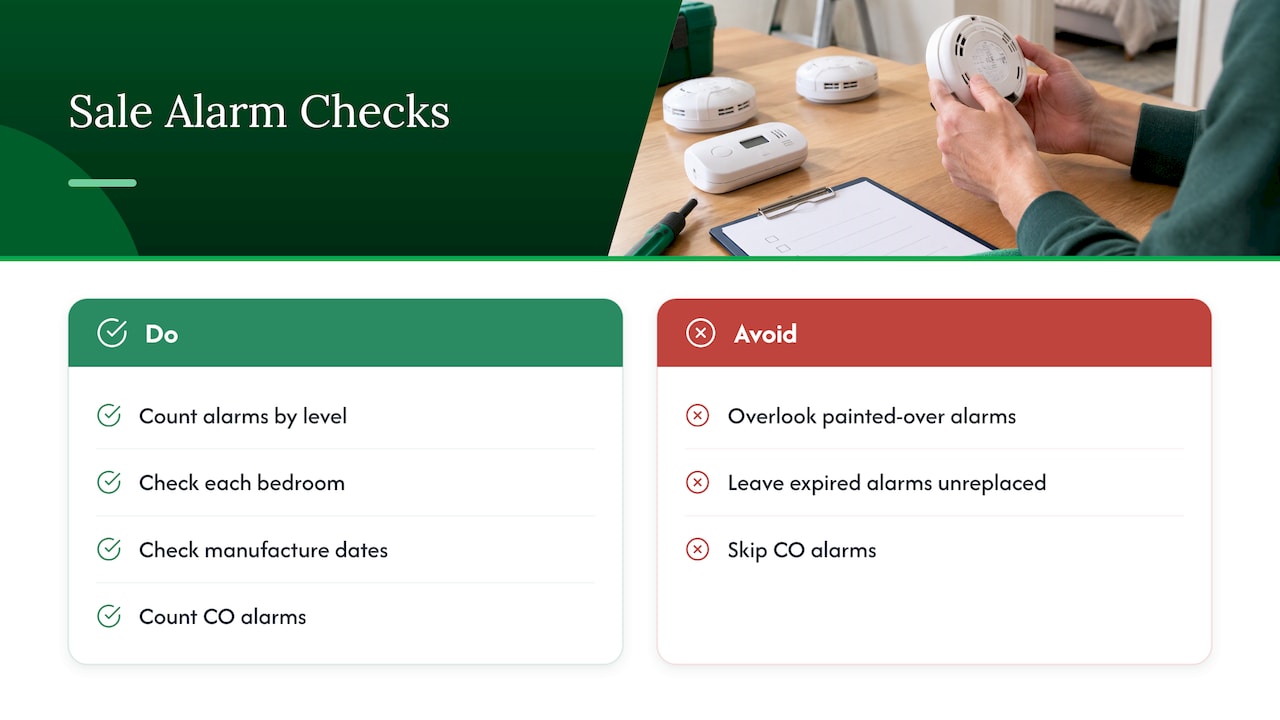
If you are buying: Walk the house with the placement rules above. Count alarms by level, look for one in each bedroom, check manufacture dates, and note whether any are missing or have been painted over. Include CO alarms in your count, particularly if the home has gas appliances or an attached garage. Our guide to what to expect on inspection day explains how to use the visit, and our red flags list for buyers covers what else to watch for.
If you are selling: Replace expired or missing alarms before photos and showings. In Illinois, new replacements should be sealed 10-year units. A pre-listing inspection lets you find and fix items like this on your schedule rather than the buyer’s.
If you own an older home: Alarm placement is only one part of electrical and life-safety checks. Aging panels and missing circuit protection matter too. See our pieces on AFCI and GFCI protection and Federal Pacific panels. For gas and CO risk from the ground up, our page on radon in the home covers the other invisible hazard that buyers should test for.
Common mistakes that fail a check
- Alarms in the hallway only, with none in the bedrooms.
- No alarm in the basement or on a finished attic level.
- A detector within a few feet of a shower door or a kitchen range that has been disabled because of nuisance alarms.
- Alarms older than 10 years, with a manufacture date that has worn off the back label.
- Removable-battery alarms with the battery removed.
- Mixed brands wired together. Interconnected alarms generally need to be compatible, so check the manufacturer’s instructions before you add a new unit to an existing wired system.
- CO alarms plugged in behind furniture or placed right next to a fuel-burning appliance, which can cause false trips.
Our perspective
Alarm problems rarely come from a hard decision. They come from small things nobody looked at: a dead battery in a bedroom, a unit older than the buyer, a basement with nothing on the ceiling. Most of these cost less than a pizza to fix, and they matter more than almost anything else in a house.
We want buyers to see them before closing, not after move-in. That is why we deliver reports within 24 hours and offer both in-person and video walkthroughs, so you can read the findings and ask your agent for repairs while the contract still allows it. Our Create Request List™ tool is built to turn findings into a clear list that buyers and agents can act on together.
First-time buyers, veterans and families on tight budgets should not have to guess whether a house is safe. If you are unsure which rule applies to your property, ask us, and we will help you work out what to verify with the local fire authority.
JOHN
Book an inspection that covers the basics
We inspect homes across the St. Louis metro area and Southern Illinois, with reports returned within 24 hours, evening and weekend scheduling, and discounts for veterans and first-time buyers. Our services include buyer’s inspections, pre-listing inspections, radon testing, mold inspections and more, and you can see them all on our inspection services page.

If you are ready to schedule, start there or visit our home page to reach us.
FAQ
How much clearance does a smoke detector need?
Keep smoke alarms at least 10 feet from cooking appliances, and mount wall alarms no more than 12 inches below the ceiling. On a pitched ceiling, place the alarm within 3 feet of the peak but not in the apex. Check the manufacturer’s instructions for any additional distances from bathrooms, vents and fans.
Do I need smoke alarms in every bedroom?
National fire-safety guidance says yes: inside every bedroom, outside each sleeping area, and on every level of the home. A closed bedroom door can delay smoke reaching a hallway alarm. Your local code may set its own minimum, but this layout is the one fire agencies recommend.
How often should smoke alarms be replaced?
Replace any smoke alarm that is more than 10 years old. Test every alarm monthly and change removable batteries at least once a year. In Illinois, new installations must use sealed 10-year battery units.
Where should carbon monoxide alarms go?
Place them in a central spot outside each separate sleeping area and on every level of the home. Illinois law requires at least one within 15 feet of every room used for sleeping. Homes with fuel-burning appliances or an attached garage should treat CO alarms as essential.
Sources
- Installing and maintaining smoke alarms, NFPA
- Smoke Alarms, U.S. Fire Administration
- Carbon Monoxide Poisoning Prevention, U.S. Fire Administration
- Smoke Alarms, Consumer Product Safety Commission
- Smoke and Carbon Monoxide Alarms, Rhode Island State Fire Marshal
- Residential Smoke and Carbon Monoxide Alarm Requirements, City of Antioch, 2026
- Carbon Monoxide Detection and Alarm Requirements, NFPA Research Foundation
- Smoke Alarms and Carbon Monoxide, Village of Richton Park
Recent Comments