
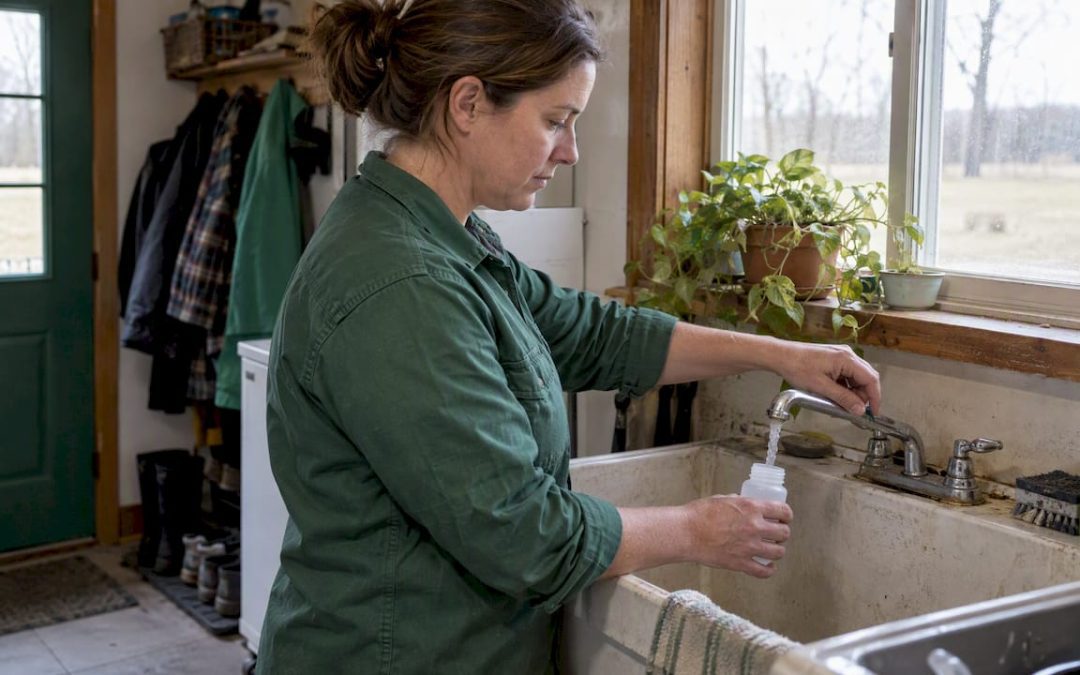
If a property is served by a private well, make your offer conditional on a professional water quality test analyzed by a state-certified laboratory. At minimum, order total coliform bacteria, E. coli, and nitrate testing, and add others based on local risk factors. We recommend coordinating sampling through a certified lab or local health department, never a drugstore strip kit, since lenders and future buyers will expect defensible results.
TL;DR:
- Order baseline testing for total coliform, E. coli, and nitrate through a lab certified by the state early; results take three to ten business days.
- Add arsenic, lead, radon, VOCs, or other metals based on local risks; infants and pregnant people should prioritize nitrate and lead testing.
- A lab measures current water quality, while a licensed well contractor checks the pump, casing, and flow; a clean sample cannot confirm sound equipment.
- Write the contingency to name tests, allow a retest, and specify seller payment for treatment, a credit, escrow, or termination if results exceed limits.
Table of Contents
- What to test: baseline panels and when to add more
- Who handles each part: inspector, well contractor, and certified lab
- How sampling and lab testing work, step by step
- Reading your results and deciding what happens next
- Timing and costs: what to expect before closing
- What to put in your water testing purchase contingency
- How a professional inspection supports your water testing process
- The part of water testing buyers consistently get wrong
- How we help you get through water testing before closing
- FAQ
- Sources
What to test: baseline panels and when to add more
Every buyer purchasing a home on a private well should request a baseline panel before the inspection contingency expires. The CDC recommends testing at minimum for total coliform bacteria and nitrates, with additional parameters added depending on local groundwater conditions and property history.
- Total coliform and E. coli: indicate bacterial contamination from septic systems, surface runoff, or well defects.
- Nitrate and nitrite: signal agricultural runoff or septic influence and matter most for infants and pregnant people.
- pH and total dissolved solids (TDS): flag corrosivity and mineral content that affect plumbing and taste.
- Arsenic: warranted in areas with naturally occurring arsenic in bedrock or groundwater.
- Lead: tested from first-draw tap samples when the home has older plumbing or lead solder.
- Radon in water: relevant in regions with known radon-bearing geology.
- Volatile organic compounds (VOCs): important near fuel storage, dry cleaners, or industrial sites.
- Additional metals: appropriate where mining, smelting, or heavy industry operates nearby.
Households with infants, pregnant people, or anyone on a restricted diet should treat nitrate and lead results as priorities, since these groups face the sharpest health consequences from exposure. Our defensible lead testing guide walks through first-draw sampling for buyers concerned about older plumbing, and our environmental home testing overview explains how radon and lead testing typically get prioritized within a broader inspection scope.
Who handles each part: inspector, well contractor, and certified lab
Water testing during a home purchase involves three distinct roles, and confusing them is one of the most common ways buyers end up with gaps in their due diligence.
- Home inspector: performs a visual review of the home’s distribution plumbing, requests well records, notes visible defects near the wellhead, and refers buyers to specialists for deeper evaluation.
- Licensed well contractor: evaluates flow and yield, inspects the pump, casing, and mechanical components, and performs repairs or sanitation work when needed.
- State-certified laboratory: supplies the correct sampling bottles and instructions, performs the actual chemical and microbial analysis, and reports results against EPA and state drinking water standards.
A clean water sample does not mean the well itself is sound. A licensed well contractor checks the mechanical side, while the lab handles only what is in the water at the moment of sampling. Our guide on well water inspection covers the physical defects a buyer should watch for during that structural review.
How sampling and lab testing work, step by step
Getting usable results starts with contacting the right lab before your inspection period runs out. Here is the practical sequence we recommend buyers follow.
- Contact a state-certified laboratory or your local health department to request sampling kits, bottles, and written instructions.
- Confirm whether the lab wants a first-draw sample (water sitting in the pipe) or a flushed sample, since this changes what the result actually measures, particularly for lead.
- Collect the sample from the correct tap, typically an indoor faucet closest to the well before any filtration, following the lab’s volume and container requirements exactly.
- Label, refrigerate if instructed, and deliver the sample within the lab’s required window to avoid degraded results.
- Request a second or follow-up sample when initial screening suggests inconsistency or when the property has multiple water sources.
Pro Tip: Ask the lab for chain-of-custody documentation if you plan to use the results in contract negotiations; it makes the report defensible if the seller disputes it.
At-home strip kits are not built for real estate transactions. The CDC advises against relying on DIY tests for decisions of this weight, since strips lack the precision and legal standing a certified lab report carries. A state-certified lab’s chain-of-custody process is what protects you if a seller or lender challenges the findings later.
Reading your results and deciding what happens next
Lab reports compare your sample against EPA and state maximum contaminant levels, flagging any parameter that exceeds the threshold. A result above the limit for bacteria means immediate action, while a borderline nitrate or metals reading may call for monitoring and a treatment conversation rather than panic.
- Bacterial positives: switch to bottled water immediately, arrange well disinfection (often shock chlorination), and retest after the recommended waiting period.
- Chemical exceedances (arsenic, lead, VOCs): discuss treatment systems such as reverse osmosis or activated carbon filtration with a licensed contractor.
- Borderline readings: request a confirmatory retest before deciding on treatment, since a single result is only a snapshot in time.
A single clean or “non-detect” result does not guarantee future safety: labs report based on detection limits at the moment of sampling, and conditions like flooding, plumbing changes, or nearby agricultural activity can shift water quality later.
When results come back with exceedances, buyers typically have several paths: ask the seller to fund disinfection or treatment before closing, negotiate a price credit, hold funds in escrow until a retest clears, or exercise a contract contingency to walk away if remediation is not feasible.
Timing and costs: what to expect before closing
Lab turnaround for a basic bacteria and nitrate panel usually runs three to ten business days, though some labs offer expedited service for an added fee. Budget extra time if a retest is needed after disinfection, since chlorine must clear the system before a follow-up sample is valid.
- Basic bacteria/nitrate panels: the most affordable option and the minimum every buyer should order.
- Extended chemical panels (arsenic, lead, VOCs): cost more and take longer due to additional lab processing.
- Well inspection and flow testing: priced separately from water analysis since a licensed contractor evaluates the mechanical system. Our well inspection cost guide breaks down typical pricing ranges for these services.
- Scheduling tip: order tests in the first few days of your inspection period, not the last, so a retest or contractor visit does not jeopardize your contingency deadline.
What to put in your water testing purchase contingency
A well-drafted contingency protects you from closing on a property with unresolved water problems. Build it around these elements.
- Name the required tests explicitly (total coliform, E. coli, nitrate/nitrite, plus any locally relevant additions) and require analysis from a state-certified laboratory.
- Set a firm deadline for receiving results relative to your inspection period, with built-in time for a retest if the first sample is inconclusive.
- Define remedy language clearly: seller-funded repairs or disinfection, a price credit, an escrow holdback for treatment costs, or your right to terminate if contaminant levels exceed specified thresholds.
- Reference your lender’s requirements if you are financing through FHA, since HUD/FHA guidance requires certified third-party testing in specific loan scenarios and water must meet the local health authority’s standards or EPA standards where none exist.
Coordinate with your lender early. FHA loans in particular can require specific documentation, and discovering that requirement late in the process is a common cause of closing delays.
How a professional inspection supports your water testing process
A well-system inspection and a lab water analysis answer different questions, and skipping either one leaves a gap. The well contractor tells you whether the system can deliver adequate water long term; the lab tells you what is in that water right now. We fold both into a single buyer-focused workflow: requesting well permits, completion reports, and prior test results from the seller, tracking outstanding items, and offering video or in-person walkthroughs depending on your schedule. Before you close, ask the seller for the well permit, the well completion report, and any prior water test results. These documents help identify construction issues, such as a missing sanitary seal or improper setback from a septic system, that a single clean water sample would never reveal.
The part of water testing buyers consistently get wrong
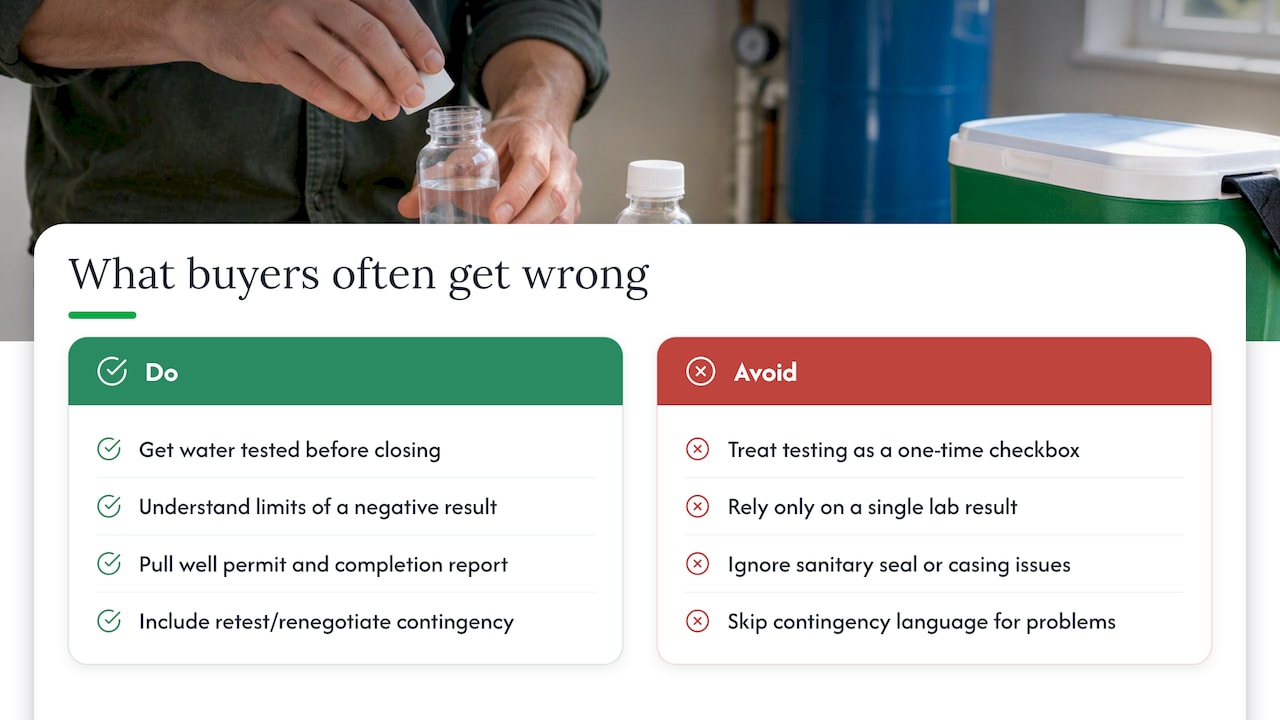
Most advice on buying a well-served home treats water testing as a box to check alongside the general inspection. That framing undersells it. A clean bacteria result on closing day tells you almost nothing about next spring, after snowmelt, fertilizer season, or a cracked well cap finally lets surface water in. The conventional advice stops at “get it tested.” The more useful advice is “get it tested, understand what a negative result does and does not promise you, and know who to call when conditions change.”
We also think buyers overweight the lab report and underweight the well record. A pristine water sample from a well with no sanitary seal and a cracked casing is a problem waiting for the right rainstorm. Pull the well permit and completion report before you obsess over parts-per-billion figures. If you prioritize one thing, prioritize contingency language that gives you room to retest and renegotiate, not just a single pass/fail test on day one.
— JOHN
How we help you get through water testing before closing
We coordinate well and septic inspections, environmental testing, and radon or lead sampling as part of the same buyer-focused process we use for home inspections.
- Schedule well and septic evaluation alongside your general home inspection.
- Get help ordering the right lab panel and interpreting results for negotiation purposes.
- Request past well records and test history.
- Choose video or in-person scheduling, including evenings and weekends.
If unexpected contamination turns up after closing, it is worth understanding how water backup coverage factors into your homeowner’s insurance before you need it. Ready to get started? Visit our inspection services page to book your well, septic, and environmental testing alongside your home inspection.
This article is general information, not a substitute for advice from a qualified doctor. Consult a qualified healthcare professional about your own circumstances before acting on anything here.
FAQ
Which state has the best water quality in the United States?
Water quality rankings vary by the contaminants measured and the source reviewed, and there is no single official EPA ranking of states by overall water quality. What matters more for your purchase is testing the specific well serving the property, since conditions vary by parcel even within the same county.
What is the biggest red flag in a home inspection?
Red flags vary by property, but for homes on private wells, a missing sanitary seal, a cracked well cap, or a well sited too close to a septic system are serious concerns because they create ongoing contamination risk even when a single water sample comes back clean. Structural and safety issues identified during a general inspection carry similar weight and should prompt further evaluation before closing.
How can I test my water quality at home?
Contact a state-certified laboratory or your local health department for a sampling kit and instructions, since DIY strip tests lack the precision needed for a real estate transaction. Follow the lab’s sampling procedure exactly, including which tap to use and how to store the sample, then submit it within the required timeframe for accurate results.
What state in the US has the worst tap water?
No single authoritative ranking identifies one state as having the worst tap water, since water quality depends on the specific source, local geology, and infrastructure rather than statewide averages. Buyers should focus on testing the particular well or municipal supply serving the property they are purchasing rather than relying on broad state comparisons.
Do FHA loans require water testing for private wells?
HUD/FHA guidance requires well water to meet local health authority standards, or EPA standards where none exist, and mandates certified third-party testing in specific loan scenarios where the water source is suspect. Coordinate with your lender early in the process to confirm which tests and documentation your specific loan requires.
Sources
- Guidelines for testing private well water — CDC
- HUD / FHA guidance on individual water supply systems
Recent Comments