

You just received a 40-page inspection report, and your closing deadline is in five days. The document is packed with photos, technical language, and what feels like hundreds of problems. Knowing how to inspection report summarize for buyers, or more precisely, how to read and use the executive summary section that good inspectors provide, is what separates buyers who negotiate confidently from buyers who either panic or ignore critical findings. This guide breaks down exactly how those summaries are structured, how to prioritize what matters, and how to turn a dense report into a clear decision.
Table of Contents
- Key Takeaways
- How to inspection report summarize for buyers: the basics
- Categorizing findings to focus your attention
- Reading, summarizing, and using your report step by step
- Common mistakes that cost buyers money and leverage
- Using your inspection summary after you close
- My take on what actually matters in an inspection summary
- Get a report that actually works for you
- FAQ
Key Takeaways
| Point | Details |
|---|---|
| Focus on 3-5 critical findings | A good real estate inspection summary highlights only the most urgent issues, not every minor flaw. |
| Categorize before you act | Sort findings into safety hazards, major defects, maintenance items, and cosmetic issues before drafting any requests. |
| Respect contingency deadlines | Buyers typically have 5-10 days to review and respond, so read the report the same day you receive it. |
| Limit negotiation to big issues | Submitting repair requests for dozens of minor items weakens your position and often kills deals unnecessarily. |
| Keep the report after closing | Your inspection findings become a long-term maintenance roadmap, not just a one-time negotiation tool. |
How to inspection report summarize for buyers: the basics
The formal term inspectors use is the executive summary, and it functions as a decision document. ASHI describes each inspection comment as containing four parts: Observation, Explanation, Implication, and Recommendation. A well-written executive summary compresses the most critical findings into that four-part structure so buyers, agents, and lenders can grasp the home’s condition without reading every page.
What separates a summary from the full report is scope and purpose. The full report documents everything the inspector observed across every system, from the roof to the foundation. The executive summary pulls out the findings that actually affect your decision. Buyer-friendly summaries highlight only 3 to 5 most critical findings upfront, each described in 2 to 3 sentences.
Here is what a strong buyer inspection overview typically includes:
- Safety hazards that pose immediate risk to occupants
- Major defects affecting the home’s structure, systems, or habitability
- Significant maintenance items that will cost real money soon
- A brief note on items requiring specialist evaluation
Pro Tip: Ask your inspector directly whether their report includes a dedicated executive summary section. Not every inspector formats reports the same way, and knowing where to look saves you from missing the most critical findings buried on page 32.
The summary is not a replacement for reading the full report. Think of it as the map. You still need the terrain.
Categorizing findings to focus your attention
Understanding inspection reports gets much easier once you recognize that not all findings carry equal weight. Inspectors and real estate professionals use a consistent priority framework, and learning it changes how you read every page.
Here is how the four main categories break down:
| Category | Examples | Buyer action |
|---|---|---|
| Safety hazards | Missing GFCI outlets, exposed wiring, carbon monoxide risk | Address immediately, non-negotiable |
| Major defects | Failed HVAC, roof at end of life, foundation cracks | Negotiate repair, credit, or reconsider |
| Significant maintenance | Aging water heater, minor roof wear, clogged gutters | Budget and plan; may negotiate |
| Minor or cosmetic | Sticky door, chipped paint, loose cabinet hinge | Accept and move on |
Inspection findings categorized by priority give buyers a structured way to separate deal-breakers from background noise. Safety hazards require immediate attention regardless of cost. Major defects may justify a repair request, a price reduction, or in serious cases, walking away from the deal entirely.

Significant maintenance items are worth knowing about for budgeting, but they rarely justify hard negotiations. A water heater that has two years of life left is not a reason to blow up a deal. It is a reason to set aside $1,200 in your post-closing budget.
Minor and cosmetic issues are the category that trips up first-time buyers most often. First-time buyers frequently treat every finding as equally important, which leads to unfocused repair requests and frustrated sellers. A sticky door is not in the same universe as a cracked heat exchanger in the furnace.
Pro Tip: Color-code your printed report or use your phone’s notes app to tag each finding with S (safety), M (major), Maint (maintenance), or C (cosmetic) as you read. This simple step turns a 40-page document into an organized action list in under an hour.
Reading, summarizing, and using your report step by step
Most buyers make one of two mistakes when they receive their report. They either spiral into anxiety after reading the first few pages, or they hand it entirely to their agent without reading it themselves. Neither approach serves you well.
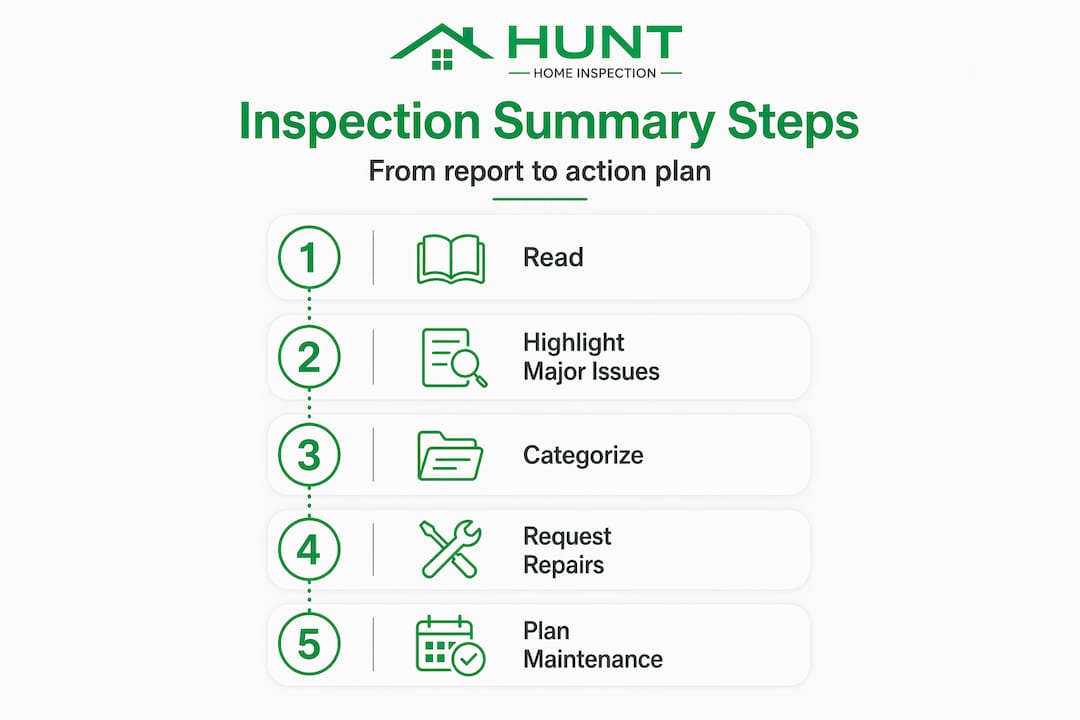
Here is a practical workflow that works:
-
Read the full report once without stopping. Do not Google repair costs. Do not call your agent in a panic. Just read. Your only goal in this pass is to understand the overall picture of the home’s condition.
-
On the second read, sort every finding into the four categories above. Write them down or use a spreadsheet. This is where your personal summary of the inspection report takes shape.
-
Research repair costs for safety hazards and major defects only. Estimated repair costs for high-priority findings help you negotiate effectively, but avoid quoting numbers without getting a specialist’s input first. A general contractor’s ballpark and an actual bid can differ by thousands of dollars.
-
Draft your repair or credit request around 2 to 5 items maximum. Focus on safety hazards and major defects. If you have a failed HVAC system, a compromised roof, and two electrical safety issues, those four items are your entire request. Nothing else.
-
Check your contingency deadline immediately. Buyers typically have 5 to 10 days after offer acceptance to complete this process. Missing that window means losing your contractual protection.
-
Schedule specialist evaluations when your inspector recommends them. If the report says “recommend evaluation by a licensed electrician,” that is not optional language. It means the inspector found something beyond the scope of a visual assessment. Get the specialist in before your contingency expires.
A few additional tips that make the process smoother:
- Read the report the same day you receive it, not two days later
- Attend the inspection in person when possible. Buyers who accompany inspectors understand the findings far better than those who only read the report
- Use your inspector’s summary section as your starting point, then verify it against the full findings
- Keep all communication with your agent in writing once you begin the negotiation phase
Pro Tip: If your inspector’s report includes a tool like the Create Request List™, use it. These tools are designed specifically to help buyers translate inspection findings into clear, organized repair requests that agents can act on immediately.
Common mistakes that cost buyers money and leverage
The most expensive mistakes buyers make during the inspection phase are not about missing a defect. They are about mishandling the information they already have.
Here is what goes wrong most often, and how to avoid it:
-
Treating every line item as a negotiation point. Summaries listing dozens of minor issues often backfire. Sellers and their agents lose patience with unfocused requests, and buyers lose credibility at the exact moment they need it most. Stick to safety and major defects.
-
Ignoring safety hazards because they seem small. A missing GFCI outlet in a bathroom costs $15 to fix. But it is also a code violation and a liability. Safety items belong in every repair request regardless of cost.
-
Delaying your review. The inspection contingency window is not a suggestion. If you wait until day eight of a ten-day window to read your report, you have almost no time to get specialist evaluations, draft a request, and negotiate a response.
-
Relying on repair cost estimates from the inspector alone. Inspectors are not contractors. Their cost references are general guidelines. For anything over $2,000, get an actual bid from a licensed professional before you use a number in negotiations.
-
Failing to verify repairs before closing. If the seller agrees to fix the HVAC system, get documentation and schedule a re-inspection or walkthrough to confirm the work was completed properly. Verbal agreements and vague receipts are not enough.
Good inspection report analysis for buyers preserves the four-part structure that ASHI recommends: what was observed, what it means, why it matters, and what to do next. When your summary keeps that structure, everyone on your team knows exactly what they are dealing with.
Pro Tip: Never submit a repair request that reads like a copy-paste from the inspection report. Translate findings into plain language: “The furnace heat exchanger is cracked and poses a carbon monoxide risk. We are requesting repair or replacement by a licensed HVAC contractor prior to closing.”
Using your inspection summary after you close
Most buyers treat their inspection report as a one-time negotiation document and then file it away forever. That is a mistake. The home inspection findings you received before closing are one of the most useful maintenance references you will ever have for that property.
Here is how to put it to work after you move in:
- Keep a digital and physical copy of the full report and your summary in an accessible place
- Build a maintenance calendar from the significant maintenance items the inspector flagged. If the water heater was noted as eight years old, set a reminder to evaluate it in 18 months
- Schedule re-inspections or specialist assessments for anything the inspector flagged as “monitor” or “evaluate further”
- Use the report as a baseline when you hire contractors. Showing a contractor the specific finding from your inspection report gets you faster, more accurate bids
- Reference it for energy upgrades. Many inspection reports note insulation gaps, older windows, or aging HVAC equipment. Those findings can guide where you invest in efficiency improvements first
A thorough buyer inspection overview delivered at closing is not just about getting through the transaction. It is a document that saves you money for years.
My take on what actually matters in an inspection summary
I have been doing this long enough to know that the buyers who walk away most confident are not the ones who read every word of a 50-page report. They are the ones who understood which five things actually mattered.
The biggest misconception I see is that a longer repair request signals a more informed buyer. It does not. Experienced practitioners avoid negotiating every defect because focus is what creates leverage. When you submit a request for 22 items, sellers read it as noise. When you submit a request for four serious issues with clear documentation, they take it seriously.
What I have found genuinely changes outcomes is the quality of the recommendation language in a summary. When a buyer reads “the electrical panel has double-tapped breakers, which creates a fire risk and requires correction by a licensed electrician before occupancy,” they know exactly what to do. When they read “electrical issues noted,” they have no idea whether to panic or ignore it.
A good summary empowers. A vague one paralyzes. That is why the structure of how findings are written matters as much as the findings themselves. Buyers deserve reports that tell them what was found, why it matters, and what to do next. Every time.
— JOHN
Get a report that actually works for you

If you are buying a home in the St. Louis Metro area or Southern Illinois, Jhunthomeinspections delivers inspection reports built specifically for buyers. Every report from Hunt Home Inspection, LLC includes a prioritized summary of findings so you know exactly what needs attention and what can wait. Reports are returned within 24 hours, giving you maximum time within your contingency window to review, consult specialists, and negotiate with confidence.
Jhunthomeinspections also offers the Create Request List™, a tool that turns your inspection findings into a clear, organized document your agent can use immediately. Whether you are a first-time buyer, a veteran, or purchasing on a tight timeline, the team at Jhunthomeinspections is built to support you through every step. Schedule your inspection today and get the clarity you need to make a confident decision.
FAQ
What should a home inspection summary include?
A strong executive summary highlights 3 to 5 critical findings, each described with the observation, its implication, and a recommended next step. Safety hazards and major defects should always appear first.
How long do buyers have to act on an inspection report?
Most purchase contracts give buyers 5 to 10 days after offer acceptance to review the inspection and submit any repair requests. Missing this window can eliminate your contingency protection.
How many items should buyers request repairs for?
Limit repair requests to 2 to 5 items focused on safety hazards and major defects. Submitting large lists of minor issues reduces your credibility and often derails negotiations unnecessarily.
What is the difference between a summary and the full inspection report?
The full report documents every observed condition across all home systems. The summary, or executive summary, pulls out only the findings that directly affect your purchase decision, making it faster to act on under tight deadlines.
Can I use my inspection report after closing?
Yes, and you should. Your home inspection findings serve as a long-term maintenance reference, helping you prioritize repairs, schedule specialist assessments, and avoid surprise expenses for years after closing.
Recent Comments