

Scheduling a home inspection step by step is the single most protective move you can make after your offer is accepted. The home inspection process gives you documented evidence of a property’s true condition before you commit your money. Done right, it also hands you real negotiation leverage. Most buyers treat it as a formality. The buyers who treat it as a strategy get better deals. This guide walks you through every stage, from the moment your offer is accepted to the day you decide whether to proceed, using methods recommended by ASHI and InterNACHI certified inspectors.
What do you need before scheduling a home inspection?
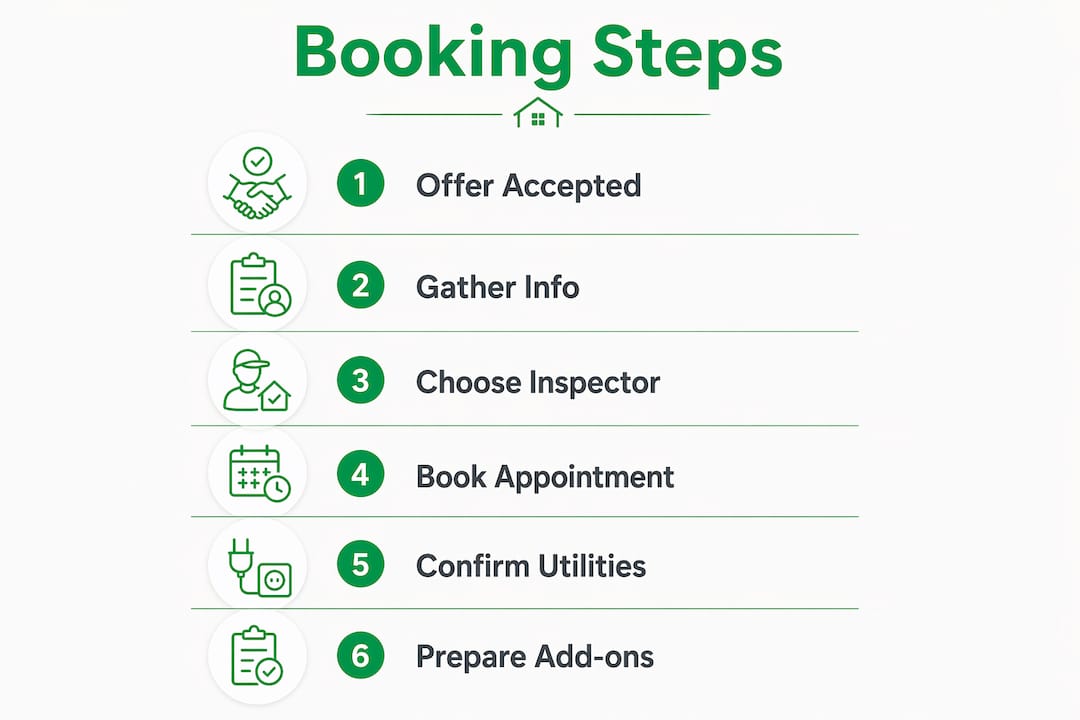
Preparation before you book determines how smooth the entire process runs. Gather property details like the address, square footage, year built, and any special systems such as a well, septic tank, or multiple HVAC units. Inspectors use this information to give you an accurate quote and block the right amount of time.
Confirm that all utilities are active before the inspection date. Electricity, water, and gas must be on for the inspector to test appliances, outlets, water pressure, and the HVAC system. If utilities are off, the inspector cannot complete a full evaluation and you may face a re-inspection fee.

Clear access to every area the inspector needs to reach. That means the attic hatch, crawlspace entry, electrical panel, and water heater closet. Sellers or listing agents are responsible for this, but you should confirm it in writing before the appointment.
Decide which add-on inspections you want before you call. Common add-ons include:
- Radon testing (typically $150–$250 based on inspection add-on pricing)
- Termite or wood-destroying organism inspection
- Sewer scope inspection
- Mold or air quality testing
- Well and septic evaluation
Listing your desired add-ons before booking lets you coordinate everything in one visit. That matters more than most buyers realize, which we cover in the next section.
Pro Tip: Build a short property fact sheet with the address, square footage, year built, and your add-on list before you call any inspector. You will get faster quotes and avoid back-and-forth delays.
How to book your home inspection appointment step by step
The home inspection process guide from most real estate professionals is clear: schedule within 24 hours of offer acceptance and complete the on-site inspection within the first 5–7 days of your contingency window. That timeline gives you room to review the report, request repairs, and still meet your contract deadlines.
Here are the exact steps to book your inspection:
- Contact a licensed inspector immediately. Search for inspectors certified by ASHI (American Society of Home Inspectors) or InterNACHI (International Association of Certified Home Inspectors). Both organizations maintain public directories.
- Use real-time online scheduling when available. Online booking tools let you secure your preferred time slot instantly without waiting for a callback. This matters most during spring and summer when inspector calendars fill fast.
- Bundle all specialty inspections at booking. Coordinating all inspections during the initial appointment saves time and protects your contingency window. Scheduling a sewer scope or radon test as a separate visit later can push you past your deadline.
- Confirm the appointment in writing. Get the date, time, estimated duration, and access instructions confirmed by email or text. Verbal confirmations get forgotten.
- Notify the listing agent. Your agent should inform the seller’s agent of the inspection date so the property is accessible and utilities remain on.
- Block your calendar for inspection day. A standard inspection runs 2–4 hours. Plan to arrive partway through, which we explain in the next section.
Pro Tip: If you are buying in a competitive market like St. Louis Metro or Southern Illinois, call your inspector the same afternoon your offer is accepted. Popular inspectors book out 3–5 days in advance during peak seasons.
Real-time online booking, as offered by firms like Jhunthomeinspections, is the fastest way to lock in preferred slots before another buyer’s inspector takes your window.
What should you expect on inspection day?
A standard home inspection runs 2–4 hours depending on the property’s size and age. The inspector follows a systematic sequence, starting with the exterior, roof, foundation, and mechanical systems, then moving inside to cover electrical, plumbing, HVAC, insulation, and every room.
You do not need to be there for the entire inspection. Arriving about 60 minutes in lets the inspector complete the exterior and mechanical checks without interruption. You then join for the interior walkthrough, which is where you learn the most. Showing up at the very start often slows the inspector down and reduces the quality of their focus.
Use your time during the walkthrough to ask direct questions. Bring a notepad or use your phone to photograph areas the inspector flags. Your goal is to understand which issues are safety hazards, which are major defects, and which are normal wear.
Here is a practical inspection day checklist:
- Confirm utilities are still active the morning of the inspection
- Verify the seller has cleared access to the attic, crawlspace, and panel
- Arrive approximately one hour after the scheduled start time
- Bring a list of specific concerns you noticed during your showing
- Ask the inspector to explain severity ratings for every flagged item
- Request a verbal summary at the end of the walkthrough
Pro Tip: Ask the inspector to show you the main water shutoff, electrical panel, and HVAC filter location during the walkthrough. This information is useful whether you buy the home or not.
Attending the inspection also builds your understanding of the home inspection checklist in ways the written report alone cannot replicate. Seeing a cracked heat exchanger in person hits differently than reading about it on page 34 of a PDF.
How do you review the report and decide next steps?
Inspection reports are delivered within 24–48 hours of the on-site visit. Most reports run 30–50 pages and include photos, severity ratings, and repair recommendations for every flagged item. That volume can feel overwhelming, but the review process has a clear priority order.
Focus first on safety hazards. These include items like faulty electrical wiring, carbon monoxide risks, structural damage, and active water intrusion. Next, address major defects, meaning systems or components that are failing or near the end of their useful life. Cosmetic issues come last and rarely justify repair requests.
| Outcome | Typical Next Step | Timeline |
|---|---|---|
| Minor defects only | Proceed as planned | No action required |
| Major defects found | Request repairs or seller credit | Within 2–3 business days of report |
| Safety hazards identified | Negotiate or walk away | Immediately after report review |
| Specialty test needed | Schedule follow-up inspection | Within contingency window |
| Undisclosed issues found | Consult attorney or agent | Before contingency deadline |
Send repair requests within 2–3 business days of receiving the report to meet contingency deadlines. Your agent will draft a formal repair addendum or request a credit at closing. If the seller refuses and the defects are serious, your inspection contingency gives you the right to walk away and recover your earnest money.
The goal of the inspection is not to find a perfect house. The goal is to inform your negotiation and safety decisions, not to catalog cosmetic flaws. Keep that frame in mind when you read the report.
What mistakes do buyers make when scheduling inspections?
The most costly mistake is waiting. Booking on day one versus day three can be the difference between having time to negotiate repairs and being forced to waive your contingency. Every day you delay shrinks your window.
The second most common error is failing to bundle specialty inspections at the time of booking. Older homes and properties with wells, septic systems, or older HVAC units almost always need add-on testing. Scheduling add-ons separately creates scheduling conflicts and risks pushing past your contingency deadline.
Here are the most frequent mistakes buyers make:
- Waiting more than 24 hours after offer acceptance to contact an inspector
- Skipping add-on inspections to save money upfront, then discovering problems after closing
- Failing to confirm utilities are active before inspection day
- Attending the full inspection and slowing the inspector’s workflow
- Ignoring the verbal walkthrough summary and relying only on the written report
- Missing the repair request deadline because report review took too long
Pro Tip: Ask your real estate agent to recommend two or three inspectors before your offer is accepted. That way, you can book immediately without spending time researching while your contingency clock is already running.
Early scheduling also creates room for specialized evaluations like structural engineering reviews or HVAC assessments if the general inspection flags something serious. That flexibility disappears when you wait.
Key takeaways
Scheduling your home inspection within 24 hours of offer acceptance, bundling add-on services at booking, and attending the walkthrough strategically are the three moves that separate informed buyers from reactive ones.
| Point | Details |
|---|---|
| Schedule immediately | Book within 24 hours of offer acceptance to protect your full contingency window. |
| Bundle add-ons at booking | Coordinate radon, termite, and sewer scope tests in one visit to avoid deadline risks. |
| Prepare property access | Confirm utilities are active and all access points are cleared before inspection day. |
| Attend the walkthrough | Arrive 60 minutes in to observe the interior phase and ask questions directly. |
| Act fast on the report | Send repair requests within 2–3 business days of receiving the report to meet deadlines. |
Why timing your inspection is a buyer’s best leverage
Most buyers I work with treat the home inspection as a checkbox. They schedule it when they get around to it, skip the add-ons to save a few hundred dollars, and then read the report alone at 11 p.m. without understanding what they are looking at. That approach costs them money.
The buyers who come out ahead treat the inspection as a strategic tool. They book the same day their offer is accepted. They bundle the radon test and sewer scope because they know that finding a $4,000 sewer line problem before closing is worth far more than the $200 it costs to scope it. They show up for the walkthrough and ask the inspector to explain every flagged item in plain language.
I have seen buyers negotiate $15,000 in seller credits based on a thorough inspection report. I have also seen buyers waive their contingency because they waited too long to schedule and ran out of time. The difference was not the house. It was the timing.
Veterans and first-time buyers especially benefit from attending the walkthrough. The role of the home inspector is to document and explain, not to make your decision for you. But when you are standing next to the inspector and they show you a cracked foundation wall or a panel with double-tapped breakers, you understand the risk in a way no PDF can convey.
Schedule fast. Bundle everything. Show up. Those three habits will protect your investment better than any other step in the homebuying process.
— JOHN
Book your inspection with Jhunthomeinspections today
Jhunthomeinspections serves the St. Louis Metro area and Southern Illinois with licensed, certified inspectors who deliver reports within 24 hours. Their real-time online booking system lets you lock in your preferred time slot the same day your offer is accepted, which is exactly when you need it most.
Jhunthomeinspections offers general home inspections alongside specialty add-ons including radon testing, termite inspections, mold assessments, and sewer scope evaluations. All services can be bundled at booking through their inspection services page. Their proprietary Create Request List™ tool also simplifies communication between you and your agent after the report is delivered. If you are a first-time buyer, a veteran, or working within a tight budget, Jhunthomeinspections also offers flexible payment options to keep the process moving without financial stress.
FAQ
How soon should i schedule a home inspection after offer acceptance?
Schedule within 24 hours of offer acceptance and complete the on-site inspection within the first 5–7 days of your contingency window. This gives you maximum time to review the report and negotiate repairs before your deadline.
How long does a home inspection take?
A standard home inspection takes 2–4 hours on-site, depending on the property’s size and age. The written report is typically delivered within 24–48 hours after the inspection is complete.
Do i need to attend the entire home inspection?
Attending the full inspection is not required. Arriving about 60 minutes into the inspection lets you observe the interior walkthrough without slowing the inspector’s exterior and mechanical checks.
What add-on inspections should i bundle at booking?
Common add-ons include radon testing, termite inspection, sewer scope, mold testing, and well or septic evaluation. Bundling these at the time of booking avoids scheduling conflicts and protects your contingency deadline.
What happens if the inspection report finds major defects?
Send a formal repair request or credit request to the seller within 2–3 business days of receiving the report. If the seller refuses and the defects are serious, your inspection contingency allows you to walk away and recover your earnest money.
Recent Comments