
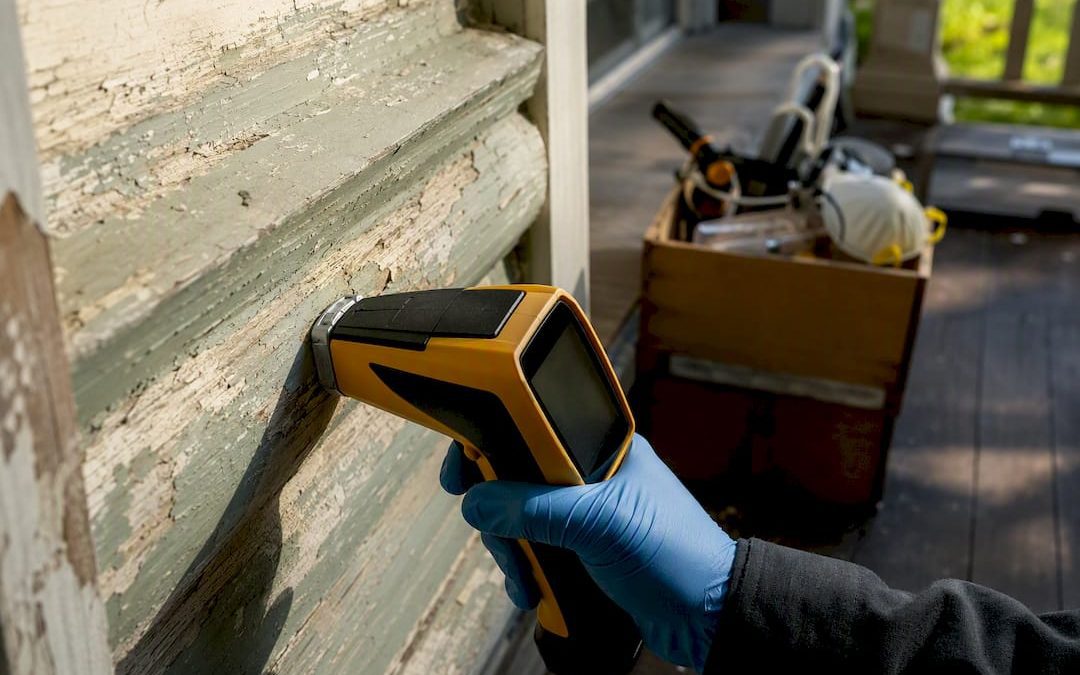
If your house was built before 1978, assume it has lead paint somewhere unless testing proves otherwise. Don’t sand, scrape, or disturb painted surfaces until you’ve either run a certified test or sent samples to a lab. The EPA reports that 87% of homes built before 1940 contain lead-based paint, along with 24% of homes from 1960 to 1978. HUD’s disclosure rule gives homebuyers a 10-day window to test before closing, and the CDC treats no blood lead level as safe for children.
- Stop sanding or dry scraping any paint you suspect is old.
- Keep kids and pregnant household members away from peeling or chipping paint.
- Decide now: screen it yourself with caution, or call a certified inspector for results you can actually rely on.
Key Takeaways
Certified XRF screening paired with NLLAP lab-confirmed paint-chip sampling gives homeowners the only defensible answer on lead paint, while store DIY kits serve only as a rough first check.
| Point | Details |
|---|---|
| Assume risk in older homes | Homes built before 1978 may contain lead paint, especially pre-1940 construction at 87%. |
| Match method to the stakes | Use DIY kits for a quick screen, but rely on XRF or NLLAP lab analysis for decisions that matter. |
| Prioritize friction surfaces | Test windows, doors, trim, and stair rails first since they generate the most lead dust. |
| Know the disclosure rule | Pre-1978 home sales require lead disclosure and give buyers a 10-day testing window. |
| Get a defensible result | Jhunthomeinspections combines XRF and lab-confirmed sampling with reports delivered in 24 hours. |
Table of Contents
- Lead Paint Testing Methods Compared: DIY Kits vs. XRF vs. Lab Analysis
- When Should You Test for Lead Paint in Your Home?
- How Much Does Lead Paint Testing Cost and How Long Does It Take?
- How Do You Choose a Qualified Lead Paint Inspector?
- What Does DIY Sample Collection Look Like and Is It Safe?
- What Should You Do If Your Home Tests Positive for Lead Paint?
- How Jhunthomeinspections Handles Lead Paint Testing
- Frequently Asked Questions About Lead Paint Testing
- Sources
Lead Paint Testing Methods Compared: DIY Kits vs. XRF vs. Lab Analysis
Homeowners generally have four ways to check for lead paint, and they are not interchangeable. A visual inspection just flags paint that’s old, alligatored, or chalky. It tells you nothing about lead content on its own.
Store-bought chemical swab kits promise quick answers, but the Consumer Product Safety Commission found that many of these kits produce unreliable results. EPA recognizes three specific kits, LeadCheck™, D-Lead®, and a Massachusetts-issued kit, for use under the RRP rule, but EPA is clear that none of them meets both the negative and positive accuracy standards needed for general reliability. They’re built for trained renovators checking a single surface before starting work, not homeowners screening a whole house.
XRF (X-ray fluorescence) is what most certified inspectors carry into a home. It reads lead content through paint layers in seconds, without cutting into the wall, and gives a quantitative number on the spot. Paint-chip sampling sent to an NLLAP-accredited lab is the most rigorous option: a lab technician measures lead concentration directly, and results typically arrive as a hard number in parts per million.
| Method | Accuracy | Cost | Speed | Invasiveness |
|---|---|---|---|---|
| Visual inspection | Low, screening only | Free | Immediate | None |
| Store DIY kit | Inconsistent | Low | Immediate | Minor surface scrape |
| EPA-recognized kit | Moderate, trained use only | Low to moderate | Immediate | Minor surface scrape |
| XRF inspection | High | Moderate to higher | Same visit | None |
| Lab paint-chip analysis | Highest | Moderate | 24 hours | Small chip removed |
- DIY kits work best as a rough first check, not a final answer.
- XRF gives you instant, non-destructive numbers but requires a trained operator.
- Lab analysis is the gold standard for legal disclosure or a health concern.
- Combining a fast screen with a lab-confirmed sample often gives the clearest picture.
Pro Tip: If you use an EPA-recognized kit like LeadCheck™ or D-Lead®, have it applied by someone trained under the RRP rule. A false negative on a friction surface like a window sash can leave real exposure unaddressed.
When Should You Test for Lead Paint in Your Home?
Test before you disturb any painted surface in a home built before 1978, and definitely before starting a renovation. Peeling, chipping, or chalking paint is a red flag on its own, even in a home you’ve lived in for years. If a child in the household has an elevated blood lead level, testing the home becomes urgent rather than optional.
Focus first on windows, window sills, and frames, since these friction surfaces generate lead dust every time they’re opened. Doors, thresholds, stair rails, trim, and painted porches come next, followed by cabinets and any spot where kids play or crawl. Don’t skip bare soil near the foundation. Old exterior paint sheds into the ground over decades.
- Test each distinct paint color and layer, not just the top coat.
- Sample multiple spots in high-traffic rooms like kitchens and kids’ bedrooms.
- Prioritize surfaces that move or rub against each other.
How Much Does Lead Paint Testing Cost and How Long Does It Take?
Costs scale with how much certainty you need. A store DIY kit runs a modest amount per test, but you’re paying for speed, not confidence. Lab paint-chip analysis through an NLLAP-accredited lab typically costs $25 to $50 per sample, and a full-home XRF inspection from a certified professional usually runs $300 to $1,200 depending on square footage and how many surfaces get tested. Full risk-assessment services, which evaluate hazards rather than just presence, land at the higher end of that range.
| Testing option | Typical cost | Typical turnaround |
|---|---|---|
| Store DIY kit | Low, per test | Immediate |
| Lab paint-chip sample | $25 to $50 per sample | 24 hours |
| Professional XRF inspection | $300 to $1,200 | Same day |
| Full risk assessment | Higher end of range | 3 days to a week |
- Immediate kits give you an answer on the spot, but not a defensible one.
- Lab samples take a day or two once the lab receives them.
- XRF readings come back before the inspector leaves your house.
- Full risk-assessment reports take longer because they document hazards room by room.
How Do You Choose a Qualified Lead Paint Inspector?
Not every “inspector” carries the same credentials, and the gap matters. Look for an EPA RRP-certified renovator if the work involves disturbing paint, plus a state or EPA-certified Lead Inspector or Risk Assessor for the testing itself. Any samples should go to an NLLAP-accredited laboratory, and if XRF is used, ask to see current calibration records for the instrument.
Before you hire anyone, ask these questions directly:
- Which testing method will you use, and why is it right for my situation?
- How do you handle chain-of-custody for samples sent to a lab?
- What’s your turnaround time for results and the written report?
- Do you offer clearance testing after remediation work?
- Are you insured, and can you provide references from recent jobs?
Watch for red flags: anyone promising a single DIY kit proves your home is “100% safe,” an inspector who can’t produce a calibration record for their XRF unit, no written report at the end, or reluctance to show certifications on request.
Pro Tip: A verbal “looks fine to me” from a contractor is not a lead inspection. Insist on a written report with numbers, not just an opinion.
What Does DIY Sample Collection Look Like and Is It Safe?
If you collect your own paint chip sample, follow these steps closely:
- Call the lab first to confirm minimum sample size and packaging requirements.
- Cut through all paint layers down to the substrate, not just the top coat.
- Avoid scraping excess wood or drywall into the sample.
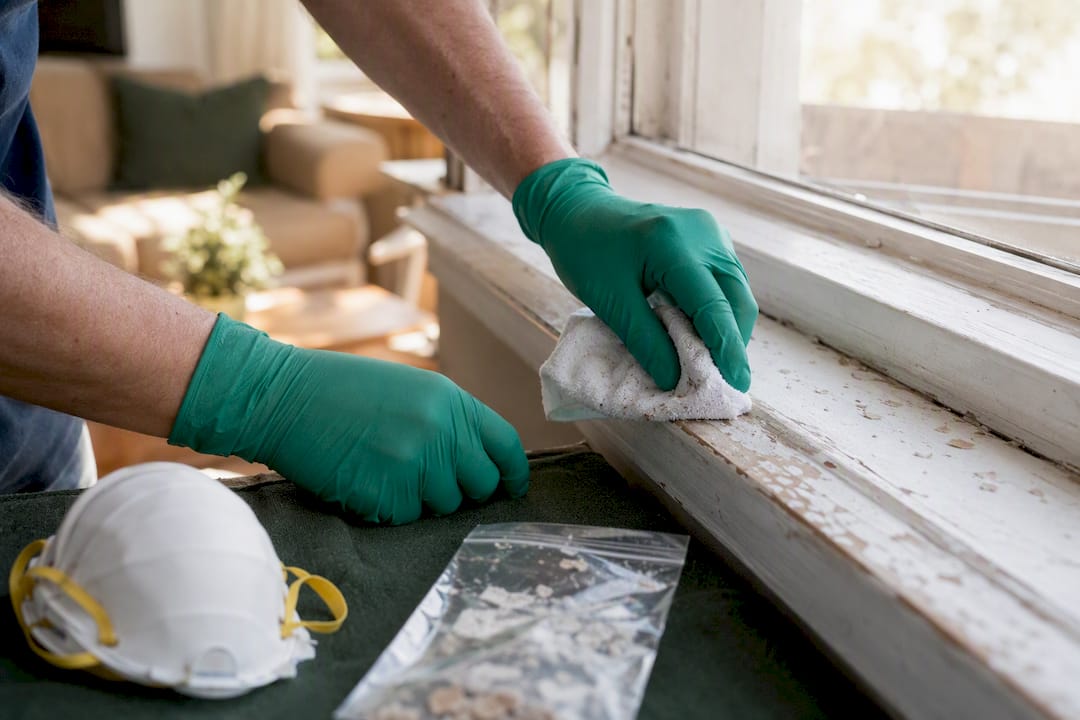
- Bag and label each sample by location and surface.
Soil samples follow a similar logic: take the top inch of soil from several spots near the foundation, use clean tools between locations, and label everything clearly.
Safety comes first regardless of method. Never dry-sand a surface you’re sampling. Wear gloves and a mask, keep kids and pets out of the work area, and wipe down surfaces with a wet cloth afterward rather than sweeping dry dust into the air.
Pro Tip: If a household member is pregnant or a child has a known elevated blood lead level, skip DIY sampling entirely and call a certified risk assessor instead. That’s not a situation for guesswork.
What Should You Do If Your Home Tests Positive for Lead Paint?
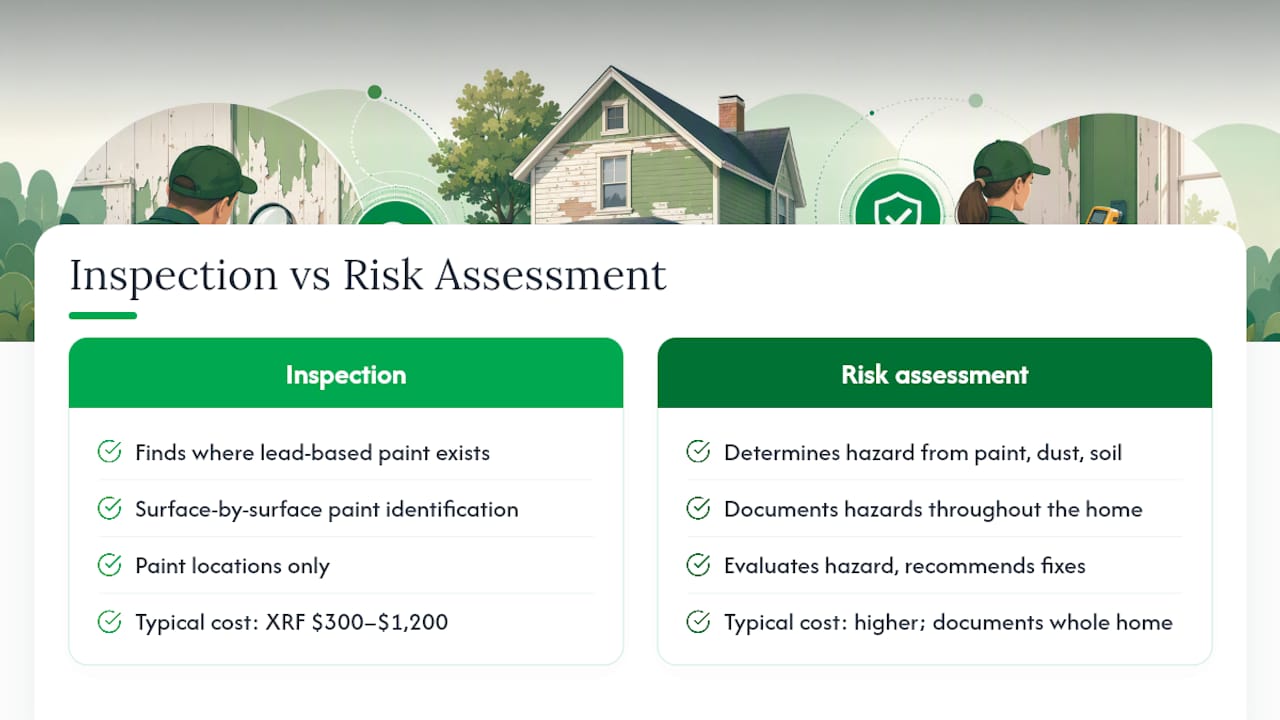
A positive result on an inspection tells you where lead paint exists. It doesn’t automatically mean you have a hazard. A lead risk assessor evaluates whether that paint is actually creating exposure through dust, chips, or friction, and that distinction drives what happens next.
If the lead paint is intact and on a surface nobody touches, like a sealed attic beam, you can often manage it in place with regular monitoring. If it’s on a window sash, deteriorating trim, or anywhere a child could reach it, you’re looking at interim controls or full abatement, followed by clearance testing to confirm the work succeeded.
- Isolated, intact, inaccessible lead paint: monitor and manage in place.
- Peeling, friction-surface, or child-accessible lead paint: interim controls or abatement, then clearance testing.
- Selling a pre-1978 home: disclosure is required regardless of the outcome.
Federal rules under 24 CFR Part 35 require sellers of pre-1978 housing to disclose known lead-based paint information and give buyers a 10-day window to conduct their own inspection or risk assessment before the sale closes.
How Jhunthomeinspections Handles Lead Paint Testing
Jhunthomeinspections coordinates lead testing alongside standard home inspections, using XRF screening and paint-chip sampling sent to NLLAP-accredited labs for confirmed results. Reports come back within 24 hours, so buyers working inside HUD’s 10-day disclosure window aren’t left waiting on results they need to make a decision.
- XRF inspections and lab-based paint-chip sampling.
- Risk assessment coordination when a hazard needs deeper evaluation.
- The Create Request List™ tool for organizing findings between buyers and agents.
- In-person or video walkthroughs, serving the St. Louis Metro area and Southern Illinois.
Every booking includes documentation of scope, sampling method, and certification proof before work begins.
Why professional testing matters
A store kit can tell you something looks concerning. Only a certified inspection or an NLLAP lab result gives you a number you can act on, disclose, or use to plan remediation with confidence.
Book a Lead Inspection With Hunt Home Inspection
Jhunthomeinspections gives homeowners in the St. Louis Metro and Southern Illinois a faster path to a defensible answer than piecing together store kits and guesswork: certified XRF screening, lab-confirmed sampling, and a written report back in 24 hours instead of days of uncertainty.
If your home was built before 1978, or you’re closing on one inside the HUD 10-day window, schedule an inspection with Jhunthomeinspections and get results you can act on before paint gets disturbed.
Frequently Asked Questions About Lead Paint Testing
Can I test for lead paint myself?
Yes, with a store kit or an EPA-recognized kit like LeadCheck™, but treat the result as a screening tool, not a final answer. For anything tied to a home sale, renovation, or a child’s health, send a sample to an NLLAP-accredited lab or hire a certified inspector.
How much does professional lead paint testing cost?
XRF inspections generally run $300 to $1,200 depending on home size, while individual lab-analyzed paint chips cost $25 to $50 each. Full risk assessments cost more because they document hazards throughout the home, not just paint content.
Do I have to disclose lead paint when selling my home?
If your home was built before 1978, federal law requires you to disclose known lead-based paint information and give buyers a 10-day window to test before closing, under 24 CFR Part 35.
What’s the difference between a lead inspection and a risk assessment?
An inspection identifies where lead-based paint exists on a surface-by-surface basis. A risk assessment goes further, evaluating whether that paint, along with dust or soil, actually creates a health hazard, and recommends specific corrective steps.
This article is general information, not a substitute for advice from a qualified doctor. Consult a qualified healthcare professional about your own circumstances before acting on anything here.
Sources
- How can I tell if my home contains lead-based paint? | US EPA
- Testing Your Home for Lead – CDPH – CA.gov
- Part 35—Lead-based paint poisoning prevention in certain residential structures | eCFR
Recent Comments