
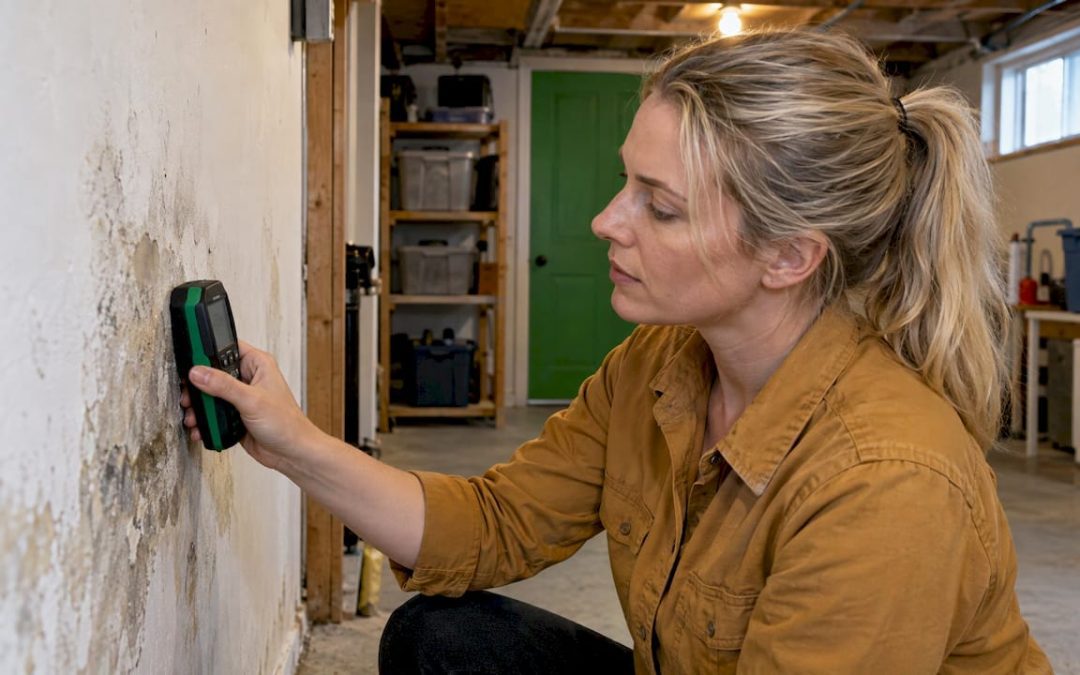
Most U.S. homeowners and buyers pay somewhere between about $300 and $1,000 for a professional mold inspection. Bob Vila’s cost guide puts the range at $299 to $1,014, with a national average of $656. An analysis of 343,231 inspector quotes by ListWithClever lands close by, at $687 on average. Where you fall depends on the size of the home, how many samples are taken, where the suspected mold is and what part of the country you live in.
Below, we break down what moves the price, what you get for it, when lab samples earn their cost and how to read a quote.
TL;DR
- Expect roughly $300 to $1,000 for a professional mold inspection, with a national average between $656 and $687 depending on the data set.
- Size, number of samples, hard-to-reach areas and your region move the price most. Homes over 4,000 square feet can run $700 to $1,000.
- A visual inspection with moisture readings documents conditions. Lab samples are an add-on that answers specific questions, such as whether a cleanup worked.
- Homeowners insurance usually does not cover mold, so budget for the inspection yourself, especially during a home purchase.
- Ask each company what the quote covers: number of samples, lab fees, the written report and how fast you get it.
Table of Contents
- How much does a mold inspection cost?
- What changes the price
- What you get for the money
- When lab samples are worth paying for
- What happens during a mold inspection
- Mold inspections for buyers
- Will insurance cover it?
- How to compare quotes
- Our perspective
- Book a mold inspection with us
- FAQ
- Sources
How much does a mold inspection cost?
Two large national data sets agree on the shape of the market. Bob Vila reports a typical range of $299 to $1,014, averaging $656. ListWithClever’s quote analysis shows an average of $687, with a spread from $165 to $2,967. The outliers on both ends are rare: a very low quote usually means a narrow scope, and a very high one usually means a large property or extensive sampling.
Geography matters more than most people expect. The same ListWithClever analysis shows state averages running from $281 in Utah to $1,766 in Oregon. A price you read for another state tells you little about your own market, so use national figures as a sanity check and get local quotes for the real number.
| Home or situation | Typical cost | Source |
|---|---|---|
| Typical U.S. inspection | $299 to $1,014 (average $656) | Bob Vila |
| Average across 343,231 quotes | $687 (range $165 to $2,967) | ListWithClever |
| Homes over 4,000 square feet | $700 to $1,000 | Bob Vila |
| Extra work such as drywall removal or added samples | Can push the total above $700 | Bob Vila |
These are market figures, not our price list. Our fee depends on the property, and we quote it before you book.
What changes the price
Four things do most of the work in any quote.
Property size
More square footage means more rooms, more moisture readings and usually more time on site. Testing in homes larger than 4,000 square feet may cost $700 to $1,000. A two-bedroom bungalow and a five-bedroom house with a finished basement are different jobs.
Testing type and number of samples
A visual inspection costs less than an inspection with air or surface sampling. Every sample adds lab fees and analysis time. Ask for the sample count in writing. A quote that says “mold testing” without a number is not a quote you can compare.
Location and access
Crawl spaces, attics and the areas behind finished basement walls take longer to examine than an open, well-lit room. If the inspector has to work around stored belongings or a tight access hatch, expect that to show up in the price. Our guides to mold in a crawl space and mold in the attic cover what these areas look like and why they are common trouble spots.
Your region
Labor costs, lab shipping and local demand all vary. That is why a quote in one state can be several times the average in another.
What you get for the money
A complete mold inspection is more than walking through with a flashlight. The Mold Inspection Standards of Practice from the International Institute for Inspection and Certification describe a complete inspection as a non-invasive visual examination, measurements of moisture, temperature and humidity, and mold samples.
The same standard says the written report covers:
- moisture intrusion and water damage
- musty odors and apparent mold growth
- conditions that could allow mold to develop
- laboratory results, when samples were taken
- any systems or components that were not inspected, with the reason
That last item matters. A report that tells you what was not examined is more useful than one that implies everything was.
Inspection versus testing
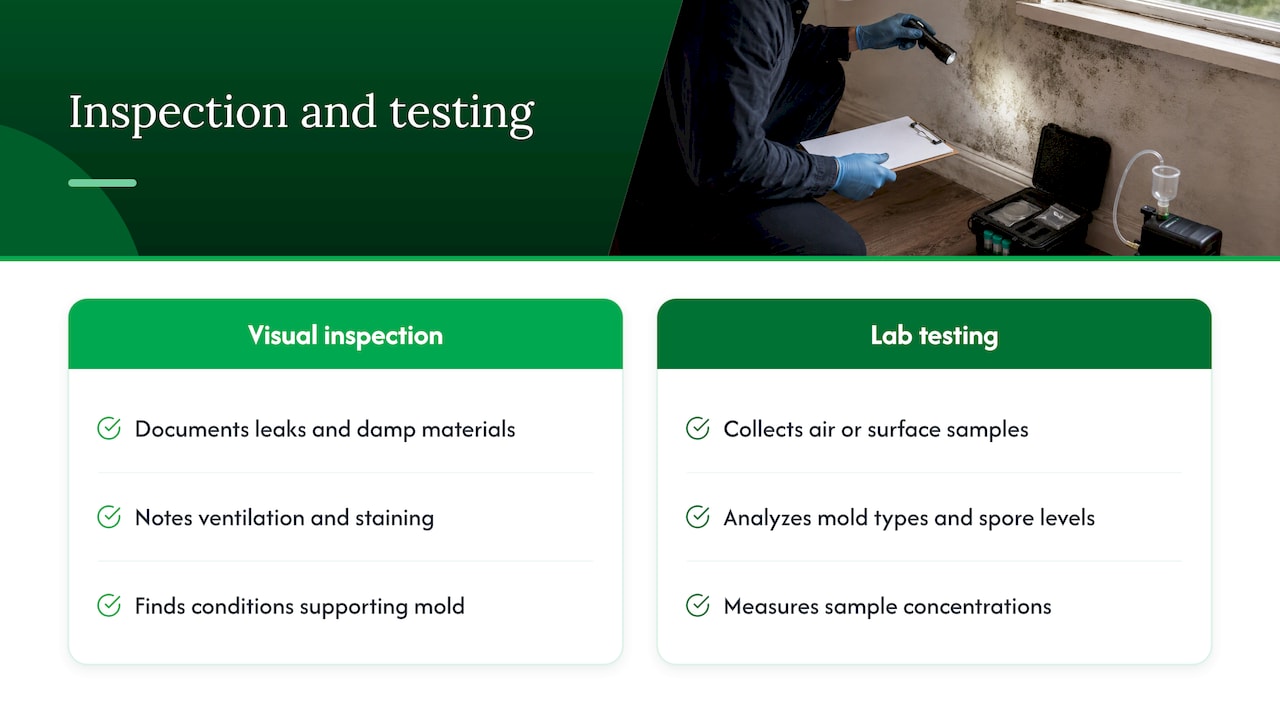
A visual inspection documents the physical conditions that support mold: leaks, damp materials, poor ventilation, staining. Testing collects air or surface samples that a laboratory analyzes for mold types and spore concentrations. They answer different questions, and the best results come when the inspector decides which one is needed instead of selling a fixed package.
When lab samples are worth paying for
Here is where honest advice saves you money. Federal agencies are clear that no federal limits exist for mold or mold spores. The EPA’s guide to mold, moisture and your home says sampling is usually unnecessary when you can already see mold, and that surface sampling may help determine whether a cleanup was adequate. Because there are no federal limits, a lab number cannot show that a home meets a federal standard.
The CDC adds that you do not need to identify the specific type of mold to decide it should be removed and the water source fixed. NIOSH, in its guidance on mold testing and remediation, holds that a thorough visual inspection and noticing musty odors are more reliable indicators of a mold problem than short-term air sampling.
What does that mean for your budget? Sampling is a tool for particular situations:
- You smell mold or see water damage but cannot find the source. An inspector with moisture meters is what you need first. Samples can support the findings.
- Remediation has been completed. Follow-up sampling can help show whether the cleanup worked. We explain what that testing does and does not prove in our guide to post-remediation mold testing.
- You are buying a home and need documentation. A written record of conditions at the time of purchase gives you something concrete to negotiate with.
- A lender, insurer or attorney asks for lab results. Then the sampling is a requirement, not a choice.
The New York State Department of Health makes a related point in Mold and Your Home: with no state or federal standard for mold in homes, sampling can cost more than simply cleaning and repairing the moisture problems that let mold grow. A good inspection finds those moisture problems. That is where the money does the most good.
What happens during a mold inspection
The visit follows a predictable order, so you know what you are paying for.
- Conversation. The inspector asks about water history: past leaks, flooding, roof repairs, musty smells, anyone with symptoms they associate with the house.
- Exterior and grounds. Grading, gutters, downspouts and foundation drainage show where water may be entering.
- Interior walkthrough. The inspector looks for staining, bubbling paint, warped materials and visible growth, then checks high-risk rooms such as bathrooms, kitchens and laundry areas.
- Moisture readings. Moisture meters, temperature and humidity readings find damp materials you cannot see.
- Hard-to-reach areas. Attic, crawl space and basement get close attention.
- Sampling, if warranted. Air or surface samples go to a laboratory.
- Written report. You get the findings, photos, readings and any lab results.
For buyers, the mold visit often sits alongside the general inspection. Our walkthrough of what to expect on home inspection day shows how the pieces fit together.
Mold inspections for buyers
A real estate transaction runs on a clock. Inspection contingencies, repair requests and closing dates leave little room for waiting on a report. If you are buying, the practical questions are:
- Who pays? In most purchases, the buyer orders and pays for inspections they want. Sellers sometimes commission one before listing, which can speed negotiations. Our seller’s guide to pre-listing inspections explains that route.
- When should it be done? During your inspection period, so findings can feed into repair requests or a price discussion.
- What should you ask for? Documentation of conditions, photos and moisture readings, so you and your agent can point to specifics.
Mold inspection is one line in the total cost of buying. If you are building that budget, our home inspection cost guide and tips for comparing inspection quotes help you see the whole picture. Radon and lead are common companions to a mold visit, and our overview of environmental home testing explains the order to do them in.
Will insurance cover it?
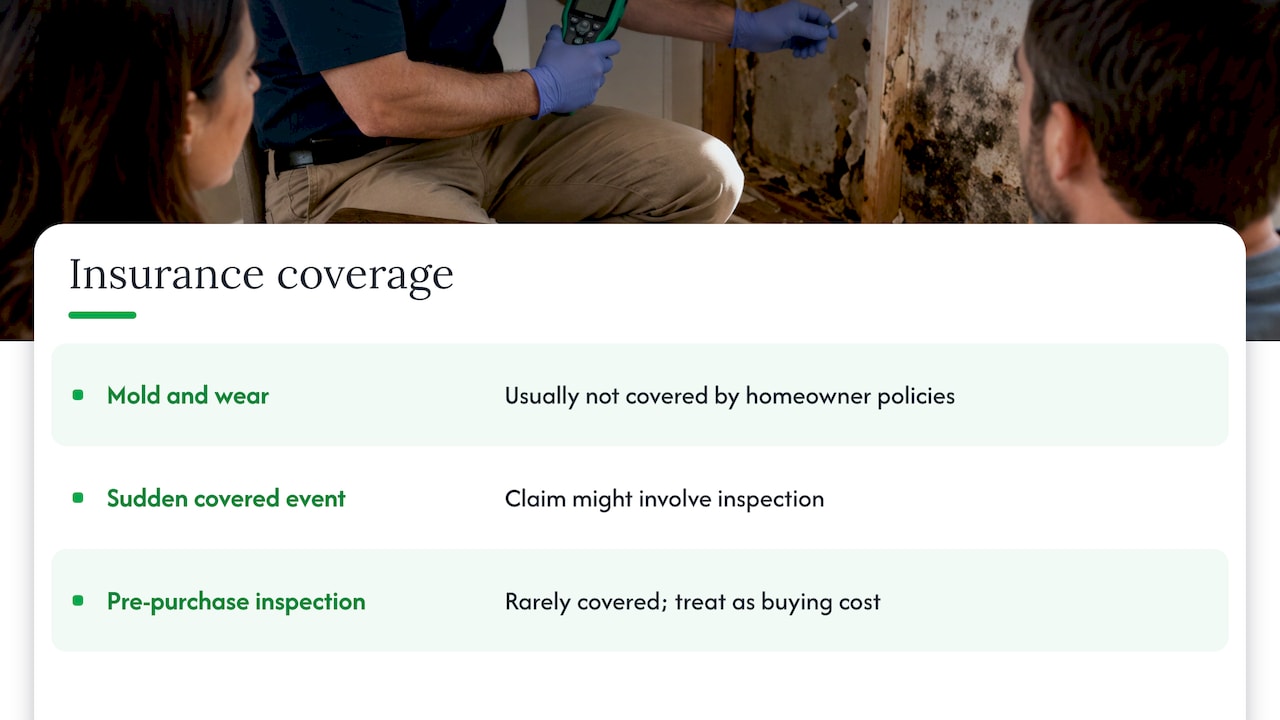
Usually not. California’s official homeowners insurance guide states that mold and wear and tear are not usually covered by a homeowner’s policy. That is one state’s regulator describing common policy language, and policies differ, so read your own and ask your insurer or agent about water-damage exceptions. If mold followed a sudden covered event, such as a burst pipe, a claim might involve the inspection. A pre-purchase inspection is rarely covered, so treat it as a cost of buying.
How to compare quotes
Two quotes can look $200 apart and describe entirely different work. Before you choose:
- Get more than one estimate and compare the scope of work and each company’s methodology. ListWithClever notes that reputable companies follow EPA guidelines.
- Ask what is included: number of samples, lab fees, moisture mapping, photos, a written report.
- Ask about credentials. The CDC recommends professionals certified by organizations such as AIHA or IICRC.
- Ask about turnaround. Lab results take longer than a visual report, and a purchase timeline may not wait.
- Ask who does the work. Choose an inspector who does not also sell the cleanup, so the report is about your house and not a sales lead.
Our perspective
We see the same pattern on most mold calls: the buyer or homeowner is worried, has found three quotes with three different scopes and does not know which one answers their question.
Our view is that the inspection should start with the building. Where does water get in, where does it sit, and what has it touched? Moisture readings and a careful look at the attic, crawl space and basement tell you most of what you need. Samples belong in the plan when they answer a specific question, and we will say so up front.
Because we are a St. Louis Metro and Southern Illinois inspection company, much of our mold work happens inside a real estate deal. That is why we deliver reports within 24 hours and offer evening and weekend scheduling, plus video or in-person walkthroughs. Our certifications include NACA, ASHI and HUD 203k. We offer discounts for veterans and first-time buyers, and our Create Request List™ tool helps buyers and agents turn findings into a clear repair request.
Mold inspection is also easier to schedule alongside the rest of the inspection: radon, termites, sewer line, septic or well. One appointment window beats three.
JOHN
Book a mold inspection with us
If you are buying, selling or maintaining a home in the St. Louis Metro area or Southern Illinois, we can inspect for mold and pair it with radon, termite, sewer camera, septic or well work. We do not publish a flat price because it depends on the property, so ask for a quote for your address. See our full list of inspection services or start from our home page.
If you want a plain-language primer before you call, our practical guide to mold inspection walks through the basics.
FAQ
What is the average cost of a mold inspection?
National figures put the average between $656 and $687. Bob Vila reports a typical range of $299 to $1,014, while ListWithClever’s analysis of 343,231 quotes shows a wider spread of $165 to $2,967. Your local price depends on home size, sampling and region.
Is mold testing included in a mold inspection?
Not always. A visual inspection with moisture readings is one service, and air or surface sampling with lab analysis is another. Ask whether the quote includes samples, how many, and whether lab fees are in the price.
Is a mold inspection worth it when buying a house?
It can be, especially if the home has had water issues, a musty smell or visible staining. The inspection documents conditions at the time of purchase, which gives you facts for a repair request or a price discussion. In areas like attics and crawl spaces, a trained eye finds what a casual walkthrough misses.
Will homeowners insurance pay for a mold test?
Usually not. California’s insurance department notes that mold is not usually covered by a homeowner’s policy. Check your own policy and ask your insurer about exceptions tied to sudden water damage.
Do I need to test for mold if I can already see it?
Usually the priority is to fix the water source and remove the growth. The EPA says sampling is usually unnecessary when mold is visible. An inspection still helps you find hidden moisture and understand how far the problem reaches.
Sources
- Here’s How Much Mold Inspection Typically Costs, Bob Vila
- How Much Does a Mold Inspection Cost? ListWithClever
- Mold Inspection Standards of Practice
- A Brief Guide to Mold, Moisture, and Your Home, EPA
- You Can Control Mold, CDC
- Mold, Testing, and Remediation, CDC and NIOSH
- Mold and Your Home: What You Need to Know, New York State Department of Health
- Homeowners Insurance, California Department of Insurance
- Homeowner’s and Renter’s Guide to Mold Cleanup, CDC
Recent Comments