
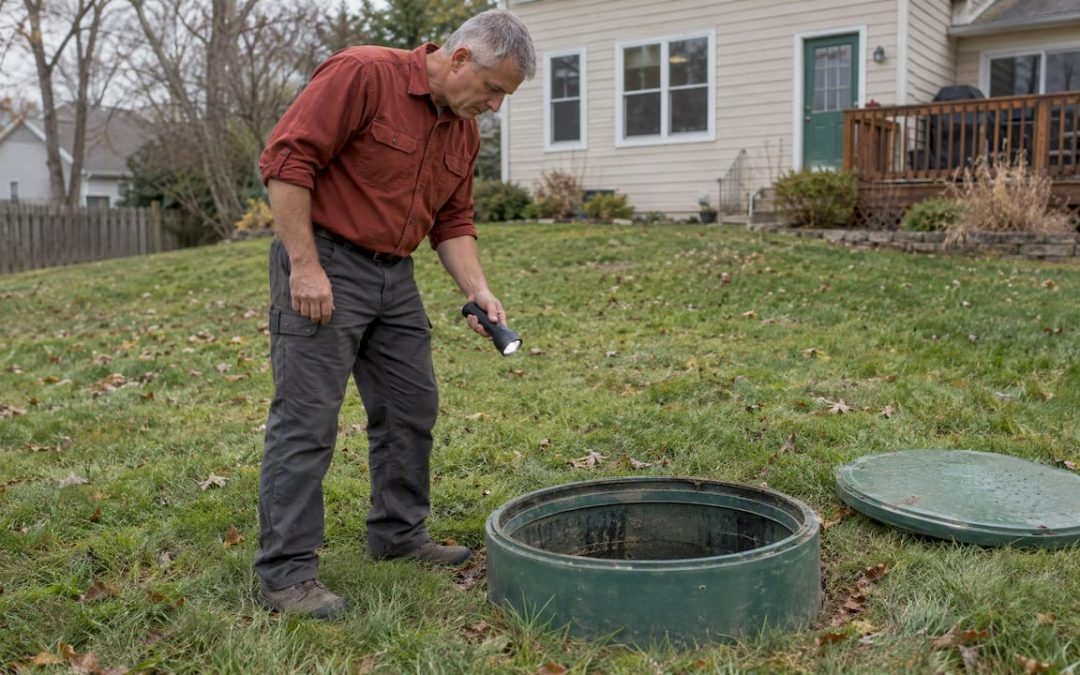
A septic inspection for a home purchase is a hands-on review of the whole system: the records, the tank, the pipes, the distribution box and the drainfield. A qualified inspector opens the tank, measures what is inside, looks for leaks and backup, and reports whether the system appears to be working. It usually happens during your inspection period, before you are committed to the house, so the findings can shape your decision.
This guide walks through the process in the order it happens, gives you a checklist to bring, and explains what to do when the report is not clean.
TL;DR
- A septic inspection checks the records, the tank, the pipes, the electrical parts, the distribution box and the drainfield, not just the lid and the yard.
- A visual or dye-test-only inspection is thinner than a full inspection with the tank opened. Ask which one you are getting.
- Locate the system and request records early. Inspection caps, lids or manhole covers in the yard point to the tank.
- Slow drains, gurgling, odors and lush, spongy grass over the drainfield are the classic warning signs.
- Use the findings to negotiate repairs, adjust your price or walk away, and ask your agent how your contract handles it.
Table of Contents
- Why buyers get a septic inspection before closing
- Before the inspection: find the system and gather records
- The septic inspection process, step by step
- Visual inspection versus full inspection
- A septic inspection checklist for buyers
- Warning signs the system may be failing
- Why a professional inspector matters before you sign
- What the findings mean and what to do next
- Requirements vary by state and county
- Book your septic inspection in the St. Louis Metro and Southern Illinois
- FAQ
- Sources
Why buyers get a septic inspection before closing
A septic system is a private wastewater plant that sits under the yard. When it fails, the bill lands on whoever owns the house. The US EPA’s Homebuyer’s Guide to Septic Systems recommends a professional inspection so you can assess the system before purchase and decide whether the home is right for you. It frames the inspection as a way to avoid expensive, unforeseen repairs after you own the property.
There is a health and legal side too. Oklahoma State University’s extension service notes that improperly treated wastewater from a failed system can bring fines for the homeowner and can threaten human health and groundwater. A general home inspection looks at the house. It does not open the tank or test the drainfield, which is why the septic system needs its own specialist visit.
If you want the bigger picture of how the house itself gets evaluated, our guide to the home inspection process for homebuyers covers the main inspection day, and why a home inspection matters before you buy explains what is at stake.
Before the inspection: find the system and gather records
You cannot inspect what nobody can find. The EPA guide says buyers can locate a system through as-built drawings, yard access covers, a septic service provider, or the seller or realtor. Walk the yard and look for inspection caps, lids or manhole covers. Those usually mark the tank and sometimes the distribution box.
Before the appointment, ask your agent to request from the seller:
- Any as-built drawing or system sketch showing tank and drainfield locations
- Past pumping and maintenance receipts
- Repair history, including any pipe, pump or drainfield work
- The tank size and how many bedrooms the system was designed for
- Any prior inspection reports
A clear paper trail tells the inspector where to dig and what to compare against. Missing records are not a deal breaker by themselves, but they mean the inspector has more to locate and verify on site.
Also confirm that the seller will allow access to uncover the tank lids. Tanks buried under sod may need to be dug out, and that is easier to arrange before the day than on it. Our DIY pre-inspection checklist helps you organize the rest of the walkthrough.
The septic inspection process, step by step
The EPA’s septic system FAQ describes an inspection that reviews system records, opens the tanks, checks sludge and scum levels, and assesses leakage, backup, pipes, electrical components, the drainfield and the distribution box. In practice it unfolds like this.
- Records review. The inspector looks at the permit, the drawings and the maintenance history, and talks with the seller or agent about how the house has been used. Occupancy matters, because a system that has sat empty behaves differently from one serving a full household.
- Locating and uncovering components. The inspector finds the tank lids, the distribution box and the drainfield area, and uncovers what needs to be opened.
- Looking inside the tank. With the lids off, the inspector checks the liquid level, the sludge and scum layers, and the condition of the tank itself. A cracked wall, a damaged baffle or a roof in poor shape shows up here. The EPA notes inspectors may look for signs of backup, such as staining in the tank.
- Checking pumps and electrical parts. If the system has a pump, alarm or float, the inspector evaluates the electrical connections and whether they operate.
- Checking the lines. Some inspections use a camera to look at internal lines for collapses or blockages. A camera is also the usual tool for the pipe between the house and the system, and our explainer on the sewer scope inspection shows what that looks like.
- Evaluating the drainfield and distribution box. The inspector walks the dispersal area looking for wet spots, odors, surfacing effluent and unusually lush growth, and checks that the distribution box is level and sending flow evenly.
- Running water through the system. Many inspectors run fixtures to watch how the system responds. Connecticut’s health department advises that for flooding tests you consider home occupancy, water use in the prior 24 hours, and soil conditions such as groundwater, rainfall or time of year.
- Written report. You receive findings on each component, with photos where possible, and a recommendation on repairs or further evaluation.
Oklahoma State’s guidance adds that a proper inspection treats the whole thing as a chain: from plumbing fixtures through the drain pipes to the pre-treatment tanks and soil dispersal field. The same fact sheet points out that a malfunction in one part, such as a leaking toilet, can create symptoms that look like a drainfield failure. That is a good reason to hire someone who reads the system as a whole rather than checking one part in isolation.
The New Jersey Department of Environmental Protection also expects inspections to include a site sketch and an assessment of landscaping, such as trees and roots, that could harm system components. If a large tree stands over the drainfield, ask the inspector to comment on it.
Visual inspection versus full inspection
Not every “septic inspection” is the same product. Providers commonly sell a lighter visual or dye-test check and a fuller one with the tank opened, and the price and the information differ accordingly.
| Visual or dye-test check | Full inspection | |
|---|---|---|
| Tank opened and measured | Usually no | Yes |
| Sludge and scum levels | Not measured | Measured |
| Baffles, walls and roof of tank | Not seen | Examined |
| Pumps and electrical parts | Often skipped | Evaluated |
| Distribution box and drainfield | Surface look only | Evaluated |
| What it can tell you | Whether something is obviously failing right now | Condition of the components and how they are performing |
The caution on dye tests is worth repeating. The Connecticut Department of Public Health warns that dye-testing only detects grossly failed systems and does not guarantee future functionality. A system can pass a dye test and still have a tank in poor shape or a drainfield that is close to the end of its life.
For a purchase, ask for the full version. When you book, ask the provider directly whether the tank will be opened, whether it will be pumped if needed to see inside, and whether the report covers every component listed above. Our septic inspection cost guide breaks down what drives the price of each level.
A septic inspection checklist for buyers
Bring this with you or send it to your inspector ahead of time.
Before the visit
- Request records, drawings and pumping receipts from the seller through your agent
- Confirm the number of bedrooms and the tank size on record
- Ask whether the home has been occupied recently and by how many people
- Walk the yard to spot lids, caps and any wet or unusually green patches
What the inspector should cover
- Records and permit review
- Tank lids, tank walls, roof, inlet and outlet baffles
- Sludge and scum levels
- Signs of backup or leakage
- Pumps, alarms, floats and electrical connections
- Internal lines, by camera if there is reason to check
- Distribution box
- Drainfield condition and surrounding landscaping
- A site sketch showing where everything is
After the visit
- Get the full written report, not just a verbal summary
- Ask which items are urgent, which can wait and which need a specialist
- Ask whether pumping is due and the inspector’s view of the system’s remaining service
- Keep the report with your closing documents for future maintenance
Warning signs the system may be failing
You do not need to be an expert to notice trouble. The EPA lists slow-draining plumbing, gurgling sounds, sewage odors, and wet or lush, spongy grass over the tank or drainfield. Sewage backing up into the house or untreated sewage surfacing on the ground are clear indications of failure.
The same EPA page adds other indicators: straight pipes discharging to the surface, algae blooms in nearby waterbodies, and high levels of nitrates or coliform bacteria in drinking water wells. That last point matters if the property also has a private well. A well and a septic system share the same ground, so test them with that in mind. A odor inside the house is not always the septic tank, either. If you notice one, our piece on sewer gas smells explains the common sources.
Why a professional inspector matters before you sign
Buyers sometimes treat plumbing and wastewater as something to sort out after the move. Doing it before closing is cheaper and gives you leverage. Plumbing contractors make the same point about inspecting plumbing before closing: findings in the inspection period can be negotiated, while problems found after closing are simply yours.
The qualifications matter. Septic work is a specialty, and you want someone who opens tanks and writes up what they find rather than someone who glances at a cover. Our guide to choosing an inspection company lists the questions to ask, from certifications to report timing.
What the findings mean and what to do next
Read the report as a decision tool. The EPA’s FAQ notes that inspection results let buyers make informed decisions about the property, since repairs to a system can involve significant financial costs. A pass is not a lifetime guarantee, either. Massachusetts authorities say the goal of an inspection is to determine whether the system can protect public health and the environment, rather than guarantee long-term adequacy.
Here is how most outcomes play out:
- Clean report, routine maintenance only. Proceed, and schedule pumping and your next inspection. The EPA recommends inspections every 1 to 3 years for as long as you own the home.
- Minor repairs. A broken baffle, a failed float or a damaged lid is often a repair request or a seller credit. Get a written estimate from a septic contractor so the number in the negotiation is real.
- Major problems. A failing drainfield or a cracked tank can mean replacement. Talk with your agent about asking the seller to repair, lowering the price, or using your contract’s inspection contingency to withdraw.
- Unclear results. If the system was too saturated, the house was vacant, or access was blocked, ask for a follow-up evaluation rather than guessing.
We also recommend a re-inspection after any repair so you have written proof the fix worked before closing.
Requirements vary by state and county
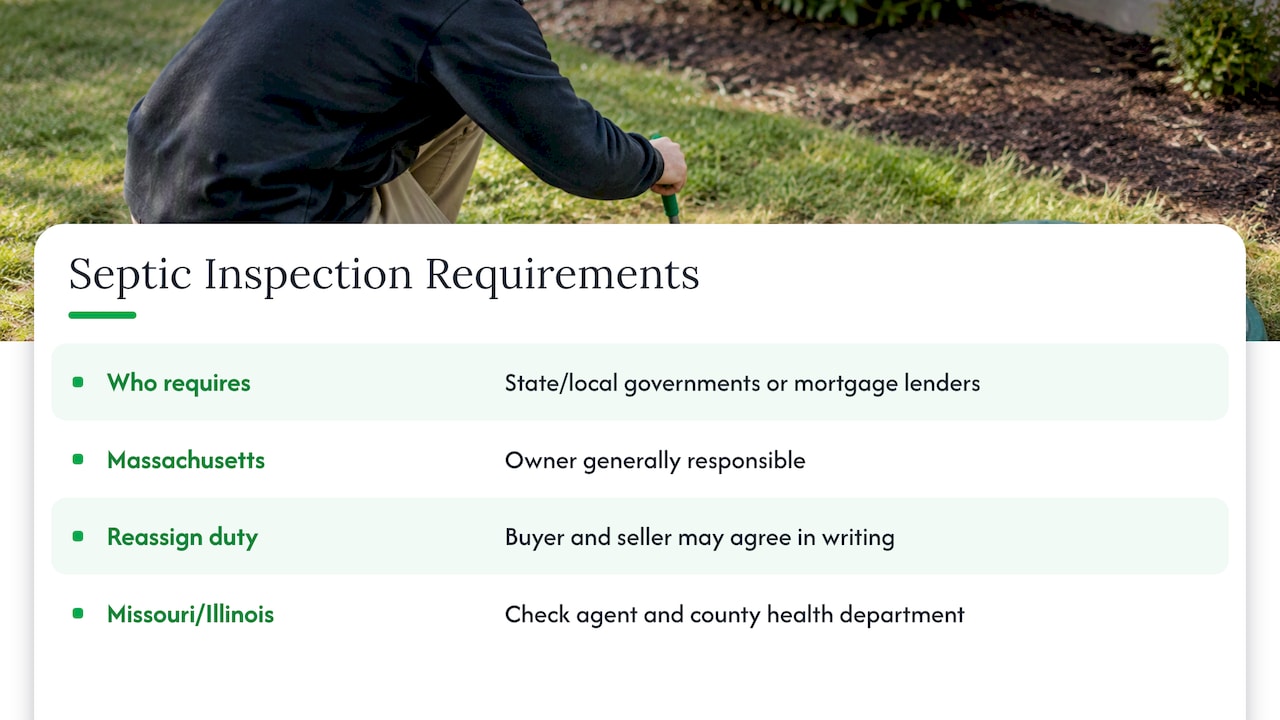
There is no single national rule. The EPA notes that septic inspections may be required by local or state governments or by mortgage lenders during a real estate transaction. Who arranges it differs as well. In Massachusetts, for example, the property owner is generally responsible, but the buyer and seller may agree in writing to reassign that duty.
For a home in Missouri or Illinois, check with your agent and the county health department about local rules before you set your timeline. Local requirements affect who pays, who must be certified and how fast you need to book.
Our view: treat the septic system as its own inspection
We see buyers pour all their attention into the kitchen, the roof and the paint, then discover the most expensive item on the property is buried under the lawn. Our view is simple: if the house has a septic system, it deserves its own inspection, with the tank opened and the whole system read together.
We built our process around buyers who need clear answers fast. Reports come back within 24 hours, we offer video walkthroughs for buyers who cannot be on site, and we schedule evenings and weekends so the inspection fits around your job. We also offer service discounts for veterans and first-time buyers, because the people with the least room for a surprise repair bill are the ones who most need to see one coming.
Our Create Request List™ tool turns the findings into a clear list your agent can take straight to the seller, so a report becomes a negotiation rather than a stack of pages. Bundle the septic work with sewer camera, well, radon or termite inspections and you get a complete picture of the property in one coordinated visit.
JOHN
Book your septic inspection in the St. Louis Metro and Southern Illinois
Hunt Home Inspection serves buyers, sellers, investors and agents across the St. Louis Metro area and Southern Illinois. Our septic and well inspections sit alongside the buyer’s home inspection, sewer camera lateral inspections, radon testing, mold and termite inspections, so you can schedule everything in one pass. Reports are delivered within 24 hours, which keeps you inside your inspection window.

See all of our inspection services or start from our home page to request your appointment. If the property is on a well, add the water testing and ask us about environmental testing in the same visit.
FAQ
How long does a septic inspection take?
The length depends on access, tank size and whether the tank must be uncovered or pumped to be seen. Digging out buried lids adds time, so ask the seller for locations and records first. Your inspector can give you a realistic window when you book.
Who pays for the septic inspection when buying a house?
In most purchases the buyer orders and pays for it as part of due diligence, although local rules and your contract can change that. In Massachusetts, for example, the owner is generally responsible unless the parties agree otherwise in writing. Ask your agent how your contract and your county handle it.
Is a dye test enough?
Usually not. Connecticut’s health department warns that dye testing only finds grossly failed systems and does not guarantee future function. For a purchase, choose an inspection where the tank is opened and the drainfield and distribution box are evaluated.
How often should a septic system be inspected after I buy?
The EPA says inspections should happen every 1 to 3 years for as long as you own the home. Systems with pumps, alarms or electrical parts may need more frequent attention, so follow your inspector’s guidance and local rules.
What are the early signs that a septic system is failing?
Slow drains, gurgling pipes, sewage odors and wet, spongy or unusually lush grass over the tank or drainfield are the usual early signs. Backups in the house and sewage on the surface mean the system has already failed and needs a professional right away.
Sources
- Homebuyer’s Guide to Septic Systems, US EPA
- Frequent Questions on Septic Systems, US EPA
- Inspection of Septic Systems, Oklahoma State University Extension
- Technical Guidance for Inspections of Onsite Wastewater Systems, New Jersey DEP
- Home Buyers Guide, Connecticut Department of Public Health
- Guidance for the Inspection of On-site Sewage Disposal Systems, Mass.gov
- Buying or Selling Property with a Septic System, Mass.gov
- Inspecting plumbing before closing for buyers and sellers
Recent Comments