

To verify a roof’s age, find paper that describes the roofing work itself: a re-roof permit with a final inspection date, the contractor’s contract or invoice, a warranty record, or a seller’s disclosure. Photos and a home inspection report help fill gaps. The year the house was built does not count, because the roof may have been replaced since. If no paper exists, an honest range backed by an inspector’s observations is better than a guessed year.
This guide walks you through where to look, what each record proves, and what to do when your insurer’s number disagrees with yours.
TL;DR
- Start with the permit office, then the contract or invoice, then warranty papers and seller disclosures. Each one dates something slightly different.
- A permit’s issue date is a clue, not proof. The final inspection date is stronger evidence that the work was finished.
- If the insurer lists the wrong roof age, ask what it has on file, send your documents, and ask what it needs to correct the record.
- With no records, a home inspection can describe the roof’s condition on the day of the visit. It is an observation, not a certified install date.
- Label what you find as exact, strong, weak or unknown, and save everything in one folder.
Table of Contents
- Why roof age gets verified
- Records that can confirm the install date
- What each record actually proves
- When there are no records
- If your insurer lists the wrong roof age
- Buying a home: verify before closing
- Selling: build the roof file now
- What to keep in your roof records folder
- Get the roof documented
- FAQ
- Sources
Why roof age gets verified
Roof age comes up in three situations: buying a home, renewing or changing homeowners insurance, and selling. In each, someone wants a number, and that number tends to follow the house from one conversation to the next.
Insurers weigh roof age and condition under their own underwriting rules. The Texas Department of Insurance notes that policies differ: some pay full replacement cost, while others reduce the payment based on roof age and condition, and wind and hail deductibles may differ from other deductibles. The same agency advises homeowners to check that the insurer’s roof age and material information is correct, and to report a replacement so the policy record gets updated.
That makes roof age two separate problems. One is data accuracy: is the number on file right? The other is coverage: what does your policy actually pay on an older roof? This article handles the first. For the second, our section on talking to your insurer points to a plain-language guide.
Records that can confirm the install date
Roof age is usually established from paper, not from the roof. Work through these in order, from strongest to weakest.

Permit and inspection records
A re-roof generally requires a permit, so the permit file is the best first stop. Many cities and counties have online search. Eau Claire, Wisconsin, for example, lets you search its permit portal by address, parcel ID, contractor or issue-date range. In the St. Louis area, St. Louis County runs an online portal with a search for existing permits. City of St. Louis, St. Charles County and Illinois municipalities such as those in Madison and St. Clair counties each keep their own records, so search the office that covers the property’s address.
When you find a roofing permit, write down the permit number, address, contractor name, scope of work, issue date and final inspection date. The final inspection date is usually more useful than the application date, since it signals the job was finished and approved.
Keep the limits in mind. A permit’s issue date is a dated proxy for roof work. Permit-data researchers point out that it does not by itself verify that replacement happened on that date, covered the whole roof or was completed. A completion date or a performed final inspection adds evidence.
Contract, invoice and payment records
A signed roofing contract, a final invoice and proof of payment tell you who did the work, when, what materials went on and how much of the roof was covered. If you bought the home, ask the seller or the listing agent whether they kept these. Many sellers have them in a folder and have never been asked.
Warranty and product records
Shingle manufacturer and workmanship warranties are dated at installation. Registration emails, warranty cards and certificates all work. Some asphalt shingles also carry a manufacturing date code on the packaging or the shingle itself. That date is close to the install date but not identical, so treat it as supporting evidence and have a professional read it. Do not climb onto the roof yourself.
Seller disclosures and prior inspection reports
In Illinois, sellers complete a residential real property disclosure report, and in Missouri a seller disclosure is standard practice. Either may state the roof’s age or the date of a replacement. Treat that as the seller’s statement, then look for a permit or invoice behind it. Prior home inspection reports, appraisals and listing photos from earlier sales can also place the roof at a point in time.
Dated photos
Photos from a past listing, a neighbor’s house in the background of an old family picture, or aerial imagery can show a roof before and after a change. They rarely give an exact date, but they can bracket one.
What each record actually proves
| Record | What it dates | What it does not prove |
|---|---|---|
| Re-roof permit (issue date) | When work was authorized | That the work finished, or covered the whole roof |
| Permit final inspection | When the work passed review | The brand or quality of materials |
| Contract or final invoice | Who did the work and when it was billed | That every roof section was replaced |
| Warranty record | Date of registration or install | Repairs made after that date |
| Seller disclosure | The seller’s stated knowledge | That the statement is documented |
| Shingle date code | When shingles were made | The exact install date |
| Dated photos | Condition at a point in time | The year of installation |
One more trap: the house’s construction year is not the roof’s install date. Only a record describing later replacement or repair work establishes that.
Homes with more than one roof section, such as a garage addition or a porch, can have different ages for each. Keep records separate by roof section.
When there are no records
Some older homes, especially pre-owned ones from estate sales or investor flips, have no paperwork at all. You still have options.
First, try the neighbors. Homes on the same street built in the same era were often re-roofed after the same storm. It is only a lead, but it helps you pick a range.
Second, bring in a home inspector. A good one will describe what the roof surface shows: curling or cupping shingles, bald spots where granules have worn off, moss or streaking, flashing condition and visible repairs. Those point toward a range rather than a year. Our own guide to real field lifespans for roofs explains how materials and ventilation affect how long a roof lasts, which helps you read what you see.
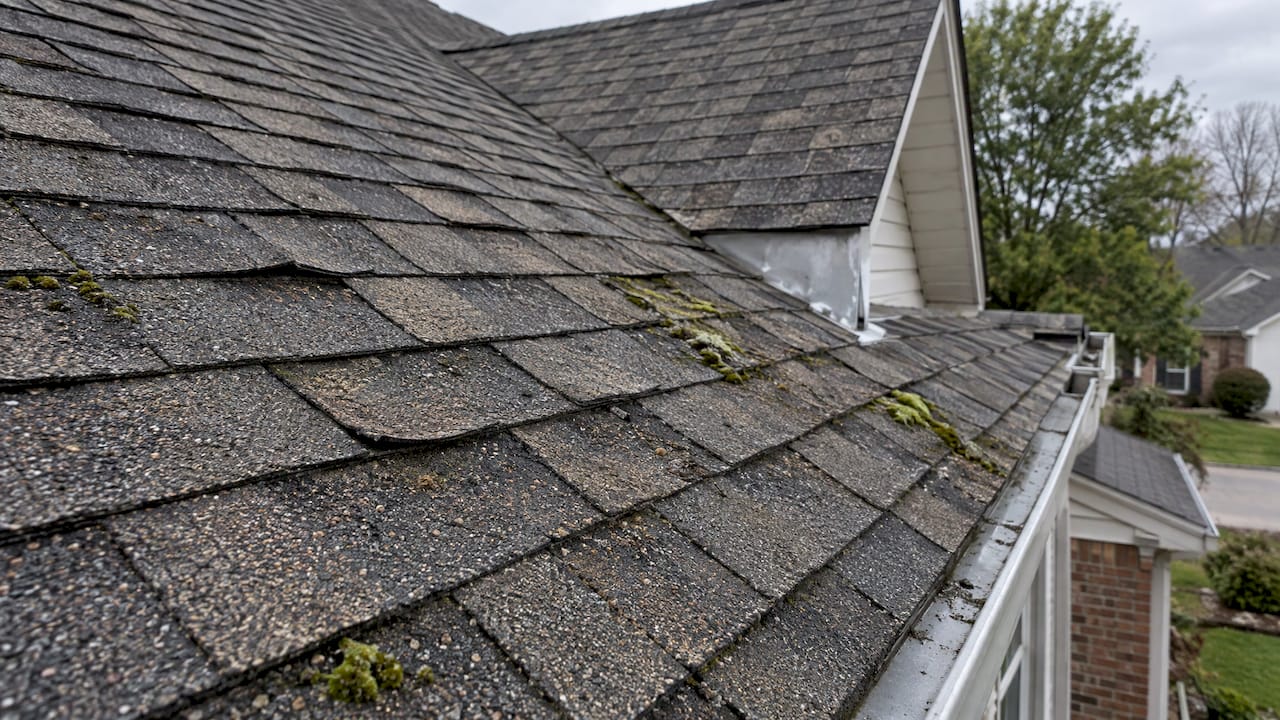
Be clear about what that inspection is. The InterNACHI Standards of Practice say the inspector is not required to predict a roof’s service life, walk on any roof surface or certify the roof, and that findings reflect observations on the day of the inspection. So the report documents condition and visible defects. It does not stamp a birth year on the roof. That is still valuable: it is dated, independent evidence you can hand to an insurer or keep with your file.
Third, label your answer honestly. A simple scale works:
- Exact: a permit with final inspection plus an invoice agree.
- Strong: one solid document, such as a contract or warranty, with a date.
- Weak: a seller’s statement or a shingle code alone.
- Unknown: nothing reliable. Say so, and give the inspector’s condition notes instead of a guess.
“Unknown” is a legitimate answer. An invented year can follow the house into insurance, resale and repair conversations, and it is hard to walk back.
If your insurer lists the wrong roof age
This happens in both directions. A policy might list a roof as four years old when it is nine, or show an old roof that was in fact replaced. Both are worth fixing, for different reasons.
- Ask what is on file. Request the roof age, material and condition the insurer has recorded, and what information it used.
- List the conflicts. Write down each date you have and where it came from. Keep differing dates visible rather than choosing one quietly.
- Send documents. Permit with final inspection, contract, invoice, warranty and dated photos are the usual set.
- Ask what else it needs. Some carriers want a roof inspection report before they will change a record. Ask which documents or inspection it will accept.
- Report new work. After a replacement, tell the insurer so the policy record is updated, as Texas regulators advise.
Regulators in other states give similar advice. Connecticut’s Insurance Department, in a February 2026 consumer advisory, tells homeowners worried about roof underwriting to ask the insurer for the specific issue, send receipts or contracts for completed or scheduled work, and ask about temporary extensions or alternatives. Rules differ by state, so Missouri and Illinois homeowners should check their own state insurance department for local guidance.
Once your records are straight, the next question is what your policy pays on an older roof. This breakdown of what a home policy pays for roof replacement covers how the coverage terms work, so you know what your verified age means in dollars.
If the roof was recently hit by hail or wind, document the damage before you call anyone. Our checklist on roof hail damage signs and inspector reports shows what to photograph and note.
Buying a home: verify before closing
If you are a buyer, roof age is a negotiation point and an insurance question at the same time. Ask for these during the option or due diligence period:
- Any re-roof permit, invoice or warranty the seller holds.
- The seller’s disclosure with the roof line filled in.
- Your insurance agent’s early read on whether the roof’s age or condition will affect your quote.
Then have the home inspected. A buyer’s inspection puts a qualified person on the property to document the roof’s visible condition, flashing, drainage and attic signs of leaks. Our guides on what inspectors look for in a home and on what the report contains show how that documentation looks. Older properties raise extra questions, and our historic home inspection guide covers them.
Selling: build the roof file now
Sellers who gather roof records before listing save time later. Pull the permit, the invoice and the warranty into one folder and add dated photos. A pre-listing inspection adds an independent, dated description of the roof’s condition, so buyers and their insurers see facts upfront instead of discovering questions at the option period.
What to keep in your roof records folder
One folder, paper or digital, per property:
- Permit number, issue date and final inspection date.
- Contractor contract, final invoice and proof of payment.
- Warranty documents and registration confirmation.
- Photos taken during and after installation, plus yearly ground-level photos.
- Home inspection reports and any roof inspection notes.
- A short log of repairs, with dates and receipts.
For each item, note the source, the roof section it covers and what it describes. Annual upkeep also helps; our maintenance inspection checklist is a good model for what to log.
Our perspective
We see the same pattern on many inspections around St. Louis and Southern Illinois: a roof that everyone “knows” is 10 years old, and nothing in writing to show it. Buyers then hear one number from the seller, another from the insurer and a third from a contractor.
Our view is that the roof’s age should be treated as evidence, not as hearsay. We write up what we can see on the day of the inspection, with photos, and our reports come back within 24 hours so you can use them while an insurer quote or a negotiation is still open. We do not guess a year we cannot support, and we encourage you to pair our observations with permits and invoices.
For first-time buyers, veterans and busy households, that speed and clarity matter most. We offer evening and weekend scheduling, and video or in-person walkthroughs, so you can get the roof documented without taking a day off.
JOHN
Get the roof documented
If you are buying, selling or sorting out an insurance record, a dated inspection report is a strong piece of evidence to add to your file. At Hunt Home Inspection, LLC, we offer buyer’s inspections, pre-listing inspections and home maintenance inspections across the St. Louis Metro area and Southern Illinois, and we return reports within 24 hours.

See our inspection services or visit Hunt Home Inspection to schedule an in-person or video walkthrough. We offer discounts for veterans and first-time buyers.
FAQ
Can a home inspector tell me exactly how old my roof is?
Not to the year, unless records exist. An inspector documents the roof’s condition on the day of the visit, and professional standards say inspectors are not required to predict service life or certify a roof. The report gives a dated, independent description you can pair with permits and invoices.
Is the permit date the same as the roof’s age?
Not quite. The permit issue date shows when work was authorized, and the final inspection date is better evidence of completion. Neither alone proves the whole roof was replaced, so combine the permit with an invoice or contract.
What if the seller does not know the roof’s age?
Ask for any invoice, warranty or permit, then search the local permit office by address. If nothing turns up, have the roof inspected and record the age as a range or as unknown, rather than accepting a guess.
Does the house’s build year tell me the roof’s age?
No. The roof may have been replaced one or more times since construction. Only a record describing the replacement or repair work dates the current roof.
What should I do if my insurer has the wrong roof age?
Ask the insurer what age and condition it has on file and what source it used. Send your permit, contract, invoice or inspection report, and ask which documents it needs to correct the record.
Sources
- Texas Department of Insurance: What to know about insurance and your roof
- Connecticut Insurance Department: Consumer Advisory, February 6, 2026
- City of Eau Claire: When is a Permit Required?
- St. Louis County Online Portal
- InterNACHI Home Inspection Standards of Practice
- PermitStack: Roof-age research from permit data
Recent Comments