
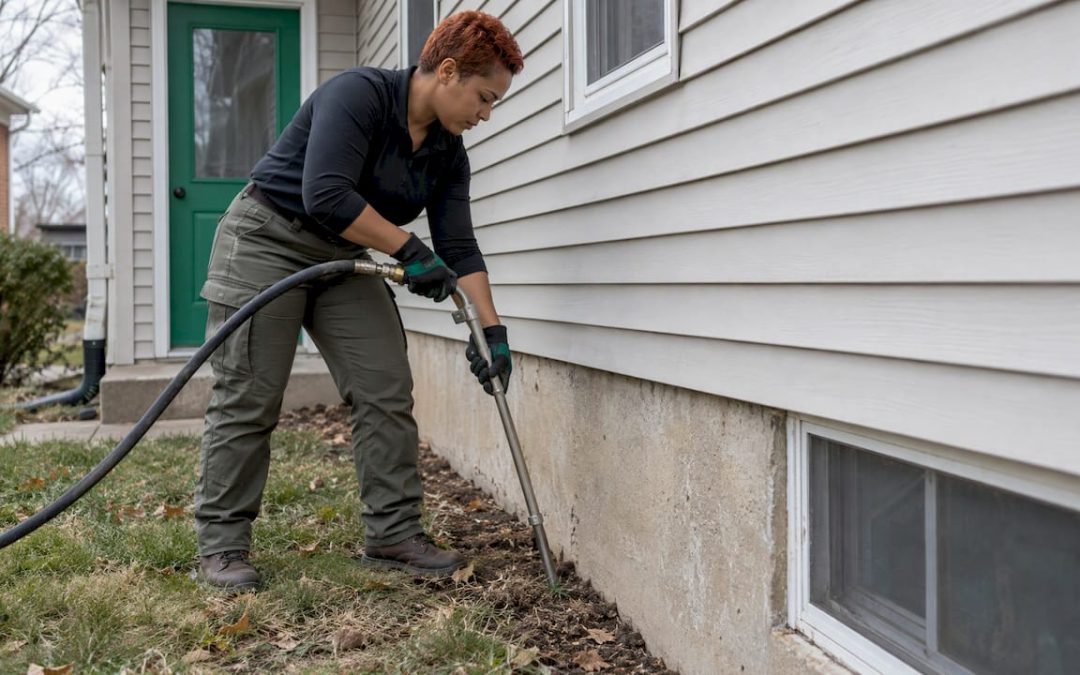
Liquid treatment stops termites quickly by putting treated soil between the colony and your house. Bait works slowly by feeding the colony a poison it carries home. Neither is better in every case. Liquid is the usual pick when termites are already active and you want fast control. Bait is the usual pick when drilling or soil treatment is a poor idea, for example near a well. Many homes do best with both. Whichever you choose, the choice starts with knowing exactly what is in your house, which is what a wood-destroying organism (WDO) inspection tells you.
This guide is written for buyers, first-time owners and anyone who has just been handed a termite report with a treatment quote attached. It explains how each method works, where each one wins, and what to ask before you sign anything.
TL;DR
- Liquid termiticide creates a treated zone in the soil around the foundation. It acts fast and, according to university extension sources, can protect for 5 years or more.
- Bait stations are slower. Worker termites must find the bait on their own and carry it back to the colony, so protection depends on a monitoring contract that continues.
- Active infestation? Extension guidance often pairs a liquid treatment for quick control with bait stations for long-term monitoring.
- Well, pond or foundation drain nearby? Bait is often the safer fit, and a licensed applicator must plan any liquid work around the water source.
- Buying a home? Get the WDO inspection first, so the treatment you price matches what is actually there.
Table of Contents
- How each treatment works
- Bait vs. liquid at a glance
- Speed and how long protection lasts
- When bait is the better fit
- When liquid is the better fit
- When combining both makes sense
- Safety, wells and who should apply it
- What a termite inspection settles before you choose
- Questions to put to the licensed applicator
- Get the termite inspection done first
- FAQ
- Sources
How each treatment works
The U.S. Environmental Protection Agency lists four broad approaches: liquid soil-applied termiticides, termite baits, building materials impregnated with termiticide, and wood treatments. For most homeowners the real decision is between the first two.
Liquid soil treatment
A licensed applicator dilutes a termiticide (a pesticide made for termites) in water and applies it under or around the foundation. According to Mississippi State University Extension, this creates treated soil that termites encounter while foraging. Termites that cross it are controlled, and termites already in the structure can be killed as well.
Newer “non-repellent” liquids are worth knowing about. Termites do not detect them, so they walk through and carry the product to nestmates. NC State Extension notes that some non-repellent products may be transferred from contaminated termites to others in the colony. Texas A&M’s university termite FAQ adds that these products can have very high success rates even when not every entry point is treated.
Termite bait stations
A bait station is a plastic unit set into the soil around the house. According to Virginia Tech’s treatment guidance, stations typically sit about 10 feet apart and hold untreated wood monitors. They are checked monthly or quarterly. When live termites turn up in a monitor, the technician swaps in toxic bait.
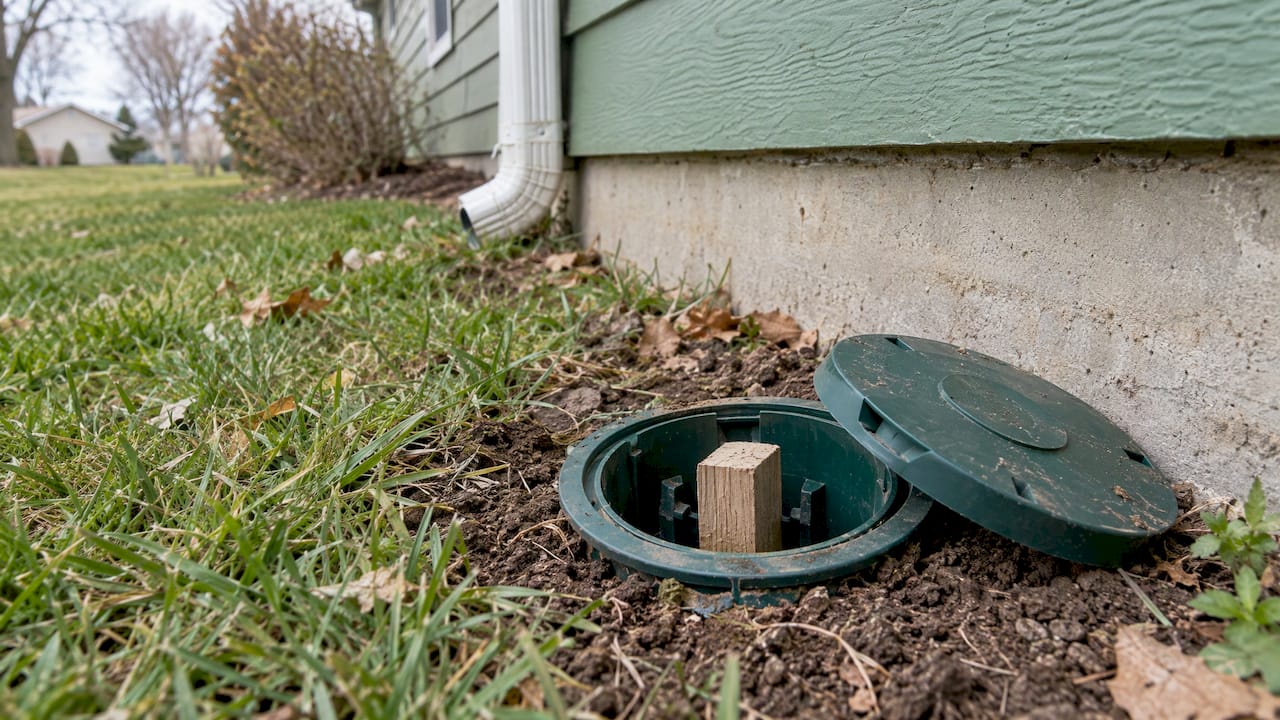
The bait itself is cellulose (the same material as wood) containing a slow-acting insecticide. Mississippi State explains that worker termites feed on it and share it with the rest of the colony, including immature and reproductive termites. The aim is to reduce or eliminate the colony rather than block a path into the house.
One point surprises many people. Stations do not attract termites. NC State says workers find them during normal foraging, and no one can predict how long that will take. Stations are usually installed about 2 to 4 feet from the foundation and no more than 20 feet apart, with closer placement near stumps or other likely food sources.
Bait vs. liquid at a glance
| Liquid termiticide | Bait stations | |
|---|---|---|
| How it works | Treated soil barrier around and under the foundation | Slow-acting bait carried back to the colony |
| Speed | Fast control of termites crossing treated soil | Slow, since termites must find the station first |
| Active infestation in the walls | Can treat known activity points | Usually not used alone for existing infestations |
| Length of protection | Roughly 5 years or more per Texas A&M; some products 8 to 12 years or longer per Mississippi State | Only while the monitoring contract continues |
| Ongoing visits | Few, mostly warranty checks | Regular station inspections |
| Best fit | Active termites, quick protection, accessible soil | Wells, drains, slabs with ducts, finished floors you do not want drilled |
Speed and how long protection lasts
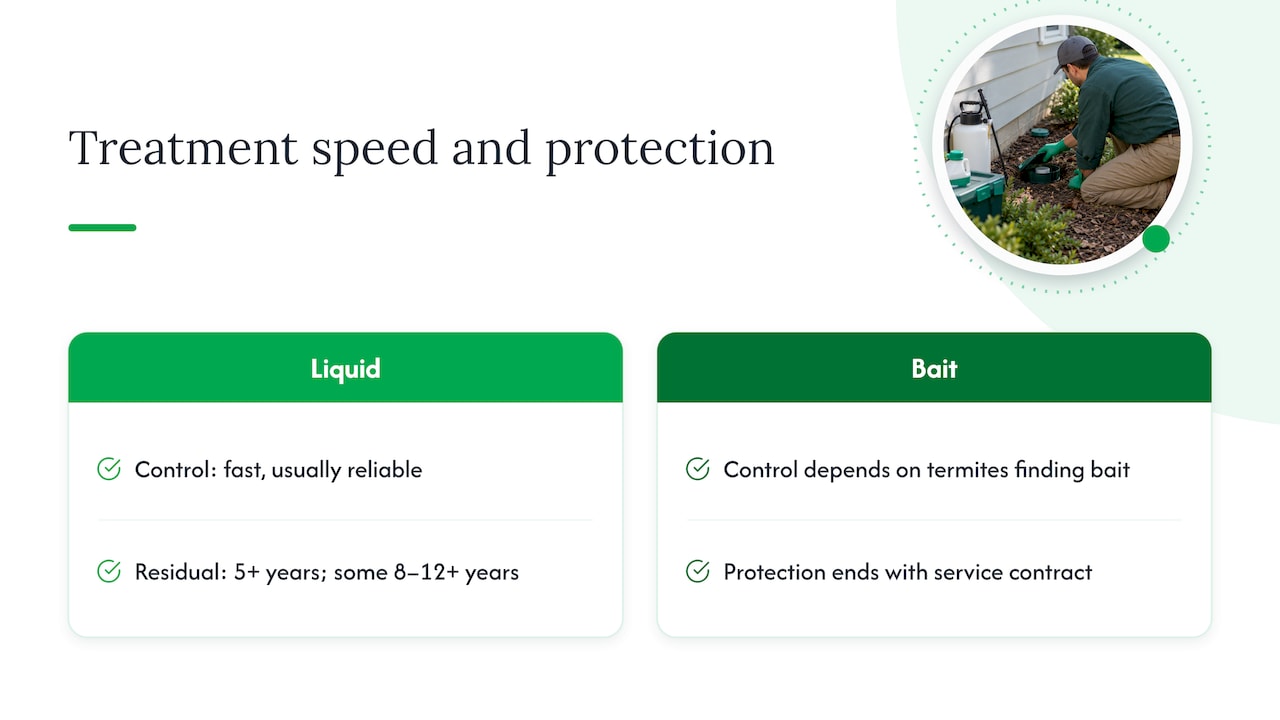
Speed is the clearest difference. Texas A&M describes liquid termiticides as providing fast and usually reliable control, while baits depend on termites discovering and eating the bait. Mississippi State adds that baits are usually not used alone when an infestation already exists. Known activity points may get a liquid treatment as well.
Longevity runs the other way. Texas A&M says soil-applied liquids can persist for five years or more, but bait protection does not continue once the baiting service contract ends. Mississippi State reports that some better liquid products give 8 to 12 years or longer of residual control. Both universities describe these as ranges that depend on the product, soil and site, not a promise. Ask for the product name and its warranty terms in writing.
Baits have a maintenance side too. A federal pesticide label for one common bait system, Recruit HD, requires stations to be inspected and serviced at intervals not longer than 12 months, with no more than 15 months between inspections. It also notes that frozen or water-saturated soil and seasonal drops in termite foraging can affect timing. In plain terms, a bait plan is a service you keep paying for, and the visits are what make it work.
When bait is the better fit
NC State Extension lists the situations where baiting is favored over a standard liquid treatment:
- Foundation drains that could carry chemical toward water
- Ducts under a slab
- Extensive drilling through finished floors or masonry
- A well or cistern near or beneath the structure, where liquid treatment may be restricted
- A homeowner who prefers to avoid treating the soil
Those are real house conditions, and they are the kind a good inspection notices. A finished basement with a slab full of ductwork, or a rural property with a private well, changes the answer.
Bait also suits households that want to keep treatment away from the soil beside the foundation. Massachusetts state guidance, for example, says vegetable gardens should be at least 5 feet from a liquid-treated foundation, which matters if your garden hugs the house.
When liquid is the better fit
Liquid is the stronger choice when termites are already active, when you want protection in place quickly, and when the soil around the house is easy to reach. It is also the usual answer on a house you are about to close on, where a lender or buyer wants a treated structure rather than a monitoring program that may take months to show results. Virginia Tech notes that in-ground stations outside the structure do not directly affect termites already foraging inside, which is one reason active interior activity points to liquid.
When combining both makes sense
The either/or framing in the search results is a little misleading. Iowa State Extension says a liquid treatment may be used for quick control while bait stations are installed for long-term monitoring. Virginia Tech supports the same idea when termites are active inside: exterior stations work on the colony over time, and spot or complete liquid treatment handles the immediate problem. Virginia Tech also notes that above-ground stations can be attached over mud tubes or directly to infested wood.
If a quote includes both, that is not automatically an upsell. Ask the applicator which part of the house each method covers, and why.
Safety, wells and who should apply it
This is not a do-it-yourself job. The EPA warns that many termiticides are highly toxic and that labels must be followed carefully, and that improper treatment can contaminate a home or nearby drinking-water wells. It advises hiring a licensed, trained professional.
Before any liquid work, do these things:
- Confirm the license. Verify the company is licensed by your state and ask for the license number.
- Ask for the product label. Check that termite-control directions appear on it.
- Get the reentry time. It varies by product and is set on the label, so ask when your family and pets may return.
- Mention every water source. Tell the applicator about wells, cisterns, ponds, streams and foundation drains. A federal product label for one liquid termiticide states that wells and cisterns must not be contaminated and gives special procedures for structures with or beside those water sources.
If you are in a well-water part of the St. Louis Metro area or Southern Illinois, this conversation matters before the contract, not after.
What a termite inspection settles before you choose
Bait versus liquid is a treatment question. It only has a good answer once you know whether termites are present, where, and what the house looks like around the foundation. That is the job of a WDO inspection, the report lenders and buyers use to document termite and other wood-destroying insect activity or damage.
For a buyer, the order matters:
- Inspect first. Get the WDO report during your inspection period, so any treatment quote is based on findings, not guesses.
- Read what it found. Active termites, past activity and conditions that invite them (wood against soil, moisture, mud tubes) point to different treatments. Our guide to what inspectors look for in a home shows how those conditions appear in a report.
- Match the finding to the method. Active infestation inside points toward liquid, often with bait for monitoring. A well beside the foundation points toward bait or a carefully planned liquid job.
- Negotiate with the report in hand. A documented finding gives you something concrete to bring to the seller. First-time buyers can see how that plays out in avoiding five-figure repairs with an inspection.
- Budget for the inspection itself. See what a termite inspection costs and why.
Treatment prices vary widely by home size, foundation type, infestation and method, and published averages come from member-reported costs, not regulated price lists. That is the reason to collect written, itemized quotes that name the product, the method, the areas covered and the warranty, and to compare them against the same inspection report.
Questions to put to the licensed applicator
Bring these to every quote:
- Which product will you use, and may I see the label?
- Is this a full perimeter treatment or a spot treatment of the active areas?
- If bait: how many stations, how often are they checked, and what does renewal cost after year one?
- If liquid: how long does the warranty run, and does it cover retreatment and repair?
- What happens if I have a well, cistern or foundation drain nearby?
- When can we re-enter the home and use the yard?
- What do you need from the inspection report to confirm where activity is?
Texas A&M advises comparing quotes, maintenance costs and warranties, and it is the right habit. A cheaper bait quote can cost more over time once yearly monitoring is added, and a liquid warranty is only as good as its written terms.
Our view: know what you have before you pay to treat it
We inspect homes across the St. Louis Metro area and Southern Illinois, and our WDO/termite inspection is built for the moment a buyer needs a clear answer on a tight timeline. We deliver reports within 24 hours, and we schedule evenings and weekends because most buyers cannot take a weekday off in the middle of a contract.
The bait-versus-liquid debate gets heated online, but for a buyer the more useful question comes first: are termites active, and where? A clear report lets you ask a licensed applicator the right questions and compare quotes for the same job.
We also think the people who need this most are the ones with the least room for surprises: first-time buyers, veterans and families stretching to afford the house. That is why we offer discounts for veterans and first-time buyers, and payment at closing for some services.
JOHN
Get the termite inspection done first
Hunt Home Inspection, LLC offers WDO/termite inspections along with buyer’s inspections, radon testing, mold inspection, sewer camera inspections and septic and well inspections, so you can cover the whole house in one appointment. You can choose an in-person or video walkthrough, and the report comes back within 24 hours. Veterans and first-time buyers can ask about our service discounts, and some services can be paid at closing.

See every service on our inspection services page and book the termite inspection before your inspection window closes.
FAQ
Is termite bait or liquid treatment more effective?
Both can work when installed and maintained properly. Liquid acts faster and is generally used when termites are already active. Bait acts on the colony more slowly and relies on continued monitoring. Many extension sources describe combining the two when you need immediate control and long-term surveillance.
How long does each treatment last?
Texas A&M says soil-applied liquid termiticides can persist for five years or more, and Mississippi State reports 8 to 12 years or longer for some better products. Bait protection lasts only while the service contract continues. Always get the product name and warranty terms in writing.
Which is safer near a well?
Bait is often favored when a well, cistern or pond is close to the structure, because liquid treatment there may be restricted. The EPA warns that improper treatment can contaminate nearby drinking-water wells. Tell the licensed applicator about every water source before they quote.
Can I treat termites myself?
The EPA advises hiring a licensed, trained professional because many termiticides are highly toxic and the label directions are strict. A licensed company will also supply the product label and reentry instructions. Your part is to get a clear inspection report and compare written quotes.
Should I inspect for termites before buying a house?
Yes. A WDO inspection during your inspection period shows whether termites are active and where, so any treatment quote is based on real findings. That gives you facts to negotiate with and helps you choose between bait, liquid or both.
Sources
- Termites: How to Identify and Control Them, U.S. EPA
- Methods of Termite Control, Mississippi State University Extension
- Termites: Baiting Systems, NC State Extension
- Frequently Asked Questions About Subterranean Termites, Texas A&M
- Termite Control in Iowa, Iowa State University Extension
- Subterranean Termite Treatment Options, Virginia Tech
- Recruit HD product label, U.S. EPA
- Termite guidance, Massachusetts Department of Agricultural Resources
- Premise Pro EPA product label
Recent Comments