
Comparing home inspection quotes means evaluating base fees, add-on service costs, inspector credentials, and report quality together, not just the bottom-line price. The national average cost for a standard home inspection in 2026 runs $350–$500 for a typical home, but that number alone tells you almost nothing. A quote from Angi-listed inspectors in New York City averages $450 or more, while Detroit averages closer to $295. Add radon testing, a sewer scope, or mold sampling, and your total can jump by $125–$600. The goal of any home inspection cost comparison is to find the inspector who delivers the most thorough service for a fair price, not just the cheapest bid.
What do home inspection quotes actually include?
A home inspection quote is made up of two parts: the base inspection fee and any ancillary service fees. Understanding both is the first step toward a fair comparison.
The base fee covers a visual examination of the home’s structure, roof, electrical systems, plumbing, HVAC, and insulation. For a 1,500–2,500 square foot home, that base fee typically runs $350–$600. Homes over 3,000 square feet often push the total past $550–$900. Geographic location also shifts prices significantly. According to Angi, Houston averages $350, Chicago $320, and Los Angeles $330, reflecting local licensing requirements and cost of living.
Add-on services are where quotes diverge most sharply. These are the line items that separate a thorough inspection from a bare-minimum one:
- Radon testing: $125–$300
- Sewer scope: $200–$350
- Mold sampling: $300–$600
- Termite inspection: $75–$150
These ancillary services can add $125–$600 to your total. That means two quotes with the same base price can differ by hundreds of dollars in actual scope. Inspector certifications also matter here. Inspectors certified through InterNACHI or ASHI carry standardized training that affects what they check and how they document findings.
Pro Tip: Always request an itemized quote. A single lump-sum number makes it impossible to know what you are actually paying for or what is missing.
Experienced buyers also ask inspectors to clarify whether crawl spaces, mechanical systems, and ancillary tests are included. Skipping that question is one of the most common ways buyers end up with surprise costs after closing.
How do you build a fair comparison grid for quotes?
A comparison grid is the most reliable method for evaluating competing home inspection quotes without getting misled by low headline prices. The approach is straightforward and takes about 20 minutes to set up.
Here is how to build one:
- List all services as rows. Include the base inspection, radon testing, sewer scope, mold sampling, termite inspection, and any other service you want.
- Add each inspector as a column. You should have at least three quotes to compare meaningfully.
- Fill in the price for each service. If an inspector does not offer a service, mark it “not offered” rather than leaving it blank.
- Request a price for missing items. If Inspector A does not include radon testing, ask what they charge to add it. This gives you a true total.
- Sum each column. Compare totals only after all services are normalized across quotes.
Here is an example of what that grid looks like in practice:
| Service | Inspector A | Inspector B | Inspector C |
|---|---|---|---|
| Base Inspection | $375 | $325 | $400 |
| Radon Testing | $150 | Not offered | $175 |
| Sewer Scope | $250 | $225 | Not offered |
| Termite Inspection | $100 | $125 | $100 |
| Total (Normalized) | $875 | $875+ | $875+ |
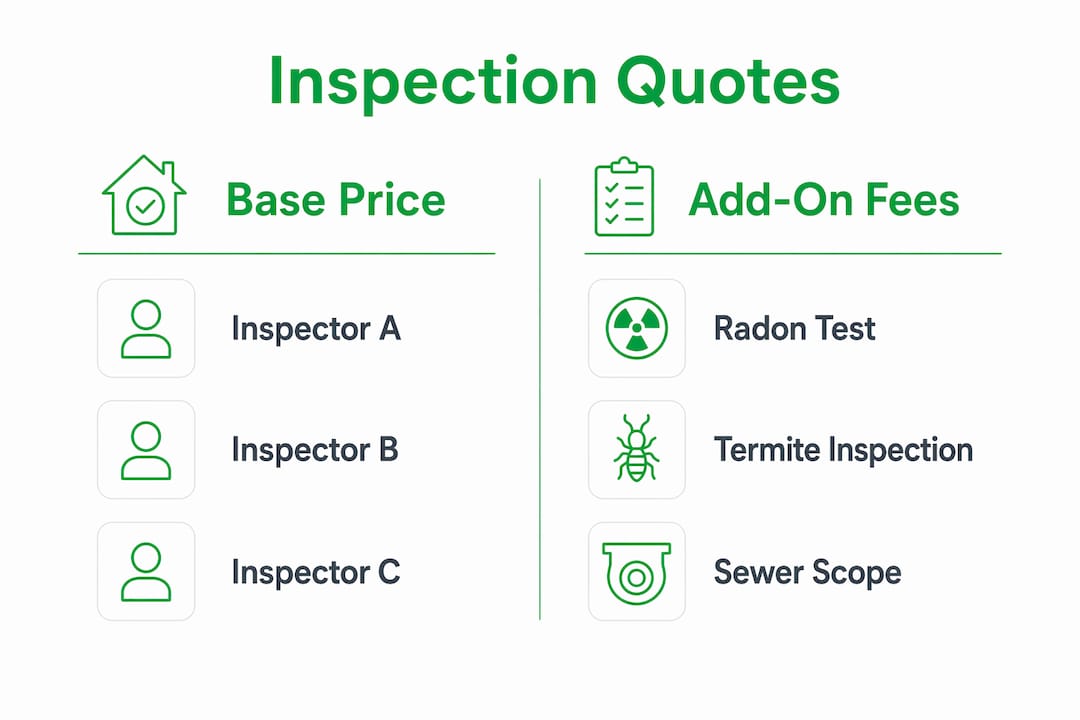
The grid above shows how a lower base price from Inspector B disappears once you add the radon test they do not include. Without this structure, you would have chosen Inspector B thinking you saved $50, only to pay more later or skip a test that matters.
Pro Tip: If two inspectors are within $30–$50 of each other after normalization, shift your focus to report quality and online reviews. Request a sample report from each before you decide.
What red flags should you watch for in quotes?
The most dangerous quote is not the most expensive one. It is the one that looks affordable but hides what it leaves out.
An all-in price below $300 for a typical 2,000-plus square foot home is a strong warning sign. A thorough inspection requires 3–4 hours on site. Any inspector promising a full inspection for significantly less than market rate is almost certainly cutting corners on time, scope, or both.
“A cursory one-hour walk-through is insufficient. Detailed inspections produce 60–100 page reports.” — Inspection Triage
Watch for these specific red flags when you review quotes:
- No itemized breakdown. A single price with no line items means you cannot verify what is included.
- Very short estimated time on site. Time on site of 2–4 hours is the standard for a thorough inspection. Less than two hours for a full-size home is a problem.
- No mention of certifications. Inspectors should be able to name their certifying body, whether InterNACHI, ASHI, or a state licensing board.
- Vague scope language. Phrases like “full inspection” without a defined checklist leave too much room for omission.
- No sample report available. Inspectors who cannot share a sample report often produce thin, checkbox-style documents that offer little negotiating power.
Choosing a cheaper inspector without verified credentials often leads to costly overlooked defects after closing. The money you save on the inspection fee can disappear quickly when a missed foundation crack or faulty electrical panel shows up six months later. Use the home inspection checklist to verify scope before you commit.
How do you use quotes to negotiate a better purchase price?
A thorough inspection report is one of the most powerful negotiating tools in a real estate transaction. 86% of home inspections uncover issues, and buyers who use those reports to negotiate save an average of $14,000 off the sale price. That return makes a $400–$500 inspection fee look like one of the best investments in the entire buying process.
Here is how to get the most out of your quotes and reports:
- Share the full inspection scope with your real estate agent before hiring. Your agent can tell you which add-ons are most relevant for the neighborhood and property type.
- Bundle add-on services with one inspector. Bundling radon, sewer, and termite services with the same inspector saves $50–$75 compared to scheduling them separately.
- Use the report to prioritize repair requests. A detailed 80-page report gives your agent specific dollar amounts and safety concerns to bring to the seller.
- Do not skip ancillary tests on older homes. A sewer scope on a 1960s home or radon testing in a high-risk county can uncover issues worth tens of thousands of dollars in repairs or remediation.
Pro Tip: Ask your inspector to walk you through the report in person or via video call. Jhunthomeinspections offers this as a standard part of their service, and it makes a real difference when you are preparing a repair request list.
Learning how to use inspection reports effectively turns a document into a negotiating asset. The buyers who get the best deals are the ones who treat the inspection as a business decision, not a formality.
Key takeaways
The most effective way to compare home inspection quotes is to normalize scope across all bids, verify inspector credentials, and treat the inspection fee as a negotiation investment rather than a cost to minimize.
| Point | Details |
|---|---|
| Normalize scope before comparing | Build a grid listing all services so totals reflect the same coverage across every quote. |
| Watch for low-price red flags | All-in quotes below $300 for a 2,000-plus sq ft home often signal skipped scope or rushed inspections. |
| Bundle add-ons with one inspector | Scheduling radon, sewer, and termite together saves $50–$75 versus booking separately. |
| Use reports to negotiate | Buyers who act on inspection findings save an average of $14,000 off the purchase price. |
| Request sample reports upfront | Report quality predicts negotiating power. Ask before you hire, not after. |
Why i think most buyers compare quotes the wrong way
After years of watching buyers navigate the inspection process, the single biggest mistake I see is treating the quote like a grocery receipt. People scan for the lowest number and stop there. That approach costs them far more than they save.
The buyers who come out ahead are the ones who ask two questions before anything else: what is included, and how long will you spend on site? Those two data points tell you more about an inspector’s quality than any price. A $425 quote with a four-hour on-site commitment and a 90-page report will almost always outperform a $300 quote with a two-hour walk-through and a 20-page checklist.
I have seen buyers negotiate $10,000 or more off a purchase price because their inspector caught a failing HVAC system or a cracked heat exchanger. That outcome only happens when the inspector had enough time and scope to find it. The $75 they saved by going with the cheaper bid would not have covered one hour of HVAC repair.
My honest advice: build the comparison grid, normalize the totals, then spend the last 10 minutes of your decision on report quality and reviews. The price difference between a good inspector and a great one is rarely more than $50–$75. The difference in outcomes can be measured in thousands.
— JOHN
Get transparent quotes from Jhunthomeinspections
Jhunthomeinspections serves homebuyers and property investors across the St. Louis Metro area and Southern Illinois with itemized, transparent quotes that make the comparison process straightforward.
Every inspection includes a detailed scope, clear add-on pricing for radon, sewer, termite, and mold services, and a comprehensive report delivered within 24 hours. The proprietary Create Request List™ tool makes it easy to share findings directly with your real estate agent. Whether you are a first-time buyer, a veteran, or an investor evaluating multiple properties, Jhunthomeinspections gives you the clarity you need to make a confident decision. View inspection services and request your itemized quote today.
FAQ
What is the average cost of a home inspection in 2026?
The national average runs $350–$500 for a standard home on a 1,500–2,500 square foot lot. Larger homes or high-cost cities like New York can push totals past $600.
How many quotes should i get before hiring an inspector?
Get at least three quotes. Three bids give you enough data to spot outliers, whether unusually low or unusually high, and to build a meaningful comparison grid.
What add-on services are worth including in my inspection?
Radon testing ($125–$300), sewer scopes ($200–$350), and termite inspections ($75–$150) are the most commonly recommended add-ons. Their value depends on the home’s age, location, and construction type.
How do i know if a low quote is a red flag?
An all-in price below $300 for a typical 2,000-plus square foot home is a warning sign. Pair that with a short estimated time on site or no itemized breakdown, and you should ask serious questions before hiring.
Does bundling inspection services actually save money?
Yes. Scheduling radon, sewer, and termite services with the same inspector typically saves $50–$75 compared to booking each service separately through different providers.
Recent Comments