
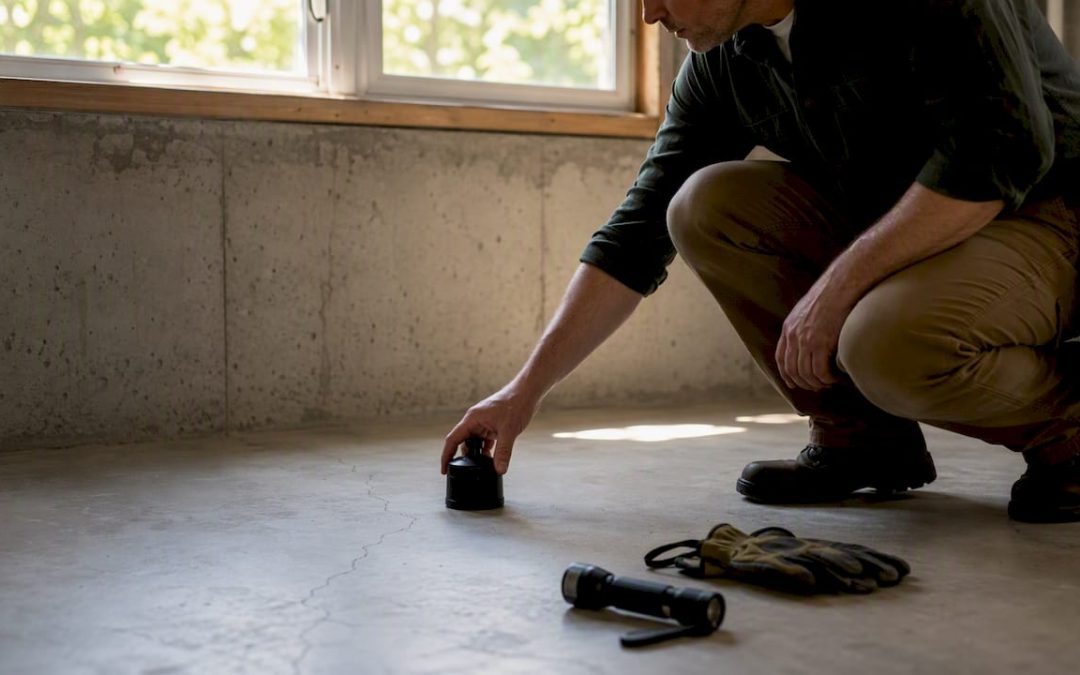
An environmental hazard inspection for a real-estate transaction is a targeted assessment that tests a property for hidden health risks — radon, lead-based paint and soil contamination, asbestos-containing materials, mold, drinking-water contaminants, and soil pollution — using certified testers and accredited lab analysis. Unlike a standard home inspection, which is visual and non-invasive by design, environmental testing requires specialized equipment, sample collection, and laboratory results. Buyers, sellers, lenders, and agents all have reasons to order these tests, but the buyer typically drives the process during the inspection contingency period.
At a glance:
- Radon testing applies to any home, any age, any geography.
- Lead paint and soil testing is generally recommended for homes built prior to 1978.
- Asbestos sampling is advisable for homes built before 1980 or when renovations might disturb materials.
- Mold, water, and soil tests depend on property features (well water, basement moisture, nearby industrial sites).
Pro Tip: Run the property address through ProtectMyZip’s environmental risk checklist before scheduling any tests. It surfaces FEMA flood zones, EPA-regulated facilities nearby, and water-supply context in minutes, so you prioritize the right tests instead of ordering everything.
Key Takeaways
Environmental hazard inspections are a separate, specialized layer of due diligence that standard home inspections do not replace, and ordering them early in the contingency period is the single most effective way to protect both the transaction and the people who will live in the home.
| Point | Details |
|---|---|
| Order tests early | Schedule environmental add-ons on day one of the contingency period to allow lab turnaround time. |
| Know your triggers | Pre-1978 homes need lead testing; pre-1980 need asbestos sampling; radon testing applies to any home. |
| EPA thresholds matter | Radon action level is 4 pCi/L; consider mitigation between 2–4 pCi/L per EPA guidance. |
| Verify credentials | Require state certification (NRPP/NRSB for radon, EPA-authorized for lead) and NELAP lab accreditation. |
| Jhunthomeinspections | Offers radon, lead, water, asbestos, and mold testing with 24-hour reports in the St. Louis Metro area and Southern Illinois. |
Table of Contents
- What does an environmental hazard inspection typically cover?
- When should you order environmental tests in a transaction?
- How are environmental tests performed, and what do results mean?
- What do environmental tests cost, and how long do they take?
- How do you choose a qualified inspector or testing service?
- How Jhunthomeinspections handles environmental hazard inspections
- What to do when environmental test results are elevated
- What buyers and agents most often get wrong about environmental inspections
- Primary sources and where to find authoritative guidance
- Jhunthomeinspections: environmental testing built into your transaction
- Sources
What does an environmental hazard inspection typically cover?
The scope varies by property age, location, and features, but most property-focused environmental assessments address six core hazard categories.
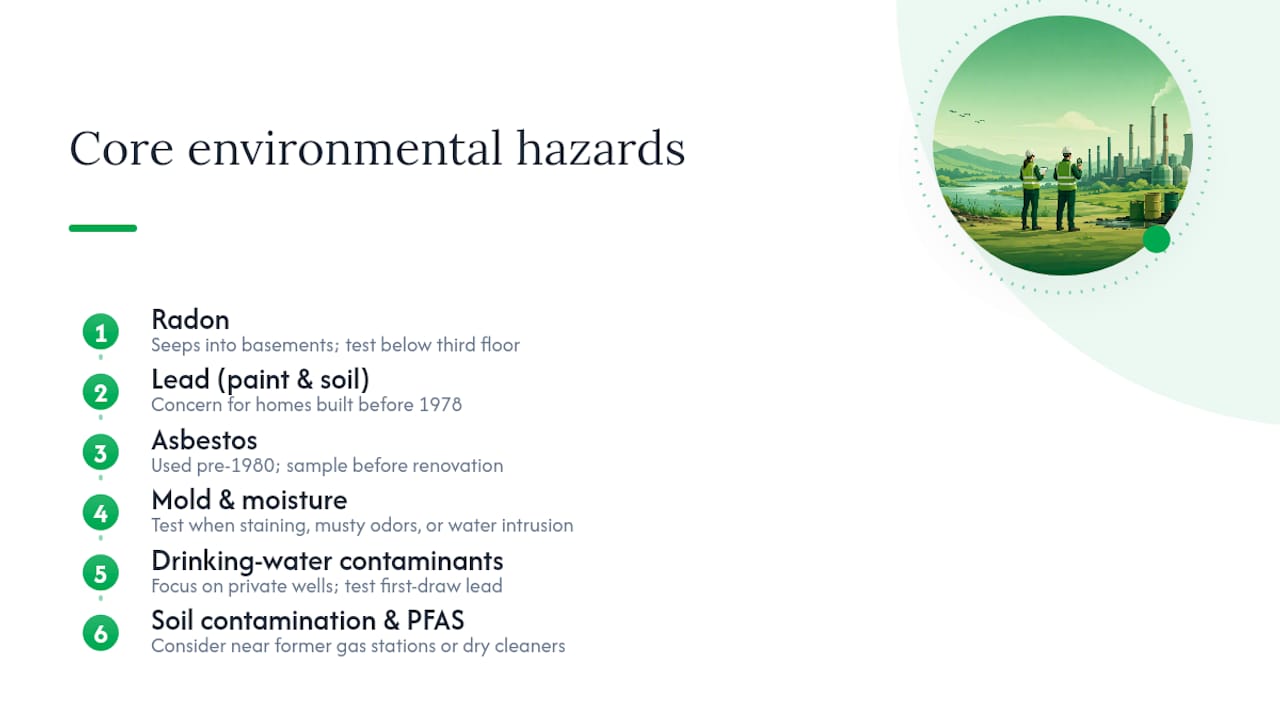
Radon is the most universally ordered test. It is a colorless, odorless gas that seeps from soil into basements and lower floors regardless of how new or well-built the home is. Testing is recommended for homes with living spaces below the third floor.
Lead-based paint and lead soil contamination are primary concerns for homes built before 1978, when lead paint was federally banned for residential use. Soil near the foundation can also carry lead from decades of exterior paint weathering or from nearby industrial activity.
Asbestos was used widely in insulation, floor tiles, roofing, and pipe wrap through the late 1970s. Pre-1980 homes and any property slated for renovation should be sampled before any disturbance of suspect materials.
Mold and moisture testing is appropriate when there is visible staining, musty odors, a history of water intrusion, or a crawlspace without adequate vapor barriers. Mold sampling without a moisture-source investigation is largely pointless.
Drinking-water contaminants matter most for homes on private wells, which are not regulated by municipal monitoring programs. First-draw lead testing is also recommended for any home with older plumbing, even on public water.
Soil contamination and PFAS screening apply when a property sits near a former gas station, dry cleaner, industrial facility, or agricultural operation. This is a less routine test but worth considering based on address-level research.
On the screening-versus-comprehensive question: a screening test (short-term radon charcoal canister, DIY lead swab) gives a fast, low-cost signal. A comprehensive risk assessment uses certified professionals, accredited lab analysis, and a full written report with chain-of-custody documentation. For real-estate transactions, always use the comprehensive approach — screening results alone rarely satisfy lenders or support contract negotiations.
When should you order environmental tests in a transaction?
Order tests on day one of the inspection contingency period, not after the standard home inspection report comes back. Lab turnaround times for water and soil samples can run 5–10 business days, and radon short-term tests require a minimum 48-hour closed-house period. Waiting costs you negotiating leverage.
For pre-1978 homes specifically: federal law gives buyers a 10-day window to conduct a lead paint inspection or risk assessment before becoming obligated under the contract, under the Lead-Based Paint Disclosure Rule. Sellers must provide the EPA pamphlet, disclose any known lead records, and include a Lead Warning Statement in the contract per CFR §745.113. Buyers can waive the 10-day window in writing, but doing so before testing is rarely wise.
Quick timing checklist:
- Buyers: Schedule radon, lead, and any water tests the same day as the standard inspection. Ask the seller for any prior test records upfront.
- Sellers: Pull existing radon or lead reports before listing. Proactive disclosure shortens negotiation cycles.
- Agents: Confirm the contingency window covers lab turnaround time. Build in at least 10 business days for any water or soil panel.
- Lenders: FHA and VA loans may require radon testing in high-risk states and well-water testing for properties on private wells. Confirm requirements with the loan officer before the inspection period opens.
Pro Tip: For real-estate transactions, the EPA radon guide specifically warns against device interference — keep windows closed and avoid operating fans or fireplaces during the 48-hour test period. A failed closed-house protocol invalidates the result and costs you time you may not have.
Radon is the second leading cause of lung cancer in the U.S., yet most buyers never think to test for it until an agent mentions it.
How are environmental tests performed, and what do results mean?
Radon is tested with a short-term charcoal canister (48–96 hours) or a continuous electronic monitor. The EPA action level is 4 pCi/L; mitigation is worth considering between 2–4 pCi/L. The average U.S. indoor level is low but variable. A result at or above 4 pCi/L requires a mitigation system before or at closing, not after.
Lead testing splits into two distinct services. A lead inspection uses XRF (X-ray fluorescence) technology to map every painted surface without disturbing it. A risk assessment goes further, evaluating dust wipe samples, soil samples, and paint condition to determine actual exposure risk. For a pre-1978 home, a risk assessment gives you more negotiating data. Soil lead is analyzed using EPA methods 3050/3051 for acid digestion and ICP analysis.
Asbestos requires bulk sampling of suspect materials (floor tiles, pipe insulation, ceiling texture) analyzed by polarized-light microscopy (PLM) in an accredited lab. The cardinal rule: never disturb suspect materials before sampling. A positive result does not automatically mean removal — intact, undisturbed asbestos-containing materials are often left in place and managed.
Mold assessment starts with a moisture investigation. Air sampling or surface sampling follows only when a specific source is identified. A Certified Industrial Hygienist (CIH) is worth the cost on complex cases involving large affected areas or HVAC contamination.
Water testing for private wells should include bacteria, nitrates, pH, and a metals panel at minimum. First-draw lead sampling (water sitting in pipes for 6+ hours before collection) gives the most accurate household exposure picture. A full PFAS panel is reasonable near agricultural or industrial sites.
| Test | Sample Method | Typical Turnaround | Reporting Metric |
|---|---|---|---|
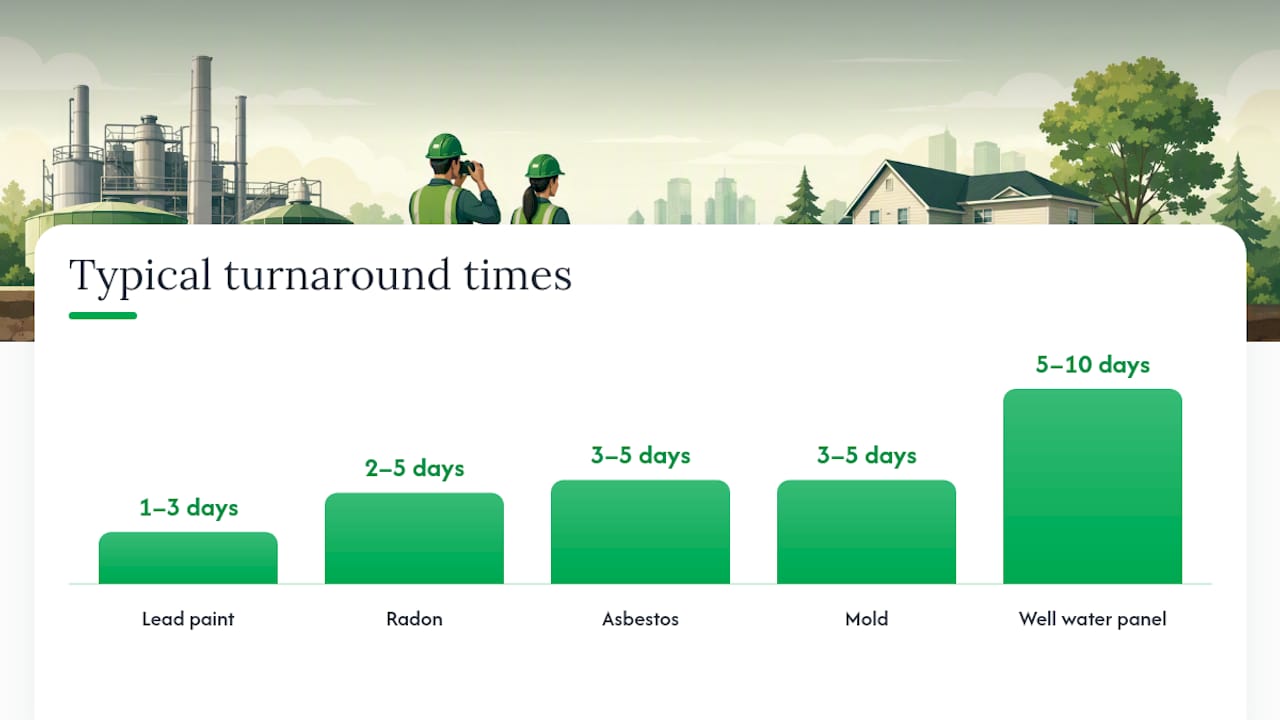
| Radon | Charcoal canister or continuous monitor | 2–5 days | pCi/L |
| Lead paint | XRF scan or dust wipe | 1–3 days | mg/cm² or µg/ft² |
| Lead soil/water | Lab digestion (EPA 3050/3051) | 5–10 business days | µg/L or mg/kg |
| Asbestos | Bulk sample, PLM analysis | 3–5 days | % chrysotile/amosite |
| Mold | Air or surface sample | 3–5 days | spores/m³ or colony count |
| Well water panel | Collected sample, lab analysis | 5–10 days | mg/L, CFU/100mL |
What do environmental tests cost, and how long do they take?
Costs vary by region and scope, but these ranges reflect typical U.S. residential transactions:
| Test | Typical Cost Range | Turnaround |
|---|---|---|
| Radon (short-term) | $100 | 2–5 days |
| Lead inspection (XRF) | $300–$600 | 1–3 days |
| Lead risk assessment | $400–$800 | 3–5 days |
| Asbestos sampling (per sample) | $25 per sample plus lab fees | 3–5 days |
| Mold air sampling | $300–$600 | 3–5 days |
| Basic well water panel | $100–$300 | 5–10 business days |
| Full metals/PFAS water panel | $300–$700 | at least 10 business days |
Reports from accredited labs include sample location maps, chain-of-custody documentation, numeric results with detection limits, lab accreditation numbers, and recommended next steps. A good report is self-contained — a lender, attorney, or future buyer should be able to read it without calling the tester for clarification.
Who pays is negotiable. Buyers typically pay for tests ordered during the contingency period. If results are elevated, remediation costs are negotiated separately. Some sellers pre-test before listing to remove uncertainty and speed up closing.
How do you choose a qualified inspector or testing service?
Choose state-certified professionals for radon and lead work. For radon, look for certification through NRPP (National Radon Proficiency Program) or NRSB (National Radon Safety Board). For lead, the tester must be certified under an EPA-authorized state program. Labs should carry NELAP (National Environmental Laboratory Accreditation Program) accreditation. Home inspectors operating under ASHI or InterNACHI standards are a solid baseline for the visual inspection, but environmental add-ons require separate credentials.
Questions to ask before hiring:
- Are you state-certified for radon/lead testing in this jurisdiction?
- Which lab do you use, and is it NELAP-accredited?
- Can you provide a sample report and chain-of-custody documentation?
- What is your turnaround time from sample collection to written report?
- Have you conducted environmental testing for real-estate transactions specifically?
- Will results be delivered in writing, with lab accreditation numbers included?
Red flags: verbal-only results, no lab accreditation documentation, pricing significantly below market without a credential explanation, and refusal to provide references or sample reports.
Choosing a tester who has real-estate transaction experience specifically matters more than most buyers realize. A tester unfamiliar with closed-house protocols, contingency deadlines, or lender documentation requirements can produce a technically valid result that still derails a closing.
Pro Tip: For radon tests during a real-estate transaction, request tamper-evident short-term devices and document the placement and retrieval with photos and timestamps. This protects both buyer and seller if results are disputed.
You can also review inspection company selection criteria before making a hiring decision.
How Jhunthomeinspections handles environmental hazard inspections
Jhunthomeinspections (Hunt Home Inspection, LLC) covers the full environmental testing workflow for buyers and sellers in the St. Louis Metro area and Southern Illinois: scheduling, on-site sampling, lab coordination, and written report delivery within 24 hours.
What the service includes:
- Radon testing, lead testing, water testing, asbestos sampling, and mold inspection as add-ons to standard buyer or seller inspections
- Reports delivered within 24 hours of sample collection, formatted for lender and agent use
- The Create Request List™ tool, which lets buyers and agents convert report findings directly into repair or remediation requests without a separate document
- Video inspection options for remote buyers or investors who cannot attend in person
- Payment-at-close options to align inspection costs with transaction timing
A typical environmental inspection timeline with Jhunthomeinspections:
- Day 0: Schedule inspection and environmental add-ons; confirm closed-house protocol for radon.
- Day 1: On-site sampling and device placement; samples shipped to accredited lab.
- Day 1–2: Written report delivered with numeric results, lab documentation, and recommended next steps.
The inspection services page lists current add-on options and scheduling availability for the St. Louis Metro area and Southern Illinois.
What to do when environmental test results are elevated
The right response depends on the hazard, but act before the contingency expires.
- Radon at or above 4 pCi/L: Hire a state-certified radon mitigator to install a sub-slab depressurization system. Radon mitigation services typically bring levels well below the action threshold. After installation, an independent tester (not the same contractor) should perform a post-mitigation confirmation test.
- Lead: Hire an EPA-certified lead abatement contractor for removal, or negotiate encapsulation with a certified renovator. Re-test with dust wipe samples after work is complete.
- Asbestos: Licensed asbestos abatement contractors handle removal. Intact, non-friable materials may be encapsulated and left in place with a management plan.
- Mold: Eliminate the moisture source first. Remediation without fixing the source is a temporary fix. A CIH can scope the work and verify clearance.
- Contaminated water: Point-of-use filtration (reverse osmosis for lead, activated carbon for PFAS) addresses exposure while a longer-term solution is evaluated.
- Soil contamination: Remediation options range from excavation and replacement to institutional controls (deed restrictions on land use). Costs vary widely by contamination type and depth.
Pro Tip: When negotiating after elevated results, ask for a holdback or escrow rather than a price credit. A credit gives you money; a holdback gives you leverage to confirm the work is actually done before funds are released.
What buyers and agents most often get wrong about environmental inspections
The most common mistake is treating a standard home inspection as a substitute for environmental testing. It is not, and the gap between the two can be expensive.
- Scope confusion: Buyers assume the home inspector will flag radon or lead. Standard inspections are visual and explicitly exclude environmental sampling.
- Late scheduling: Ordering tests after the standard inspection report comes back eats into the contingency window. Lab results for water or soil can take 10 business days.
- Screening vs. risk assessment: A positive DIY lead swab tells you lead is present. It does not tell you the concentration, location, or exposure risk. That distinction matters in negotiations.
- Under-budgeting remediation: Buyers budget for the test but not the fix. Radon mitigation generally costs several hundred to a few thousand dollars depending on system and home. Lead abatement on a whole house can reach five figures.
- Skipping credential verification: Not every tester advertising “environmental inspection” holds state certification. An uncertified result may not satisfy a lender or hold up in a post-closing dispute.
One corrective behavior agents can adopt immediately: build environmental test scheduling into the standard inspection coordination call, not as an afterthought.
Primary sources and where to find authoritative guidance
- EPA Citizen’s Guide to Radon: Covers action levels (4 pCi/L), testing methods, and real-estate transaction protocols including closed-house requirements.
- EPA Lead Disclosure Rule: Full text of seller disclosure obligations, the 10-day inspection window, and required pamphlet distribution.
- CFR §745.113: Regulatory text for the Lead Warning Statement, recordkeeping duties, and buyer inspection rights.
- ASHI Standard of Practice (2026): Defines the scope and limits of a standard home inspection, including explicit exclusions for environmental testing.
- ProtectMyZip Homebuyer Environmental Risk Checklist: Address-level screening for flood zones, EPA-regulated facilities, and water-supply context to prioritize which tests to order.
Jhunthomeinspections: environmental testing built into your transaction
If you are buying or selling in the St. Louis Metro area or Southern Illinois and need environmental test results before your contingency expires, Jhunthomeinspections delivers. Reports come back within 24 hours, the Create Request List™ converts findings directly into repair requests, and payment-at-close options mean you are not out of pocket before the deal is done.
Jhunthomeinspections covers radon, lead, water, asbestos, and mold testing alongside the standard inspection, so you are not coordinating three separate vendors during an already compressed timeline. Video inspection options are available for remote buyers and investors. To see the full list of environmental add-ons and check scheduling availability, visit the inspection services page and book directly online.
This article is general information, not a substitute for advice from a qualified doctor. Consult a qualified healthcare professional about your own circumstances before acting on anything here.
Sources
- A Citizen’s Guide to Radon — EPA (real-estate guidance excerpt)
- Real estate disclosures about potential lead hazards — EPA
- CFR Title 40 §745.113 — Certification and acknowledgment of disclosure
- ASHI Standard of Practice for the Home Inspection Profession (2026)
- Homebuyer environmental risk checklist — ProtectMyZip
Recent Comments