

The rule is simple: a finding is critical if it threatens safety, points to active system failure, or could block financing or insurance; everything else that’s cosmetic, routine maintenance, or a “keep an eye on it” note is optional. That one distinction should drive every decision you make in the first hour after your report lands.
Read your report in this order, before anything else:
- Structural issues (foundation cracks, sagging framing)
- Active water intrusion (roof leaks, basement seepage)
- Major electrical hazards (double-tapped breakers, exposed wiring)
- Active gas leaks or unvented combustion appliances
- Sewage backflow or failed sewer laterals
- Missing smoke detectors, carbon monoxide alarms, or GFCI protection
Buyers who focus repair requests on their top 3 to 5 highest-severity items consistently get further with sellers than those who submit a ten-page wish list.
Triage the report in three moves. First, confirm which safety items are real and current, not historical or already-repaired. Second, pull rough cost estimates for anything big-ticket, since dollar figures win negotiations faster than adjectives do. Third, sort what’s left into repair, credit, or monitor buckets using the decision rules below.
Key Takeaways
Critical inspection items threaten safety, financing, or major systems, while optional items are cosmetic, routine, or scheduled for monitoring, and a decision log converts that distinction into a negotiation strategy.
| Point | Details |
|---|---|
| Safety comes first | Structural, electrical, gas, and sewage hazards get addressed before any cosmetic item is discussed. |
| Learn the report language | “Monitor” means watch periodically; “further evaluation recommended” means call a specialist before closing. |
| Focus your request | Leading with 3 to 5 high-severity items gets better seller responses than a long, unfocused list. |
| Get real estimates | Contractor bids need line-item pricing, licensure proof, and a signed quote before they support a negotiation. |
| Use a decision log | Hunt Home Inspection’s Create Request List™ assigns an owner, evidence, and action to each finding within 24 hours. |
Table of Contents
- How to Identify Critical vs Optional Inspection Items From Report Language
- Which Inspection Items Are Critical by Home System?
- How Should You Decide Between Repair, Credit, or Walking Away?
- When Do You Need a Specialist Instead of a Contractor Estimate?
- What One Inspector’s First Pass Through a Report Looks Like
- How Hunt Home Inspection Turns Findings Into Negotiation Leverage
- Where to Verify Inspection Standards and Terminology
- Sources
How to Identify Critical vs Optional Inspection Items From Report Language
Inspectors don’t grade findings on a pass/fail scale. They use specific terminology, and misreading it is how buyers either panic over nothing or ignore something that actually matters.
A material defect, per InterNACHI, is an observed condition that poses an unreasonable risk to occupants or could significantly hurt the home’s value. Age or wear alone doesn’t qualify. InterNACHI is explicit that inspectors shouldn’t blur the line between minor defects and material ones, because that confusion is exactly what causes buyers to either over-negotiate or miss real risk.
Other terms carry their own weight:
- Safety hazard means immediate risk, not eventual risk.
- Monitor means watch it on a schedule, not ignore it.
- Further evaluation recommended means call a specialist before closing, not after.
- Not inspected flags a gap in coverage, not a clean bill of health.
- Marginal sits between fine and failing, and usually warrants a follow-up look rather than a repair check.
Inspectors distinguish these categories precisely because “monitor” should trigger a recheck every six to twelve months, not an immediate repair demand — treating every note as urgent burns your negotiating leverage on things that don’t deserve it.
Remember, too, that a general inspection is visual and non-invasive. The InterNACHI Standards of Practice limit inspectors to accessible areas, meaning a clean report on a hidden pipe or a sealed crawlspace section isn’t a guarantee, just a scope limit.
A material defect is a condition that, in the inspector’s professional judgment, significantly affects the property’s value or poses an unreasonable risk to people. Proximity to the end of a component’s useful life does not, by itself, meet that bar.
Which Inspection Items Are Critical by Home System?
Every system throws off both real dealbreakers and forgettable footnotes. Here’s what separates the two, system by system.
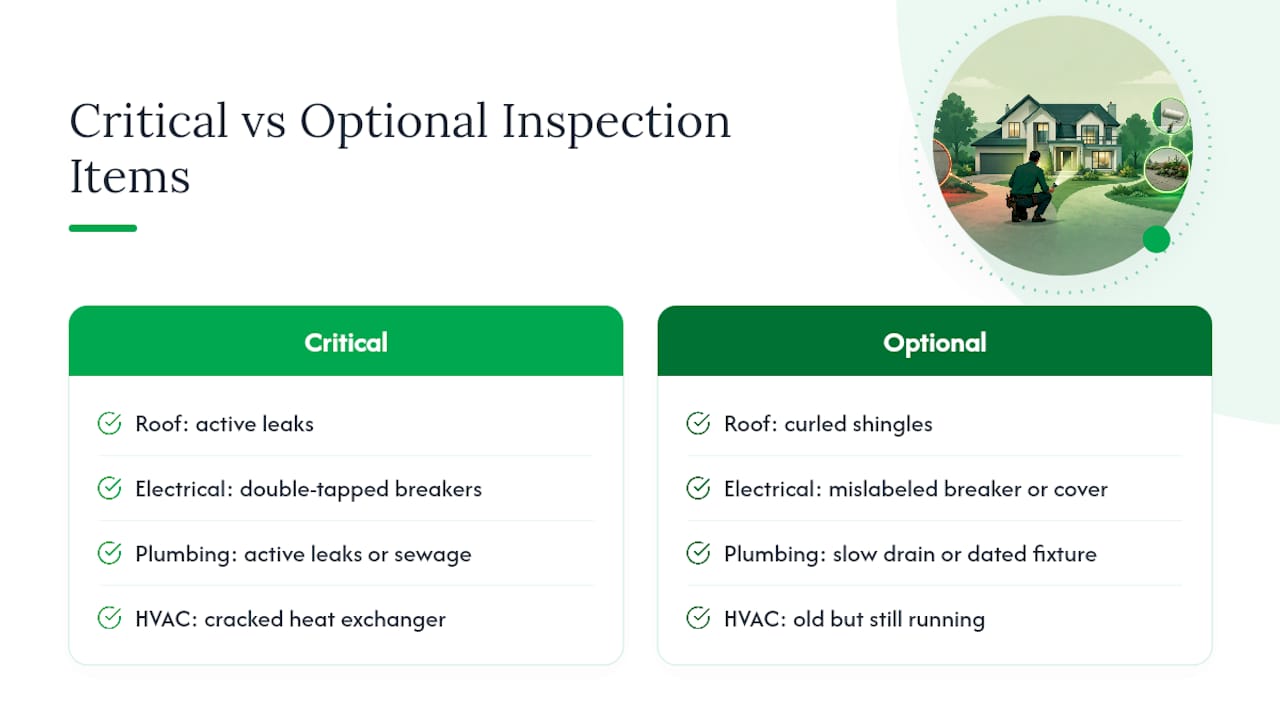
Roof. Critical: active leaks, structural sagging, or exposed decking near the end of shingle life. Optional: a few curled shingles on an otherwise sound roof with years left. Major roof failure often runs $5,000 to $30,000 or more to correct, squarely in dealbreaker territory.
Electrical. Critical: double-tapped breakers, federal Pacific or Zinsco panels, exposed live wiring, missing GFCI near water sources. Optional: a single mislabeled breaker or an outdated but functional cover plate. Multiple electrical defects clustered in one panel is a pattern worth escalating, not a coincidence worth shrugging off. A licensed electrician’s defect rectification typically documents exactly this kind of panel-level risk with photos and code citations.

Plumbing. Critical: active leaks, sewage backup, or corroded supply lines. Optional: a slow-draining sink or a dated but working fixture. Significant plumbing repairs generally land between $1,000 and $10,000, negotiable with a solid contractor estimate.
HVAC. Critical: a cracked heat exchanger or a furnace that’s inoperable. Optional: a system nearing end of life but still running fine. Age alone doesn’t make a unit a material defect.
Foundation and structure. Critical: active settling, wide diagonal cracks, or bowing walls. Optional: hairline shrinkage cracks common in poured concrete. Foundation collapse sits at the top of the cost scale, easily exceeding $30,000.
Moisture and sewer. Critical: a failed sewer lateral, standing water in a crawlspace, or mold tied to an active leak. Optional: minor efflorescence with no moisture source identified.
Safety devices. Critical: missing smoke or carbon monoxide alarms, blocked egress windows. Optional: an alarm that’s present but slightly out of date.
Pro Tip: When you see three or more small issues clustered around one component, like a panel, a bathroom, or a roof section, treat it as one system-level concern instead of three cosmetic notes. Clusters usually point to a root cause an isolated flaw doesn’t.
How Should You Decide Between Repair, Credit, or Walking Away?
Every finding eventually needs an owner and a decision, not just a description. Building a decision log before drafting any repair request forces that discipline instead of letting the loudest item in the report drive the whole negotiation.
| Field | What to record |
|---|---|
| Category | System affected and inspector’s severity label |
| Evidence | Report page, photo number, or inspector’s exact wording |
| Severity | Safety, significant, monitor, or informational |
| Owner | Who follows up (buyer, agent, seller, specialist) |
| Recommended action | Repair, credit, price adjustment, decline, or escalate |
| Financial range | Contractor estimate or ballpark cost |
| Timing risk | Can it wait past closing, or does it need action now |
A few rules keep this from turning into guesswork:
- Safety items go first, every time, regardless of dollar amount.
- Big-ticket items need a contractor estimate before you name a number.
- Push for a credit instead of a repair when timing is tight or you don’t trust the seller’s contractor to do quality work before close.
- Decline requests on cosmetic items or anything already disclosed upfront.
- Escalate to a specialist or your agent when the inspector’s language says “further evaluation recommended.”
Pro Tip: Lead your request with the three to five items that carry the most safety or financial weight. A tight, well-documented list gets a faster and more favorable seller response than a comprehensive one that buries the real issues.
When Do You Need a Specialist Instead of a Contractor Estimate?
Some findings are outside a general inspector’s scope by design, and pushing forward without a specialist’s sign-off leaves you negotiating with incomplete information. Order a structural engineer for foundation movement or framing concerns, a licensed electrician for panel or wiring hazards, an HVAC technician for a suspected cracked heat exchanger, a plumber for recurring leaks, and a sewer camera scope whenever the report notes slow drains or an aging lateral line.
A usable bid needs to include:
- A clear, written scope of the work
- Line-item pricing, not a lump-sum guess
- A realistic timeline for completion
- Warranty terms on labor and materials
- Proof of licensing and insurance, plus a signed quote or invoice
Order specialists during your inspection contingency window, not after, so their findings can still shape your repair request or credit ask. Lenders and insurers sometimes require proof of correction on safety items before closing, which makes an early specialist report worth more than a late one.
What One Inspector’s First Pass Through a Report Looks Like
Opening a fresh report, the first scan is always for safety and active failure, never cosmetics. Photos get cross-referenced against report language immediately, since a vague note paired with a clear photo tells a very different story than either alone.
From there, findings go into a simple decision log, similar to what our Create Request List™ tool builds automatically, assigning an owner, a deadline, and a proof standard to each item before anyone drafts a request. Quote specialists by name when the report calls for one. Clear communication with agents beats a longer report every time.
How Hunt Home Inspection Turns Findings Into Negotiation Leverage
Jhunthomeinspections is the difference between staring at a 40-page PDF alone and having a clear, prioritized action list within a day. Every inspection comes with a report delivered within 24 hours, video or in-person walkthrough options, and access to a specialist referral network for structural, electrical, or sewer follow-ups when a finding needs more than a visual check.

The Create Request List™ tool takes report findings and converts them directly into negotiation-ready items, so you’re not manually building a decision log from scratch. Every inspection follows InterNACHI and ASHI standards, giving buyers, sellers, and agents in the St. Louis Metro area and Southern Illinois a report they can actually act on, not just read. If you’re heading into a contingency period and need findings turned into a clear repair strategy fast, schedule an inspection and get your report, photos, and prioritized list within 24 hours.
Where to Verify Inspection Standards and Terminology
- InterNACHI’s material defect guidance for definitions and over-reporting cautions
- ASHI Standards of Practice for required scope and exclusions
- Inspection report terminology guide for interpreting report language
- Hunt Home Inspection’s report walkthrough for local scheduling and report format
Sources
- Material Defects Defined for Home Inspectors – InterNACHI®
- Home Inspection Red Flags: A Buyer’s Guide to Critical vs. Cosmetic Issues | EffectiveAgents®
- Inspection Repair Decision Logs for AI Negotiation
- Home Inspection Report Terminology Explained — InspectionTriage
Recent Comments