
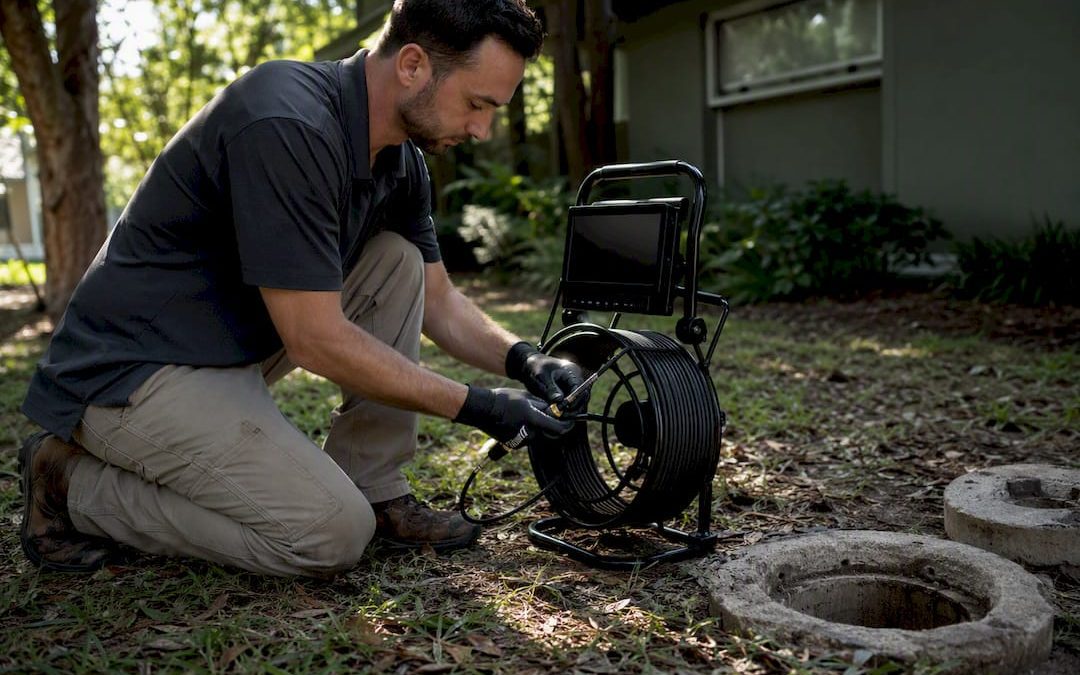
Most homeowners pay a few hundred dollars for a residential sewer camera inspection, though the price varies significantly depending on how easily the plumber can access your line. Jobs with an existing cleanout stay cheap. Jobs that require pulling a toilet or cutting in a new access point can push the total well past $1,500. Ask any provider upfront how they’ll access the line and what your written quote actually includes before you compare prices.
TL;DR:
- Access type significantly impacts the cost, with existing cleanouts costing as little as $100, while installing new access can exceed $1,500.
- Per-foot pricing applies mainly to long or complex pipe runs, making estimates difficult without knowing the total footage beforehand.
- A thorough sewer inspection should include recorded video, a detailed written report, and timestamped images of any issues for negotiation leverage.
- Basic inspections typically cost between $271 and $1,726, but more complex jobs with no access can reach up to $6,000 or more.
- Including documentation with the inspection maximizes value, as recorded footage and reports aid in negotiating repairs and verifying line condition.
Table of Contents
- How much does a sewer camera inspection cost by tier?
- What actually drives sewer scope inspection pricing?
- Real-world access scenarios and what they cost
- What should a sewer inspection report actually include?
- Is a sewer camera inspection worth the cost?
- How to choose a sewer scope provider without overpaying
- Why documentation changes the whole conversation
- Ready to add a sewer scope to your inspection?
- Sources
How much does a sewer camera inspection cost by tier?
Sewer scope pricing breaks into a few clear bands, and knowing which one applies to your house tells you a lot about what you’re actually paying for. Angi’s cost data puts the national average around $996, with a typical range of $271 to $1,726. That spread isn’t random. It tracks directly with access difficulty and how much labor the job requires beyond just running the camera.
- Bundled add-on ($100 to $300): Added to a home inspection that’s already scheduled, with an existing cleanout and easy access.
- Standard cleanout scope ($250 to $500): A straightforward camera run through a cleanout that’s already installed, according to Rocket Mortgage.
- Toilet-entry inspection ($400 to $900): Requires pulling and resetting a toilet to reach the line, which adds real labor time.
- New cleanout or complex diagnostics ($1,000 to $6,000+): Involves cutting into the pipe, installing access hardware, or scoping unusually long or commercial-length runs, per Balkan Plumbing’s estimates.
Here’s the number that puts all of this in perspective: the average sewer repair costs around $2,556, according to Rocket Mortgage. Even the priciest inspection tier is a fraction of what a collapsed or root-choked line costs to fix.
What actually drives sewer scope inspection pricing?
Access is the single biggest lever, but it’s not the only one. Once you understand the line items, a quote stops looking like a mystery number and starts looking like a checklist.
Access type sets the floor. With an existing cleanout, ibuyer’s pricing breakdown shows a scope can run $100 to $300. No cleanout means the technician enters through a toilet, adding roughly $50 to $175 in labor for removal and reinstallation. No usable entry point at all means installing a new cleanout, which tacks on $500 to $1,500 or more, largely because it requires cutting the pipe and weatherproofing the new access point.
Pricing model matters too. Most residential jobs are priced per visit as a flat fee, but some contractors charge based on the length of the pipe inspected rather than a flat fee, with per-foot rates varying widely. HomeAdvisor notes that line length and access difficulty are the two variables that swing the final number most. Per-foot pricing shows up mainly on long residential runs or commercial jobs. Be cautious of a per-foot quote that doesn’t specify whether reporting and locating are included.
Camera technology adds its own premium:
- Standard push cameras: baseline pricing, adequate for straightforward diagnostic runs.
- HD cameras: sharper image quality, useful for spotting hairline cracks or root intrusion.
- Pan-and-tilt cameras: can rotate to inspect lateral connections and joints, typically the priciest option.
Common add-ons stack on top of the base price. Recording the footage and hydro-jetting to clear debris before scoping commonly add $150 to $800 combined, per Angi’s data.
Real-world access scenarios and what they cost
Numbers on a chart only mean so much until you match them to your actual house. Here’s how the three most common access situations typically play out.
- Existing cleanout, easy access. The technician locates the cleanout, feeds the camera in, and records the run. Expect $100 to $500 total, and often under an hour on site.
- Toilet-entry access. No cleanout near the affected line means the crew removes a toilet, feeds the camera through the drain, then resets the toilet with a new wax ring. That extra labor typically pushes the total to $400 to $900.
- New cleanout installation. If there’s no workable entry point anywhere on the line, the plumber cuts into the pipe, installs a two-way cleanout fitting, and weatherproofs it before scoping. This is where totals jump to $1,000 to $2,500, and sometimes higher on older homes with unusual pipe layouts.
Inspections involving long pipe runs, commercial properties, or multiple branches are more likely to be priced per foot rather than a flat fee. If your quote mentions per-foot billing, ask for an estimated total footage upfront so you’re not guessing at the final invoice.
What should a sewer inspection report actually include?
A cheap quote that skips documentation isn’t actually cheap. It’s incomplete. A proper sewer scope inspection should hand you something you can use, not just a verbal “looks fine.”
- Full recorded video of the camera run, not just a live viewing
- A written report noting pipe material, condition, and any defects found
- Timestamped still images of problem areas (root intrusion, bellies, joint separation)
- Location notes marking where issues sit relative to the house or property line
Timestamped footage and photos carry real weight in a purchase negotiation. If a scope reveals root intrusion 12 feet from the foundation, that’s a concrete repair estimate you can bring to the seller, not a vague concern.
Add-ons worth knowing about: locating and marking (pinpointing the exact underground path), hydro-jetting to clear blockages before a clean scope, full pipe mapping for larger properties, and emergency or after-hours fees if you need same-day service.
Pro Tip: Always ask whether the recording is yours to keep permanently. Some providers only offer a live walkthrough and won’t hand over footage after the appointment, which leaves you with nothing to show an agent or seller later.
Is a sewer camera inspection worth the cost?
For most buyers, yes, and the math isn’t close. A scope costs a few hundred dollars in the majority of cases, while sewer line repairs average around $2,556 and full replacements can run several times higher depending on excavation needs. A scope is close to essential on homes built before the 1980s, houses with mature trees near the main line, or any property with a history of slow drains or backups. It’s more optional, though still smart, on newer construction with modern PVC piping and no drainage complaints. Recorded findings also give buyers real leverage: a documented crack or offset joint is something you can negotiate a credit for before closing, not after.
How to choose a sewer scope provider without overpaying
A fair quote and a useless quote can carry the same price tag. The difference is in what you ask before booking.
- Confirm access type upfront: existing cleanout, toilet entry, or new installation, since that alone can double your cost.
- Ask specifically whether recorded video and a written report are included, not just a live walkthrough.
- Find out the pricing model: flat per-visit fee or per-foot, and get an estimated total either way.
- Request a rough repair estimate if defects are found, so you have a number to work with immediately.
- Get two or three quotes when the timeline allows. Bundling the scope into a home inspection you’re already scheduling often lowers the marginal cost since the technician is already on site.
Red flags worth walking away from: a quote with no mention of documentation, a price that seems unusually low with no explanation of access assumptions, or a provider who can’t say how long the appointment will take. For general context on defect inspections during a home purchase, Monarch Carpenters’ buyer guide covers what thorough documentation should look like across inspection types.
Why documentation changes the whole conversation
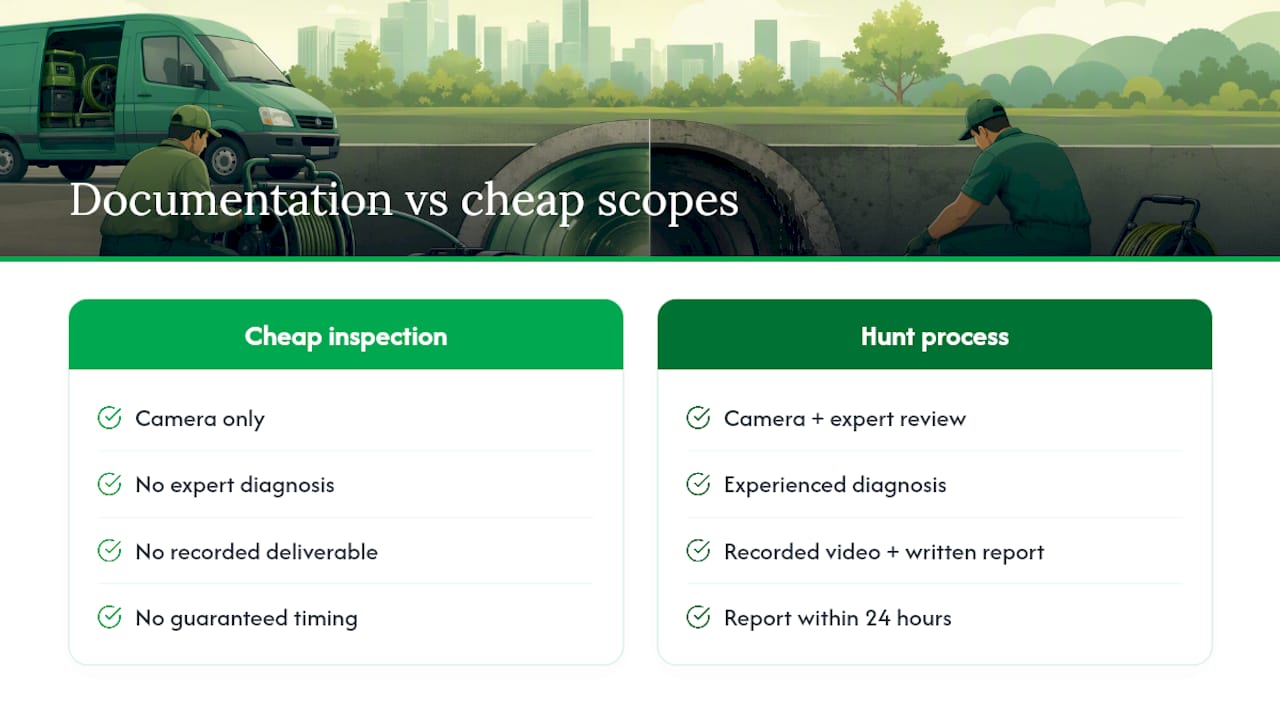
A sewer scope is only as useful as what you can do with the findings afterward, and that’s where a lot of cheap inspections fall short. Anyone can run a camera down a pipe. Diagnosing what’s actually on the screen, a hairline crack versus a normal joint, a minor root hair versus active intrusion, takes someone who’s looked at hundreds of these lines before.
That’s the gap Hunt Home Inspection built its process around. Every sewer scope comes with recorded video and a full written report delivered within 24 hours, so buyers have something concrete to bring into negotiations rather than a technician’s verbal summary. The Create Request List™ tool then turns those findings into a clear list agents and sellers can actually act on. For clients who can’t be on site, video inspection options mean nobody has to choose between documentation quality and scheduling convenience.
— JOHN
Ready to add a sewer scope to your inspection?
If you’re buying or selling in the St. Louis Metro area or Southern Illinois, Hunt Home Inspection can add a sewer camera inspection directly onto your existing home inspection appointment, which is often the cheapest way to get one done since the crew is already on site. That’s the real advantage here: no separate appointment, no second travel fee, no waiting on a second contractor to schedule you in.
Every scope comes with full recorded video and a written report back in your inbox within 24 hours, giving you the documentation you need whether you’re negotiating repairs or just confirming a clean line before closing. Hunt Home Inspection also works with first-time buyers, veterans, and low-income families navigating financing timelines, so scheduling flexibility isn’t an afterthought. Visit the inspection services page to see current packages and request a quote for your address today.
Sources
- How Much Does a Sewer Line Camera Inspection Cost? 2026 Data | Angi
- How Much Does It Cost to Inspect a Sewer Line With a Camera? 2025 Data
- What is a sewer scope inspection? | Rocket Mortgage
- Sewer Line Inspection Cost: 2026 Breakdown
Recent Comments