
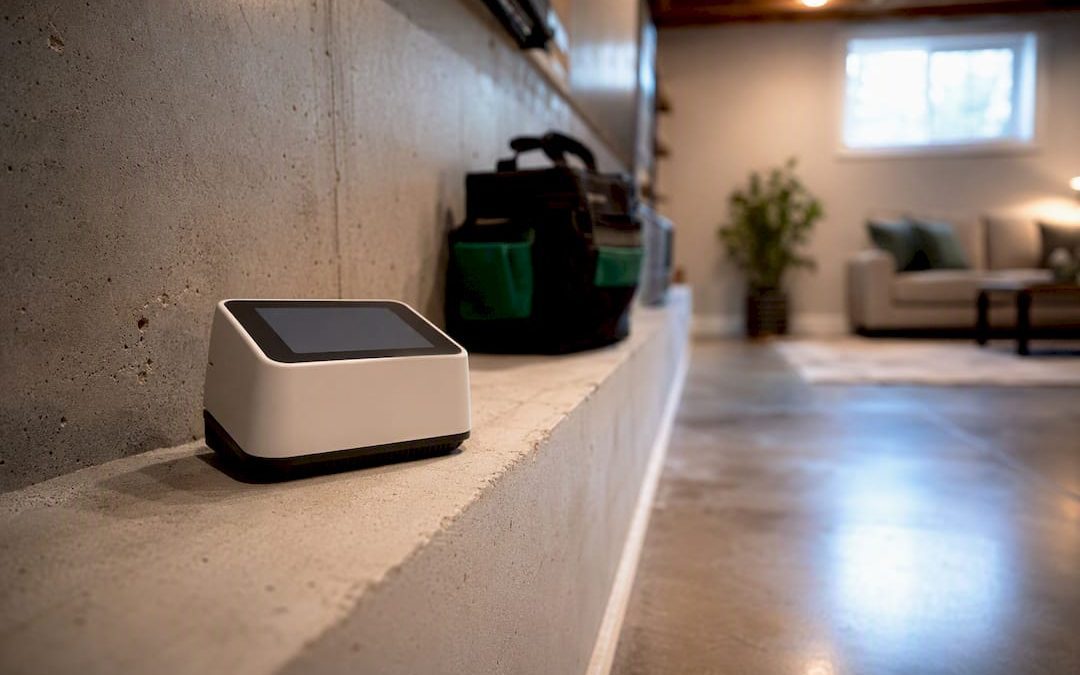
A basic short-term radon kit runs about $15 to $30, a long-term alpha-track kit costs $20 to $60, and a professional continuous radon monitor test from an inspector typically lands between $150 and $300, often discounted when bundled with a home inspection. Use a short-term kit for a quick screening, a professional test for closings or documentation, and a plug-in digital detector for ongoing monitoring. The number that matters most is 4 pCi/L, the EPA’s action level for fixing the problem.
TL;DR:
- Short-term radon kits priced between $15 and $30 are suitable for quick screening, but may incur additional costs if lab fees or postage are not included.
- Professional continuous radon monitors cost $150 to $300 and provide detailed hourly data, tamper alerts, and are essential during real estate closings or mitigation verification.
- Multiple test points, larger or multi-foundation homes, and high radon zones increase testing costs, while bundling with general inspections can reduce overall expenses.
- Radon testing at closing requires a sealed-house test lasting at least 48 hours, with costs often negotiated between buyers and sellers, and DIY kits are typically not accepted.
- Fixing radon levels above 4 pCi/L usually costs $800 to $2,500, with recommendations to get multiple quotes and verify that mitigation systems are correctly installed and retested afterward.
Table of Contents
- Radon Testing Cost Breakdown: Kits, Detectors, and What You’re Really Paying For
- Why Professional CRM Testing Costs More, and When It’s Worth It
- What Actually Drives the Price of a Radon Test
- Radon Testing During a Real Estate Closing: Why It Costs More and Who Pays
- Your Radon Level Came Back High. Here’s What Mitigation Actually Costs
- How Hunt Home Inspection Handles Radon Testing for St. Louis and Southern Illinois Buyers
- The Real Trade-Off Nobody Explains Well
- Ready to Schedule a Radon Test With Your Next Inspection?
- Where to Verify Radon Facts and Find Local Help
- Sources
Radon Testing Cost Breakdown: Kits, Detectors, and What You’re Really Paying For
The price tag on a radon test tells you almost nothing until you know what’s bundled in. A $15 kit that requires you to mail a sample and pay a separate lab fee can end up costing more than a $25 kit that includes everything.
Here’s how the main options break down:
- Short-term charcoal kits ($15 to $30): These sit in your home for 2 to 7 days and are the fastest, cheapest way to get a baseline reading. Many prices already include lab analysis, but not all, so check what’s covered before you buy.
- Long-term alpha-track kits: These tests last several months up to a year and provide a more reliable average over time, accounting for seasonal and environmental variations.
- Consumer digital detectors ($150 to $400): These are one-time purchases that pair with an app and show rolling averages over months or years. Homeowners who plan on repeated testing or live somewhere with inconsistent readings tend to get the most value out of owning one outright.
Before you check out, confirm three things: whether lab analysis is included, whether return postage is prepaid, and how fast the lab turns around results. Skip any of those and your “$15 test” can quietly become a $40 test.
Why Professional CRM Testing Costs More, and When It’s Worth It
A professional continuous radon monitor (CRM) test costs more than a DIY kit for a simple reason: you’re paying for a calibrated instrument, a trained technician, and a document that holds up in a real-estate transaction. Typical pricing runs $150 to $300 standalone, though bundling it with a general home inspection often brings the add-on price down. Rural markets or areas with fewer certified testers can push that number higher due to travel time.
What that price actually buys you:
- Hourly logged readings instead of a single average, which flags whether someone opened a window or ran a fan during the test.
- Tamper detection, so a seller can’t game the result by propping doors open.
- A signed, dated report suitable for lenders, title companies, and real estate contracts.
- Faster turnaround, usually 48 hours of deployment plus same-day or next-day reporting.
Professional testing earns its cost in three scenarios: closing on a home purchase, verifying a mitigation system actually worked, or resolving a DIY kit result that seems inconsistent with your gut sense of the house. When you’re vetting who does the testing, look for NRPP or NRSB certification, the two credentialing bodies for radon measurement professionals in the U.S.
What Actually Drives the Price of a Radon Test
Four factors decide whether you pay the low end or the high end of any given price range.
- Number of test points. Larger homes or homes with multiple foundation types (basement plus crawl space, for example) may need more than one test location, and each added point adds cost.
- Finished vs. unfinished space. A finished basement that’s regularly occupied needs testing there; an unfinished crawl space usually doesn’t count as a living area for placement purposes.
- Local market and radon zone. Areas with high natural radon levels tend to have more testing companies competing for business, which can lower prices, while remote areas often carry travel fees.
- Bundling. Adding radon testing onto a general home inspection almost always costs less than booking it as a standalone service, since the technician is already on-site.
When you request a quote, ask directly whether the price includes lab fees, whether rush processing costs extra, and whether the quote covers one test point or several.
Radon Testing During a Real Estate Closing: Why It Costs More and Who Pays
Selling or buying a home changes the rules of radon testing, and that changes the price. Real-estate transactions require closed-house conditions, meaning windows and exterior doors stay shut for 12 hours before and during the entire test, which limits when testing can happen and adds scheduling pressure that DIY kits don’t face.
The typical professional workflow looks like this:
- The inspector deploys a CRM device, often during the same visit as a general home inspection.
- The monitor runs for a minimum of 48 hours under closed-house conditions.
- The inspector retrieves the device and generates a report with hourly data and tamper alerts, which title companies and lenders will actually accept.
Who pays varies by contract and local custom. Buyers typically request the test and negotiate remediation costs into the purchase agreement; sellers sometimes pay upfront to speed up closing, especially when payment at closing is an option. A DIY kit is rarely accepted for this stage, since it lacks the tamper detection and chain-of-custody documentation a lender or title company expects to see.
Your Radon Level Came Back High. Here’s What Mitigation Actually Costs
About 1 in 15 U.S. homes tests at or above 4 pCi/L, the EPA’s threshold for action. Between 2 and 4 pCi/L, the agency recommends considering mitigation even though it’s not mandatory. Above 4 pCi/L, fixing the problem stops being optional.
Mitigation systems, most commonly sub-slab depressurization, typically run $800 to $2,500 depending on your foundation type, crawl space access, and how many suction points your home needs. Homes with sump pits or multiple foundation types tend toward the higher end.
- Get at least two quotes from qualified mitigation contractors, not just the company that tested you.
- Check your state radon program’s website for a list of certified installers.
- Require a post-mitigation retest, ideally with a long-term or professional test, to confirm the fix actually worked.
- Ask whether other planned repairs (foundation sealing, sump pump work) can be bundled into the same visit to save labor costs.
Pro Tip: Sealing cracks yourself might lower your number slightly, but it’s a temporary patch, not a fix. A properly installed depressurization system by a licensed professional is the only approach the EPA considers a permanent mitigation.
How Hunt Home Inspection Handles Radon Testing for St. Louis and Southern Illinois Buyers
Radon testing is one of the most requested add-ons Hunt Home Inspection, LLC handles alongside general buyer’s inspections across the St. Louis Metro area and Southern Illinois. Reports typically come back within 24 hours, whether you booked an in-person visit or a video inspection.
Bundling radon testing with a full home inspection tends to make the most financial sense for buyers heading toward closing, since you’re covering two needs in one visit instead of scheduling separate appointments. Elevated readings or unclear DIY results are the other common trigger for calling in a professional test before you commit to a purchase decision or a repair estimate.
The Real Trade-Off Nobody Explains Well
Most radon advice treats every home the same, and that’s where it goes wrong. A $20 charcoal kit is genuinely enough for a homeowner who just wants a baseline number and isn’t facing a closing deadline. Spending $200 on a professional CRM test to answer a question a $20 kit already answers is money wasted.
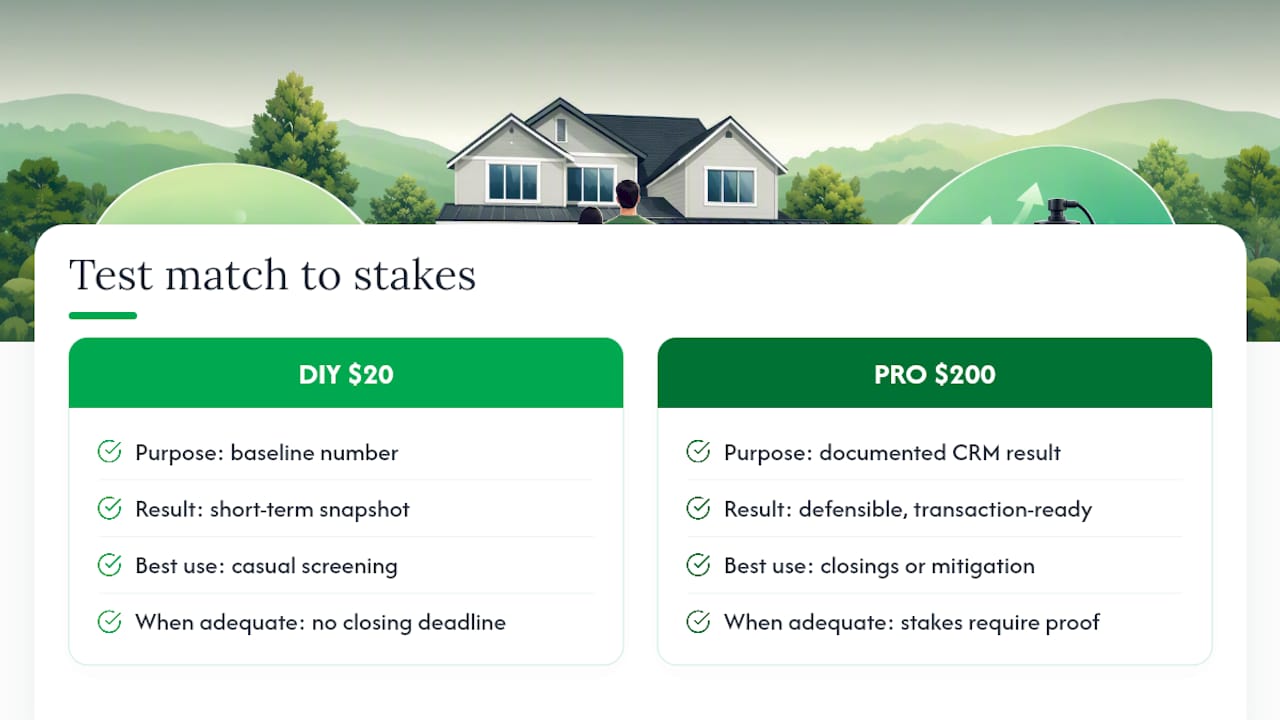
The mistake I see homeowners make in the other direction is trusting a single short-term DIY result for a transaction that hinges on it. Radon levels swing with weather, ventilation, and even which doors got left open during the test window. A short-term kit gives you a snapshot; a real estate closing needs a document, not a snapshot.
Here’s what actually matters: match the test to the stakes, not the price tag. Screening yourself costs almost nothing to get wrong. A closing, a mitigation decision, or a health concern for young kids in the house costs a lot to get wrong. Spend accordingly, and don’t let a bargain kit make a decision that deserves a documented, defensible number instead.
— JOHN
Ready to Schedule a Radon Test With Your Next Inspection?
Hunt Home Inspection gives St. Louis Metro and Southern Illinois buyers a faster path to a documented radon number than juggling a separate testing company and a separate inspector. Book radon testing alongside your buyer’s inspection and you get one scheduled visit, one 24-hour report, and one point of contact instead of chasing down two vendors on two timelines.
The radon add-on typically includes deployment and retrieval of a continuous monitor and a documented report suitable for lenders and title companies. If timing around closing is tight, ask about paying at close so the cost lines up with your transaction instead of your calendar. Visit the inspection services page to see current availability and get your radon test scheduled alongside your next inspection.
Where to Verify Radon Facts and Find Local Help
For official guidance, check the EPA’s radon action-level page and CDC’s radon health resources. State radon programs, like California’s discounted kit program, often list certified mitigators too.
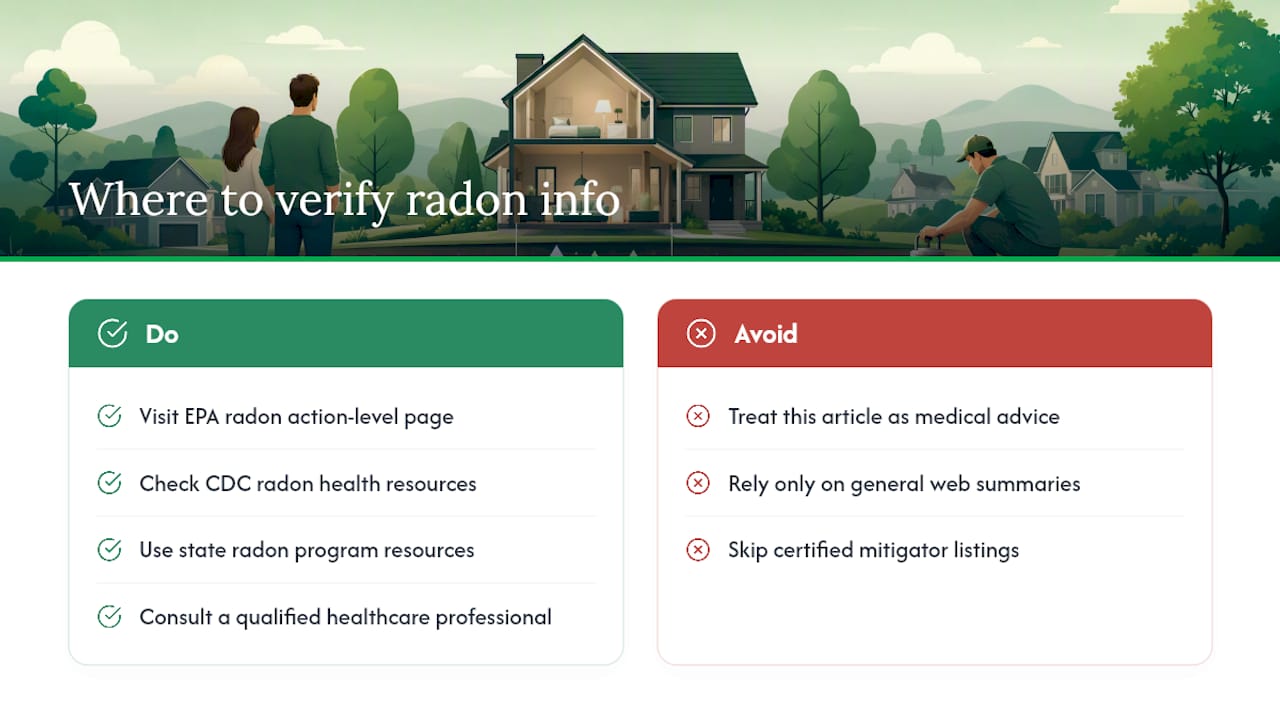
This article is general information, not a substitute for advice from a qualified doctor. Consult a qualified healthcare professional about your own circumstances before acting on anything here.
Sources
- What is EPA’s action level for radon and what does it mean? | US EPA
- Radon and Your Health | Radon | CDC
- Cost of Radon Testing: 2026 DIY and Professional Pricing Guide – InspectandTest
- Radonrn
- Testing your home for radon – CDPHE
Recent Comments