
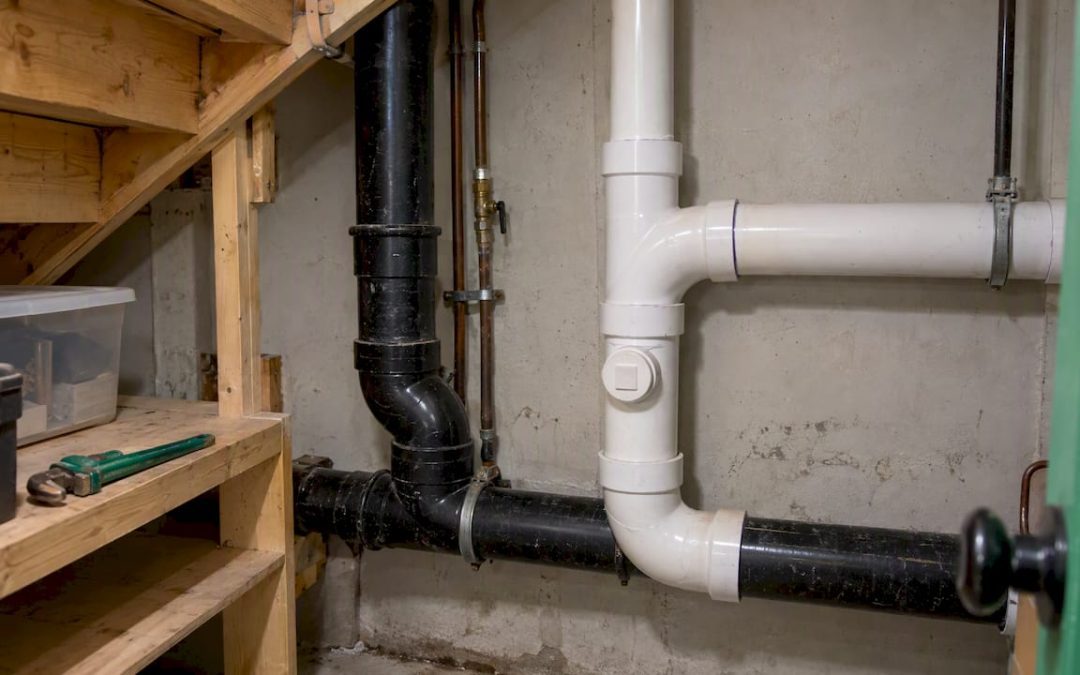
Neither one is better across the board. Both PVC and ABS are approved for residential drain, waste and vent (DWV) piping, and in normal service they perform about the same. The choice comes down to where the pipe runs, what your local code allows, and what your local supply yard stocks. The real trouble starts when the two are joined the wrong way, or when an older ABS run is hiding a defect. That is what we look for when we inspect homes in the St. Louis Metro area and Southern Illinois.
TL;DR
- Both ABS (black) and PVC (white or light gray) Schedule 40 are approved under the 2024 IRC for above-ground residential drains. Your local amendments still decide what is legal at your address.
- ABS is the usual pick for underground runs: it takes impacts well and joins in one step. PVC is quieter inside walls but needs primer and cement.
- Mixing the two with ordinary cement is a classic inspection finding. A joint that looks solid can have no chemical bond and leak out of sight.
- ABS made roughly 1985 to 1990 by certain brands is known to split along the seams. A camera scope is the way to check what is buried.
Table of Contents
- What the two pipes are
- Side by side: PVC vs ABS drain pipe
- What the code says
- Which is better where
- Cost and availability
- Mistakes that fail inspections
- Why a camera beats guessing
- Our perspective
- Get the pipes checked before you commit
- FAQ
- Sources
What the two pipes are
ABS stands for acrylonitrile butadiene styrene. PVC stands for polyvinyl chloride. Both are rigid plastics sold as DWV pipe for carrying waste water out of a house and venting the system so it drains properly. Neither is meant for pressurized supply lines in a typical home drain system.
The quickest way to tell them apart is color. ABS is solid black, while PVC is white or dark gray. Pipe labels printed on the side also name the material and the standard it meets, which matters if you are trying to identify an older run.
One thing that trips up buyers: the same house can contain both. A previous owner’s plumber may have used ABS for the main stack and PVC for a basement bathroom addition. That is legal, as long as the transition between them was made correctly.
Side by side: PVC vs ABS drain pipe
| Factor | ABS | PVC |
|---|---|---|
| Color | Black | White or light/dark gray |
| Joining | One-step ABS cement | Two steps: primer, then PVC cement |
| Impact resistance | Higher | Lower, more rigid |
| Sound dampening | Noisier | Quieter |
| Typical home | Underground runs, cold-weather installs | Indoor, above-ground runs |
| Max operating temperature | 140°F (60°C) | 140°F (60°C) |
| UV exposure | Becomes brittle, needs protection | Becomes brittle, needs protection |
The joining and sound differences come from manufacturer guidance on cellular core DWV pipe: ABS is generally preferred underground for impact resistance and a one-step cement process, while PVC is preferred indoors because it dampens the sound of running water better. The temperature figure matches Charlotte Pipe’s technical manual, which lists 140°F (60°C) as the maximum operating temperature for these DWV systems.
What the code says
The IRC lists both materials. Section P3002.1 of the 2024 IRC approves Schedule 40 PVC and Schedule 40 ABS for residential sanitary drainage. So on paper, you can build a legal drain system from either.
The catch is local amendments. Some jurisdictions prohibit ABS because it burns and drips more readily than PVC, which can matter in certain fire-rated wall and floor assemblies. Others lean toward ABS by habit. If you are planning work, call your city or county building department before buying pipe. Using a material your jurisdiction has banned means a failed inspection, even though the national model code allows it.
The code is also firm on one more point: you cannot simply glue the two together. The IPC and IRC both require an approved mechanical transition coupling or a listed transition cement when ABS meets PVC. The two plastics differ chemically and expand differently with heat.
Which is better where
Underground and under slabs
ABS is the common choice here. It is tougher against impact during backfill, and the one-step cement is forgiving in cold, wet trenches. If your home has a black drain line coming up through a slab or leaving the foundation, that is normal and not a defect.
Inside walls and finished spaces
PVC wins on noise. If a drain stack runs beside a bedroom or through a living area, the quieter plastic makes a difference. Cast iron is still the quietest option, and a common approach is to use it for the exposed pipe in living space, then switch to cheaper ABS or PVC once the pipe is hidden under the floor or behind a finished wall. If your house still has original cast iron, see our guide on why we scope cast iron drain pipes first.
Outdoors and in attics or crawl spaces
Both plastics degrade in sunlight. Both ABS and PVC need protection from direct UV, typically a thick coat of water-based latex paint, or they turn brittle and can shatter. A sun-bleached, chalky section of exposed drain or vent is worth noting on any inspection.
Hot water and heat
Drain pipe has a ceiling around 140°F, as noted above. A dishwasher or washing machine discharging into a trap is fine, but repeated very hot discharge is not what this pipe is designed for. If you want a deeper look at how heat limits play out across plastic pipe types, this explainer on PVC and CPVC temperature limits covers the hot-water side, though remember that drain-grade DWV pipe is a different product from pressure-rated pipe.
Cost and availability
People search “is ABS or PVC cheaper” and get a different answer from every forum. The honest answer is that it varies by region and by the month. Distributors stock what local contractors prefer, so the cheaper material is usually the one your supply yard carries in volume. Industry guidance is to check what the nearest yard primarily stocks, so matching fittings and repair parts are easy to find later.
There is also a labor angle. ABS skips the primer step, which speeds installation. PVC’s extra step costs a little time but gives a quieter result indoors. Neither difference is large on a single repair, so do not choose a material on price alone. Choose by location, code, and compatibility with what is already in the wall.
Mistakes that fail inspections
Joining ABS to PVC with the wrong cement
This is the one we see flagged most. Standard ABS cement works only on ABS. PVC needs its own cement, normally after a primer (often purple). Because the two plastics are chemically distinct, a joint made with plain solvent between them can look finished yet lack any real bond. Over time it can weep or fail, sending sewage into a floor cavity or wall where nobody sees it until a stain or smell appears.
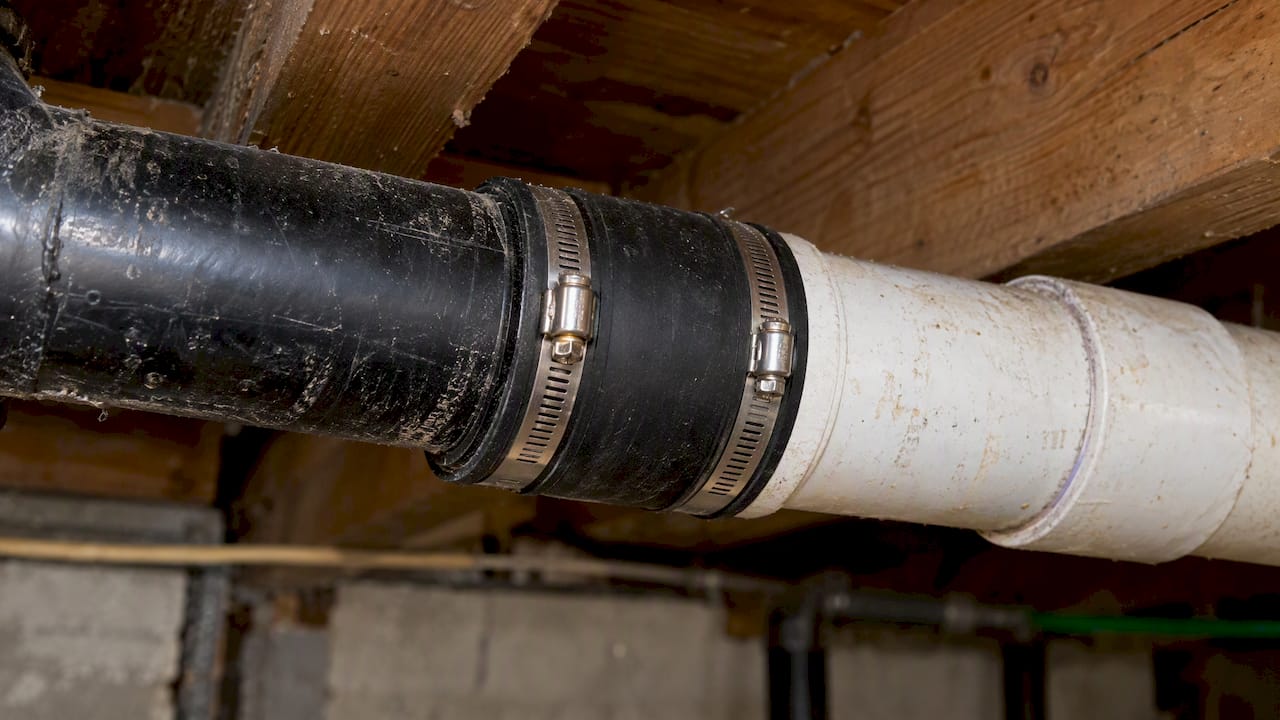
The correct fixes are a banded mechanical transition coupling (the Fernco style) or a transition cement listed for ABS-to-PVC. When you see a rubber coupling with steel bands connecting a black pipe to a white one, that is usually a sign somebody did it properly.
Ignoring the 1985 to 1990 ABS batch
ABS has been in use since the late 1950s and has a good record. The American Society of Home Inspectors notes that some ABS made between about 1985 and 1990 tends to split along its seams. Brands associated with that period include Apache, Centaur, Gable, Phoenix, Polaris and Spartan. If your home was built in that window, check the printed labels on exposed pipe. A defect like this is rare, but it can call for targeted replacement, so it is worth knowing before closing rather than after.
Skipping UV protection or support
Unpainted outdoor runs, unsupported horizontal sections and missing cleanouts show up on reports often. None is exotic. All are cheaper to fix when found early.
Why a camera beats guessing
Most of a drain system is out of sight. The visible pipe in a basement tells you little about a buried lateral running under the yard. A camera does. We cover what the process finds in our guide to sewer scope inspections for homebuyers, including belly sections, root intrusion, cracks and offset joints.
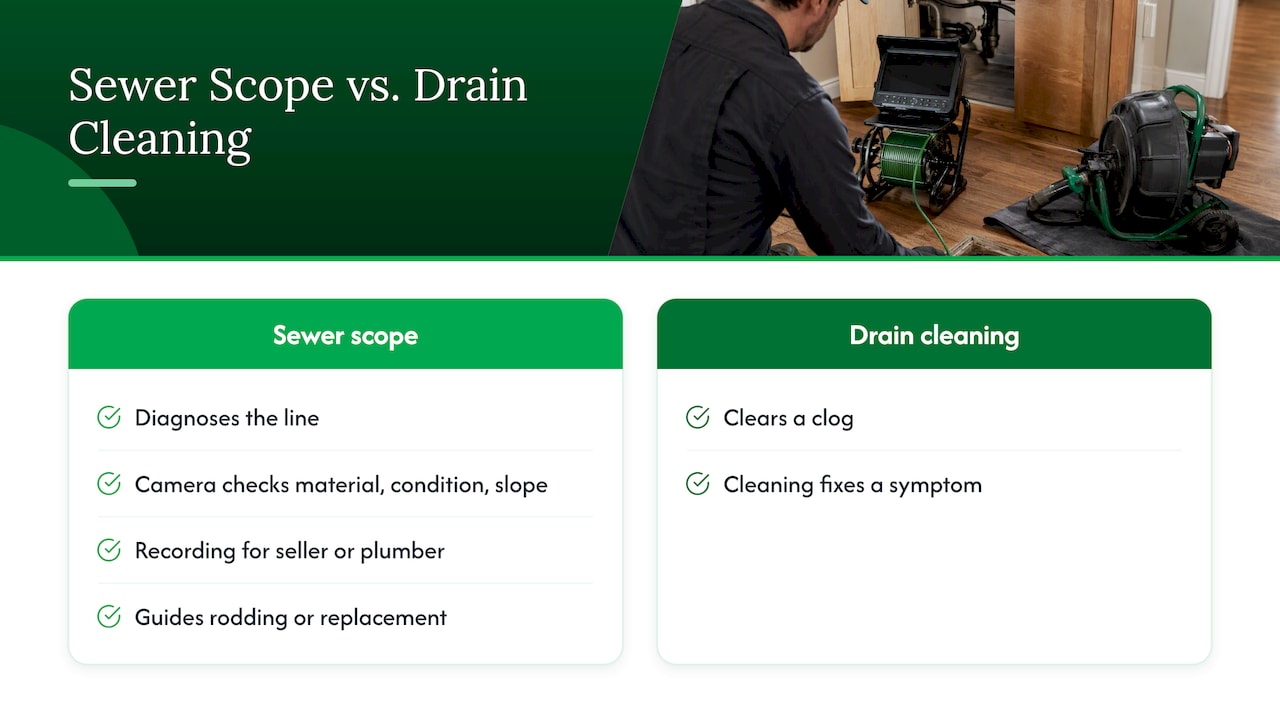
A frequent point of confusion is the difference between a sewer scope and drain cleaning. Drain cleaning clears a clog. A sewer scope is an inspection: a camera is fed down the line to see its material, condition and slope, and it gives you a recording to show a seller or plumber. Cleaning fixes a symptom. Scoping diagnoses the line. If you have recurring backups, a scope before any repair tells you whether you need a rodding or a replacement.
If you cannot find the access point, our post on sewer cleanout location explains how to locate it without digging blind. And if you notice odors near a drain, here are six fixes for sewer gas smell, including when a failed joint or dry trap might be behind it.
Our perspective
We inspect homes across the St. Louis Metro area and Southern Illinois, and we do not walk into a house hoping to find black pipe or white pipe. Both are fine when installed correctly. What matters to us is whether the material suits where it runs, whether the joints between materials are made with proper couplings, and whether the pipe is supported, protected from sun, and free of cracks.
For buyers, the practical advice is this. Do not let a seller’s remark of “it’s all plastic, it’s fine” settle the question. Plastic drain lines can still have bad transitions, poor slope or a buried defect. Ask for a sewer camera lateral inspection when the house is older, has mature trees near the yard line, or has had repair work you cannot see. We return reports within 24 hours, so findings reach you and your agent while there is still time to negotiate.
For sellers, a quick look at visible drain connections before listing can head off a surprise. Our pre-listing inspection guide for sellers shows how that works.
And if you are a first-time buyer or a veteran, ask us about discounts. Budget should not be the reason a buried sewer line goes unchecked.
— JOHN
Get the pipes checked before you commit
When you are buying, we can pair a full buyer’s inspection with a sewer camera lateral inspection, and we offer in-person or video walkthroughs plus evening and weekend scheduling. See everything we offer on our inspection services page, or read what else commonly turns up in our home inspection red flags list.
FAQ
Can I connect ABS to PVC?
Yes, but not by gluing them directly with ordinary cement. Use a banded mechanical transition coupling or a transition cement specifically listed for ABS-to-PVC. Codes explicitly prohibit unapproved mixing, and a bad joint can leak inside a wall.
Is ABS or PVC better for underground drain lines?
ABS is generally preferred underground because it resists impact better and uses a one-step cement. PVC is also approved and widely used underground in many areas. Check which your local code and supply yard favor, and keep the material consistent along each run.
How hot can drain pipe get?
Manufacturers list a maximum operating temperature of 140°F (60°C) for both ABS and PVC DWV systems. Normal household drain discharge sits within that. Sustained very hot discharge is outside what this pipe is designed for.
Is black ABS pipe from the 1980s a problem?
It can be. Some ABS made from about 1985 to 1990 by certain manufacturers is known to split along the seams. Not every house from that era has it, so check pipe labels and consider a camera inspection if the home was built then.
What is the difference between a sewer scope and drain cleaning?
Drain cleaning removes a blockage. A sewer scope sends a camera through the line to inspect its material and condition, then gives you a recording. Scoping tells you whether cleaning is enough or the pipe needs repair.
Sources
- IRC 2024 Drain Pipe Materials: PVC vs ABS, Jaspector
- Plastics technical manual, Charlotte Pipe
- Cellular core DWV vs ABS DWV pipe, Westlake Pipe
- ABS vs PVC Pipe for Plumbing Applications, Ferguson
- Plumbing Pipes, American Society of Home Inspectors
- Drains field guide, JLC Online
Recent Comments