
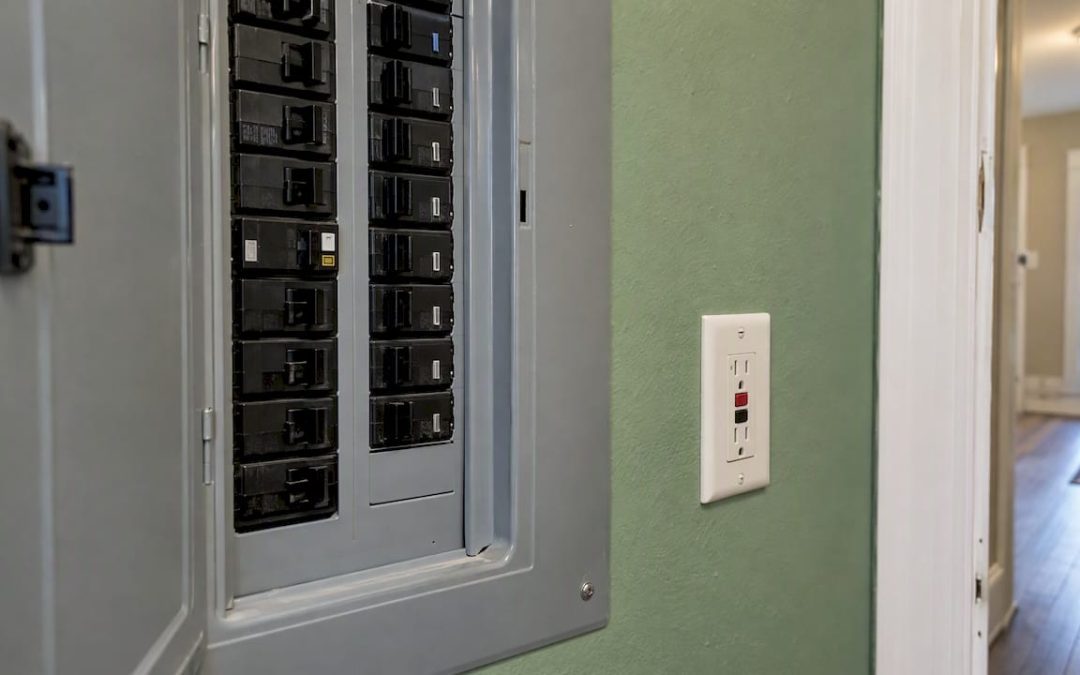
A GFCI protects people from electric shock. An AFCI protects the house from fires started by arcing in the wiring. They detect different faults, so one cannot stand in for the other. If you are buying a home, or trying to make sense of a line in an inspection report, that is the short version. The rest of this guide covers where each device belongs, how to tell them apart, and what we look at when we test them.
TL;DR
- GFCI = shock protection. It trips when current leaks out of the circuit, at 6 mA or more of ground-fault current.
- AFCI = fire protection. It recognizes the electrical signature of an arc in wiring and cuts power before the arc starts a fire.
- They are not interchangeable. A circuit that needs both can use two devices or one dual-function breaker.
- Test both. GFCIs have a test and reset button you press. AFCIs need manual testing too, usually monthly.
- Buying a home? Ask your inspector to test every GFCI and AFCI they can reach, and read what the report says about missing or failed devices.
Table of Contents
- The core difference: shock versus fire
- Where each one is required
- Can one device do both?
- Breaker or outlet?
- Myths worth clearing up
- How to test them
- Placement matters too
- What we see in St. Louis-area inspections
- Reading your inspection report
- Work with an inspector who tests them
- FAQ
- Sources
The core difference: shock versus fire
Both devices watch a circuit and shut it off when something goes wrong. What they watch for is different.
A ground fault circuit interrupter (GFCI) compares the current going out on the hot wire with the current coming back on the neutral. If some of it is leaking another way, say through a person standing on a wet floor, the device opens the circuit. The Mike Holt NEC analysis notes that the code definition ties a GFCI to de-energizing the circuit at 6 mA or more of ground-fault current. The aim is to protect people.
An arc fault circuit interrupter (AFCI) is built for a different failure. It recognizes characteristics unique to arcing and de-energizes the circuit when it sees one. Arcing happens at a damaged cord, a loose terminal, a nail through a cable, or a wire chewed by a rodent. The U.S. Consumer Product Safety Commission explains that arcing and sparking in home wiring can cause fires, and that AFCIs give added protection beyond what ordinary fuses and breakers offer.
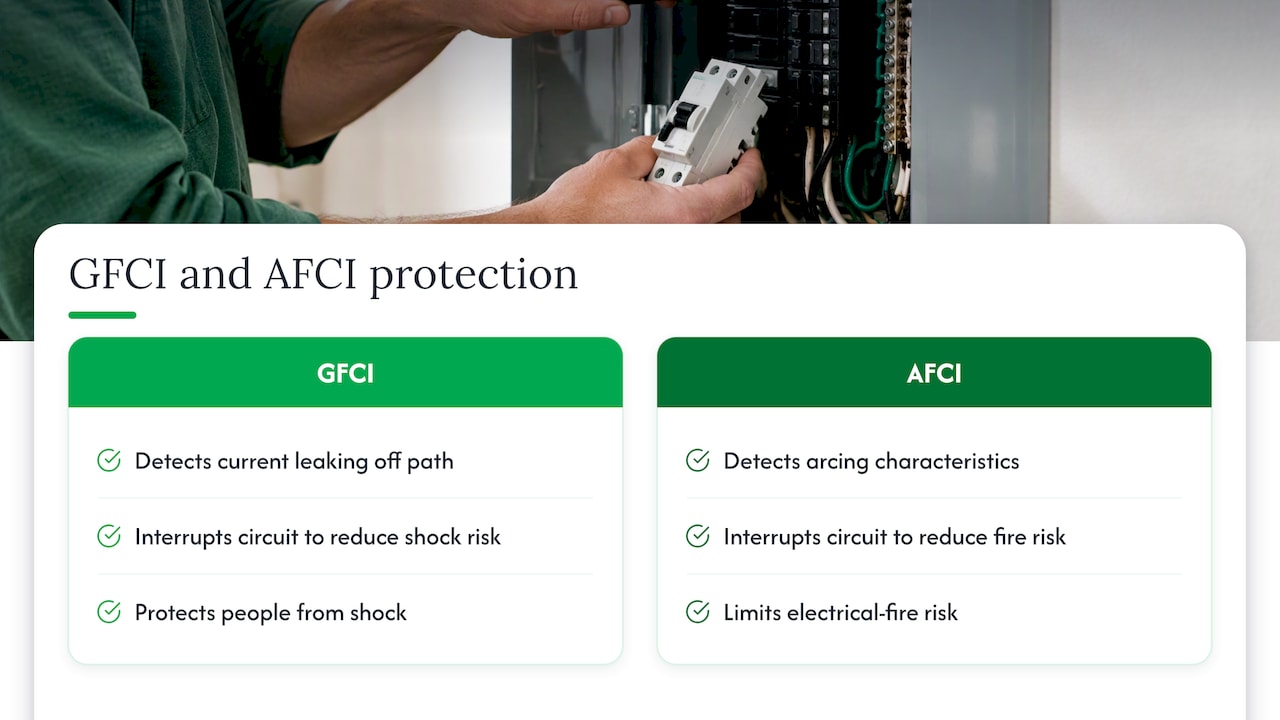
The American Society of Home Inspectors puts the split plainly in its GFCI vs. AFCI article: GFCIs are meant to protect people from shock, and AFCIs are meant to limit the chance of an electrical fire caused by an arc.
Side-by-side comparison
| GFCI | AFCI | |
|---|---|---|
| Protects against | Electric shock and electrocution | Fires from arcing in wiring or cords |
| What it senses | Current leaking out of the circuit (ground fault) | Arc waveform in the circuit |
| Typical form | Receptacle (outlet) or breaker | Breaker, sometimes a receptacle |
| Where it is required | Wet or damp areas: bathrooms, kitchens, garages, outdoors, and similar | Living areas such as bedrooms, living rooms, hallways and, in newer codes, more of the house |
| Self-test | Newer receptacles test themselves | Manual monthly test typical |
| After a trip | Usually a safe reset at the outlet | A repeat trip can point to a wiring problem in the wall |
Which rooms are covered depends on the code edition your area has adopted, which is the next point.
Where each one is required
The National Electrical Code (NEC) is a model code, republished every three years. It does not become law until a state, county or city adopts it, often with amendments. The pattern is uneven. An NAHB summary of state adoptions lists Illinois as requiring new construction to meet the 2008 or a later NEC edition, and Missouri as having no statewide residential adoption, so it is left to cities and counties. That table is a few years old, so check the current rule with your local building department before relying on it.
For St. Louis-area buyers, the practical takeaway is this: the edition in force when a house was built, or when a circuit was last altered, decides what that house should have. A 1985 ranch in South County will often have no AFCI protection at all, and that is normal for its age, not a defect by itself. A 2022 build in St. Charles County should have far more.
GFCI locations
GFCI protection is the older of the two requirements and the one you see most often. Think bathrooms, kitchen countertops, garages, unfinished basements, crawl spaces, laundry areas and outdoor outlets. The common thread is water or damp concrete near an outlet. The CPSC GFCI fact sheet describes the device as an inexpensive way to guard against severe shocks.
AFCI locations
AFCI requirements began with bedrooms and grew with later NEC editions to cover more living spaces. We do not rely on a single rule of thumb for this, because the answer depends on the edition and the local amendments. What we do is note what is present, what is missing, and whether the house’s age explains it.
Can one device do both?
Yes. A dual function circuit interrupter combines AFCI and GFCI protection in one breaker. The Mike Holt analysis of the 2026 NEC describes these as a practical fit for areas such as kitchens and laundry rooms, where both shock and arc-fault requirements can overlap.
In plain terms, a dual-function breaker is often the tidiest way to protect a circuit that needs both. The alternative is an AFCI breaker at the panel plus a GFCI receptacle at the first outlet. Both approaches can meet code when done correctly. Two things to know:
- Dual-function breakers cost more than standard breakers, and the cost varies by brand and panel, so ask an electrician for a written quote rather than guessing.
- Not every panel accepts every breaker. Older panels may have limited or no compatible options, which is one reason an upgrade request can turn into a bigger conversation. If you see a panel brand that worries you, our guide to Federal Pacific panels covers what we do about it.
Breaker or outlet?
The two device types can go in different places, and the choice matters for who fixes what.
GFCIs are usually most useful as receptacles, because a homeowner can see the trip and reset it on the spot. AFCIs are generally installed as breakers at the panel. According to the ASHI article, an AFCI trip often points to a branch-circuit wiring issue in the wall, which needs a professional to track down rather than a simple reset.
There is one more wrinkle for older houses. The EC&M code analysis explains that AFCI breakers are the standard approach in new construction, while retrofitting AFCI protection in older homes can be technically harder and potentially more costly. If a seller or buyer asks “can we just swap the outlets?”, the honest answer is that it depends on the wiring, and an electrician should say so in writing.
Myths worth clearing up
“A GFCI needs a ground wire.” Not true. A GFCI works by sensing current imbalance, so it can be installed on a two-wire circuit. The EC&M article points out that if a GFCI receptacle is meant to protect downstream outlets, the line and load wires must pass through the device and not be pigtailed together.
“A GFCI replaces grounding.” No. OSHA’s interpretation on grounding stresses that grounding requirements for cord-and-plug equipment remain in force. A GFCI can stop an electrocution by cutting power fast, but it cannot prevent the initial jolt. Ungrounded outlets in an older house are still a finding worth taking seriously, even if a GFCI has been added.
“An outlet can be an AFCI and a GFCI at once.” Combination receptacles exist, but at the panel the dual-function breaker is the more common route. Whichever you choose, the label on the device tells you what it does.
“If it trips, it’s broken.” Often it is doing its job. A GFCI that trips on a hair dryer might be telling you about a damaged cord. An AFCI that trips repeatedly might be telling you about a loose connection. Replacing the device without finding the cause is the mistake we see most.
How to test them
GFCI receptacles and breakers
- Plug in a lamp or a small tester.
- Press the TEST button. Power should cut off.
- Press RESET. Power should return.
Newer GFCI receptacles include built-in self-testing. According to the ASHI article, devices made since around 2016 test themselves every few seconds and will not supply power if they fail. Older ones do not, so still test them monthly.
AFCI breakers
AFCIs lack that self-test feature, so the same ASHI article says they should be tested manually, typically monthly, following the manufacturer’s instructions. The usual method is pressing the TEST button on the breaker, which should trip it. Then reset it. Follow the label on your own breaker, and if you are not comfortable opening the panel cover, ask an electrician or inspector to do it. Never remove a panel’s dead front yourself.
Placement matters too
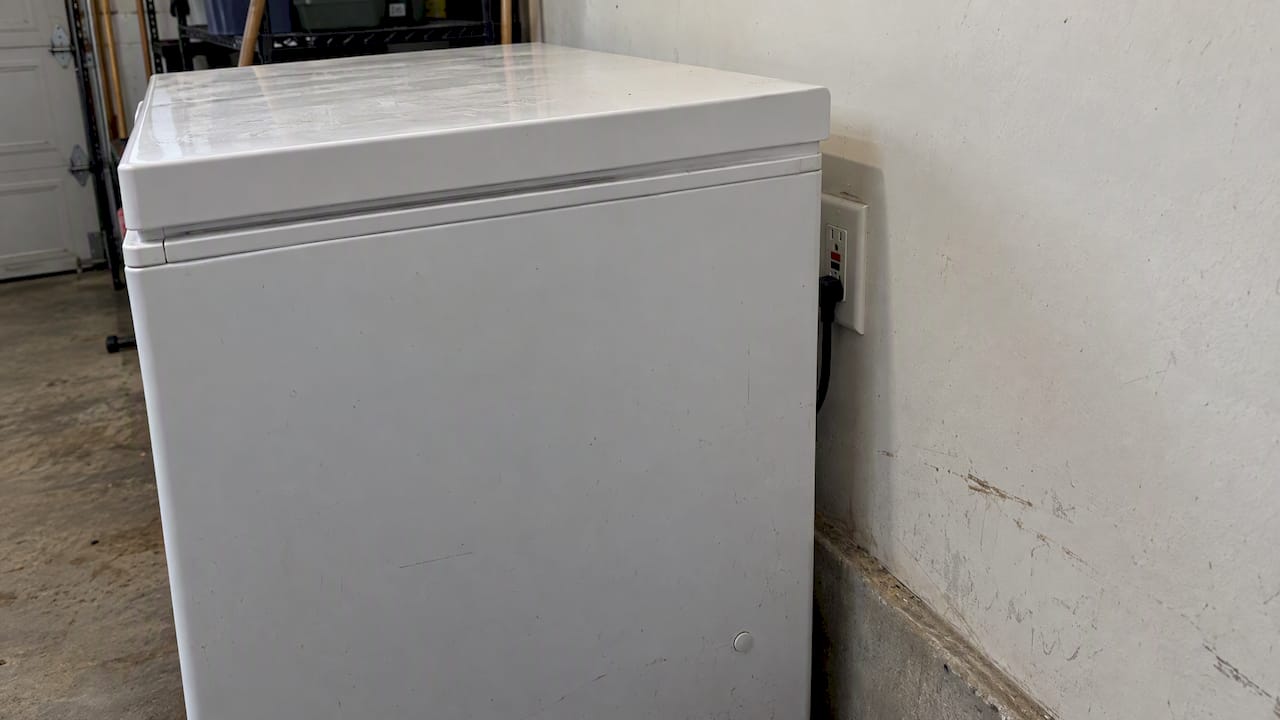
Both device types must be readily accessible. In the NEC’s language, that means reachable for operation or inspection without moving obstacles or using a ladder. A GFCI hidden behind a freezer or a panel blocked by shelving can draw a note in a report. If you are selling, clear a path to the panel and to any GFCI that serves appliances before the inspector arrives.
What we see in St. Louis-area inspections
We inspect homes across the St. Louis Metro area and Southern Illinois, and these devices come up on many reports. Here is how we think about them.
Our perspective. Most people ask which device is better, and that is the wrong question. A GFCI is about protecting the person at the outlet. An AFCI is about protecting the walls and everyone sleeping in them. A house that has one and not the other is not half safe, it is exposed to a different hazard.
When we test devices during a buyer’s inspection, we are looking for three things: is the protection present where the home’s age and use suggest it should be, does it trip and reset properly, and does anything around it, such as reversed wiring, double-tapped breakers, or a blocked panel, suggest a deeper problem. A failing GFCI in a garage is usually a small repair. An AFCI that trips for no obvious reason, or scorch marks at an outlet, is a reason to call a licensed electrician before closing, not after.
We also try to be fair to older homes. Missing AFCI protection in a house built decades ago is information, not an accusation. Our job is to tell you what is there, what it means, and what to get quoted, so you can negotiate with real numbers. Reports come back within 24 hours, and the Create Request List™ turns our findings into a clean list your agent can send to the seller.
— JOHN
If you want to understand what else we check around the panel, read about double-tapped breakers and our broader list of home inspection red flags.
Reading your inspection report
Here are common electrical findings and what they usually call for.
| Finding | What it usually means | Typical next step |
|---|---|---|
| GFCI missing near a sink or outdoors | Not present, or the house predates the requirement | Ask for a quote from a licensed electrician |
| GFCI will not trip or reset | Failed device or wiring fault | Replace device, have the circuit checked |
| AFCI trips repeatedly | Possible arc or overload on the circuit | Electrician to trace the circuit |
| No AFCI in older house | Age-related, often not a violation | Consider an upgrade, get a quote |
| Panel blocked | Accessibility problem | Clear the area, re-inspect |
For anything involving repeated trips, burn marks, or buzzing, treat it as a safety item, not a negotiating chip. Call a licensed electrician.
Work with an inspector who tests them
If you are buying in the St. Louis area or Southern Illinois, our buyer’s home inspection includes a look at the electrical panel and the protective devices we can safely reach. We offer in-person and video inspections, evening and weekend appointments, and discounts for veterans and first-time buyers. After the report, a post-inspection consultation can help you turn findings into a repair request. Not sure how to choose a company? Our selection criteria for homebuyers walk through it.
FAQ
Should I use AFCI or GFCI?
It depends on the circuit, not on preference. Use GFCI where water or damp surfaces raise shock risk, and AFCI where the code requires fire protection for living spaces. Some circuits, such as kitchens and laundry areas, can need both, and a dual-function breaker handles that in one device. Your local adopted code and a licensed electrician decide the specifics.
Can an outlet be both GFCI and AFCI?
Dual-function protection is most often delivered by a breaker at the panel. Combination receptacles also exist, and the label will state the protections it provides. Whatever you install, confirm that it matches the circuit and the panel’s requirements. If you are unsure, ask an electrician before buying parts.
Where should you not use AFCI breakers?
AFCIs are not a fit for every circuit, and requirements and exceptions change from one NEC edition to the next. Do not guess: manufacturers list compatibility, and your local code office or electrician can confirm what applies to a given circuit. Never swap breakers yourself in a panel you cannot safely open.
Does laundry need AFCI?
In newer code editions, laundry areas are often covered by AFCI protection and may also need GFCI near sinks, which is where dual-function devices help. Whether your home needs it depends on the code in force when it was built or last rewired. An older laundry room without AFCI is common and is usually noted in a report as information, not a defect.
Why does my AFCI keep tripping?
A repeat trip can mean a loose connection, damaged cable, or a failing appliance cord on that circuit. Unplug devices and reset once. If it trips again, stop and call an electrician, since an AFCI trip often points to a wiring issue inside the wall.
Sources
- GFCI vs AFCI Devices, American Society of Home Inspectors
- The Differences Between AFCIs and GFCIs, EC&M
- GFCI and AFCI, based on the 2026 NEC, Mike Holt
- Preventing Home Fires: Arc Fault Circuit Interrupters, CPSC
- GFCI Fact Sheet, CPSC
- Grounding requirements for equipment connected by cord and plug, OSHA
- State Adoptions of the National Electrical Code, NAHB
Recent Comments