

Most inspection contingencies give a buyer about 7 to 14 days from an accepted offer to inspect the home and respond. The exact number is whatever your signed contract says. The days also have to cover more than the inspection visit: you need to book the inspector, get the report, read it, decide, and deliver written notice to the seller before the deadline.
This guide covers how long the window usually lasts, when the clock starts, how weekends and holidays are counted, and how to plan the days so you don’t lose your right to renegotiate or walk away.
TL;DR
- Typical inspection windows run seven to 14 days from an accepted offer, but your contract sets the real number.
- The clock usually starts on the contract’s effective date, often the day the last party signed. Check whether weekends and holidays count.
- Inspecting is not enough. You normally have to send the seller written notice before the deadline, or your rights can lapse.
- Book the inspector the day the offer is accepted, and ask for the report within 24 hours so you have time to decide.
- Waiving the contingency or shortening it makes an offer stronger, and it moves the risk of hidden defects onto you.
Table of Contents
- How long an inspection contingency lasts
- When the clock starts
- Calendar days, business days, weekends and holidays
- A realistic day-by-day plan for a 7-day window
- How long the inspection and the report take
- What you must do before the deadline
- What happens if you miss the deadline
- Shortening or waiving the contingency
- Our perspective: protect days, not just the clause
- Book your inspection inside the window
- After the contingency ends: what comes next
- FAQ
- Sources
How long an inspection contingency lasts
There is no single national number. Contingencies are terms that buyers and sellers must agree to and sign before they are binding, so the length is negotiated and written into your purchase agreement. Many forms have a default that applies if nobody changes it, and local practice shapes what agents write in.
In practice, the ranges look like this:
| Window | How it’s typically used |
|---|---|
| 3 to 5 days | Competitive offers where the buyer wants to look strong |
| 7 days | A common standard in many markets |
| 10 days | Common when the form counts business days, or for larger or older homes |
| 14 days | Slower markets, rural properties, or when extra tests are needed |
A buyer can do inspections within a time frame mutually agreed upon with the seller, typically within seven to 14 days of an accepted offer. Some contracts split the period into stages: one deadline to complete inspections, then a second to send a repair request or cancel. Read yours to see whether you have one deadline or two.
What decides your number
Three things set the length:
- The state or local form. Realtor associations and attorneys publish standard contracts, and each has its own default period and its own way of counting.
- The negotiation. Your agent can ask for more time, and the seller can counter with less. Sellers also sometimes limit the contingency so a buyer can cancel only for major structural issues or when repair costs pass a set amount.
- What you need to test. Radon, mold, sewer line, well, septic, and wood-destroying insect checks add scheduling time and lab turnaround. If your home needs them, ask for a window that fits them.
When the clock starts
The clock almost never starts when you first shake hands on a price. The contract’s “effective date” is typically defined as the date the final party signed or initialed all terms, and that date often marks the start of contractual deadlines.
That has real consequences:
- If the seller signs a counteroffer on Friday night, your days begin then, not when your agent calls you on Monday.
- If the form says the period starts the day after the effective date, day one is the next day. In Texas, for example, a TREC contract period starts the day after the Effective Date.
- Electronic signatures are time-stamped. Look at the date on the final signature page, not the date you remember.
On day one, write down the effective date and count forward to your deadline. Put it on your calendar with a reminder two days earlier.
Calendar days, business days, weekends and holidays
This is where buyers get caught. A “10-day” period can mean very different calendar spans depending on how the form counts.
- Calendar days include every day. On Florida’s AS IS form, periods are counted in calendar days, and a period ending on a Saturday, Sunday, or national legal public holiday extends to the next day that is not one.
- Business days skip weekends and usually holidays. In Wisconsin, for instance, days run Monday through Sunday, while business days run Monday through Friday and exclude holidays and other noted exceptions.
- Time of day matters too. Some contracts end at a stated hour. On a Texas resale contract, the Option Period ends at 5:00 p.m. local time on its last day. Sending notice at 6:30 p.m. may be too late.
Here is a worked example. Your offer is accepted and fully signed on a Thursday. The contract gives you 10 days.
- If those are calendar days, the period runs to a Sunday, and your form may or may not roll it to Monday.
- If those are business days, you count Friday as day one, skip the weekend, and the deadline lands on the Thursday of the following week, a few days later.
Same “10 days,” different deadlines. Ask your agent, or the attorney who reviews your contract, to confirm the exact date in writing.
A realistic day-by-day plan for a 7-day window
A week goes fast. Inspectors, especially good ones, book up. Here is a schedule that leaves room to decide.
| Day | What to do |
|---|---|
| Day 0 (effective date) | Confirm the deadline with your agent. Call your inspector and book the earliest slot. Ask which add-on tests you need. |
| Day 1 to 2 | Schedule radon, termite, sewer camera, or well and septic tests if the property calls for them. Confirm access with the listing agent. |
| Day 2 to 3 | Inspection day. Attend if you can, at least for the walkthrough at the end. |
| Day 3 to 4 | Receive the report. Read it twice, and mark safety items, structural items, and big-ticket systems separately. |
| Day 4 to 5 | Get contractor estimates for the largest items. Talk with your agent about what to ask for. |
| Day 5 to 6 | Send your written repair request, credit request, or cancellation notice. |
| Day 7 | Buffer. Never plan to deliver notice on the last day. |
On a 10 to 14 day window, the same steps simply spread out. The point is to leave at least a full day between receiving the report and the deadline.
How long the inspection and the report take
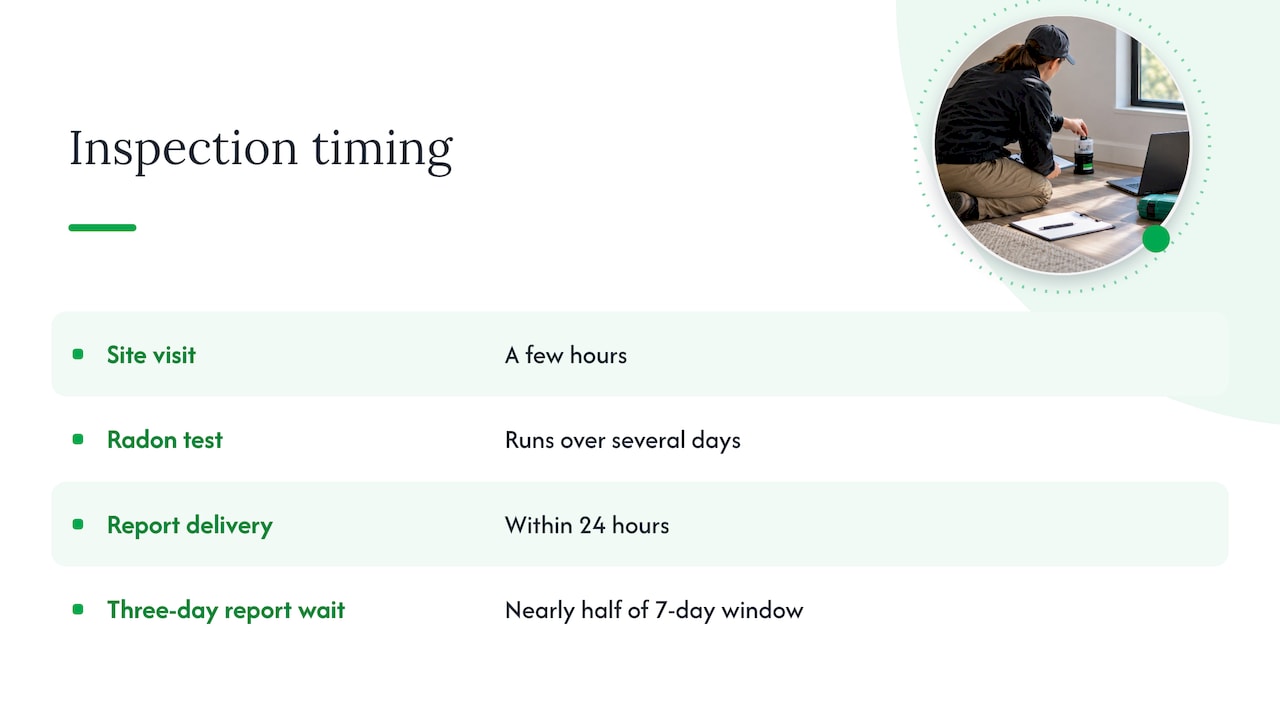
The site visit for a typical single-family home usually takes a few hours, and larger or older homes take longer. Add-on tests extend this. A radon test runs over a period of days before the result is in, so book it early. For more detail on timing, see our guide on why inspection duration matters and our walkthrough of the home inspection process.
The report is the bigger risk to your timeline. If an inspector takes three days to send it, a 7-day window loses nearly half its length. That’s why we deliver reports within 24 hours, and why we explain how that fits your deadline in our home inspection report timeline guide. Ask any inspector you consider when the report will arrive before you hire them.
What you must do before the deadline
The most common mistake is thinking the inspection itself protects you. It doesn’t. In a typical contract, you must complete the inspection and send the seller formal notice within the stated period, which in the example Realtor.com gives is seven days after signing the purchase agreement.
Before the deadline, choose one of these paths and put it in writing:
- Accept the home as is. Say nothing, or confirm acceptance if your form requires it.
- Request repairs or a credit. Send a list of specific items, ideally with the inspector’s page references and contractor quotes.
- Request a price reduction. Useful when problems are real but you still want the house.
- Cancel. Use the notice method in the contract, such as email, certified mail, or a signed addendum, and keep proof it was delivered.
- Ask for an extension. If a specialist test or contractor quote isn’t back, request a written extension signed by both parties. A verbal “take your time” protects nobody.
Our Create Request List™ tool is built for step two. It turns the findings into a clean list your agent can send, so the request stays focused on what matters.
What happens if you miss the deadline
If the period expires without notice, the contingency is generally treated as satisfied. You may lose the right to cancel for inspection reasons and the right to ask for repairs, and your earnest money can be at risk if you back out later. The outcome depends on your contract and state law, so ask your agent or a real estate attorney about the specific consequences in your form.
A few related points:
- The seller can say no. Sellers do not have to agree to repairs. They may deny your terms and allow the sale to fall through, so decide beforehand which items are dealbreakers.
- You can generally walk away if you follow the rules. A buyer can usually back out penalty-free during the contingency period if results are unsatisfactory, provided they follow the contract’s notice requirements.
- Some forms attach an option fee. On a TREC resale contract, the buyer may end the contract without restriction by giving notice by 5:00 p.m. local time on the last day of the Option Period, if the option fee is paid as required.
Shortening or waiving the contingency
In hot markets, some buyers waive the inspection contingency to make an offer more appealing. Some states have responded: Massachusetts, for example, prohibits sellers from conditioning acceptance of an offer on a buyer waiving, limiting, or forgoing a home inspection.
If you want a competitive offer without giving up everything, you have middle options:
- Shorten the window from 10 days to 5 or 7, and line up your inspector before you submit the offer.
- Do a pre-offer inspection where the seller allows it, so you know the condition before you commit.
- Narrow the contingency to safety and structural issues, with a repair cost threshold you can afford to accept.
- Keep the contingency, and keep it clean. Pair it with strong financing and a flexible closing date.
Before you waive anything, read why waiving an inspection contingency is risky and what skipping a home inspection can cost you. For a deeper look at the mechanics, our buyer inspection contingency guide covers the clause itself.
Our perspective: protect days, not just the clause
We inspect homes across the St. Louis Metro area and Southern Illinois, and the pattern we see most is not a bad house. It is a good buyer running out of days. A first-time buyer signs, takes a few days to find an inspector, waits for a report, and suddenly has a day and a half to make the biggest decision of their year.
So we build our service around protecting your days. We offer evening and weekend appointments, because busy buyers can’t always take a weekday off. We offer video walkthroughs for buyers who can’t be on site. We return reports within 24 hours. And we help you turn findings into a short, clear request list your agent can send quickly.
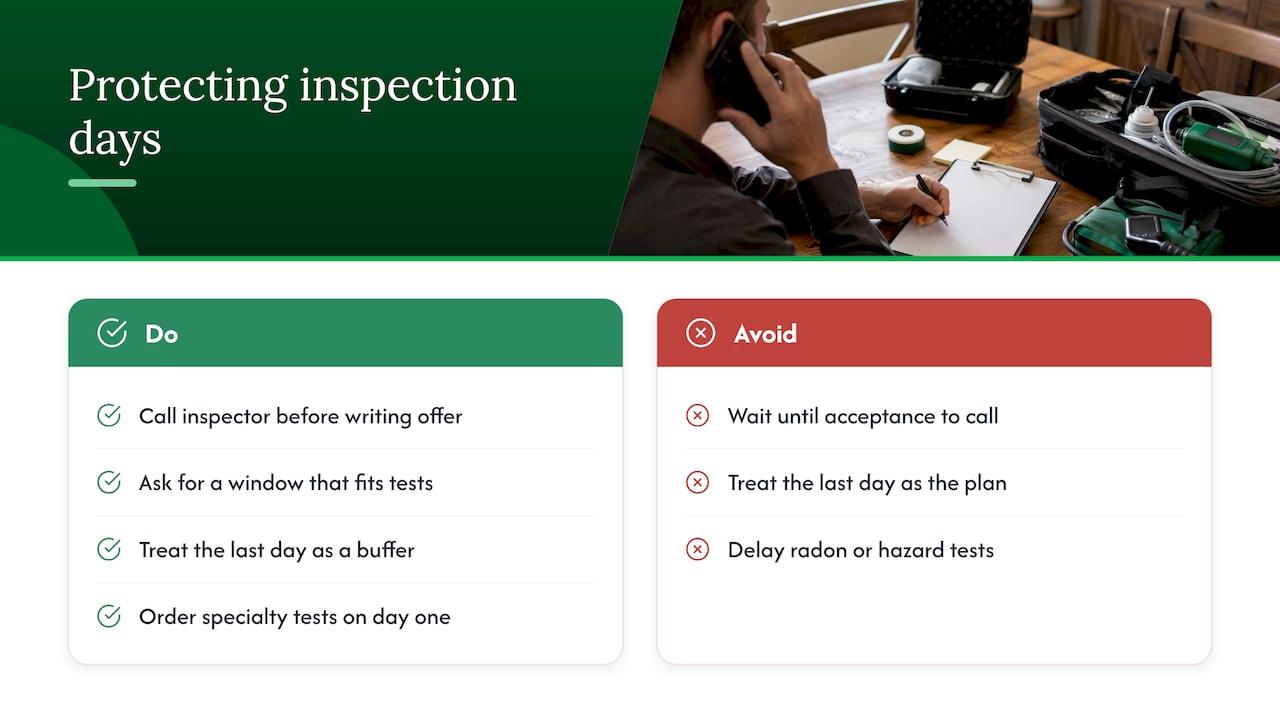
Our advice is simple. Call the inspector before you write the offer, not after it is accepted. Ask for a window that fits the tests the property needs. Treat the last day as a buffer, never the plan. For specialty items such as radon or environmental hazards, order them on day one, because lab results take time you can’t speed up.
— JOHN
Book your inspection inside the window
If you are under contract in Missouri or Illinois, tell us your effective date and deadline when you call. We will work backward from it to schedule your inspection, add-on tests, and report delivery. See our full list of home inspection services, including radon, mold, termite, sewer camera, and well and septic inspections. We offer discounts for veterans and first-time buyers, and pricing details are available when you contact us. If you need evening slots, see how to book an evening inspection 48 to 72 hours ahead.
After the contingency ends: what comes next
When the inspection period closes and the issues are resolved, your attention shifts to closing. Lenders, appraisals and insurance all run on their own clocks. Line up coverage early, because your lender will want proof of a homeowners policy before closing. This overview of insurance after home purchase closing explains what buyers need once the deal is done.
Keep your inspection report, repair receipts and any signed addenda. They are useful for insurance questions, for warranty claims, and for planning maintenance in your first year. A home inspection checklist can help you stay organized, and our cost guide helps you budget for the inspection itself.
FAQ
How long is an inspection contingency?
Most run between 7 and 14 days from the effective date of the contract, though some competitive offers use 3 to 5 days. Your signed purchase agreement controls. Confirm with your agent whether the days are calendar or business days.
Does the inspection contingency clock include weekends?
It depends on the form. Calendar days include weekends, though many forms roll a deadline that lands on a weekend or holiday to the next business day. Business-day periods skip weekends and holidays. Ask your agent to write out the exact deadline date.
Can I back out after the inspection?
Generally yes, if you are still inside the contingency period and follow the contract’s notice requirements. After the deadline passes, backing out can put your earnest money at risk. Talk to your agent or a real estate attorney about your specific contract before you act.
What if the report isn’t ready before the deadline?
Ask your agent for a written extension signed by both parties before the deadline passes. Don’t rely on a verbal agreement. It also helps to choose an inspector who commits to a fast report turnaround before you book.
Can the seller refuse repairs?
Yes. The seller is not required to agree to your requests. You can then accept the home as is, negotiate a credit or price change, or cancel if you are still within the contingency period.
Sources
- Consumer Guide: Real Estate Sales Contract Contingencies, National Association of Realtors
- Real Estate Contract Terms Home Buyers Should Know, Realtor.com
- How to Get Out of a Contract When Buying a House, Realtor.com
- Real Estate Contingencies in 7 States: Rights and Deadlines
- Tick Tock, Wisconsin Real Estate Magazine
- Help Sellers Regain Confidence After a Buyer Backs Out, National Association of Realtors
- How long after the home inspection do I have to close?, Rocket Mortgage
- Buyer, Seller Agreements to Waive Inspections, National Association of Realtors
Recent Comments