
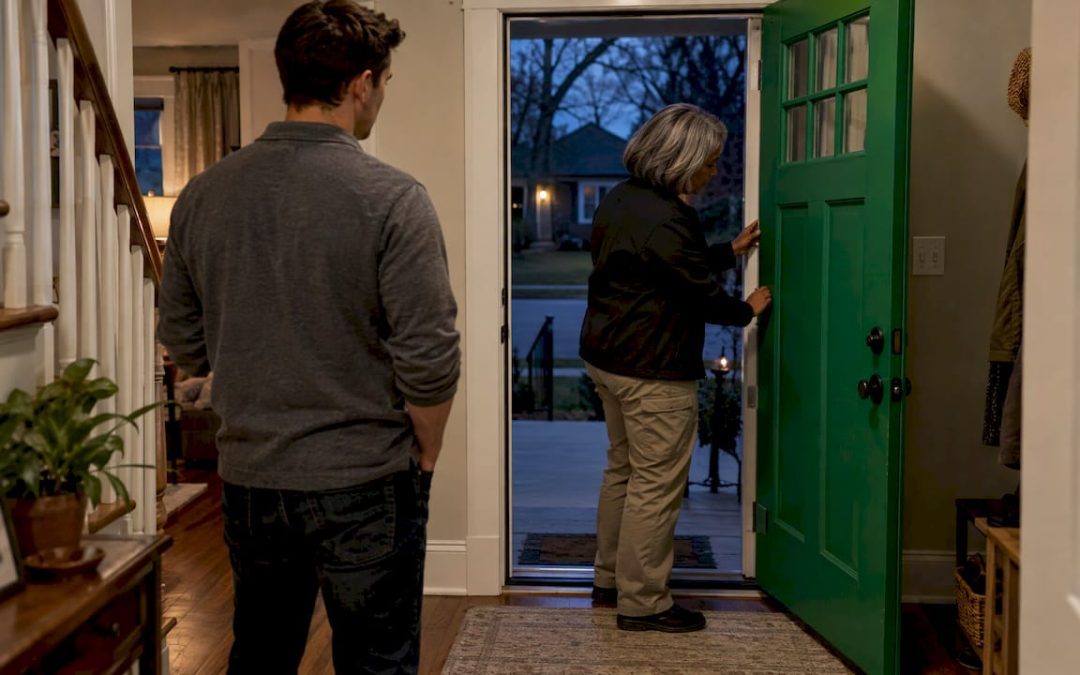
You can get a home inspection outside the 9-to-5 window. At Hunt Home Inspection, we schedule evening and weekend appointments across the St. Louis Metro area and Southern Illinois, offer in-person or video walkthroughs, and return your report within 24 hours. You don’t have to burn vacation days to protect the biggest purchase of your life.
This guide explains how after-hours inspections work, how to book one without losing days on your contract, what you will pay, and how to get the most from the visit when you can only attend after work.
TL;DR
- No national inspection standard sets appointment hours, so evening and weekend availability is a choice each inspector makes. We offer both.
- Book as soon as your offer is accepted. Inspections are normally scheduled after acceptance and before closing, and evening slots fill first.
- A typical U.S. inspection runs about $300 to $500, and St. Louis size-based ranges are listed below. Ask for a written quote that states what is included.
- You can attend in person after work, or join live by video. Either way, our report arrives within 24 hours.
- Veterans and first-time buyers can ask us about our service discounts.
Table of Contents
- Do home inspectors work evenings and weekends?
- Why timing matters more than the hour on the clock
- How to book an after-hours inspection step by step
- What the inspection covers
- How long an after-hours inspection takes
- What a St. Louis home inspection costs
- Attending after work, or joining by video
- Choosing an inspector who fits your schedule
- Book your evening or weekend inspection
- Our view on after-hours inspections
- FAQ
- Sources
Do home inspectors work evenings and weekends?
Some do, and some don’t. Nothing in the profession’s rules decides it. The ASHI Standard of Practice describes what must be inspected, namely readily accessible, visually observable installed systems, and what the written report must contain. It says nothing about which days or hours an inspector must be available. InterNACHI’s home buyer FAQ explains when inspections are normally scheduled in a transaction but also sets no appointment hours.
That means “after hours” is a service decision. An inspector who only works weekday daytime is not breaking any rule, and neither is one who works evenings. If you work a standard schedule, ask about hours before you hire, not after.
We built our schedule around working buyers. Evening and weekend appointments are part of how we serve busy professionals, first-time buyers and families who can’t take a day off for an inspection. If you want the details on how we handle evening slots, our page on booking evening inspections walks through it.
Why timing matters more than the hour on the clock
The real pressure is not the time of day. It is the calendar. InterNACHI notes that inspections usually happen after an offer is made and accepted, but before closing. Your purchase contract gives you a limited window for the inspection and for any repair negotiation that follows. Once it closes, your leverage shrinks.
That makes an after-hours inspection useful in two ways:
- You can be there. Attending is something the National Association of Realtors encourages in its consumer guide: inspectors can show you where plumbing and electrical details are located and help you understand the scope of any problems. If the only open appointments are Tuesday at 10 a.m., you may end up skipping that walkthrough.
- You protect your deadline. A slot that fits your life is a slot you can book on day one, not day six.
Several business days can pass between acceptance and the first available daytime opening in a busy season. An evening or Saturday slot can close that gap.
How to book an after-hours inspection step by step
The process is simple, but each step has a place where buyers lose time. Here is the routine, and what we take off your plate at each stage. For a longer version, see our step-by-step scheduling guide.
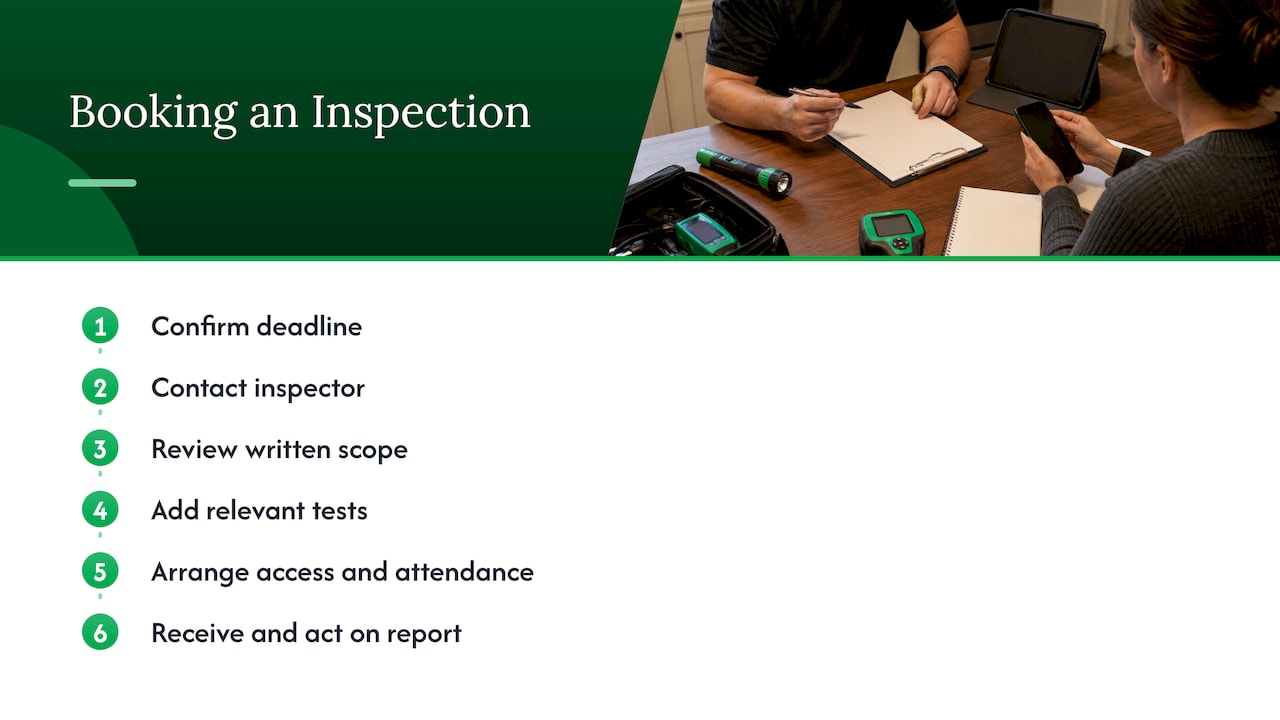
Step 1: Confirm your inspection deadline
Read the inspection contingency in your purchase agreement. Note the number of days you have and the date it ends. Missouri and Illinois contracts differ in form, so confirm the exact dates with your agent. Where it goes wrong: buyers count from the closing date rather than the acceptance date and discover they have two days left.
Step 2: Call or message as soon as you are under contract
Don’t wait for the lender or the title company. Tell us the property address, your contract deadline, and that you need an evening or weekend slot. Because we book evening appointments, you are not trying to fit an inspection into someone else’s weekday. Our guide on fast scheduling and getting your report covers what to have ready when you call.
Step 3: Ask what is included and in writing
InterNACHI says the agreement should state what is and is not included. Read it before the visit. We use pre-inspection agreements for Missouri and Illinois, so you know the scope before we arrive. A standard visual inspection does not by itself cover radon, mold, environmental hazards or pests, so decide now which of those you want added.
Step 4: Add the tests that match the house
In the St. Louis area, common add-ons include radon testing, a sewer camera lateral inspection and a wood-destroying organism (termite) inspection. We perform all three, as well as mold inspections, septic and well inspections and environmental testing for lead, water and asbestos. Adding them to one appointment saves you a second trip and a second scheduling scramble. Where it goes wrong: ordering add-ons after the main visit, when the contract window is already shrinking.
Step 5: Arrange access and your own attendance
Your agent usually coordinates entry with the seller’s side. Decide whether you will come in person for the last part of the visit or join by video. We offer both.
Step 6: Receive the report and act on it
ASHI says a report often arrives within 24 to 48 hours, with findings, pictures, analysis and recommendations. Ours is delivered within 24 hours. That matters most when your appointment is at 6 p.m. and your repair-request deadline is close. We also give you and your agent our Create Request List™, a tool that streamlines communication between buyers and agents when it is time to ask the seller for repairs.
What the inspection covers
A standard home inspection is a visual review of the home as it stands on the day. InterNACHI’s Standard of Practice defines it as a non-invasive visual examination of accessible residential areas, reporting material defects observed on the inspection date. ASHI’s list, as summarized by The Mortgage Reports, includes:
- Heating and central air conditioning
- Plumbing and electrical systems
- Roof and gutters
- Attic and visible insulation
- Walls, ceilings, floors, windows and doors
- Foundation, basement and structural components
The ASHI standard applies to buildings with four or fewer dwelling units, plus garages and carports, subject to its stated limitations.
The InterNACHI standard also notes that a standard inspection is not technically exhaustive and does not determine market value, code compliance, service life or repair costs. This is why specialized testing exists. Radon, mold, sewer line condition and wood-destroying insects each call for their own method, and each can be added to the same appointment with us.
We are certified through NACA, ASHI and HUD 203k, which matters if you are buying with an FHA renovation loan or need HUD compliance paperwork. Our HUD compliance certifications page explains that service.
How long an after-hours inspection takes
Plan for two to four hours. ASHI says a single-family inspection usually takes that long, and InterNACHI says up to three hours depending on age, size and location, with outbuildings and ancillary services adding time.
This is the practical point for evening appointments. A 5:30 p.m. start can run past dark in winter. Exterior elements such as the roof, gutters and grading are easier to evaluate in daylight, so in the short days of November through February, choose the earliest evening slot or a weekend morning. Our page on what to know about evening appointments explains what can be missed when light is limited and why booking 48 to 72 hours ahead helps.
A simple rule: in summer, almost any evening slot works. From late autumn to early spring, ask for a Saturday morning or the earliest weekday opening after work.
What a St. Louis home inspection costs
This is the second thing after-hours buyers ask about. Start with what the evidence shows: there is no set price. InterNACHI says cost varies with the inspector, local market, region and scope, and that the agreement should spell out what is included.
National figures give you a frame:
- Redfin puts a regular U.S. inspection at $300 to $500, and says size, age, home type, location, number of structures and specialized services all move the price. Pools, fireplaces and detached garages can add to it.
- Realtor.com gives a general range of about $300 to $600.
For St. Louis specifically, a September 2026 local cost article reports representative base ranges by home size:
| Home size | Typical base range |
|---|---|
| Under 1,000 sq ft | $275 to $325 |
| 1,000 to 1,500 sq ft | $300 to $375 |
| 1,500 to 2,000 sq ft | $350 to $425 |
| 2,000 to 2,500 sq ft | $400 to $475 |
| 2,500 to 3,500 sq ft | $450 to $550 |
| Over 3,500 sq ft | $525 to $700 or more |
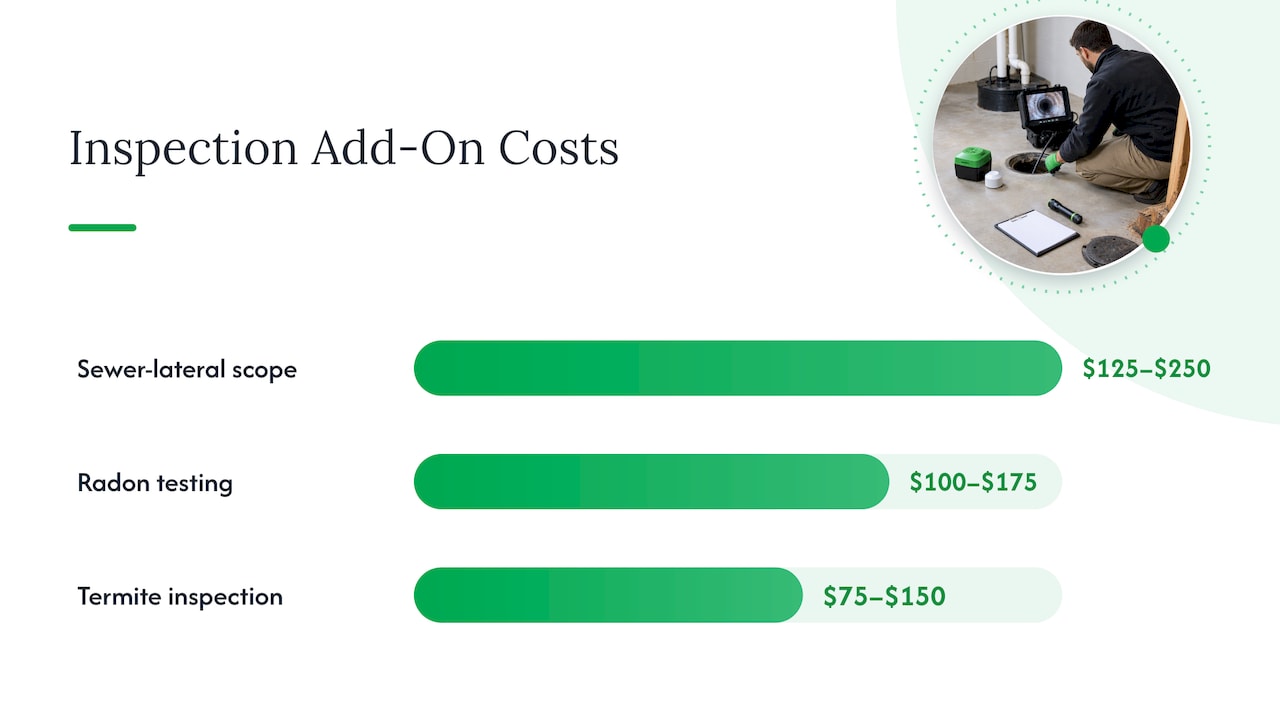
The same article estimates common add-ons at $125 to $250 for a sewer-lateral scope, $100 to $175 for radon testing and $75 to $150 for a termite inspection. Treat these as market ranges, not our prices. We don’t publish a price list, because the scope depends on the property. Contact us with the address, size and the services you want, and we will quote it before you commit. Our 2026 pricing guide explains the factors in more depth.
We also offer discounts for veterans and first-time buyers, and payment at closing for some services, which can help line up costs with your transaction timing. Ask what applies to you when you request your quote.
Attending after work, or joining by video
Buyers who can attend should. Consumer Reports recommends making time to attend, and notes that some inspectors prefer to work alone for the first couple of hours and then walk you through at the end. That format suits an evening appointment well: arrive for the final hour, when the inspector has findings to show you.
When to arrive, in practice:
- Arrive about an hour before the end. Ask your inspector for the expected finish time and plan for the walkthrough.
- Bring a flashlight and a list of questions. Write down anything you noticed at the showing: stains, odors, doors that stick.
- Ask to see the main shutoffs. The water shutoff, electrical panel and furnace are worth knowing from day one.
- Take your own photos of anything the inspector points out, alongside the report.
If you can’t be there, we offer video inspections. You join live, the inspector narrates, and you can ask for a closer look at anything that worries you. This is especially useful if you are relocating or working long shifts. For out-of-town buyers, our guide to out-of-state home inspections covers the specifics, and the page on attending your inspection helps you decide how to take part.
Choosing an inspector who fits your schedule
Hours are one criterion. Weigh them with these:
- Report speed. A report in 24 hours leaves you more of your contract window for negotiation than one in several days.
- Credentials. Look for recognized certifications. Ours are NACA, ASHI and HUD 203k.
- Scope in one visit. Can the same company handle radon, sewer, termite and mold so you do not coordinate several vendors?
- Clear agreement. You should know what is and is not covered before the visit.
- Communication with your agent. Repair requests go faster when your findings are organized.
Our page on inspection company selection criteria goes deeper on each point, and what to expect on inspection day shows the visit from start to finish.
Book your evening or weekend inspection
We inspect homes across the St. Louis Metro area and Southern Illinois, from buyer’s inspections to radon testing, sewer camera lateral inspections and termite inspections, with evening and weekend scheduling and reports within 24 hours. Send us your address and contract deadline and we will find the slot.

See everything we offer on our inspection services page, or start at jhunthomeinspections.com.
Our view on after-hours inspections
Most of the buyers who call us are not looking for a special favor. They have a job, kids, a contract deadline and a house they hope to call home. Asking them to take a weekday off to protect the biggest purchase of their lives is a poor fit.
That is why we offer evening and weekend appointments, and video walkthroughs for people who cannot be on site. It is also why we return reports within 24 hours: a fast report is only valuable if it lands while you still have time to use it.
We built the Create Request List™ for the same reason. Findings are only useful if they turn into clear requests your agent can send. We work especially with first-time buyers, low-income families and veterans, and we offer discounts for veterans and first-time buyers because good information should not depend on budget.
Our advice: book on the day your offer is accepted, add the tests that fit the house, and be there for the last hour if you can.
JOHN
FAQ
Do home inspectors do inspections on Saturdays?
Some do, and availability is up to each company, because the professional standards do not set appointment days or hours. We schedule weekend and evening appointments in the St. Louis Metro area and Southern Illinois. Ask for your preferred day when you call.
How much does a home inspection cost in St. Louis?
National guides put a regular inspection at about $300 to $500, and a local St. Louis article reports base ranges that rise from $275 to $325 for homes under 1,000 square feet to $525 to $700 or more above 3,500 square feet. Add-ons such as radon, sewer scope and termite checks raise the total. Contact us with the address and the services you want for a quote.
Can you be at your house during an inspection?
Yes, if you are the buyer. The National Association of Realtors says buyers can attend and that it can be very beneficial. Many inspectors like to work alone at first, then walk you through the findings at the end, so arriving in the final hour works well. If you cannot come, we can run the walkthrough by video.
How long does an inspection take, and when do I get the report?
A single-family inspection usually takes two to four hours, depending on size, age and add-on services. We return your report within 24 hours of the inspection.
What does a home inspector look for?
Inspectors review the visible, accessible parts of the house: heating and cooling, plumbing, electrical, roof, attic, walls, floors, windows, doors, foundation and structure. Radon, mold, sewer line, termite and other environmental checks are separate tests, and we can add them to the same appointment.
Sources
- ASHI Standard of Practice for Home Inspections
- InterNACHI Home Inspection FAQ for Home Buyers and Sellers
- InterNACHI Home Inspection Standards of Practice
- NAR Consumer Guide: Home Inspections
- Consumer Reports: How to Get the Most From a Home Inspection
- ASHI: What is a Home Inspection?
- The Mortgage Reports: Home inspection checklist
- Redfin: Home Inspection Cost
- Realtor.com: 16 Questions To Ask a Home Inspector
- What Home Inspections Actually Cost St. Louis Buyers
Recent Comments