
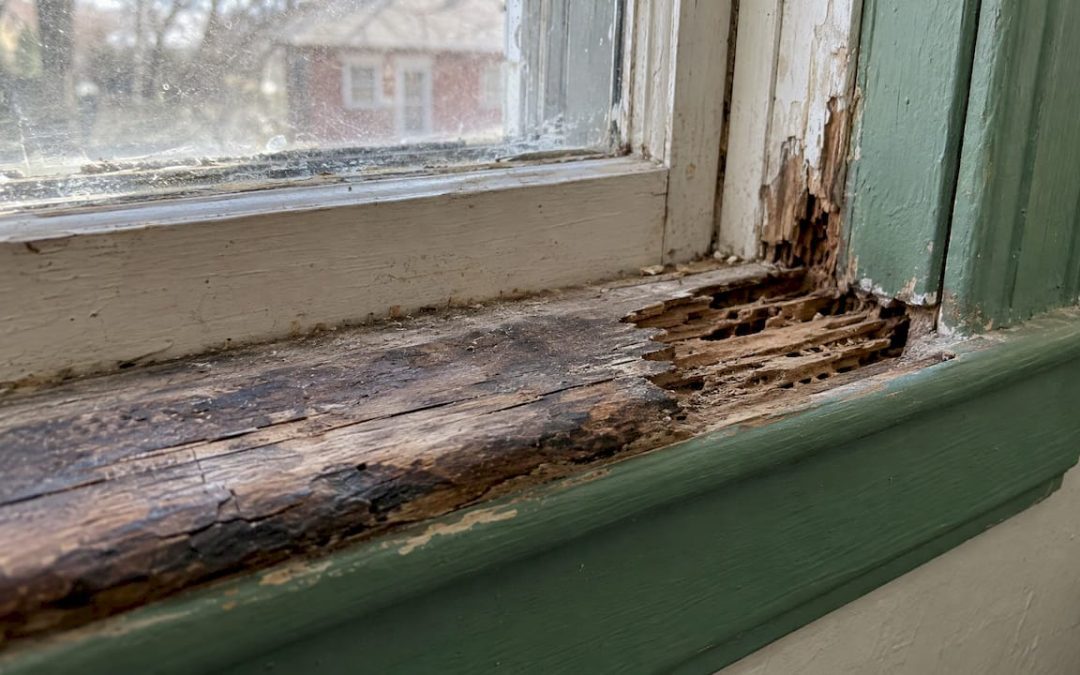
Wood rot is a fungus breaking down damp wood. Termite damage is live insects eating the wood from the inside. Rotted wood feels soft, damp and mushy, while termite-eaten wood often looks solid, sounds hollow and opens into tunnels when probed. The two need completely different fixes, so naming the right one before you pay for repairs, or before you sign on a house, can save you real money. A buyer’s inspection with a termite (wood-destroying organism) check is the way to get that answer in writing, and we offer both across the St. Louis Metro area and Southern Illinois.
TL;DR
- Rot needs moisture. Wood feels spongy, damp and musty, and may crumble into cubes. The cure is removing the water source and replacing the wood.
- Termite damage needs a living colony. Wood sounds hollow, may look fine on the surface, and shows tunnels, mud tubes or discarded wings. The cure is treating the colony first.
- A screwdriver probe is the quickest check: rot mushes, termite wood gives way into layered galleries.
- Both can exist in the same board, so a surface look is never the final word.
- If you are buying, get the wood checked before closing. Our reports come back within 24 hours.
Table of Contents
- The core difference: fungus versus insects
- Side-by-side comparison
- What wood rot looks like
- What termite damage looks like
- The screwdriver test
- When it is both
- Why the fixes are so different
- Why this matters most when you are buying
- What to do if you suspect damage right now
- Where our inspections fit
- Our perspective
- FAQ
- Sources
The core difference: fungus versus insects
Wood rot is decay caused by fungi. Fungi need food (the wood), oxygen and water. According to InterNACHI’s wood decay guide, decay fungi are active at roughly 77°F to 90°F, and their spores need wood moisture above the fiber saturation point, typically 27% to 30%. Take away the water and the process stops.
Termite damage is different in kind. Termites are insects that eat the cellulose in wood. Moisture helps some species, but the damage comes from a living colony that keeps feeding until someone stops it. The Spruce sums up the two this way: termite damage is usually dry, cored and hollowed out, while rotted wood is spongy, mushy and often musty.
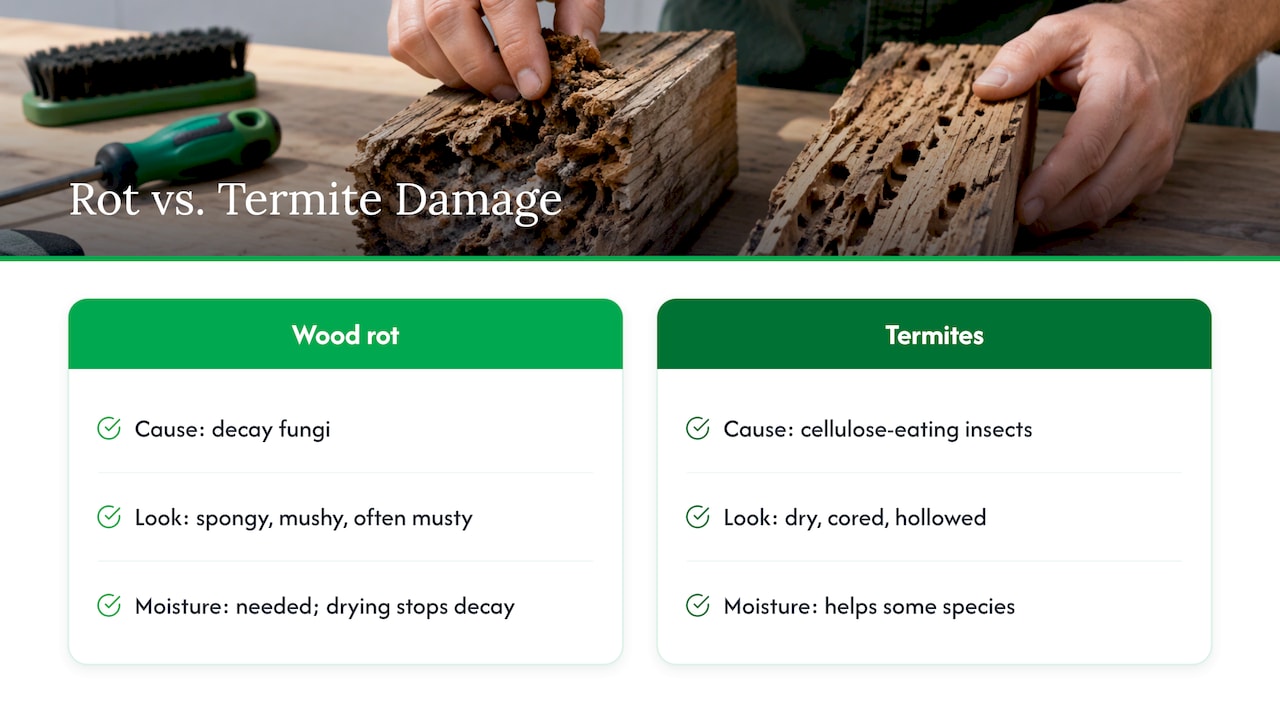
That one distinction drives everything else: what it looks like, how fast it spreads, what it costs and who fixes it.
Side-by-side comparison
| Clue | Wood rot | Termite damage |
|---|---|---|
| Cause | Fungus plus moisture | Living insect colony |
| Feel | Soft, spongy, damp, crumbles | Often firm on the surface, hollow underneath |
| Sound when tapped | Dull | Hollow |
| Inside the wood | No tunnels, just mush or cube-shaped cracks | Maze-like tunnels, sometimes dried mud |
| Smell | Musty, damp | Usually none |
| Common spots | Near plumbing leaks, window sills, decks, crawl spaces, roof leaks | Close to the ground, foundation, sill plates, joists |
| Extra clues | Fungal growth, shrunken or discolored wood | Mud tubes, discarded wings, tiny pellets, sticking doors |
| Speed | Slower, tied to how wet the wood stays | Can run unnoticed for years |
| First fix | Stop the water | Treat the colony |
The comparison is based on descriptions from the Spruce and Bob Vila.
What wood rot looks like
Rot comes in two main forms. Brown rot, which is more common in softwoods like the framing lumber in most houses, leaves wood dark brown, dry and fragile. It cracks across the grain into small cubes, according to Washington State University’s Pestsense fact sheet. White rot, more common in hardwoods, bleaches the wood and leaves it whitish, spongy or stringy.
In a house, rot shows up where water lingers. The American Society of Home Inspectors lists typical moisture-prone spots: crawl spaces, floor joists, eaves and fascia boards, door jambs and thresholds, window sills, deck posts, roof penetrations, attics, and any wood touching soil, stone or the exterior.
Signs you can check yourself:
- Wood that feels soft or crumbles under thumb pressure
- A musty smell near a leaky pipe, window or roof edge
- Paint that peels over damp wood
- Wood that has shrunk, cracked into cubes or looks stringy
- Visible fungal growth
Rot is usually easy to spot once it is advanced, because the damaged area is obvious and often wet. If your home has a damp crawl space, our crawl space inspection guide explains how moisture shows up there before wood suffers.
What termite damage looks like
The tricky part is that termites often leave the outer shell untouched. As University of Maryland Extension explains, subterranean termites tunnel inside wood, so even a very active infestation can appear normal from the outside.
The signs to look for, per the same extension page:
- Mud tubes, about 1/4 inch wide, on foundation walls or exposed wood
- Swarmer wings, silvery piles about 1/4 inch long on floors or windowsills
- Soil packed in cracks
- Dark or blistered wood with bubbling or peeling paint
- Structural weakness, such as sagging floors or settling cracks
Virginia Extension adds a useful detail: subterranean termites often eat the softer springwood and leave the harder grain and the surface intact, which is why it recommends tapping every few inches with a screwdriver handle until the wood sounds hollow.
Termite damage is slow but steady. NC State Extension reports that a colony of 60,000 workers could consume about a foot of a 2×4 in slightly over five months, and that serious damage usually takes about three to eight years to develop. That is the reason an old, hidden infestation can surprise a new owner.
The screwdriver test
The fastest way to separate the two is to probe the wood. InterNACHI describes a pick test used by inspectors: sound wood snaps crisply, while decayed wood breaks with a dull sound and little resistance.
Try this on a stained or soft-looking board, such as a sill, deck post or door frame:
- Tap first. Use the screwdriver handle. A dull thud suggests rot, a papery hollow sound suggests termites.
- Press the tip in. Rotted wood mushes with no structure. Termite-damaged wood may resist, then collapse into thin layers with tunnels.
- Look at what comes out. Crumbly cubes and dampness point to rot. Mud, tunnel walls or tiny pellets point to termites.
- Photograph it. Take clear pictures before you disturb anything more.
Keep it gentle. Do not pull out damaged wood or spray anything. The goal is information, not repair. And remember: a probe only tells you about the spot you probed.
When it is both
The either/or framing is useful for learning, but real houses often have both problems. InterNACHI notes that termites are attracted to decayed wood but also live in sound wood. Wet, softened wood is an easy meal, so a leaking window sill can start as rot and become a termite entry point.
That is why a quick look from a seller, or a single screwdriver poke, does not settle the question. Decay can also be hidden. The AITC technical guidance on timber notes that decay may exist even when it is not visible on the surface, and that professionals use tools such as moisture meters with long needles and stress wave timing to find it.
Why the fixes are so different
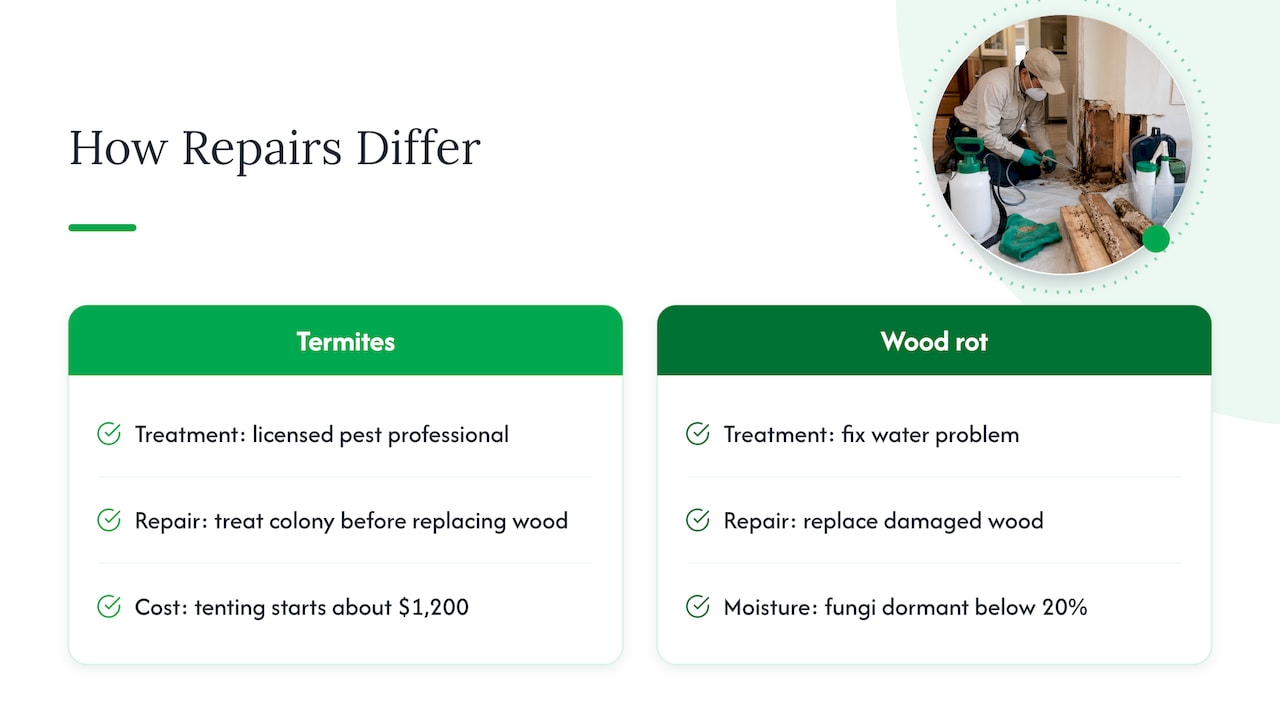
For termites, the colony has to be dealt with by a licensed pest control professional. Replacing the wood without treatment simply gives a live colony fresh lumber. Insecticide does nothing for rot, either. Costs vary widely by method: Bob Vila’s termite repair cost guide reports that tenting a home starts at about $1,200 and can exceed $2,500, and it recommends a second opinion before paying for treatment. Our own page on termite inspection cost covers what the inspection step involves.
For rot, the job is to fix the water problem: a leaking pipe, a failed flashing, bad grading, a missing gutter, a damp crawl space. Then damaged wood gets replaced. The AITC guidance says that once wood dries below 20% moisture, decay fungi go dormant and will not spread if the wood stays dry. It also says repaired members should not be sealed, painted or wrapped in ways that trap moisture.
When both are present, the sensible order is: confirm the damage, treat the colony, fix the moisture, then repair the wood. If framing, joists or beams are affected, a licensed contractor or structural engineer should decide how much wood is sound and how to replace it. The AITC note says the first repair step is determining how much sound wood remains.
Can a house be saved from termite damage? In most cases, yes, when the colony is stopped and damaged members are repaired. The Spruce notes that rot develops more slowly and can often be addressed if caught early, while termites can feed unnoticed until wood is beyond repair. Early detection is the difference.
Why this matters most when you are buying
If you are a first-time buyer, a seller’s “it’s just cosmetic” is a risk, because the two problems can sit behind fresh paint. NC State Extension points out there is no accurate way to date newly found termite damage without a record of when the wood was known to be undamaged. In a purchase, you usually have no such record, so the inspection becomes your baseline.
What a good inspection reports. InterNACHI’s Standards of Practice have inspectors report as needing correction items such as wood in contact with or near soil, active water penetration, possible foundation movement, and cutting or boring of framing members that creates a structural or safety concern. Those are exactly the conditions behind both rot and termite trouble.
Practical steps in a purchase:
- Order the wood-destroying organism (termite) inspection alongside the general inspection, within your inspection contingency window.
- Ask for the crawl space and basement to be checked, since that is where wood meets moisture and soil.
- Read the report for both words: “moisture,” “decay” and “evidence of wood-destroying insects.” Our home inspection red flags list and guide to what inspectors look for show how those items read on a report.
- Use the findings in negotiation: a repair request, a credit or a treatment before closing, depending on what your agent and the contract support.
- If you plan a loan with specific property requirements, such as FHA or VA, check what your lender asks for early, so the wood check does not surprise you late.
Owners should not wait for a sale. NC State Extension recommends annual inspections and keeping records, so that any future finding has a reference point. Decks deserve the same attention, since they are wet, exposed wood: see our deck safety inspection page on probe tests.
What to do if you suspect damage right now
- Do not tear out the wood or spray it. Disturbing a colony can make it harder to assess.
- Photograph the wood, any mud, wings or pellets, and the surrounding area, including nearby leaks.
- Find and note the water: stains, drips, damp insulation, clogged gutters.
- Get it inspected. The earlier the better, but termites generally work slowly, so you have time to do it right.
- If the structure feels compromised (sagging floor, a bouncy deck, a sagging beam), keep people off it and bring in a licensed contractor or structural engineer.
A quick note on mold: wet wood that has rot often also has mold. If you see it in a crawl space, our page on checking crawl space mold before closing explains how buyers document it.
Where our inspections fit
Hunt Home Inspection, LLC serves the St. Louis Metro area and Southern Illinois. Our buyer’s inspection covers the whole house, and a WDO/termite inspection is among the services we offer, along with mold inspection and crawl space evaluation. Reports are delivered within 24 hours, so you can act inside your contingency window. We offer in-person and video walkthroughs, evening and weekend scheduling for busy schedules, and service discounts for veterans and first-time buyers. Our team holds NACA, ASHI and HUD 203k credentials.
If you are a real estate agent, the same-day-turnaround reports and our Create Request List™ tool are built to move a buyer’s repair requests to you without back-and-forth.
See all of our inspection services or start with the buyer’s home inspection overview.

To book a termite or home inspection, visit our home page and request an appointment.
Our perspective
Most buyers we talk to ask the same thing: is this stain a leak, or is it bugs? The honest answer is that you often cannot tell from the surface, and that is the point of an inspection.
We think of wood damage as two questions. First, what is attacking the wood: water and fungus, an insect colony, or both? Second, how far has it gone? The first question decides who you call and in what order. The second decides how much money is at stake. A report that answers both, with photos, lets you negotiate with facts instead of fear.
That is why we pair the general inspection with a wood-destroying organism check when a buyer wants one, and why we pay attention to crawl spaces, sills and decks where moisture and wood meet. We deliver the report within 24 hours and offer evening and weekend slots and video walkthroughs, because decisions on a house do not wait for a convenient workday.
We also believe first-time buyers, veterans and families on a budget deserve the same thorough look as anyone else. That is why we offer discounts to veterans and first-time buyers, and why we explain findings in plain language.
JOHN
FAQ
How can I tell the difference between wood rot and termite damage?
Feel and sound are the best clues. Rotted wood is damp, soft and dull when tapped, often with a musty smell. Termite-damaged wood sounds hollow, may look fine outside and reveals tunnels or mud when probed. A screwdriver tip makes the difference obvious, but a professional check confirms it.
Can wood rot and termite damage happen together?
Yes. Termites are drawn to decayed wood but also live in sound wood, and both problems can occur in the same board or joist. Treating only one leaves the other. A full inspection looks at moisture and insects together.
What does it look like when termites eat wood?
From outside, wood may look normal or slightly darker, with blistered or bubbling paint. Inside, subterranean termites leave long tunnels along the grain, often with dried mud. Other signs include mud tubes about 1/4 inch wide, discarded wings on sills, and floors or doors that begin to sag or stick.
Can a house be saved from termite damage?
Often yes, if the colony is treated and weakened wood is repaired or replaced. Early detection matters, because damage can go unseen for years. When framing is affected, a licensed contractor or structural engineer should evaluate the repair.
Should I get a termite inspection before buying a house?
It is a smart step, especially for older homes or those with crawl spaces. Ask for it with your general inspection so the report arrives within your contingency period. Some loan programs and lenders have their own requirements, so confirm with your lender early.
Sources
- Termite Damage vs. Wood Rot: How to Tell the Difference (The Spruce)
- Termite Damage vs. Wood Rot: How To Know What’s Causing It (Bob Vila)
- How Much Does Termite Damage Repair Cost? (Bob Vila)
- Termites (University of Maryland Extension)
- Termites: Biology and Control (NC State Extension)
- Signs of Subterranean Termite Infestation (Virginia Extension)
- Wood Decay (InterNACHI)
- Home Inspection Standards of Practice (InterNACHI)
- Wood-rotting fungi (Washington State University Pestsense)
- Managing Risk Claim 8: Wood Rot (American Society of Home Inspectors)
- AITC Technical Note 13
Recent Comments