
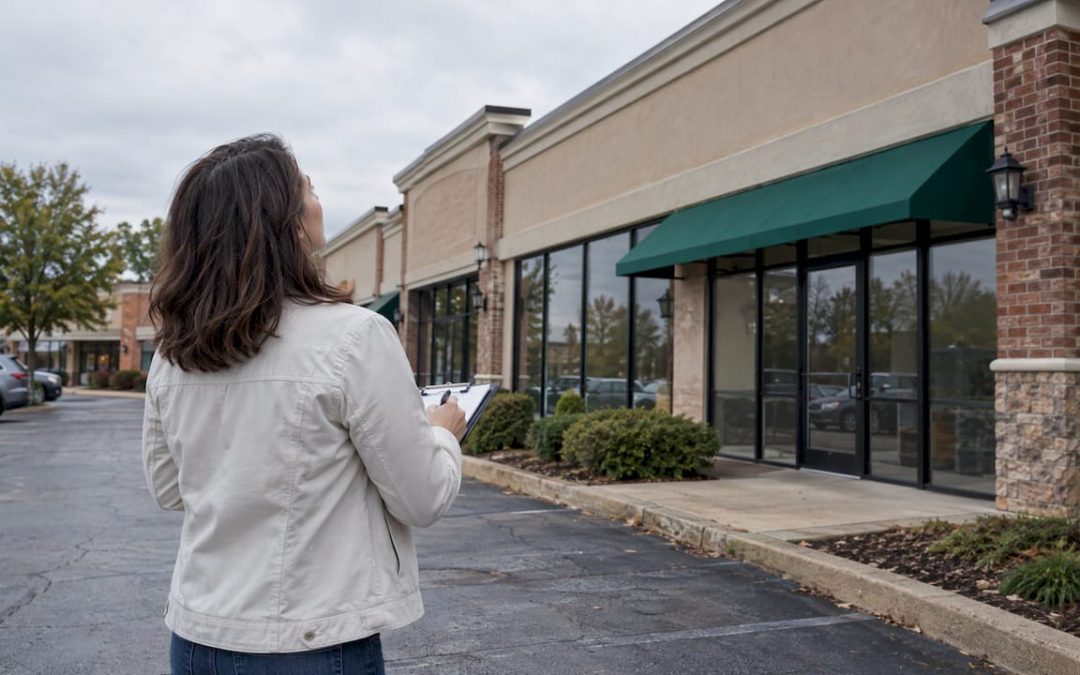
A retail property inspection is a visual, top-to-bottom review of a store, strip center or shopping center before you buy it, lease it or lend against it. It tells you what condition the roof, parking lot, HVAC, electrical, plumbing and fire-safety systems are in, so you can price repairs into your decision instead of discovering them after you sign. If you are a buyer, investor, landlord, tenant or agent in the St. Louis Metro area or Southern Illinois, we handle commercial inspections with written reports returned within 24 hours, and we can schedule evenings and weekends around a working day.
TL;DR
- A retail property inspection documents the physical condition of the building and its major systems. It is not a store operations audit and it is not a home inspection.
- It matters most before a purchase, a lease signing (especially a triple-net lease, where the tenant pays most building costs) or a loan draw.
- Shopping centers take more planning than a single suite: scope decides whether anchor stores, shell spaces and pad buildings are included.
- Ask for a dated written report with photos and a clear list of the systems reviewed, so you can use it in negotiation.
- Our reports come back within 24 hours, with video or in-person walkthroughs and evening or weekend scheduling.
Table of Contents
- What a retail property inspection actually is
- What gets checked
- Shopping center versus a single retail space
- How the process works, step by step
- What about a retail store inspection checklist?
- What it costs
- Who this is for, and where we fit
- Promo: Book your commercial inspection
- Our perspective
- FAQ
- Sources
What a retail property inspection actually is
The Commercial Property Inspection Association describes retail inspections as covering everything from pad sites and individual suites to malls, shopping centers and power centers. The goal is an understanding of the property’s physical condition as a whole, plus an inventory and evaluation of its major systems.
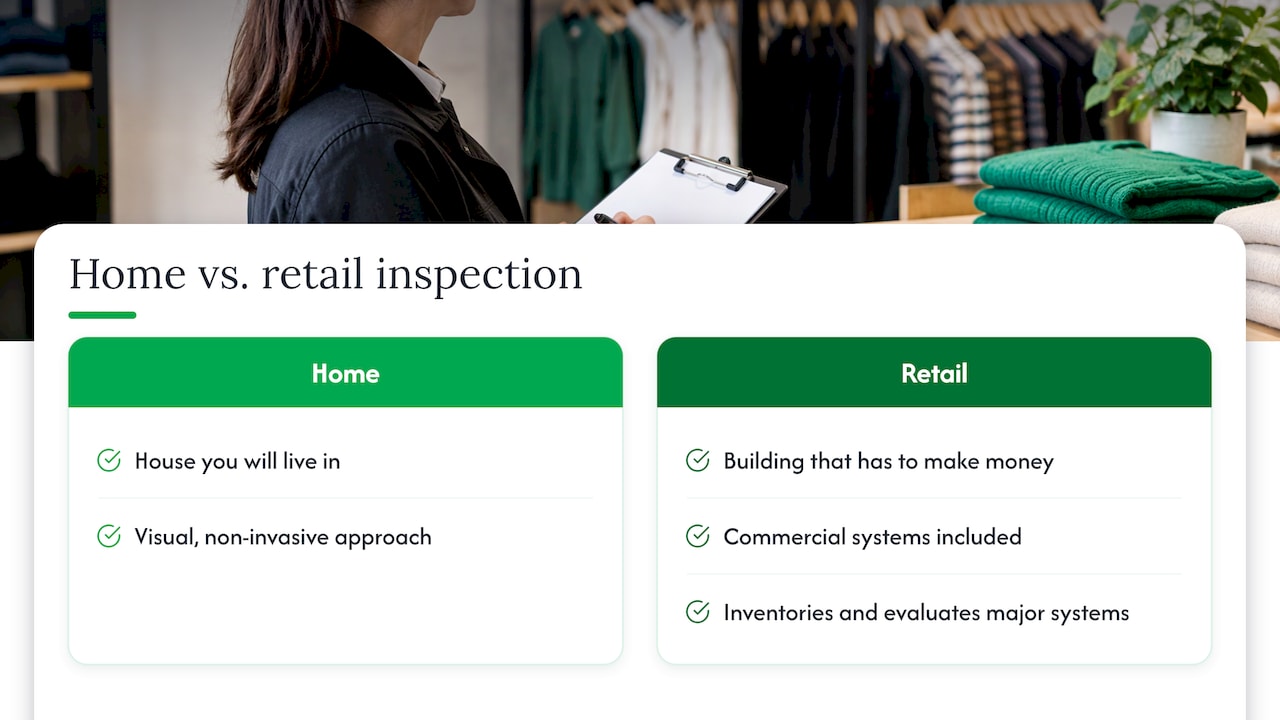
That is different from what most first-time buyers picture. A home inspection looks at a house you will live in. A retail inspection looks at a building that has to make money: it has to keep tenants or customers safe, stay open, and not drain the budget with surprise repairs. If you have only ever bought a house, our guide to what inspectors look for in a home is a good baseline. Retail work uses the same visual, non-invasive approach but adds commercial systems and a different kind of report.
Who needs one
The same association lists investors, lessors, and current and prospective lessees as the usual clients. In practice that means:
- Small-business owners buying a storefront. The building is probably your largest single expense. A failing roof or an undersized electrical service is a cost you carry personally.
- Tenants about to sign a lease. Under a net or triple-net lease, the tenant often pays for maintenance, taxes and insurance. The same association notes these lease types make inspections especially important for both landlord and tenant, because who pays for the HVAC unit that dies in year two depends on what was documented at the start.
- Investors. If you are weighing a strip center against a rental house, see our notes on investor property inspections.
- Landlords and sellers. Knowing the condition of your own building before a buyer’s inspector does keeps negotiations from surprising you.
- Lenders and agents. A condition report supports a loan decision, and it gives an agent something concrete to bring to the table.
The association also points out that retail competes on product niche and on operating costs, mainly rent, so understanding a property’s condition is a safeguard against unforeseen costly maintenance and repairs.
What gets checked
Every building is different, but a retail inspection follows the same logic: look at the shell, then the systems, then the parts customers and tenants use every day.
| Area | What the inspector looks at | Why it matters for retail |
|---|---|---|
| Roof and drainage | Membrane or covering condition, ponding water, flashing, rooftop equipment curbs, canopies | Flat and low-slope roofs are common on retail buildings, and a leak damages inventory and finishes |
| Structure and exterior | Foundation, walls, cracks, storefront glazing, doors, signage mounts | Visible movement or water staining points to deeper problems |
| Parking lot and sitework | Paving, curbs, striping, accessible routes, drainage, sidewalks | Customers walk here first; trip hazards and ponding are liability issues |
| HVAC | Rooftop units or split systems, age, condition, service access | Often the most expensive single replacement item |
| Electrical | Service size, panels, visible wiring, lighting, emergency lighting | Tenant build-outs often add load to old services |
| Plumbing | Water heaters, restrooms, visible supply and drain lines, grease or floor drains | Restrooms and drains see heavy use |
| Fire and life safety | Alarms, extinguishers, sprinklers, exit signs, egress paths | Safety and insurance both depend on it |
| Interior common areas | Corridors, restrooms, loading areas, back-of-house | Reveals how the property has been maintained |
The industry’s standard process is a walk-through survey of visual observations plus research: reviewing documents such as previous inspection reports, building permits, code violation notices and environmental assessments, and talking to building managers, tenants and owners. The result is a written report. Before the inspection, gather what you can from the seller or landlord: permits, roof and HVAC service records and any past reports. The more history the inspector has, the more precise the findings.
Add-on testing that often belongs with a retail purchase
Beyond the building itself, some retail properties call for specialized checks. We offer several that apply to commercial and mixed-use properties: sewer camera lateral inspections, wood-destroying organism and termite inspections, mold inspection, radon testing and environmental testing. Ask which are worth adding based on the building’s age, use and the ground it sits on.
Shopping center versus a single retail space
This is where buyers and tenants most often misunderstand the scope. A single suite is straightforward. A multi-tenant center is not.
The ASTM E2018 standard for baseline property condition assessments includes an appendix on retail buildings. It says that for shopping-center-type properties, the consultant is not required to survey the interior of shell-finish tenancies or anchor stores unless that is specifically included in the scope, and that pad buildings with different ownership are excluded. Representative observations must cover each building individually, with a mix of occupied and unoccupied spaces plus common areas. Canopy roofs, loading docks and flatwork (the concrete slabs and walkways) are to be reported.
What that means for you:
- Decide up front what you own or are responsible for. An anchor store may carry its own maintenance obligations. A pad building next door may belong to someone else.
- Put the scope in writing. If a vacant shell space matters to your deal, say so before the inspection, because it will not necessarily be included by default.
- Expect sampling. In a large center, not every unit is opened. The inspector reviews a representative mix, which is why we explain our sampling approach in our commercial inspection checklist and sampling rules.
- Plan for more systems. A multi-tenant property can have separate rooftop units, electrical panels and plumbing systems, which takes more evaluation than a single-tenant space.
For a freestanding store or a single in-line suite, the question is simpler: which parts of the building does your lease or purchase make you responsible for? The inspection should be built around that answer.
How the process works, step by step
1. Define your reason and your scope
Tell the inspector whether you are buying, leasing, selling, refinancing or drawing on a construction loan. Name the buildings, the suites and any systems you care about. For buyers, this is also the moment to decide whether a basic condition inspection is enough or whether a lender requires a more formal format.
We offer buyer’s, seller’s and loan draw inspections as well as investor and mortgage consultations. You can see the full list on our inspection services page.
2. Gather documents
Permits, prior reports, roof warranties, service records for HVAC and fire systems, and any code violation notices. This is the research half of the job. Missing records are themselves useful information about how a property has been maintained.
3. The walkthrough
The inspector walks the property, looking at what can be seen without taking things apart. The franchise site-survey standard describes this as a visual inspection using common non-destructive means, recorded in checklists, narrative and photos. It applies to shopping centers, in-line spaces, freestanding buildings and former restaurants alike.
If you cannot be on site, we offer video walkthroughs as well as in-person ones, and we schedule evenings and weekends, which helps if you are running your own business and cannot close the shop on a Tuesday morning.
4. Read the report
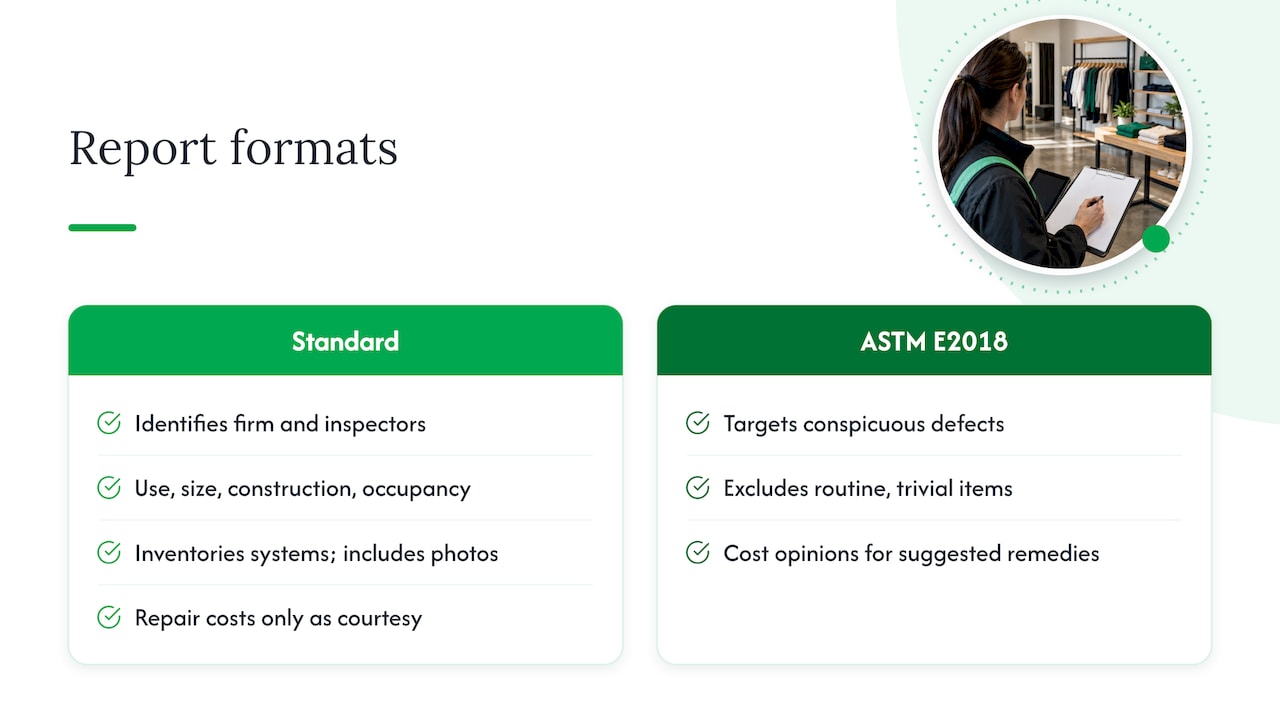
The professional standard says the report should be dated, identify the firm and inspectors, describe the property (use, size, construction, occupancy), and include an inventory, descriptions and photo documentation of material systems and components. It also notes that repair cost estimates fall outside the standard scope unless offered as a courtesy.
A more formal property condition assessment under ASTM E2018 goes further. It aims to identify conspicuous defects and material deferred maintenance, leaves out items fixed by routine maintenance and trivial conditions, and produces a report that includes opinions of cost for suggested remedies. Which format you need depends on the transaction: some lenders ask for the formal version, and many small buyers and tenants do well with a clear condition report. Ask your lender early.
Our reports are delivered within 24 hours, which keeps you inside typical due diligence windows. Check your contract’s inspection period before you book so the report lands with time to negotiate.
5. Use the findings
A good report gives you three levers: ask the seller to repair, ask for a price reduction or credit, or negotiate who bears which cost in a lease. It can also tell you to walk away. Prioritize by safety and water first, then major systems near end of life, then cosmetic items.
What about a retail store inspection checklist?
People searching this phrase sometimes mean two different things.
Building condition. This is the property inspection described above: roof, systems, structure, site.
Store operations. Retail audit guides cover things like aisle clearance, merchandise storage, lighting, security cameras, and safety, loss prevention and customer experience, plus comparing physical inventory counts with point-of-sale records. That is a management routine run by store staff, and it is separate from the building.
If you are buying or leasing, you need the first. A simple pre-visit checklist you can run yourself on a tour:
- Look up at ceilings for stains, sagging tiles or buckets
- Check that exit signs and emergency lights are present and lit
- Note the age labels on rooftop or ceiling HVAC units if you can see them
- Walk the parking lot for ponding, cracked asphalt and trip hazards
- Run restroom faucets and flush toilets
- Ask what the last roof and HVAC service dates were
Those observations help you ask better questions. They do not replace a trained inspector’s report, and the questions you note are exactly what to hand over when you book.
What it costs
Price depends mostly on size, age, complexity and the report format. Square footage is the usual starting point, and a formal ASTM-style assessment takes more time than a summary report. We do not publish a price list for commercial work, so the practical step is to send the address, approximate square footage, number of tenants and your deadline, and ask for a quote. A quote based on those details is the only number that will match your building.
Who this is for, and where we fit
Most of our readers are first-time buyers, veterans, families working with a budget, busy professionals and agents who need dependable reports. If you are buying a small retail space, leasing a storefront for a new business or advising a client who is, the same principles apply: define the scope, get the documents, read a dated report and use it.
We inspect homes and commercial properties in the St. Louis Metro area and Southern Illinois, with video and in-person options and evening and weekend appointments for people who work full time.
Our certifications include NACA, ASHI and HUD 203k, and we offer service discounts for veterans and first-time buyers. For investors, we also offer consultations that connect inspection findings to the numbers. Our Create Request List™ tool is built to streamline communication between buyers and their agents, so the findings turn into a clear repair request.
Promo: Book your commercial inspection
If you are looking at a storefront, in-line suite or small center, our commercial inspection service covers the building and its systems and returns the written report within 24 hours. Pick a video or in-person walkthrough, and ask about evening or weekend times.
If you are comparing building types, our guides to office building inspections and industrial building inspections show how the checklist changes by use.
Our perspective
A retail building is a business expense that happens to have a roof. Most people who buy or lease one spend weeks on the rent, the traffic count and the build-out, then give the building itself an afternoon.
We think that is backwards. Roofs, rooftop units, electrical service and drainage are the costs that arrive without warning, and they arrive on the owner’s or tenant’s schedule, not yours.
Our approach is built around people who do not have a corporate facilities team: first-time buyers, veterans, small families and owners running their own shop. That is why we offer video and in-person walkthroughs, evening and weekend appointments, and reports within 24 hours. You get the information while the decision is still open.
Ask us to inspect before you sign. Define the scope, decide which add-ons fit, and bring the report to the negotiating table.
JOHN
FAQ
Is a retail property inspection the same as a home inspection?
No. Both are visual and non-invasive, but a retail inspection covers commercial systems, parking and site, fire and life safety and often a multi-tenant layout. The report is also written for a buyer, tenant or lender weighing a business decision. We offer both kinds of inspection.
When should I schedule one?
Before you commit: during your due diligence window on a purchase, or before you sign a lease. Check the dates in your contract first, because the report needs to arrive with time left to negotiate. Our reports return within 24 hours.
Does the inspector go inside every unit in a shopping center?
Not necessarily. Under the ASTM E2018 retail appendix, shell-finish tenancies and anchor store interiors are not required unless specifically included in scope, and observations are representative. If a particular unit matters to your deal, put it in the scope before the inspection.
Will the report include repair costs?
Under the commercial inspection standard, repair cost estimates are outside the scope unless offered as a courtesy, while a formal property condition assessment includes opinions of cost. Tell us at booking which format your lender or deal requires.
Sources
- Retail Property Inspection, CCPIA
- CCPIA ComSOP Commercial Inspection standard, 2026
- ASTM E2018-15 Property Condition Assessments, retail appendix
- ASTM E2018-15 Property Condition Assessments, goals and report
- Site survey inspection list
- Store audit guide
Recent Comments