
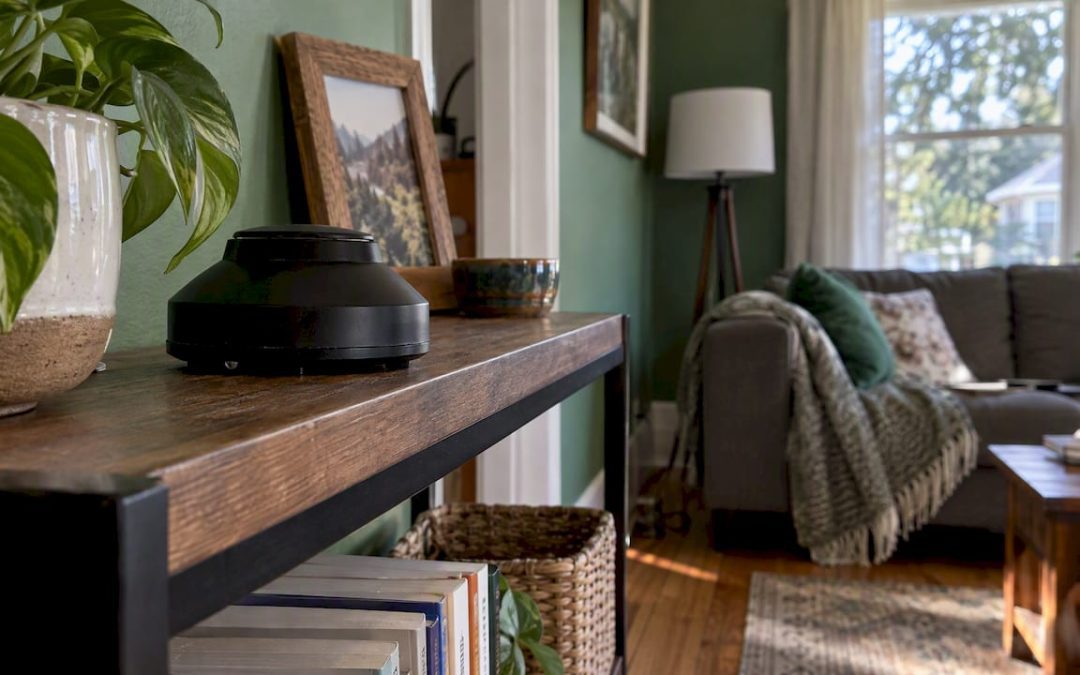
A radon test takes at least 48 hours, and most short-term tests run two to seven days. A long-term test runs longer than 90 days. Which one you need depends on whether you are screening a house you are about to buy or sell, or trying to learn the true year-round level in a home you live in. The rest of this guide covers how long each test runs, when you get results, what can throw off the numbers, and what to do with a high reading.
TL;DR
- Every radon test should run a minimum of 48 hours, and some devices need longer.
- Short-term tests cover 2 to 90 days. Long-term tests cover more than 90 days and better reflect the annual average.
- For a home sale, a 48-hour to 7-day short-term test is the usual screening tool because it fits inside an inspection window.
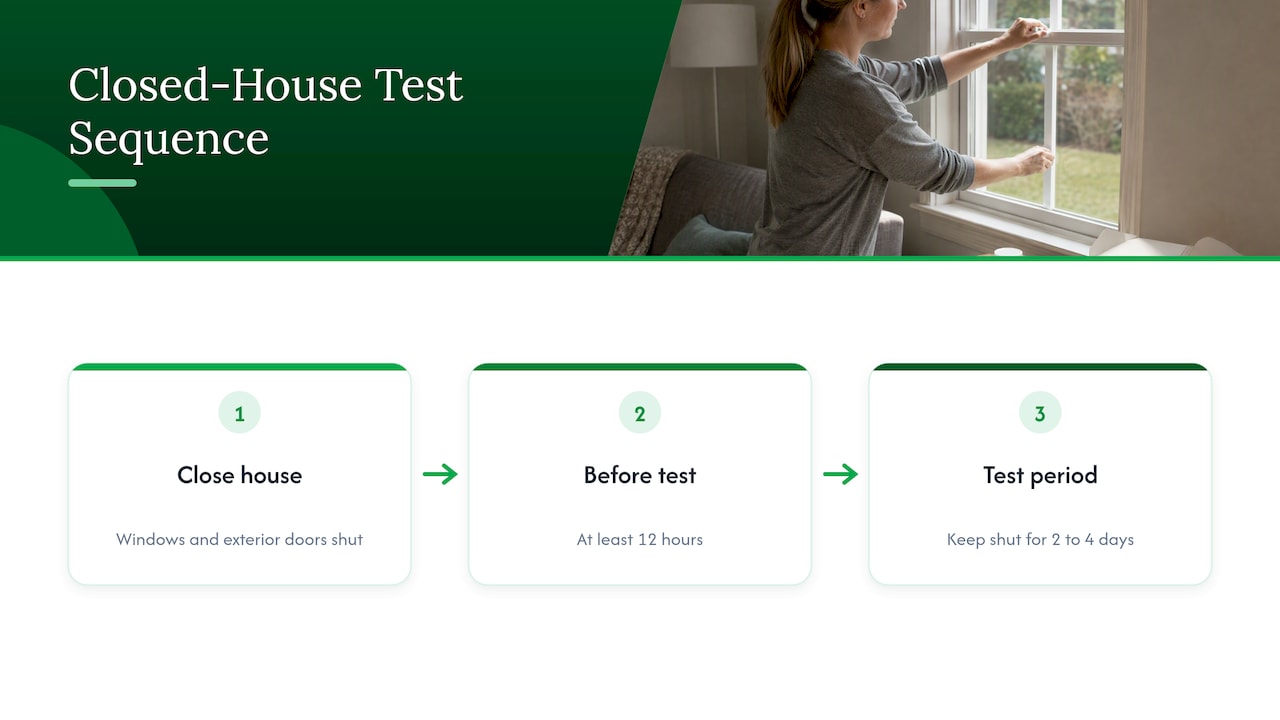
- Keep windows and exterior doors closed (except normal entry and exit) for at least 12 hours before a 2 to 4 day test and throughout it.
- A result of 4.0 pCi/L or higher is the EPA’s action level. Confirm with a second test before you spend money on a fix.
Table of Contents
- How long does a radon test take?
- Short-term vs. long-term radon tests
- Radon testing methods and how they differ
- How accurate is a 48-hour radon test?
- What to do with your result
- Perspective: how we schedule radon testing around a sale
- Plan the test around your closing
- Radon testing with Hunt Home Inspection
- FAQ
- Sources
How long does a radon test take?
There are two answers, because there are two families of tests.
The CDC describes short-term testing as measuring radon for anywhere from 2 to 90 days for quick results. In practice, most devices used in home sales are set for 2 to 7 days. The EPA’s buyer and seller guide puts the dividing line at 90 days: short-term tests last 2 to 90 days, and long-term tests last longer than 90 days. Wisconsin’s health department sets the long-term minimum at 91 days and notes that typical long-term tests run six to twelve months. We could not verify that page’s current wording, so treat the 91-day figure as the commonly cited practice and confirm it with your state radon program.
| Test type | Typical duration | Best for | Weakness |
|---|---|---|---|
| Short-term | 2 to 7 days (up to 90 days) | Real estate screening, a first look at a home | Captures only a snapshot of a variable number |
| Long-term | 91 days to 12 months | Annual average, deciding on long-term exposure | Too slow for a sale contract |
Time on the wall versus time to results
These are different clocks. The test period is how long the device sits in your home. The results clock depends on the device type:
- Continuous monitors log radon hour by hour. The professional who set it up can read the data when the test ends, often the same day.
- Passive devices such as charcoal canisters or alpha track detectors are sealed and sent to a lab. Utah’s environmental agency says you should get lab results within a couple of weeks, and warns that waiting too long to mail a completed kit can invalidate the result.
Exposure windows are also strict. Connecticut’s health department tells residents to leave a device in place for 2 to 7 days and says the lab will not analyze it if exposure was shorter or longer. Read the instructions on your own kit before you put it down.
Short-term vs. long-term radon tests
When a short-term test is the right call
If you are buying or selling, time is the constraint. An inspection period is usually measured in days, not months. A 48-hour or multi-day short-term test fits that window and tells you whether a home is likely above or below the EPA’s action level. It is also a sensible first test for a home you already own.
The tradeoff is that radon is not constant. Indoor levels shift with weather, furnace and fireplace use, and with how often windows and doors open. They are also often highest during the heating season. A short test captures only the days it ran.
When a long-term test is worth the wait
A long-term test averages out those swings. A 2024 critical review of the scientific literature found that short-term testing is cost-effective but loses accuracy for predicting annual averages when levels are moderate, which often calls for a three-month follow-up. The same review notes that short-term tests may miss seasonal swings, while long-term tests are inherently better at estimating annual exposure.
So a long-term test makes sense when:
- Your short-term result falls near the action level and you are not selling on a deadline.
- You have already moved in and want to know your real yearly exposure.
- You are deciding whether a modest reading justifies installing a mitigation system.
Radon testing methods and how they differ
The EPA guide groups devices as passive or active. Both need at least 48 hours.
| Method | Examples | How you get results |
|---|---|---|
| Passive | Charcoal canisters, alpha track detectors | Mailed to a lab for analysis |
| Active | Continuous radon monitors | Data is read directly from the device |
For a real estate transaction, active monitors are the practical choice. They take hourly readings, which lets the inspector see whether the numbers were stable or whether a door was opened mid-test, and nothing has to be mailed. A 2024 metrology paper points out that uncertainty is highest in the shortest tests, and that U.S. practice uses tests longer than two days.
How accurate is a 48-hour radon test?
Good devices, used properly, are accurate. The Kansas Radon Program notes that almost all commercial radon devices have been evaluated under the EPA’s measurement proficiency program, which required results within plus or minus 25% of established levels to pass.
The bigger question is whether a 48-hour reading represents your house. Two things matter more than which device you choose.
Closed-house conditions
Kansas says the largest source of error is failing to keep closed-house conditions, not the type of device. The EPA guide requires windows and exterior doors to stay shut, apart from normal coming and going, for at least 12 hours before the test and throughout a 2 to 4 day test. That means no whole-house fans, no propping the door for a delivery, and no running a window air conditioner that pulls outside air.
Placement and weather
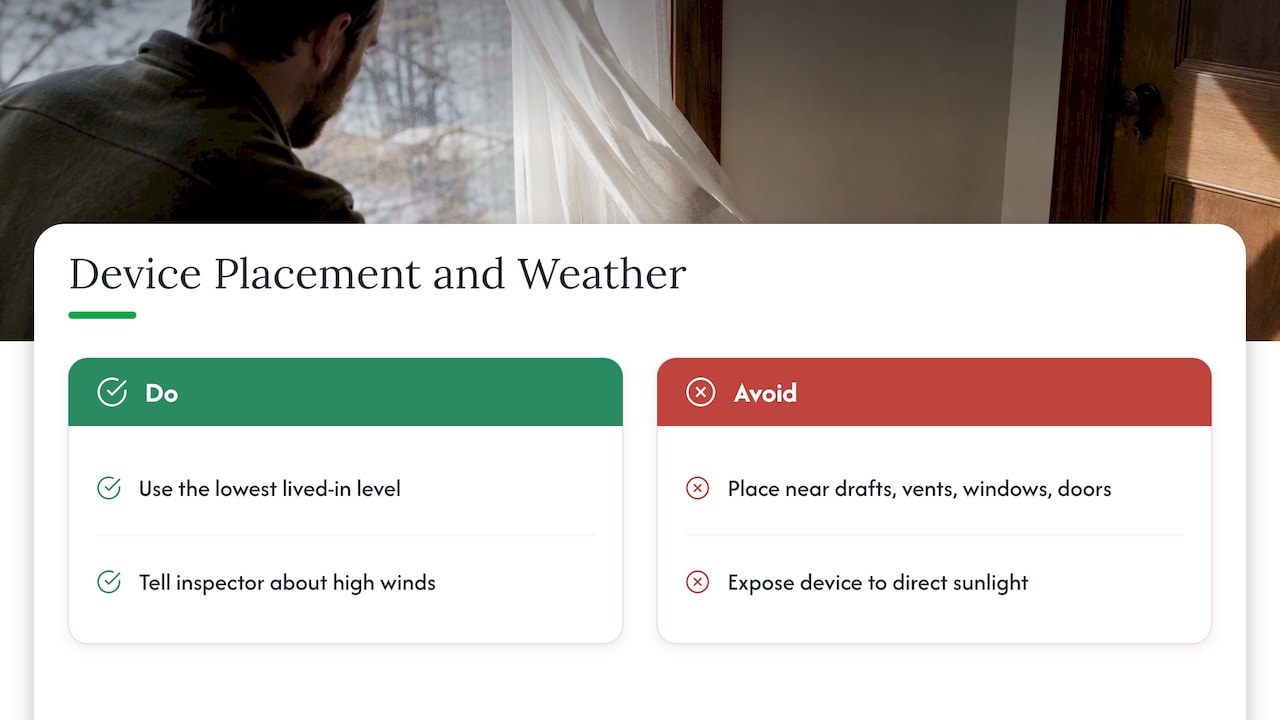
Colorado’s health department says to place the device on the lowest lived-in level, such as an occupied basement or the first floor, away from drafts, vents, windows and exterior doors. Connecticut’s checklist adds that severe weather and direct sunlight can skew results. If a storm with high winds rolls through mid-test, tell your inspector. A rerun costs less than a decision made on a bad number.
The same discipline applies to other environmental checks. If your home has a private well, for instance, a guide to well water testing costs can help you budget for the lab work that sits alongside radon testing in many rural and small-town purchases.
What to do with your result
The EPA recommends reducing radon when levels reach 4.0 pCi/L or higher. After a short-term test, the EPA says to take a second test, either short-term or long-term, and average the two if both are short-term.
Here is how that plays out:
- Below 2.0 pCi/L: Nothing urgent. Retest every couple of years or after major changes to the house.
- 2.0 to 3.9 pCi/L: Below the action level, but Connecticut recommends a follow-up test in the same location within a month once a result reaches 2.0 or higher. If you are not on a deadline, a long-term test settles it.
- 4.0 pCi/L or higher: Test again. Per the Kansas program, if the first short-term reading is above 10.0 pCi/L, the EPA recommends a second short-term test right away and using the average to decide on mitigation.
A high number is not a reason to walk away from a house. Radon can be reduced, and if you are in the middle of a purchase, a certified radon mitigation contractor can quote the work so you can negotiate with real figures.
Perspective: how we schedule radon testing around a sale
We see the same mistake every season: a buyer orders the radon test late, the kit sits in a house with the windows cracked open, and the number means nothing. Our approach is built around the timeline of a real estate deal.
We put radon on the schedule at the start of the inspection period, not the end. A 48-hour test needs that much time before the report is due, plus the closed-house hours beforehand. We tell buyers and agents what needs to stay shut and ask sellers not to air out the house the day before.
We also treat a test result as a decision tool, not a verdict. A borderline reading in January means something different from a borderline reading in May. If a short-term result lands near the action level and your contract allows it, we will talk through a confirming test rather than push you toward an expensive fix. Our reports go out within 24 hours, and our Create Request List™ lets you turn findings into clear repair requests your agent can send straight to the seller.
Our certifications and our support for first-time buyers, veterans and families on a tight budget shape how we work: we would rather you understand your number than buy a system you do not need.
— JOHN
Plan the test around your closing
A few practical points keep the testing period from becoming the slowest part of your deal.
- Order radon with the home inspection. Doing both in the same visit schedule means the device is placed on day one, and the data is back before your inspection contingency ends.
- Match the test to the lowest lived-in level. If the basement is finished or could be, tell your inspector so it is tested where you would actually spend time.
- Ask when the house was last closed up. Open windows and an active whole-house fan will affect the result.
- Keep the retest option open. If the first number is high, a second short-term test can often be done within days, which is faster than renegotiating a closing date.
- Compare against the action level, not a national average. Radon varies house by house, even on the same street.
For more on why radon should be near the top of your testing list, see our guide on environmental home testing for buyers. It sits alongside lead testing for good reason, and our page on the dangers of radon in the home explains what is at stake. If you want to understand where radon fits among other hazards, read what an environmental hazard inspection covers.
Radon testing with Hunt Home Inspection
We offer radon testing for buyers, sellers and investors across the St. Louis Metro area and Southern Illinois, alongside buyer’s inspections, mold, sewer camera, septic and well, and termite inspections. Evening and weekend appointments are available, we offer discounts for veterans and first-time buyers, and you get your report within 24 hours. See our inspection services or reach out through our home page to add radon to your inspection.
FAQ
How long do you leave a radon test in the house?
At least 48 hours, and for most short-term kits two to seven days, depending on the device. Follow the kit’s instructions exactly, because some labs reject devices exposed for too short or too long a period.
Is a 48-hour radon test enough?
It is enough for screening, which is why it is standard in real estate deals. It records only the days it ran, so a result near 4.0 pCi/L should be confirmed with a second short-term test or a long-term test.
How long before I get radon test results?
With a continuous monitor, results are available as soon as the test ends. With a mailed kit, expect about two weeks, and send it promptly after the exposure period ends so the result stays valid.
When is the best time of year to test?
Radon is often highest during the heating season, when houses are kept closed up. A winter test is more likely to show a higher-end reading, but a short-term test can be done any time if you keep closed-house conditions.
Sources
- Testing for Radon in Your Home, CDC
- Home Buyer’s and Seller’s Guide to Radon, EPA
- How to Test Your Home for Radon, Utah DEQ
- Radon Test Checklist, Connecticut DPH
- Frequently Asked Questions, Kansas Radon Program
- Testing Devices, National Radon Program Services
- Short-Term vs. Long-Term: A Critical Review of Indoor Radon Measurements
- Metrology for Indoor Radon Measurements
- Testing and mitigating your home for radon, Colorado
Recent Comments