

Effective communication is the inspector’s primary tool for protecting clients from bad decisions, not just a courtesy that comes after the technical work is done. When it works, three things happen: the client understands exactly what’s wrong with the house, knows which issues to act on first, and walks away with a written record that holds up if a dispute surfaces later.
That’s the whole job, really. The inspection itself is just data collection. Everything the client actually uses to make a decision, negotiate a price, or plan a repair budget depends on how well the inspector translates what they found into something a non-expert can act on.
This article covers:
- What makes communication effective before, during, and after an inspection
- How to structure a report so it holds up as a defensible record
- How to handle tense moments without losing the client’s trust
- Which tools and templates make consistent communication routine instead of accidental
Key Takeaways
Clear, consistent, client-focused communication turns a technical inspection into a decision-making tool that reduces disputes and builds lasting trust.
| Point | Details |
|---|---|
| Set expectations early | Confirm scope, duration, and access requirements before the inspection to prevent the most common complaints. |
| Explain findings in real time | Use the observation, plain explanation, meaning, next-step pattern to make each finding actionable on the spot. |
| Structure reports by urgency | Lead with an executive summary and sort findings into safety, urgent, moderate, and minor tiers. |
| Document tense exchanges | Acknowledge feeling, state fact, and follow up in writing within 24 hours of any difficult conversation. |
| Choose a communication-first inspector | Jhunthomeinspections delivers 24-hour reports, offers video inspections, and uses the Create Request List™ to keep buyers and agents aligned. |
Table of Contents
- The Role of Inspector Communication Explained Through Core Principles
- Setting Expectations Before the Inspection Begins
- Talking to Clients During the Inspection Itself
- Writing Reports That Reinforce What You Already Said
- Handling Tense or Emotional Conversations Without Losing Ground
- Tools That Make Clear Communication Repeatable
- How These Practices Show Up in Real Inspection Work
- Where Ethics and Liability Meet Inspector Communication
- What Changes When an Inspector Insists on Client Attendance
- Book an Inspection Built Around Clear Communication
- Sources
The Role of Inspector Communication Explained Through Core Principles
Inspectors who communicate well tend to lean on a version of the source-message-channel-receiver model, usually shortened to SMR. The idea is simple: a message only lands if the source frames it clearly, the channel fits the moment (spoken explanation on-site, written detail in the report), and the receiver actually understands it the way it was intended. That last part is where most inspectors fall short. They explain something correctly and assume the job is done.
“Proofing” the message closes that gap. It means asking the client to repeat back what they heard, in their own words, before moving on. If a client says “so the roof needs full replacement now” when the inspector actually said “the roof has 3 to 5 years of life left,” that gap gets caught on the spot instead of surfacing during a heated conversation two weeks later.
Plain language isn’t a style preference. The information an inspector gathers belongs to the client, and translating technical findings into language the client can actually use is part of the job, not an optional add-on. A phrase like “signs of moisture intrusion at the sill plate consistent with capillary action” means nothing to a first-time buyer. “Water is getting into the wood at the base of the house, and it needs a licensed contractor to look at within the next few months” does.
Consistency between what’s said on-site and what appears in the written report matters more than most inspectors realize. If the verbal walkthrough downplays an issue that the report later flags as urgent, the client reasonably feels misled, and that gap is exactly what fuels disputes.
- Say it the same way twice: verbally on-site, then in writing
- Use the client’s vocabulary, not the trade’s
- Ask the client to restate key findings before moving to the next room
- Flag anything urgent immediately, don’t save it for the final summary
Pro Tip: Before ending a walkthrough on any major finding, ask “What’s your takeaway on that one?” It takes ten seconds and catches misunderstandings while you can still fix them.
Communication isn’t a soft skill layered on top of inspection work. It functions as a primary risk management strategy, and one inspector attributes a long career without lawsuits directly to prioritizing clear, non-technical explanations over technical precision for its own sake.
Setting Expectations Before the Inspection Begins
Most client complaints trace back to a mismatch between what they expected and what actually happened, and almost all of that gets fixed with a few messages sent before the inspector ever shows up. InterNACHI’s guidance on inspector communication makes the point directly: communication starts well before the walkthrough, and clients process information differently depending on who they are.
Four things need to be communicated ahead of time, every time:
- Scope — what’s included, and just as important, what’s excluded (septic, well, and sewer camera inspections are usually separate services, and clients need to know that upfront)
- Duration — a realistic time window, not a guess (“plan for 2 to 3 hours for a typical single-family home”)
- Access requirements — utilities on, pilot lights lit, pets secured, and any locked areas unlocked
- Attendance guidance — whether the client should show up, and when during the process it’s most useful for them to arrive
Investors want something different from first-time buyers. An investor evaluating a fourth rental property usually wants the bottom line and repair cost estimates, fast. A first-time buyer needs more hand-holding: what’s normal wear, what’s a red flag, and reassurance that a 40-year-old furnace isn’t automatically a deal-breaker. Adjusting the pre-inspection message to match that reader saves time for everyone.
A short confirmation text or email the day before works better than a phone call most clients won’t pick up:
- “Confirming your inspection tomorrow at 9 AM. Please plan for 2 to 3 hours. All utilities should be on. You’re welcome to arrive around the halfway mark for a walkthrough of key findings.”
Agents deserve their own message: confirm lockbox codes, ask whether the seller will be present, and flag any known access issues (locked crawl space, aggressive dog, occupied unit) ahead of time. Miscommunication between transaction parties is one of the more common reasons closings get delayed, and a confirmation message that repeats key logistics catches most of those problems before they cost anyone a closing date.
Talking to Clients During the Inspection Itself
Inviting the client to attend, even for just the last 30 to 45 minutes, changes the entire dynamic of the report conversation. A client who watched an inspector point at a cracked foundation footing and explain what it means absorbs that information differently than one reading the same finding cold in a PDF three days later.
The clearest way to explain a finding on-site follows a simple four-part pattern:
- Observation — “This outlet near the sink doesn’t have GFCI protection.”
- Plain explanation — “GFCI outlets shut power off instantly if water gets involved.”
- What it means — “Right now, that’s a shock risk near a water source.”
- Next step — “A licensed electrician can usually swap this for about the cost of the part plus an hour of labor.”
That pattern works because it separates fact from judgment. It states what’s there, translates it, explains the stakes, and gives an action, without editorializing about the seller or the house.
Active listening carries as much weight as clear explaining. Communication during inspections runs on verbal, nonverbal, and graphic channels at once, which means an inspector who’s only paying attention to what they’re saying is missing half the conversation. Watch for crossed arms, a client stepping back from a finding, or a long pause after a number gets mentioned. Those are all signals to slow down.
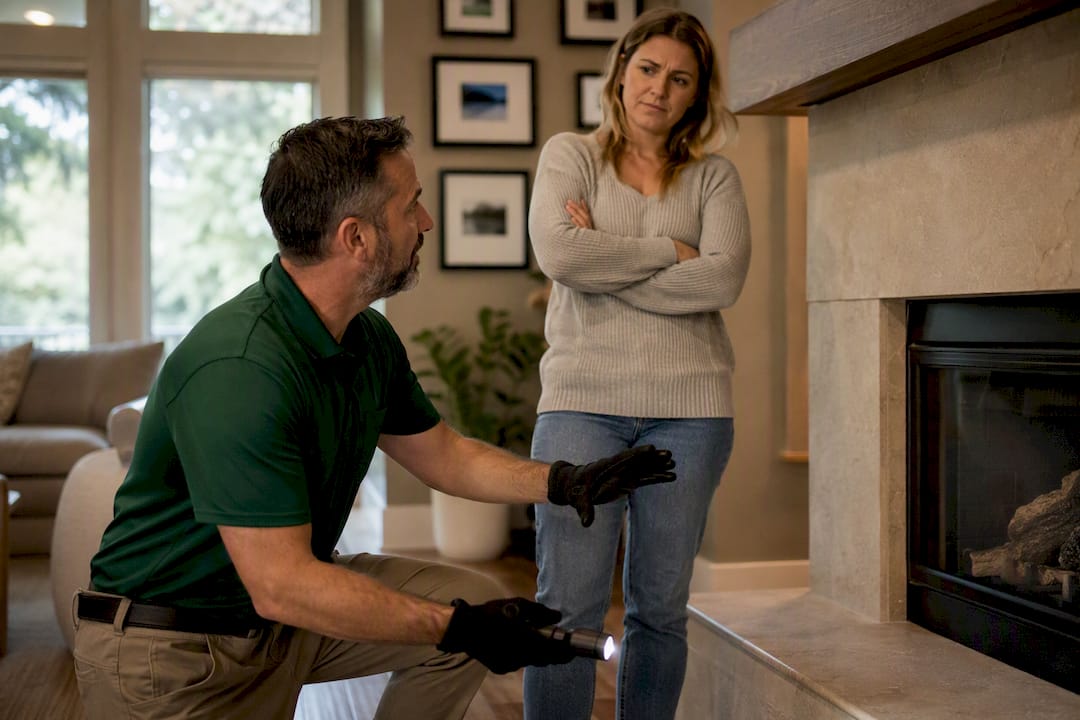
When a client gets defensive or anxious, swapping “but” for “and” keeps the conversation from turning combative. “I understand this is stressful, but the furnace really does need replacing soon” invalidates the stress. “I understand this is stressful, and here’s what your options look like for the furnace” keeps both facts on the table without picking a fight.
Pro Tip: If a client asks a question mid-inspection that you can’t answer confidently on the spot, say so. “I want to check that detail before I give you a number” builds more trust than a guess that turns out wrong.
Writing Reports That Reinforce What You Already Said
A written report exists to back up the verbal walkthrough, not contradict or duplicate it. The strongest reports open with an executive summary, then organize findings by urgency instead of by room, which is how most clients actually think about what to fix first.
Four priority tiers cover nearly every finding:
| Priority Tier | What It Signals | Typical Client Action |
|---|---|---|
| Safety | Immediate hazard to occupants | Address before move-in |
| Urgent | Significant cost or failure risk | Negotiate or repair before closing |
| Moderate | Needs attention within months | Budget for near-term repair |
| Minor | Cosmetic or low-impact | Track for future maintenance |
Annotated photos do more work than paragraphs of description. A photo with a one-line caption pointing directly at the defect answers the client’s first question, “where exactly is this?”, before they even have to ask it, and it becomes objective evidence if a dispute ever comes up during negotiation.
Terminology needs to stay consistent and nonjudgmental across every finding. “Deferred maintenance visible on exterior trim” describes a fact. “Seller clearly neglected this house” describes an opinion, and it’s the kind of line that turns a factual report into a liability. A clear, buyer-focused inspection summary sticks to observable conditions and lets the client draw their own conclusions about what it means for negotiation.
- Lead with an executive summary, not a room-by-room list
- Sort findings by urgency: safety, urgent, moderate, minor
- Caption every photo with a specific, factual note
- Use consistent, plain-language terminology throughout, not variable phrasing for the same issue
- State a delivery deadline and beat it
Delivery timing is itself a form of communication. Promising a report in 48 hours and delivering in 36 builds more trust than promising 24 hours and delivering in 26. Under-promise, then over-deliver, every time.
Handling Tense or Emotional Conversations Without Losing Ground
Every inspector eventually gets some version of “so, would you buy this house?” It’s a loaded question, and answering it directly puts the inspector in the position of realtor, therapist, and financial advisor all at once, none of which is the job.
A neutral, useful response sounds like this: “I can’t make that call for you, it’s a personal and financial decision. What I can tell you is exactly what I found, what it’ll likely cost to fix, and what I’d want a specialist to look at further.” That response respects the question without overstepping the inspector’s actual role.
The most reliable structure for a heated moment is short: acknowledge feeling, state fact, offer next step. A client upset about a foundation finding doesn’t need the inspector to argue the point technically in that moment. They need to feel heard first.
- “I can see this is frustrating.” (acknowledge)
- “Here’s exactly what the crack pattern tells us.” (fact)
- “A structural engineer can confirm the severity within a day or two.” (next step)
Documentation matters just as much as the conversation itself. Time-stamped notes of what was discussed on-site, who was present, and what was promised protect both the inspector and the client if the situation escalates later.
Pro Tip: Send a brief written recap within 24 hours of any tense on-site exchange. A two-sentence email that restates what was discussed closes the loop and creates a record, even when nothing went wrong.
Following up with a specialist referral, when warranted, and confirming it in writing closes the interaction professionally rather than leaving the client to sort out next steps alone.
Tools That Make Clear Communication Repeatable
Consistency doesn’t come from good intentions on a given day. It comes from a format that forces the same structure every single time, whether the inspector is fresh or on their fifteenth property of the month.
A column-based checklist, rating each system as Functioning, Minor Repairs, Areas of Concern, or Not Inspected, paired with a comments column, organizes findings logically while the inspection is happening and doubles as the skeleton for the client conversation afterward. The same structure that guides the walkthrough becomes the backbone of the report.
- Use a rated checklist column structure during the walkthrough, not just in the final report
- Caption every photo instead of relying on the image alone
- Adopt a digital reporting system if paper templates are still in use
- Offer a video-inspection option for clients who can’t attend in person
| Format | Best Fit | Communication Advantage |
|---|---|---|
| Printed checklist | Simple, low-tech workflows | Fast, familiar, easy to reference on-site |
| Digital report platform | High-volume inspectors | Photos, ratings, and summaries generate automatically |
| Video inspection | Remote or out-of-town buyers | Real-time explanation without an in-person visit |
A digital system that generates a structured, prioritized inspection summary report automatically removes the guesswork of formatting every finding by hand, which matters most on high-volume weeks when consistency is hardest to maintain.
How These Practices Show Up in Real Inspection Work
None of this works as theory alone. It has to survive a Tuesday morning inspection with a nervous first-time buyer standing in the driveway.
Hunt Home Inspection, LLC built its process around exactly that pressure test. Every report goes out within 24 hours of the walkthrough, which forces prioritized, plain-language writing by necessity, since there’s no time for a bloated, jargon-heavy document. Clients who can’t attend in person, whether due to scheduling conflicts or distance, get a video inspection option that keeps the live explanation intact even when physical attendance isn’t possible.
The Create Request List™ tool solves a different communication problem: the gap between the inspector’s findings and the agent’s negotiation. Rather than an agent trying to paraphrase a 20-page report into repair requests, the tool structures findings directly into a negotiable format both the buyer’s agent and seller’s agent can act on without a translation step in between.
- Reports delivered within 24 hours, keeping the written record fresh while the verbal walkthrough is still recent
- Video inspection scheduling for clients who can’t be present
- Create Request List™ aligning agents and buyers on next steps without re-explaining the report from scratch
- A focus on first-time buyers, veterans, and low-income families who often need more explanation, not less
Where Ethics and Liability Meet Inspector Communication
Inspectors occupy an unusual position: they’re paid by the buyer, but their findings often shape a negotiation between the buyer and seller, and sometimes affect the buyer’s lender. That triangle creates real ethical obligations around what gets said and to whom.
The first rule is scope discipline. An inspector who speculates beyond a visual, non-invasive inspection, guessing at what’s behind a finished wall, or predicting a system’s exact remaining lifespan, creates liability that a factual, bounded statement avoids. “I can’t see behind this wall, so I can’t confirm what’s there” is honest and protects everyone.
The second is confidentiality and audience. A report belongs to the client who paid for it. Sharing findings with a seller’s agent without the buyer’s consent, even with good intentions, crosses a line most standards of practice explicitly address.
The third is documentation integrity. Photos, notes, and written findings need to reflect exactly what was observed, not a softened or exaggerated version meant to placate a client or an agent pushing for a specific outcome. An inspector who downplays a safety issue to keep a deal moving isn’t just making a business mistake, they’re creating direct legal exposure and putting a future occupant at risk.
Finally, communication itself has to stay within professional boundaries. Answering “should I buy this house?” or offering an opinion on price negotiation strays outside the inspector’s actual expertise and creates liability for advice the inspector isn’t licensed to give.
What Changes When an Inspector Insists on Client Attendance
The single habit that shifts a report from confusing to clear is insisting, gently but consistently, that clients show up for at least the final walkthrough. Reports read differently once a client has already seen the crack, heard the explanation, and asked their first round of questions in person. The written document becomes confirmation instead of the first introduction to bad news. Same-day report delivery amplifies that effect, since the explanation and the paperwork arrive close enough together that nothing gets lost in the gap. If you want to see how a structured report and a same-day timeline work together in practice, the templates referenced throughout this article are a reasonable place to start.
Book an Inspection Built Around Clear Communication
Everything in this article points to the same conclusion: the inspection itself is only half the job. The other half is making sure the client actually understands what was found, in time to act on it. Jhunthomeinspections built its process around that second half, not as an afterthought, but as the core service.

Reports come back promptly, prioritized by urgency and written in plain language, so there’s no waiting and no decoding required. Clients who can’t attend in person can schedule a video inspection instead, keeping the live, on-site explanation intact even from a distance. And the Create Request List™ tool turns findings into a negotiable format agents and buyers can act on immediately, no re-explaining required.
First-time buyers, veterans, and investors across the St. Louis Metro area and Southern Illinois can browse the full range of inspection services and schedule a walkthrough that comes with a clear explanation attached, not just a PDF.
Sources
- The communication side of home inspection – ASHI
- Empathy and active listening – Babson Entrepreneurship
- Beyond the report: essential communication skills for building inspectors – Building Inspection App
Recent Comments