
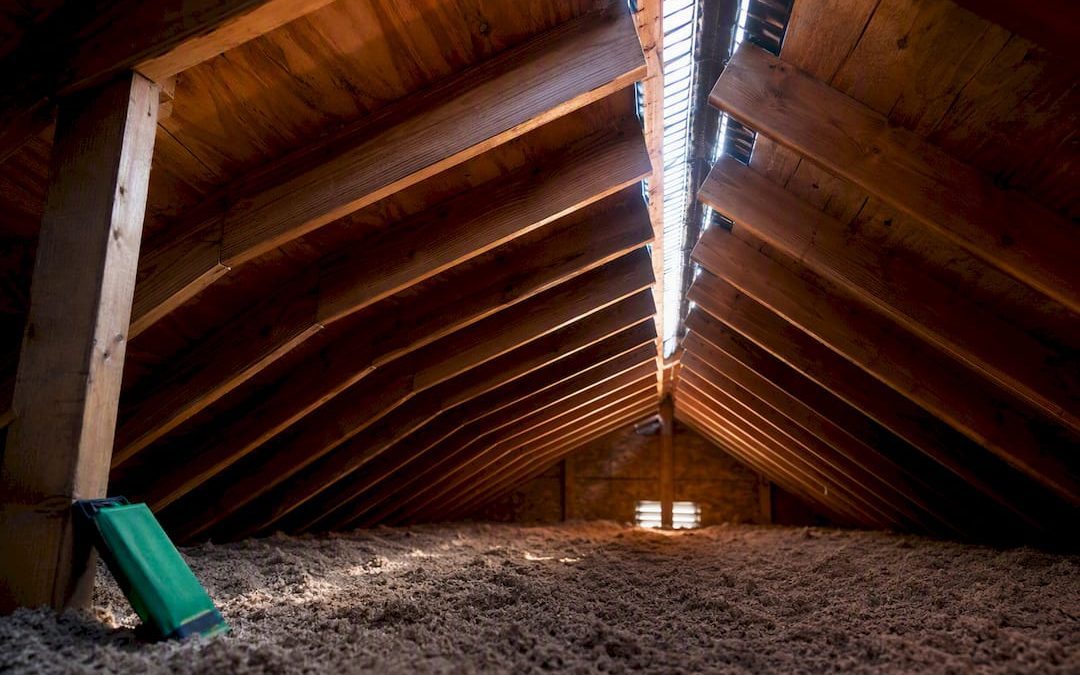
Most asphalt shingle roofs hold up for a few decades, standing-seam metal often lasts several decades longer, and slate or clay tile can outlast the house by many decades. These ranges vary with climate, installation quality, ventilation, and maintenance. Climate, installation quality, attic ventilation, and maintenance decide where your roof lands in that range, and often matter more than the material itself. If your roof is near the middle of its expected range or showing visible wear, that’s your cue to get it inspected now rather than wait for a leak to make the decision for you.
TL;DR:
- Attic ventilation, installation quality, and climate conditions are more influential on roof longevity than the roofing material itself.
- Properly maintained metal and tile roofs can last beyond 50 years, while asphalt shingles generally need replacement between 15 and 30 years.
- Regular inspections, especially after storms and every 2 to 3 years, help catch early damage that could extend roof life by up to a decade.
- Warranties often overstate actual lifespan, as roofing failure is usually caused by poor ventilation or installation errors not covered by the warranty.
- Visible signs of damage on less than a quarter of a roof, or localized issues, typically warrant repairs, while widespread damage indicates replacement.
Table of Contents
- Roof Life Expectancy by Material: What the Ranges Actually Look Like
- What Determines How Long a Roof Lasts: Climate and Installation Factors You Can Control
- How to Make Your Roof Last Longer: Inspection Cadence and High-Impact Maintenance
- Warranties and Marketing Claims vs Realistic Field Life
- Warning Signs That Mean Inspect Now
- Your Roof Age Action Checklist
- Why a Professional Eye Catches What a Homeowner Can’t
- Get a Roof Condition Assessment You Can Actually Use
- Roofing Perspective: Why the Warranty Number Isn’t the Number That Matters
- Sources
- FAQ
Roof Life Expectancy by Material: What the Ranges Actually Look Like
Manufacturers advertise long warranty periods. Field performance usually results in somewhat shorter lifespans, especially in hot, poorly ventilated attics, while a well-maintained standing-seam metal roof can quietly outlive the mortgage. InterNACHI’s life expectancy data puts realistic ranges at roughly 20 to 30 years for architectural asphalt, 40 to 80 for metal, and 50 to 100 or more for tile and clay, depending heavily on climate and upkeep.
Here’s how the major roofing materials break down in practice:
| Material | Realistic Lifespan | Main Wear Factor |
|---|---|---|
| 3-tab asphalt | 15–20 years | UV breakdown, granule loss |
| Architectural asphalt | 20–30 years | Heat cycling, poor ventilation |
| Premium/designer asphalt | 25–30 years | Same as architectural, slower onset |
| Standing-seam metal | 40–50+ years | Fastener and seam wear, coating fade |
| Exposed-fastener metal | 25–40 years | Gasket failure at screw points |
| Stone-coated steel | 30–50 years | Coating adhesion over time |
| Concrete tile | 50–80 years | Underlayment failure, not the tile |
| Clay tile | 75–100+ years | Underlayment failure, freeze-thaw cracking |
| Slate | 75–150 years | Flashing and fastener failure |
| Cedar/wood shake | 20–30 years | Rot, moss, moisture retention |
| TPO/EPDM/PVC (single-ply) | 15–25 years | Seam separation, membrane fatigue |
| Built-up roofing (BUR) | 15–30 years | Ply separation, ponding water |
| Spray polyurethane foam (SPF) | 20–30+ years* | Coating degradation, needs recoating |
*The foam substrate itself can last decades, but SPF roofs need recoating roughly every 10 to 15 years to stay watertight, according to the Roofing Material Lifespan Report from The Roofing Brief.
A few material quirks matter more than the headline number:
- Tile and slate rarely fail on their own. The clay or stone tiles can survive a century, but the felt or synthetic underlayment beneath them typically wears out in 20 to 30 years, and that’s what actually causes leaks.
- Metal roof life depends on the coating, not just the steel. Kynar 500 finish systems have documented 40 to 50 plus years of service, while cheaper paint systems chalk and fade far sooner.
- SPF’s clock resets with recoating, so a 25-year-old foam roof with good maintenance history can look and perform like new.
- 3-tab shingles are the budget option for a reason. They shed granules faster and have less UV resistance than architectural styles, which is why they sit at the bottom of the asphalt range.
What Determines How Long a Roof Lasts: Climate and Installation Factors You Can Control
Two roofs installed the same year, same material, same house style, can age a decade apart. The difference almost always comes down to four things: climate exposure, installation quality, ventilation, and roof design.
Climate does the heavy lifting. Intense UV exposure in hot, sun-heavy regions accelerates asphalt oxidation and shortens shingle life by years. Hot, humid climates encourage moss and algae growth that trap moisture against the roof deck. Cold, snow-heavy regions add freeze-thaw stress and ice-dam risk at the eaves. Coastal salt air corrodes metal fasteners and flashing faster than inland environments. And in hail or high-wind belts, a single severe storm can total a roof regardless of its age. Understanding wind mechanics and severe weather risk helps explain why uplift damage often shows up first at ridges, edges, and flashing points, not in the middle of a roof plane.
Installation quality is the wildcard most homeowners underestimate. Correct nail placement (not staples, not overdriven or underdriven nails), properly lapped underlayment, and flashing detail at every penetration and valley determine whether water actually stays out. A rushed installation crew can turn a 30-year shingle into a 15-year roof through nail pattern mistakes alone.
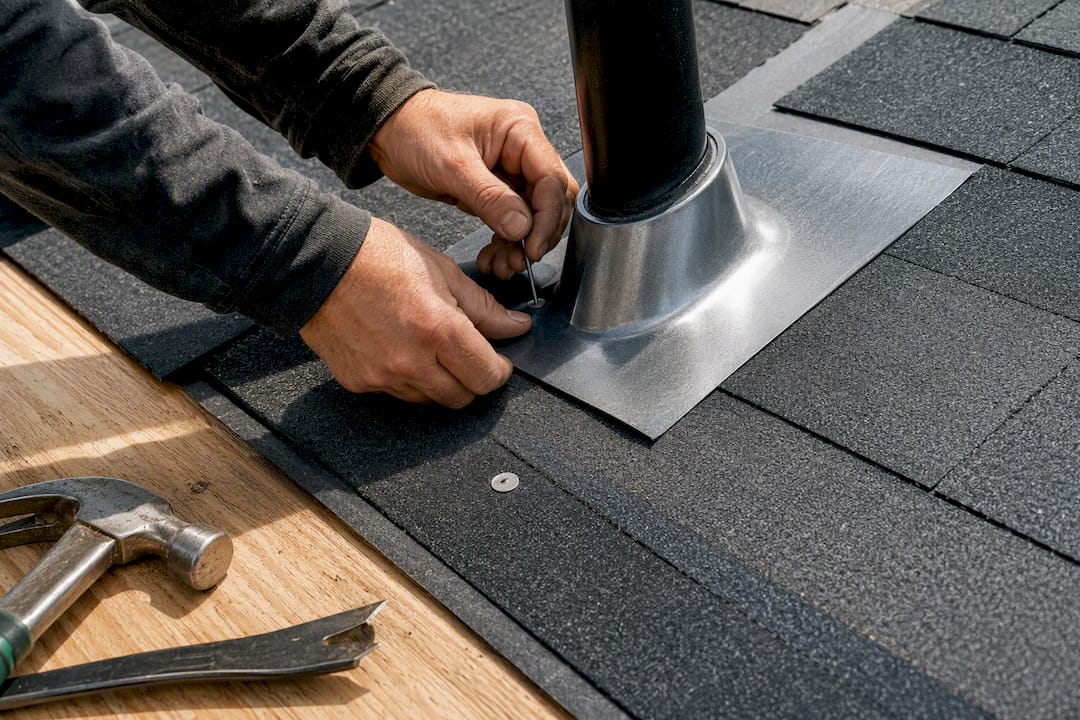
Attic ventilation is the single biggest lever homeowners actually control. Roofs need balanced intake and exhaust ventilation that meets International Residential Code section R806. Without it, summer heat builds up in the attic and bakes the shingles from underneath, accelerating the same oxidation that sunlight causes from above. Contractor field data compiled by JDH Remodeling shows that correcting poor ventilation can shift shingle lifespan by 30 to 50 percent, which dwarfs most other maintenance interventions in terms of return.
Other factors that push a roof toward the low or high end of its range:
- Steeper slopes shed water faster and last longer than low-slope roofs of the same material.
- Complex rooflines with more valleys and penetrations create more failure points than a simple gable.
- Lighter, more reflective shingle colors run cooler and age slower than dark colors in hot climates.
- Overhanging tree canopy accelerates moss growth and drops debris that traps moisture in valleys.
Pro Tip: Before you assume your roof needs replacing, check your attic ventilation first. A $500 to $1,500 ventilation retrofit is dramatically cheaper than a premature roof replacement, and it’s often the actual root cause of shingles that “failed early”.
How to Make Your Roof Last Longer: Inspection Cadence and High-Impact Maintenance
You don’t need to baby a roof constantly, but skipping maintenance entirely is how a 30-year roof becomes a 18-year roof. The routine that actually moves the needle is simpler than most homeowners think.
- Walk the perimeter twice a year, minimum. Look from the ground with binoculars each spring and fall for missing shingles, sagging lines, or debris buildup in valleys.
- Get a professional inspection every 2 to 3 years, or immediately after any major storm. OnOtto’s inspection guidance recommends this cadence as the baseline, tightening to every 1 to 2 years once a roof passes 60 to 80 percent of its expected life.
- Fix flashing before it fails completely. Flashing around chimneys, skylights, and vent pipes is the most common leak point and among the cheapest things to repair proactively.
- Clean gutters regularly to prevent clogs and water backups. Clogged gutters back water up under the shingle edge, which rots decking from the eaves inward.
- Trim overhanging branches to reduce moss growth, debris accumulation, and impact damage during storms.
- Upgrade attic ventilation if it’s undersized. This single fix carries the best lifespan return of anything on this list.
A seasonal rhythm helps: spring checks after winter’s freeze-thaw cycle, fall checks before snow load season, and an immediate walk-around after any hailstorm or high-wind event. Minor repairs, like replacing a handful of cracked shingles or resealing a flashing joint, commonly buy a roof another 5 to 10 years when caught early. Once damage spreads across large sections or the underlayment itself has failed, repair costs start approaching replacement costs, and replacement becomes the better economic call.
Warranties and Marketing Claims vs Realistic Field Life
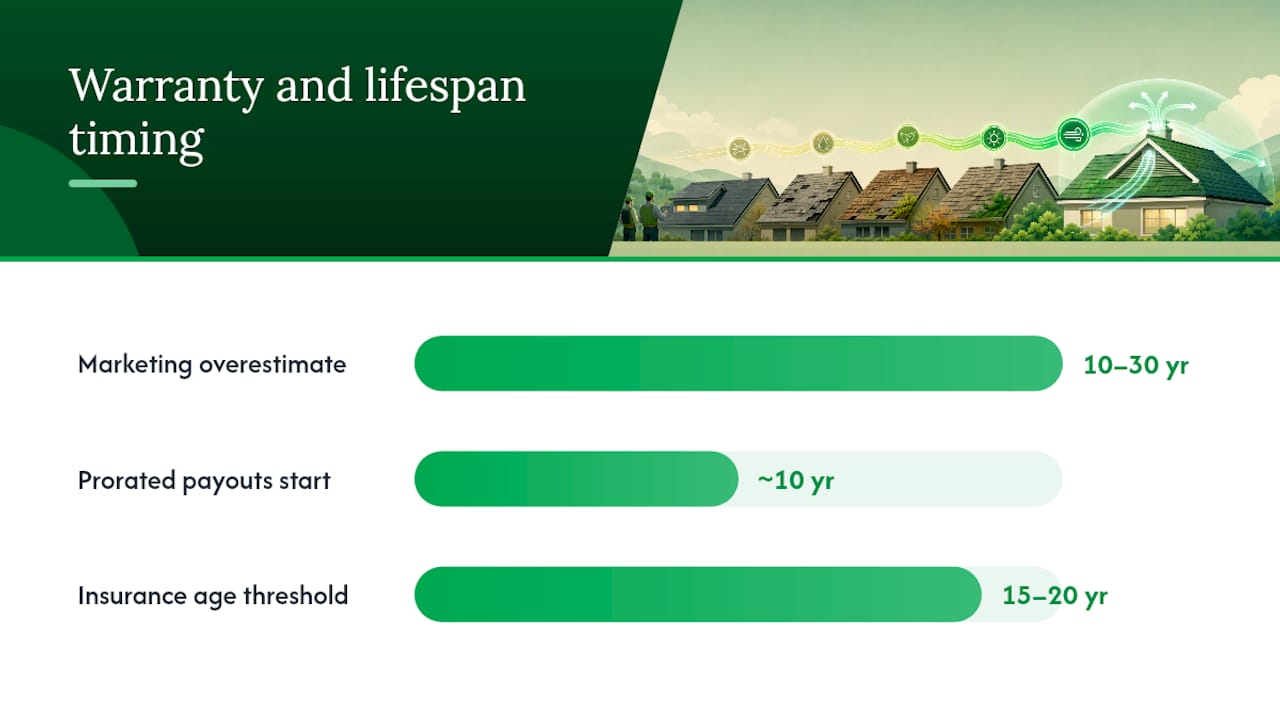
A “30-year” or “lifetime” label on a shingle package is a marketing and legal term, not a promise about how long your roof will actually perform. Field data compiled in the Roofing Material Lifespan Report found that marketing claims for asphalt products often exceed realistic field life by 10 to 30 years once you account for typical climate exposure and maintenance gaps.
The payout structure explains why that gap matters financially. Most manufacturer warranties cover 100 percent of material cost only in the early years, then shift to a prorated schedule after roughly the first decade. File a claim late in the warranty period on a “30-year” shingle, and you may recover only a small fraction of the original material cost, insufficient to cover full replacement expenses.
Warranties commonly exclude installation errors, inadequate ventilation, and lack of documented maintenance, which is exactly what causes most premature failures in the first place.
Keep these realities in mind when a warranty is part of your decision:
- Prorated payouts typically start around year 10, not at the end of the warranty term.
- Installation defects almost always void manufacturer coverage, shifting liability to the contractor instead.
- Poor attic ventilation can void shingle warranties outright since it accelerates failure independent of the product itself.
- Documentation matters: keep receipts, inspection reports, and photos, since insurers and manufacturers both lean on paper trails during disputes.
Insurance underwriting adds another layer. Many carriers apply age thresholds that shift a roof from full replacement cost coverage to actual cash value once it passes a certain age, often somewhere around 15 to 20 years depending on the policy. That shift can leave homeowners covering a much larger share of replacement cost out of pocket than they expect.
Warning Signs That Mean Inspect Now
Some signs are visible from the driveway. Others only show up in the attic, which is exactly why they get missed until a leak forces the issue.
Exterior red flags worth acting on immediately:
- Shingles that are missing, curled, or cracked across more than a small, isolated area
- Heavy granule loss showing up in gutters or downspouts
- Cracked or slipped tiles, or rusted and backed-out fasteners on metal panels
- Standing water that doesn’t drain within 48 hours on a low-slope roof
Interior red flags, checked from the attic:
- Visible daylight coming through the roof deck
- Wet or compressed insulation, especially near eaves or valleys
- Ceiling stains or bubbling paint on the floor below the attic
- Soft, spongy, or discolored decking when pressed
A useful rule of thumb: damage confined to roughly 25 percent or less of the roof, localized to one slope or section, is usually a repair candidate. Damage spread across multiple sections or paired with underlayment failure under tile or metal usually points toward full replacement. After any hailstorm or major wind event, photograph the damage immediately, since most insurers set claim filing windows, and schedule a professional inspection before the adjuster visit. Waiting too long can cost you the claim entirely.
Your Roof Age Action Checklist
If your roof is well under the median for its material and shows no red flags, stick to routine maintenance and log its condition for your records. If it’s near the median or showing one or two warning signs, book a professional inspection now: targeted repairs at this stage commonly add 5 to 10 years. If it’s past the realistic upper range for its material or showing multiple red flags, start budgeting for replacement within 12 to 24 months and get several contractor bids. When comparing materials for a replacement, weigh upfront cost against lifecycle cost. A metal roof costs more today but can outlast three asphalt replacements over the same span.
Why a Professional Eye Catches What a Homeowner Can’t
Most roof failures start invisibly: underlayment breaking down under tile, deck rot hidden beneath insulation, fasteners losing grip on metal panels. A homeowner standing in the yard can’t see any of that. At Jhunthomeinspections, our roof inspection process is built to surface exactly those hidden failure points, whether we’re inspecting in person or through a video walkthrough for clients who need a remote option.
A tool can turn inspection findings into a prioritized, negotiable repair list that buyers and agents can act on immediately, with reports typically returned quickly. That turnaround matters when you’re trying to estimate a roof’s remaining useful life before a closing deadline, not months later.
Get a Roof Condition Assessment You Can Actually Use
You’ve read the ranges and the warning signs, but the only way to know exactly where your roof stands is a hands-on look at the deck, underlayment, and fasteners. This gap can be closed for homeowners and buyers through real inspections instead of guesses based on shingle age alone.
Professional inspectors document roof condition alongside the rest of the property, whether for buying, selling, or assessing remaining life before winter. Reports return promptly, with options for in-person or video inspection formats. If tree damage or storm exposure is a concern, our guide on preparing your home for winter pairs well with a pre-season roof check. Investors managing multiple properties can also lean on our ROI-focused inspection approach to prioritize which roofs need attention first.
Ready to find out where your roof actually stands? Schedule an inspection and get a documented, photo-backed condition report within a day.
Roofing Perspective: Why the Warranty Number Isn’t the Number That Matters
The roofing industry has trained homeowners to ask the wrong question. “How many years is the warranty?” is the wrong starting point. The right question is “what’s the ventilation situation in my attic, and who installed this?” Those two answers predict actual lifespan far better than any number printed on a shingle wrapper.
What gets overlooked constantly: two identical roofs, same shingle, same climate zone, can age a full decade apart purely because one attic breathes properly and the other doesn’t. That’s not a marginal difference. It’s the gap between replacing a roof at 22 years and replacing it at 32. Homeowners spend enormous energy comparing shingle brands and almost none evaluating whether their soffit and ridge vents actually move air. That’s backwards, and it costs people thousands of dollars in premature replacements every year.
The second thing conventional advice gets wrong: treating “inspect every few years” as sufficient once a roof passes middle age. A roof at year 8 and a roof at year 22 are not the same risk profile, even if both look fine from the driveway. Underlayment degrades invisibly under tile and metal. Fasteners lose grip gradually, not suddenly. By the time a homeowner sees a stain on the ceiling, the failure has usually been progressing for months. An inspection isn’t a formality you check off. It’s the only way to catch a slow failure before it becomes an expensive one.
— JOHN
Sources
- 2026 Roofing Material Lifespan Report (Field Data) | TRB
- InterNACHI — Life expectancy of home components
- OnOtto — How often to inspect a roof
- NSSL — Wind basics
FAQ
How long do asphalt shingles actually last?
Architectural asphalt shingles realistically last 20 to 30 years, while basic 3-tab shingles typically wear out in 15 to 20 years, depending on climate and attic ventilation.
What roofing material lasts the longest?
Slate and clay tile lead the field at 75 to 150-plus years, though their underlayment usually needs replacement decades before the tile or slate itself fails.
How often should I get my roof inspected?
Check it yourself from the ground twice a year, and bring in a professional every 2 to 3 years, or immediately after any major storm.
Does a 30-year shingle warranty mean it will last 30 years?
No. Warranty terms are marketing and legal periods, and field data shows realistic asphalt lifespan often falls 10 to 30 years short of the advertised warranty length.
What’s the biggest factor that shortens roof life?
Poor attic ventilation is the single largest controllable factor, capable of cutting shingle lifespan significantly compared to a properly vented attic meeting IRC R806 standards.
How do I know if I need a roof repair or full replacement?
Damage confined to about 25 percent or less of one section usually calls for repair, while widespread damage or underlayment failure across multiple areas typically means replacement is the better economic choice. A professional inspection can give you an exact answer rather than a guess.
Recent Comments