
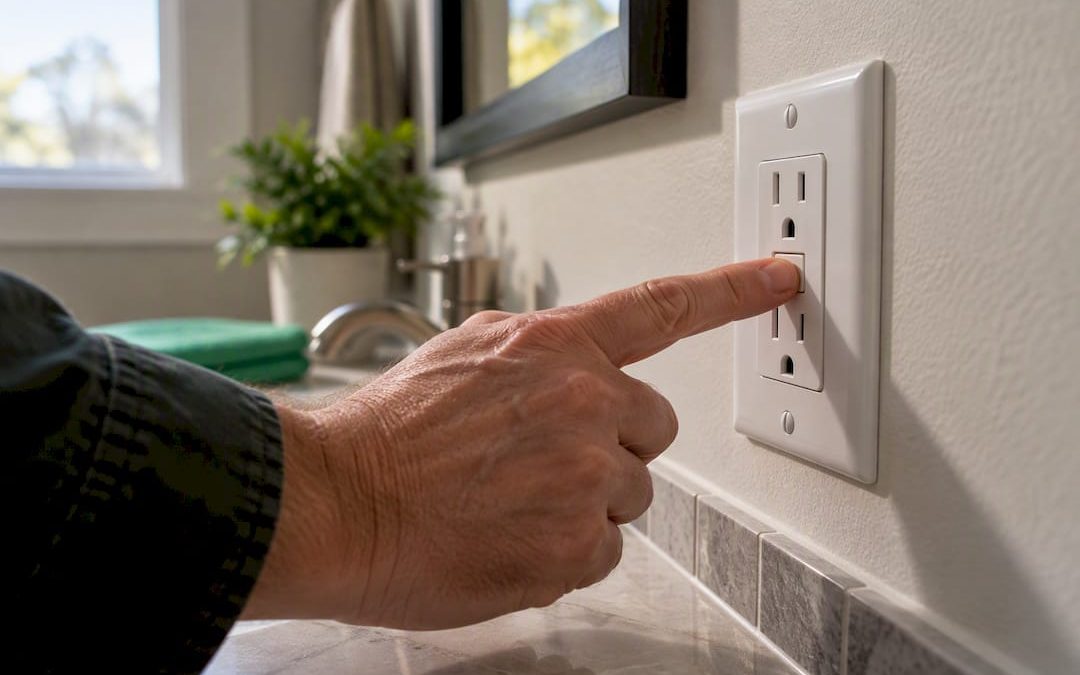
GFCI protection is required in bathrooms, kitchens (countertop receptacles), garages, outdoor locations, basements, crawl spaces, laundry areas, and any receptacle within 6 feet of a sink, tub, or shower, along with pools, spas, and pool-related lighting. That’s the shortlist under NEC 210.8. Local jurisdictions sometimes tack on their own amendments, so treat this as the baseline, not the final word for your address.
TL;DR:
- GFCI protection covers all bathroom outlets, including those not directly over the sink, with no exceptions.
- Any receptacle within 6 feet of a sink or tub must be GFCI protected, measured via the shortest cord path to the fixture’s edge, not a wall or cabinet.
- Outdoors and in garages or crawl spaces, GFCIs are required on all receptacles, with weather-rated devices needed where exposed to rain or moisture.
- Replacing a regular outlet with a GFCI is straightforward but requires correct wiring of line and load terminals to ensure downstream protection.
- Regular testing of GFCIs every month is essential to detect failures caused by damage or wiring issues, preventing a false sense of safety.
Table of Contents
- Where GFCI Protection Is Required: The NEC Room-by-Room Rundown
- How Do You Measure the 6-Foot Rule Near Sinks and Tubs?
- GFCI Receptacles vs. GFCI Breakers: Which One Do You Need?
- How Often Should You Test a GFCI Outlet?
- Do Older Homes Need to Add GFCI Protection?
- What Do Inspectors Actually Find Wrong With GFCIs?
- What Appliances Are Exempt From GFCI Requirements?
- Are Commercial GFCI Requirements Different From Residential Ones?
- How Have GFCI Requirements Changed Across NEC Editions?
- Will Future NEC Updates Expand GFCI Requirements Further?
- Why Does the Code Require GFCI Protection at All?
- Testing GFCIs Before Closing Isn’t Optional
- Schedule an Inspection That Actually Tests Your GFCI Protection
- Primary Sources and Further Reading
- Sources
- FAQ
Where GFCI Protection Is Required: The NEC Room-by-Room Rundown
The National Electrical Code doesn’t leave much guesswork once you know where to look. Section 210.8 spells out dwelling-unit locations by name, and each one exists because water and electricity keep finding each other in predictable places.
Bathrooms get full coverage. Every receptacle in a bathroom needs GFCI protection, not just the one over the sink. There’s no partial-credit version of this rule.
Kitchens require GFCI protection on receptacles that serve countertop surfaces. A receptacle feeding a dishwasher or garbage disposal tucked below the counter typically doesn’t need it unless it also falls within 6 feet of a sink, which many do simply because of how kitchens are laid out.
Garages and accessory buildings need GFCI protection at grade-level areas used for storage, work, or general habitation, which covers nearly every outlet a homeowner would actually plug something into.
Outdoor receptacles need GFCI protection across the board, and any device installed where it will face rain or moisture also needs a weather-resistant rating, a separate requirement from GFCI protection itself, according to Home Depot’s code overview.
Basements and crawl spaces, finished or unfinished, at or below grade, fall under the same umbrella. A finished basement rec room with carpet and drywall still needs GFCI-protected outlets because the code cares about grade level and dampness risk, not decor.
Laundry areas require GFCI protection on receptacles serving the space, which trips up a surprising number of older homes where the washer outlet was wired straight to the panel with no protection at all.
Here’s the condensed version for a quick scan:
- Bathrooms: every receptacle, no exceptions
- Kitchens: countertop-serving receptacles
- Garages and accessory buildings: grade-level receptacles
- Outdoors: all receptacles, weather-resistant where exposed
- Basements and crawl spaces: at or below grade
- Laundry areas: receptacles serving the laundry space
- Sinks, tubs, showers: anything within 6 feet
- Pools, spas, and related lighting: protected per equipment rules.
Each of these categories gets its own nuance once you factor in appliance wiring and proximity measurements, which is where most confusion actually starts.
How Do You Measure the 6-Foot Rule Near Sinks and Tubs?
The 6-foot rule measures the shortest path a cord could travel from the receptacle to the sink’s or tub’s top inside edge, without cutting through a wall or floor. It’s a straight-line, cord’s-eye view of the room, not a tape measure stretched along the baseboard.
- A refrigerator outlet 5 feet from a kitchen sink needs GFCI protection; one 7 feet away typically doesn’t.
- A below-counter trash compactor within the 6-foot arc still counts, even if it’s tucked behind a cabinet door.
- Master-bath suites with a vanity near a walk-in closet can catch nearby receptacles in that zone if the closet outlet falls inside the 6-foot swing from the tub.
Pro Tip: Measure from the tub or sink’s actual edge, not the cabinet or vanity frame. Cabinets often extend past the fixture, and inspectors measure to the fixture itself.
GFCI Receptacles vs. GFCI Breakers: Which One Do You Need?
A GFCI receptacle protects itself and any outlets wired downstream on its load terminals. A GFCI breaker protects the entire circuit from the panel out, which is often the simpler fix when a run feeds several unprotected outlets in a basement or garage.
- GFCI breaker: best when one circuit feeds multiple exposed outlets and running receptacle-by-reset would be redundant.
- GFCI receptacle: best for a single outlet or where you want the reset accessible without opening the panel.
- Portable GFCI: useful for temporary power at a job site or an older home mid-retrofit.
Exceptions exist for dedicated circuits like snow-melt cables and permanently wired fire or burglar alarms, plus outlets that aren’t “readily accessible,” per Eaton’s installation guidance. Outdoor devices also need a weather-resistant rating on top of GFCI protection.
How Often Should You Test a GFCI Outlet?
Test every GFCI outlet monthly. Press the test button, confirm power cuts, then hit reset and confirm it returns. A device that won’t reset, or one that never cuts power in the first place, has likely failed internally.
- Press “test” and listen for the click.
- Confirm the outlet loses power immediately.
- Press “reset” and confirm power returns.
- If either step fails, stop using the outlet and call an electrician.
The Consumer Product Safety Commission found that around 87% of homes surveyed had at least one GFCI receptacle, but 22% of those devices were blocked or hard to see, which defeats the entire point of a monthly test. Surge damage, corrosion, and miswiring are the most common failure causes the CPSC has documented. Never place a life-support device on a circuit where a GFCI trip could cut power without a backup plan in place.
Do Older Homes Need to Add GFCI Protection?
The NEC generally governs new work and renovations, not existing wiring, so a 1970s ranch house isn’t automatically in violation just because it predates GFCI rules. Whether an upgrade is required often comes down to local amendments and what happens during a sale or remodel.
- GFCI breaker swap: protects an entire circuit without touching every outlet.
- First-receptacle upgrade: replacing the first outlet in a run with a GFCI protects everything downstream on that same circuit.
- Portable GFCI: a stopgap for temporary use while a permanent fix gets scheduled.
Inspectors checking older homes focus on accessible test buttons, correct line/load wiring, and photo documentation tied to a home inspection red flags list buyers can hand to their agent for repair requests.
What Do Inspectors Actually Find Wrong With GFCIs?
Miswired devices show up constantly, where the outlet trips fine on its own but leaves every downstream outlet on the run unprotected. Blocked or painted-over GFCIs, nonfunctional reset buttons, and outlets that look protected but aren’t wired to actually protect anything downstream round out the usual list.
- Miswired line/load connections that leave downstream outlets exposed
- Reset buttons that don’t engage or don’t hold
- GFCIs hidden behind furniture or under paint, unreachable for testing
- Bathroom or kitchen outlets missing protection entirely
Inspectors test and photograph each defect, logging it through tools like the Create Request List™ so buyers can hand a specific, documented item to their agent instead of a vague concern. Pro Tip: Ask for a rough electrician estimate on any GFCI defect before you finalize repair requests. A $150 fix shouldn’t derail a closing, but it’s worth knowing the number before you negotiate. Details like these often show up in what a home inspection actually documents room by room.
What Appliances Are Exempt From GFCI Requirements?
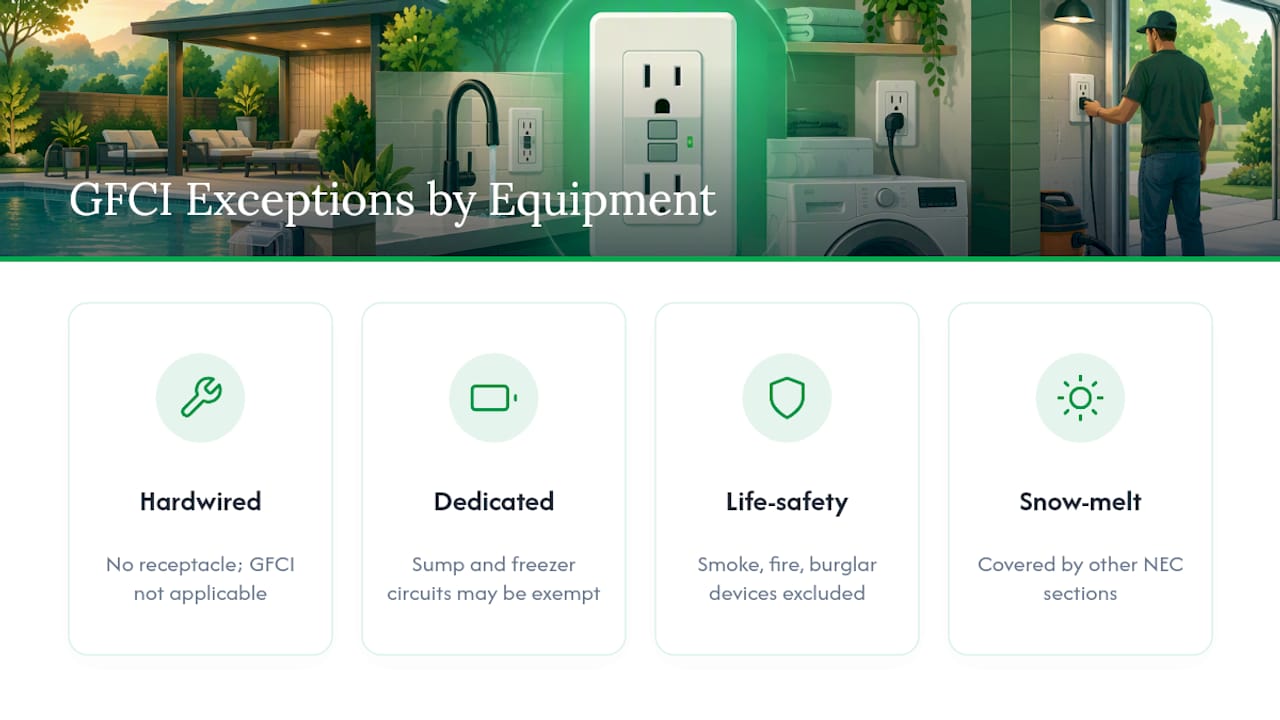
Not every outlet near water needs GFCI protection, and the exceptions trip up a lot of DIYers doing their own panel work. Dedicated-circuit appliances often get carved out because the code weighs accessibility and intended use alongside proximity to moisture.
Hardwired appliances, meaning equipment wired directly into the electrical system with no plug at all, generally fall outside the GFCI requirement because there’s no receptacle to protect in the first place. A built-in dishwasher wired through a junction box rather than a cord-and-plug connection is a common example.
Dedicated circuits for equipment like sump pumps or freezers sometimes get treated differently depending on local amendments, since a nuisance trip on a sump pump circuit during a storm can cause more damage than the GFCI prevents. Some jurisdictions allow these on standard breakers if the outlet isn’t in a location otherwise covered by 210.8.
Smoke alarms and other permanently connected life-safety devices are typically excluded from GFCI protection for a straightforward reason: an unexpected trip could disable a smoke detector at the exact moment it’s needed. The same logic applies to permanently installed fire and burglar alarm systems.
Snow-melt and de-icing cable circuits often use their own equipment-protection devices rather than standard GFCI protection, since these are addressed under separate NEC sections specific to fixed outdoor heating equipment rather than 210.8’s receptacle list.
The pattern across every exception is the same: the code weighs the risk of a nuisance trip against the risk of shock, and where that math favors uninterrupted power, GFCI protection gets excluded.
Are Commercial GFCI Requirements Different From Residential Ones?
Commercial and industrial GFCI rules borrow the same underlying technology as residential code but apply it to a different risk profile. Restaurant kitchens, for instance, often require GFCI protection on far more circuits than a typical home kitchen because commercial equipment sits closer together and gets exposed to more washdown water.
Construction sites carry some of the strictest GFCI rules in the entire code, since temporary power and wet conditions combine constantly on an active job site. Portable GFCI devices are standard equipment for contractors precisely because permanent protection isn’t always in place yet.
Industrial settings sometimes qualify for exceptions residential circuits don’t get, particularly around specific equipment where a nuisance trip could halt a production process or damage machinery. These carve-outs require documented risk assessments in most jurisdictions, not a blanket exemption.
Commercial property owners working through renovations or acquisitions run into this constantly, and a commercial inspection that specifically checks electrical protection against the applicable commercial code saves headaches later, since residential GFCI knowledge doesn’t transfer cleanly to a commercial panel.
The bottom line for anyone buying or leasing commercial space: don’t assume the residential rules you know apply. Ask specifically which code edition and occupancy classification governs the property.
How Have GFCI Requirements Changed Across NEC Editions?
The NEC gets revised every three years, and GFCI requirements have expanded almost every cycle since the rule first appeared. What started as bathroom-only protection decades ago has grown to cover kitchens, garages, basements, crawl spaces, laundry areas, and outdoor locations, according to code analysis from ECMweb.
That expansion matters for anyone buying an older home. A house built under an earlier NEC edition may be fully compliant with the code in effect when it was wired, even though it wouldn’t pass inspection under the current edition. That’s not a violation. It’s a timeline issue, and it’s why sellers generally aren’t required to retrofit older wiring just because the code has moved on.
Local amendments add another layer. Many counties and cities adopt the NEC with modifications, sometimes tightening requirements further, sometimes delaying adoption of the newest edition by a cycle or two. A property in one county might already require GFCI protection in a location that a neighboring county hasn’t mandated yet, purely because of which NEC edition each jurisdiction has adopted.
Anyone shopping for a home should ask which NEC edition the local jurisdiction currently enforces, since that answer determines what “up to code” actually means for that specific address.
Will Future NEC Updates Expand GFCI Requirements Further?
Every NEC revision cycle brings proposals to expand GFCI coverage further, and the trend line has pointed in one direction for years: more locations, not fewer. Industry discussion around future editions has floated additional coverage for areas like unfinished attics and certain dedicated appliance circuits currently exempted.
Device technology is evolving alongside the code. The CPSC has pushed for self-testing GFCI devices that detect their own internal failure and signal when they need replacement, addressing the exact blocked-or-inoperable problem the agency’s own survey data flagged. Expect future code cycles to lean harder on this kind of built-in monitoring rather than relying purely on manual monthly testing.
For homeowners and buyers, the practical takeaway isn’t to panic about a moving target. It’s to expect that a home wired ten years ago may need incremental updates the next time a permit pulls a room into scope, whether that’s a kitchen remodel or a finished basement. Renovation work almost always triggers current-code compliance for the areas being touched, even if the rest of the house is grandfathered in.
Why Does the Code Require GFCI Protection at All?
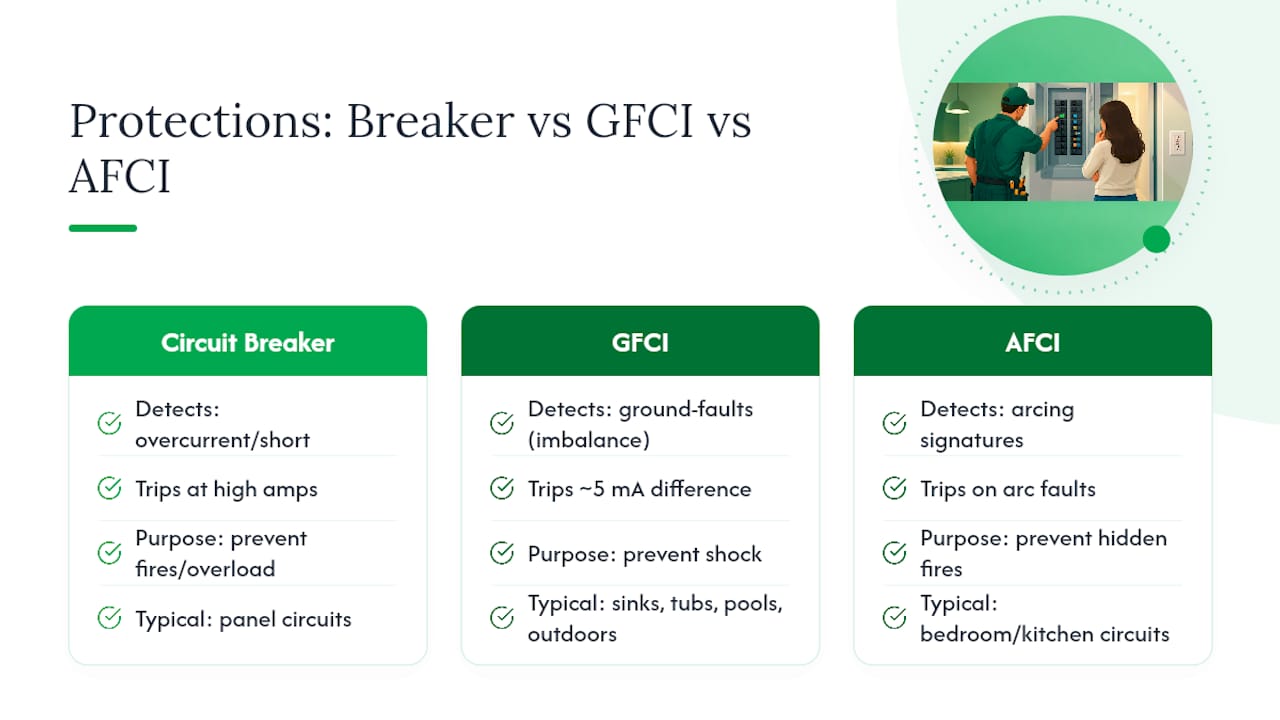
A ground fault happens when electrical current finds an unintended path to ground, often through a person’s body making contact with a live wire and a grounded surface at the same time. A standard circuit breaker won’t catch this because the current involved is nowhere near what it takes to trip a breaker designed to prevent fires from overloaded wiring.
A GFCI monitors the tiny difference between current going out on the hot wire and current coming back on the neutral wire. When that difference exceeds roughly 5 milliamps, a fraction of what’s needed to cause a fatal shock, the device cuts power in a fraction of a second. That’s a fundamentally different job than a breaker does, which is why homes need both, not one instead of the other.
Water multiplies the danger because it dramatically lowers the body’s resistance to electrical current, turning a survivable shock into a lethal one. That’s the entire reason the code clusters GFCI requirements around sinks, tubs, showers, pools, and outdoor locations. It’s not arbitrary. It’s a map of where wet skin and live current are most likely to meet.
AFCI protection, by contrast, watches for the electrical signature of arcing, the kind of intermittent sparking that starts electrical fires inside walls. The two technologies solve different problems, and modern code increasingly requires both on the same circuits in certain rooms, a distinction worth understanding before you ask an electrician which protection your panel actually needs.
Testing GFCIs Before Closing Isn’t Optional
Every GFCI defect I’ve seen documented in an inspection report traces back to the same root cause: nobody tested it after the initial install. Test every GFCI early, photograph anything that fails, and get a real electrician estimate before you negotiate. A $150 outlet swap is a rounding error against a deal falling apart over a safety item nobody flagged in time.
— JOHN
Schedule an Inspection That Actually Tests Your GFCI Protection
Clients receive a documented, room-by-room electrical check backed by a report typically returned within 24 hours.

A buyer’s home inspection from Jhunthomeinspections includes testing every accessible GFCI outlet, checking for miswired line/load connections, and photographing anything that fails, then routing those findings straight into the Create Request List™ so your agent has a specific, negotiable item instead of a vague note. That matters most in older homes, where a receptacle that looks protected sometimes isn’t wired to protect anything downstream at all.
The company offers evening and weekend scheduling and video-enabled walkthroughs to accommodate client needs. If you’re closing on a property soon, schedule your inspection now and get the electrical findings you need before your contingency window closes.
Primary Sources and Further Reading
For the full legal text, go directly to NEC 210.8 and the CPSC’s GFCI guidance. For hands-on install and testing steps, manufacturer manuals from Hubbell and Eaton walk through line/load wiring and reset behavior in more detail than any blog post can.
Sources
- CPSC: Ground-Fault Circuit-Interrupter (GFCI) consumer survey and guidance
- Hubbell installation and testing instructions for GFCI receptacles
FAQ
Where are GFCI outlets required by code?
GFCI protection is required in bathrooms, kitchens, garages, outdoors, basements, crawl spaces, laundry areas, and within 6 feet of sinks, tubs, or showers, per NEC 210.8. Pools, spas, and related lighting equipment carry their own specific rules on top of that list.
Where would a GFCI most likely be required?
Bathrooms are the location where GFCI protection applies with zero exceptions, since every receptacle in the room needs it regardless of distance from the sink. Kitchens and outdoor areas come in close behind, since almost every receptacle in those spaces ends up covered too.
Do all bathroom outlets need to be GFCI, or just one?
Every receptacle in a bathroom needs GFCI protection, not just the one closest to the sink. This is one of the few areas in the code with no proximity carve-out at all.
Where should a GFCI not be used?
Dedicated circuits for equipment like fire and burglar alarms, snow-melt cables, and certain hardwired appliances are typically excluded, since an unexpected trip on those circuits can create a bigger safety problem than the one GFCI protection prevents. A licensed electrician can confirm whether a specific circuit in your home qualifies for an exception.
Can I install a GFCI outlet myself?
Replacing a standard outlet with a GFCI receptacle is a feasible DIY project for many homeowners, but getting the line and load connections correct matters enormously, since a reversed wiring leaves downstream outlets unprotected even though the GFCI still appears to work. If you’re not fully confident identifying which wires are line and which are load, have an electrician verify the work.
Recent Comments