
Waiving the inspection contingency is one of the riskiest moves a typical homebuyer can make. Freddie Mac states plainly that inspections are a primary contractual protection, and removing that clause transfers full financial risk to you the moment you sign. Realtor.com and the National Association of Realtors echo the same warning: without the contingency, you lose the right to negotiate repairs, request credits, or exit the deal without penalty. Jhunthomeinspections offers pre-offer and buyer inspections that can help you stay competitive without surrendering that protection.
The three consequences that hit buyers hardest:
- Loss of exit rights. No contingency means no clean way out if the inspector finds a failing roof or a cracked foundation after closing.
- Full financial exposure. Every repair bill lands on you, with no recourse against the seller for defects they may have known about.
- Reduced leverage. You cannot renegotiate the purchase price or demand repairs once the contingency is gone.
Table of Contents
- What an inspection contingency actually does in a purchase contract
- What actually happens when you waive: earnest money, insurance, and legal options
- How common waivers are and what hidden defects actually cost
- Situations where waiving the contingency is more defensible
- How to stay competitive without buying blind
- A checklist for deciding whether you can afford to waive
- How waiving affects your mortgage approval and loan conditions
- How waiving affects resale value and future insurance claims
- Third-party inspection alternatives and how credible they are
- Key Takeaways
- The inspection contingency deserves more respect than it gets
- Skip the guesswork: get a fast, thorough inspection before you commit
- Useful sources and further reading
What an inspection contingency actually does in a purchase contract
An inspection contingency and a home inspection are not the same thing. A home inspection is the physical examination of the property. The inspection contingency is the contractual clause that gives you legal options based on what the inspector finds. Without the clause, the inspection is informational only; you can still hire an inspector, but the findings carry no contractual weight.
Here is what the contingency actually gives you during the inspection window:
- The right to request repairs or a price reduction
- The right to ask for a seller credit at closing
- The right to terminate the contract and recover your earnest money if the findings are unacceptable
Typical inspection windows run several days from contract execution, though some competitive markets have pushed that shorter. Within that window, you submit an inspection objection notice to trigger any of the rights above. Miss the deadline and the contingency expires automatically, even if you kept it in the contract.
Your earnest money deposit, typically a small percentage of the purchase price, is protected while the contingency is active. Walk away for a covered reason during the window and you get it back. Walk away after the contingency is gone and the seller can keep it.
What actually happens when you waive: earnest money, insurance, and legal options
Losing the contingency does not just affect your negotiating position. It reshapes your entire legal and financial situation post-closing.
Chase makes the insurance angle clear: when major defects surface after purchase, some carriers may decline coverage or flag the property during underwriting. A home with a known structural problem or active mold that was never documented before closing can become effectively uninsurable at standard rates.
On the legal side, proving seller concealment without an inspector’s contemporaneous report is genuinely difficult. Courts want documentation. An inspection report dated before closing is the clearest evidence that a defect existed and was not disclosed. Without it, you are relying on emails, neighbor testimony, or circumstantial evidence, and litigation costs frequently exceed the repair bills themselves.
Waiving the inspection contingency does not just remove a clause from your contract. It removes your ability to prove what the seller knew, when they knew it, and what condition the property was in before you took ownership. That documentation gap is where most post-closing legal claims fall apart.
Government-backed loans add another layer. FHA and VA loans have minimum property condition standards. If an appraiser or lender-ordered inspector flags a safety or structural issue, the lender may require repairs before funding, regardless of whether you waived your own contingency. Green Works Inspections notes that waiving is still legally permitted in most states, but the financing and insurance consequences can make a property harder to close on or insure.
Pro Tip: Before you agree to waive, call your lender and your insurance agent. Ask directly: “Will waiving the inspection contingency affect my loan approval or my ability to get homeowner’s insurance on this property?” Get the answers in writing.
How common waivers are and what hidden defects actually cost
During the 2021–2022 seller’s market peak, NAR data cited by Redfin showed roughly 25–30% of buyers waived inspection contingencies in competitive markets. That number has moderated since, but in tight inventory conditions, the pressure to waive returns quickly.
The cost asymmetry is stark. Investopedia points out that a standard home inspection costs a few hundred dollars, while the repairs it might catch routinely run into the tens of thousands. Blue Pebble Homes documented that Colorado buyers who waived inspections in 2024–2025 faced an average of $18,000 in unexpected repairs within their first year of ownership.
| Item | Typical cost |
|---|---|
| Standard home inspection | $300–$500 |
| Radon or mold add-on | a few hundred dollars |
| HVAC system replacement | $5,000–$12,000 |
| Roof replacement | $10,000–$20,000 |
| Sewer line repair/replacement | tens of thousands |
| Foundation repair | $5,000–$30,000+ |
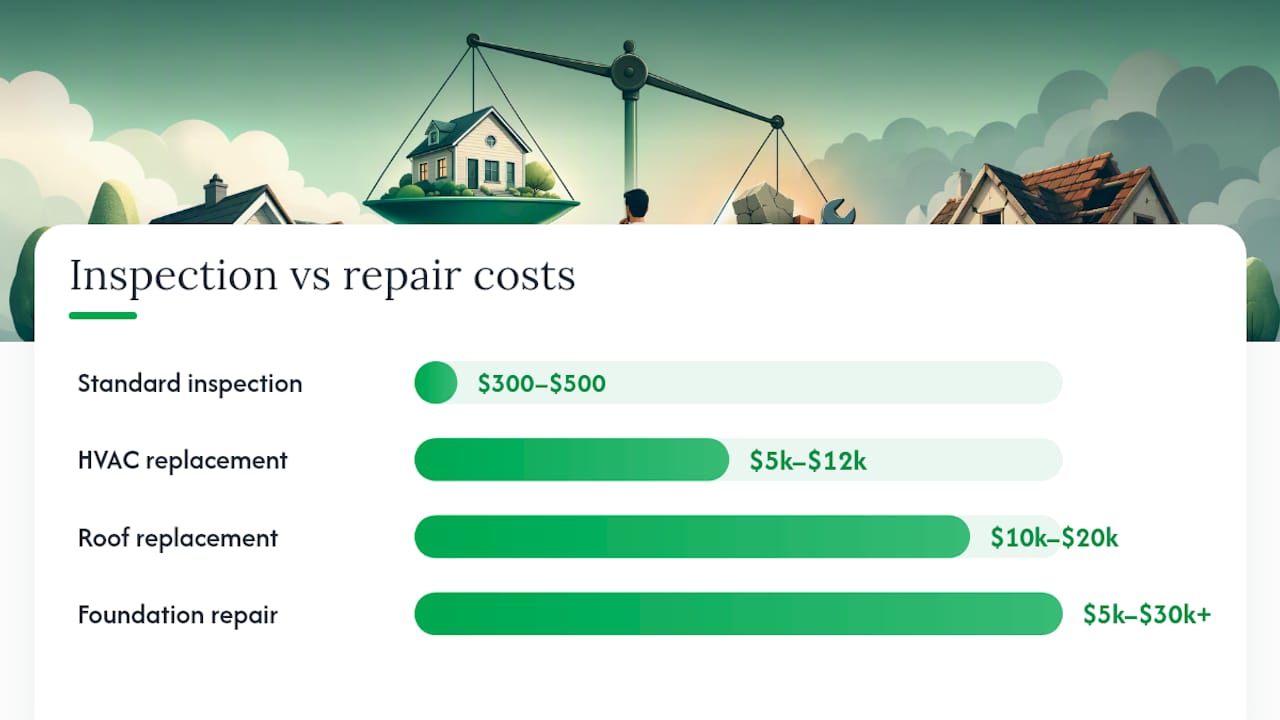
The math is hard to argue with. Spending $400 to potentially avoid an $18,000 average repair bill is not a close call. Buyers who waive are not saving money; they are deferring a cost they cannot yet see.
Situations where waiving the contingency is more defensible
There are genuine exceptions, but they are narrower than most agents in a hot market will admit.
New construction with a builder warranty. A home built within the last year under a comprehensive builder warranty offers more protection than a 1960s split-level with deferred maintenance. That said, new construction has its own defect patterns (improper grading, HVAC sizing errors, incomplete insulation), so a pre-closing walkthrough with an independent inspector still makes sense.
Experienced investors with cash reserves. A buyer who has renovated multiple properties, has a contractor on call, and is budgeting for repairs as part of the acquisition model is in a fundamentally different position than a first-time buyer. The contingency matters less when the buyer already expects to replace systems.
Pre-offer inspection already completed. This is the most defensible path for a typical buyer. You inspect the property before submitting your offer, then write a contingency-free offer with full knowledge of the home’s condition. You are not buying blind; you are buying informed.
Small-unit condo where the HOA covers structure and major systems. When the association owns the roof, foundation, and exterior walls, your exposure is narrower. Verify what the HOA actually covers before assuming this applies.
Signals that waiving is a bad idea regardless of market pressure:
- The home is more than 30 years old with no documented updates
- Seller disclosures are thin, vague, or marked “unknown” throughout
- Visible deferred maintenance (peeling paint, soft flooring, stained ceilings)
- The seller or listing agent is discouraging an inspection without explanation
- You have less than $15,000 in liquid reserves after closing costs
How to stay competitive without buying blind
You do not have to choose between a strong offer and your financial protection. FirstHomeToolkit outlines several contract-level tactics that let you compete without a full waiver.
Pre-offer inspection. Schedule an inspection before you submit your offer. You pay for it out of pocket (typically $300–$500), but you can then write a contingency-free offer knowing exactly what you are buying. Jhunthomeinspections offers pre-purchase inspection services with 24-hour report turnaround, which makes this approach practical even in fast-moving markets.
Shortened inspection period. Instead of waiving entirely, offer a 5–7 day inspection window instead of the standard 10. Sellers see speed; you keep your rights.
Dollar-threshold or pass/fail language. Cap your objection rights at a specific dollar amount (for example, you will only object to repairs exceeding $10,000) or limit the contingency to deal-breaker categories: structural, electrical, plumbing, and roof. Minor cosmetic findings do not trigger a renegotiation.
Other offer-structure swaps that signal seriousness without surrendering protection:
- Increase your earnest money deposit
- Offer a flexible closing date that works for the seller
- Include appraisal-gap coverage
- Offer a seller credit request cap in writing upfront
Pro Tip: Jhunthomeinspections’s Create Request List™ lets you and your agent turn inspection findings into a formatted repair request within hours of receiving the report. In a shortened inspection window, that speed is the difference between a clean negotiation and a missed deadline.
A checklist for deciding whether you can afford to waive
Work through these questions with your agent before agreeing to anything:
- Do you have $10,000–$25,000 in liquid reserves after closing costs and your down payment?
- Is the home less than 10 years old with documented maintenance records?
- Are the seller disclosures complete, specific, and consistent with what you can see?
- Has your lender confirmed the waiver will not affect your loan approval?
- Has your insurance agent confirmed coverage will not be affected?
- Is an inspector available for a pre-offer walkthrough before your offer deadline?
- Have you reviewed the HOA documents if applicable, and confirmed what the association covers?
Red flags in your agent’s behavior:
- Pushing a full waiver without offering shortened-period or cap alternatives
- Refusing to explain what happens to your earnest money if you walk
- Framing the waiver as “everyone does it” without addressing your specific financial situation
If you cannot answer yes to at least the first three questions, the buyer inspection contingency is protecting you from a risk you cannot absorb. Do not waive it.
How waiving affects your mortgage approval and loan conditions
Waiving the inspection contingency does not automatically derail a mortgage, but it creates real exposure on the financing side. Investopedia notes that lenders can refuse financing if an appraisal or lender-ordered review flags safety or major system problems, regardless of what the buyer agreed to in the purchase contract.
FHA and VA loans are the clearest examples. Both programs require the property to meet minimum condition standards. If the appraiser notes a failing roof, exposed wiring, or active water intrusion, the lender will condition the loan on repairs before closing. The buyer’s waiver of their own inspection contingency does not override the lender’s requirements. You can waive your right to inspect; you cannot waive the lender’s underwriting standards.
Conventional loans carry less rigid property condition rules, but an appraiser who flags a significant defect can still trigger a lender condition. And if a defect surfaces after closing that was not documented before, it can complicate any future refinance or home equity application.
How waiving affects resale value and future insurance claims
A home you buy without an inspection is a home you own without a baseline condition record. That gap matters in two specific ways.
First, resale. When you eventually sell, buyers will inspect your home. If an inspector finds a problem that traces back to before your purchase, and you have no pre-purchase inspection report showing the condition at the time you bought, you may face disclosure questions you cannot answer cleanly. Sellers who cannot document a property’s history tend to get lower offers or more aggressive repair requests.
Second, insurance claims. Chase highlights that insurers can complicate or deny claims when a defect appears to predate the policy. If a roof claim surfaces two years after purchase and the insurer’s adjuster determines the damage was pre-existing, the absence of a pre-purchase inspection report leaves you with no documentation to counter that finding. Some carriers may also decline to write new policies on homes with known or suspected defects.
Third-party inspection alternatives and how credible they are
When a full inspection contingency is off the table, buyers sometimes turn to alternatives. Here is an honest assessment of each.
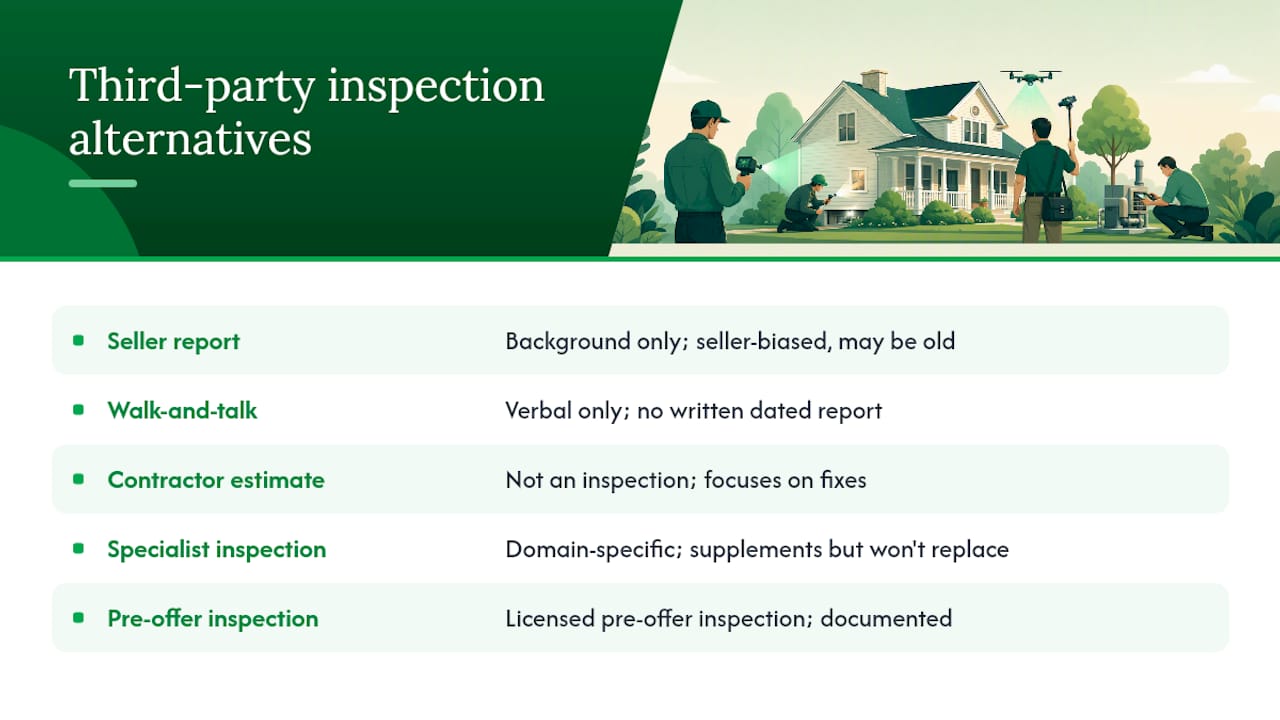
Seller-provided inspection reports. A seller who had the home inspected before listing may share that report. Treat it as useful background, not a substitute for your own. The inspector worked for the seller, the report may be months old, and you have no contractual relationship with that inspector.
Walk-and-talk inspections. Some inspectors offer a verbal walkthrough without a written report, at a lower cost. These are better than nothing, but without a written, dated report, you have no documentation if a dispute arises later.
Contractor estimates. Having a contractor walk through a home is not an inspection. Contractors assess what they would fix; they are not trained to identify all defects across all systems. Using a contractor estimate in place of an inspection is a common and costly mistake.
Specialist inspections. Hiring a structural engineer for foundation concerns or an electrician for panel issues can supplement a full inspection but should not replace one. Each specialist sees only their domain.
The only third-party alternative that preserves real credibility in a waiving situation is a pre-offer inspection by a licensed, independent home inspector, completed before the offer is submitted. Realtor.com identifies this as the compromise sellers most often accept in place of a contingency, and it is the one approach that gives you both a competitive offer and documented knowledge of the property’s condition.
Key Takeaways
Waiving the inspection contingency exposes most buyers to financial, legal, and safety risks that far outweigh the competitive advantage it provides in a seller’s market.
| Point | Details |
|---|---|
| Contingency vs. inspection | The contingency is the contractual exit right; without it, an inspection is informational only. |
| Average repair exposure | Colorado buyers who waived inspections in 2024–2025 faced an average of $18,000 in unexpected repairs within their first year of ownership. |
| Defensible exceptions | Pre-offer inspections, new construction, and experienced investors with cash reserves are the main cases where waiving is reasonable. |
| Best mitigation tactic | A pre-offer inspection lets you submit a contingency-free offer without buying blind. |
| Jhunthomeinspections | Offers pre-offer inspections with 24-hour report turnaround and the Create Request List™ to keep buyers protected and competitive in the St. Louis Metro area and Southern Illinois. |
The inspection contingency deserves more respect than it gets
The framing I keep seeing in competitive markets bothers me. Waiving the inspection contingency gets treated as a savvy move, a sign that a buyer is serious and flexible. What it actually signals is that the buyer is willing to absorb unlimited financial risk to win a bidding war. Those are not the same thing.
The buyers who regret waiving are not the ones who bought a perfect home and paid for an inspection they did not need. They are the ones who bought a home with a $22,000 sewer problem, a failing electrical panel, or active mold behind the drywall, and then discovered that without a pre-closing inspection report, their legal options were essentially zero. Litigation is expensive, slow, and rarely recovers what buyers lose.
The pre-offer inspection is the answer most agents do not push hard enough. It costs the same $300–$500, it takes the same 2–4 hours, and it gives you everything the contingency was designed to give you: knowledge. The difference is that you get that knowledge before you write the offer, not after. That sequence change is what makes a contingency-free offer genuinely competitive rather than just reckless.
If a seller or agent is discouraging you from any form of inspection, that is not a market condition. That is a red flag.
Skip the guesswork: get a fast, thorough inspection before you commit
Buyers in the St. Louis Metro area and Southern Illinois have a practical option that makes the pre-offer inspection approach work on tight timelines. Jhunthomeinspections delivers full written reports within 24 hours of the on-site walkthrough, which means you can inspect a property, receive your report, and submit a contingency-free offer before most competing buyers have even scheduled a showing.
Core services that directly reduce waiver risk include buyer inspections, pre-offer informational inspections, and add-ons for radon, mold, sewer camera, and termite. The Create Request List™ converts your report findings into a formatted repair request your agent can send immediately, cutting hours off the negotiation step. Payment at closing is available for qualifying transactions, so the inspection cost does not have to come out of pocket before you know the deal is moving forward.
Schedule your inspection or review the full service menu to find the right coverage for your property type and timeline.
Useful sources and further reading
These sources support the claims in this article and are worth reviewing before you make a waiver decision.
- Should I Waive the Home Inspection? — My Home by Freddie Mac
- Should You Waive the Home Inspection? — Redfin
- The Inspection Waiver Trap: Why Skipping Due Diligence Could Cost You $50,000 | Blue Pebble Homes Blog
- Pros and Cons of Waiving the Home Inspection | Home Buying Hub
- Waiving the Home Inspection: What To Know — Chase Bank
- Should I waive a home inspection? — Realtor.com
- Can I Waive an Inspection in 2026? What Buyers Need to Know — Green Works Inspections
- Why you shouldn’t skip a home inspection — Investopedia
Internal pages for immediate action:
- Why home inspection matters before you buy — The case for inspections in plain language.
- Buyer inspection contingency: what homebuyers must know — Contract alternatives and waiver guidance.
- Home inspection checklist for busy buyers — A practical pre-offer checklist.
- Inspection services in the St. Louis Metro area — Schedule a pre-offer or buyer inspection.
This article provides general educational information about home inspection contingencies and is not legal, financial, or real estate advice. Consult a licensed real estate attorney, your lender, and a qualified real estate agent before making decisions about your purchase contract.
Recent Comments