
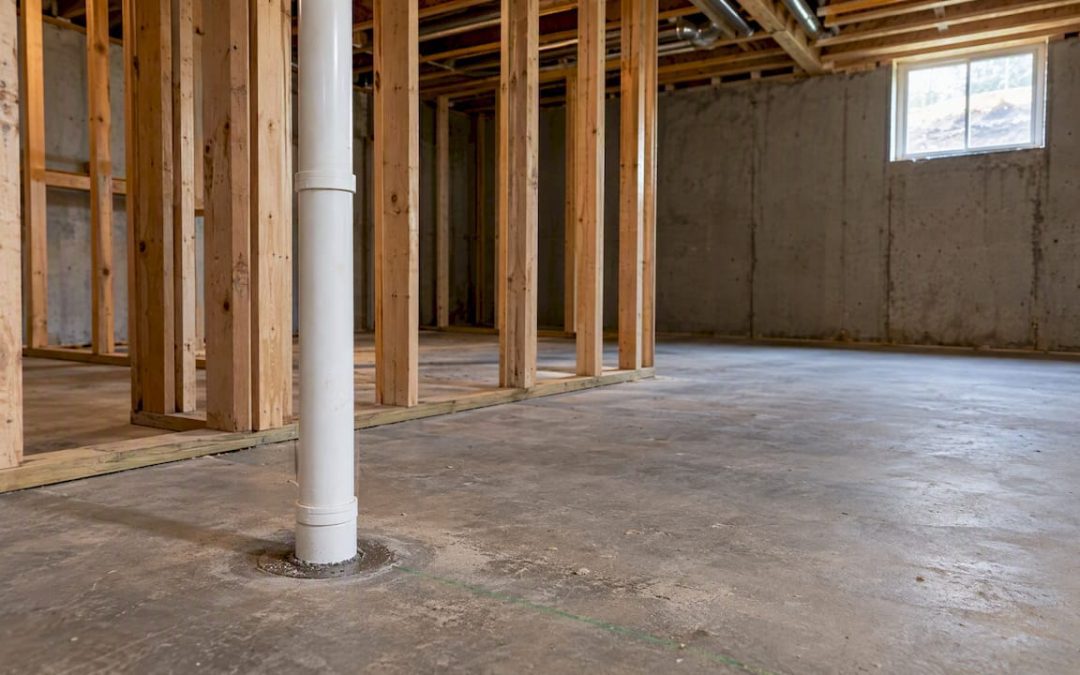
Yes, a brand-new home can have a radon problem. Radon is a natural gas that rises from the soil, and a new foundation is no guarantee against it. Some builders add radon-resistant features while the house is going up, and those features lower the risk. Whether a house has them depends on local code and on the builder, so the only way to know a new home’s radon level is to test it.
This guide explains how radon gets into new builds, what radon-resistant new construction (RRNC) includes, where it is required, and how to test a new home so you know the number before you settle in.
TL;DR
- Radon comes from soil and rock, not from building materials or the age of the house, so a new home can test high just like an old one.
- Radon-resistant features (gravel, plastic sheeting, sealing, and a vent pipe) cost much less to add during construction than to retrofit later.
- Requirements vary by state, county, and city. Illinois requires passive radon-resistant construction in new homes. Never assume your builder included it: ask and check.
- Test every new home after you move in. At 4.0 pCi/L or higher, EPA recommends reducing the level, often by adding a fan to the passive system.
Table of Contents
- Is radon common in new homes?
- What radon-resistant new construction includes
- Is radon-resistant construction required everywhere?
- How to tell if a new home has radon-resistant features
- How and when to test a new home for radon
- What to do if the number comes back high
- Get your new build tested
- Questions buyers ask about radon in new homes
- Sources
Is radon common in new homes?
Radon is not a flaw of old houses. Radon forms from the natural breakdown of uranium in soil, rock, and water, and it can enter through foundation cracks and other openings. EPA’s guidance for home buyers says any home, new or old, tight or drafty, can have a problem.
A few things make new construction worth a closer look:
- Tight building envelopes. Federal health guidance notes that newer, more energy-efficient construction can have higher indoor radon levels. A sealed house exchanges less air with the outdoors, so gas that gets in tends to stay.
- The ground is the same. A new subdivision sits on the same soil as the older neighborhood next to it. The builder did not change the geology.
- Foundation openings. Sump pits, utility penetrations, slab joints, and the gap between a slab and a wall are all paths for soil gas, whatever the year of construction.
That is why the question “is radon common in new construction?” has a practical answer: common enough that testing is recommended for every new home, regardless of builder, price, or neighborhood.
The numbers in our region show why. The Illinois Emergency Management Agency’s professional testing data since 2003 shows 41% of tested Illinois homes above 4.0 pCi/L, with a statewide average of 4.9 pCi/L. Those are tested homes, not a random sample, but they show that elevated radon is routine here, not rare.
What radon-resistant new construction includes
Radon-resistant new construction is a set of building techniques added while the house is framed and the foundation is poured. EPA lists them as gravel, polyethylene sheeting, foundation sealing, and a vent pipe running to the roof. Here is what each piece does:
| Feature | Where it goes | What it does |
|---|---|---|
| Gas-permeable gravel layer | Under the slab or floor system | Gives soil gas a path to move sideways instead of pushing up into the house |
| Plastic sheeting | Over the gravel, under the slab | Acts as a barrier so soil gas does not seep through the concrete |
| Sealed foundation | Cracks, joints, and openings in the slab and walls | Closes the easy entry points |
| Vent pipe | From the gravel layer up through the house to the roof | Carries soil gas outdoors, above the living space |
Passive versus active systems
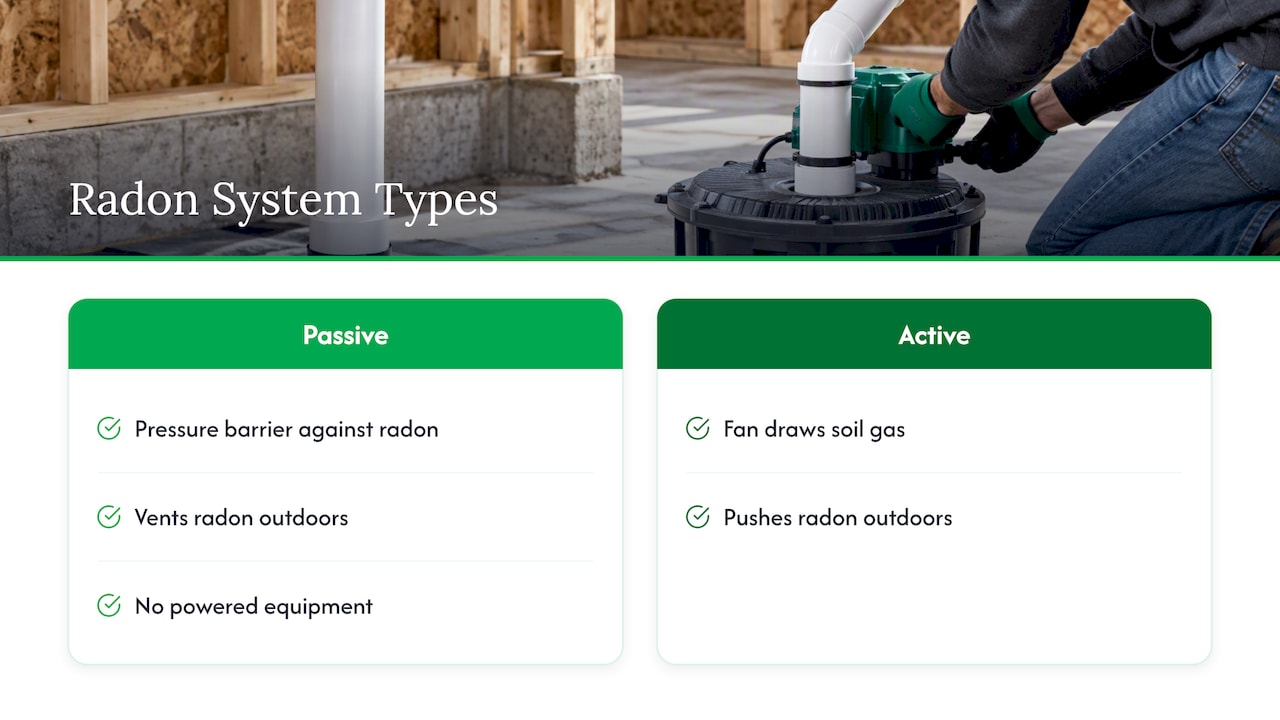
A system built this way is called passive. It creates a pressure barrier against radon entry and vents radon outdoors without any powered equipment. If a test after move-in shows a high level, a fan is added to the vent pipe and the system becomes active. The fan draws more soil gas out from under the house and pushes it up and out.
That upgrade is the main financial reason RRNC matters. EPA says that adding a radon control system while a house is under construction is much less expensive than installing one afterward. A house with a rough-in already in place means a mitigator is mostly adding a fan and an electrical connection, not opening floors.
The standard builders follow
The technical reference for these systems is ANSI/AARST RRNC-2020-1022. EPA’s builder resources page says it sets minimum requirements for rough-in of radon-control components in new dwellings under construction, with an effective date of December 1, 2023. The 10/22 revision also adds a requirement for radon testing once construction is complete. If your builder says the house follows a radon standard, ask which one and ask for the test result.
Is radon-resistant construction required everywhere?
No. This is the point that surprises many buyers. Radon-resistant features are not a single national requirement. EPA explains that municipalities, counties, or states can choose to adopt a code for radon-resistant new construction, so what applies to your house depends on where it sits.
For buyers in our service area:
- Illinois: state law requires all new residential construction to include passive radon-resistant construction. If you are buying a new build in Southern Illinois, you should see a vent pipe running through the house. Still confirm it was installed correctly and test.
- Missouri and the St. Louis side of the river: requirements depend on the jurisdiction and on what the builder chooses to include. Ask the builder and the local building department what applies to your lot, and ask for the inspection records on the radon rough-in.
Even where RRNC is required, a pipe in the wall is not proof the system works. A pipe that was capped wrong, a slab sealed poorly, or a vent that never reached the roof can leave you with a system in name only. That is a job for a trained eye during the build and a test afterward.
How to tell if a new home has radon-resistant features
You do not need to be a contractor to check the basics. Walk the house with these questions in mind:
- Look for the vent pipe. In a passive system, a 3 or 4 inch pipe usually runs from the basement or crawl space floor level up through the walls and attic to a roof vent. It is often visible in a basement corner, a utility room, or an attic.
- Look for a labeled pipe. Many builders mark the pipe so later owners know what it is. A label is a good sign, not proof.
- Check for an electrical box near the pipe. A junction box in the attic or near the pipe suggests the builder planned for a future fan.
- Ask for paperwork. Request the builder’s radon specification, photos of the gravel and sheeting before the slab was poured, and any post-construction test result.
- Check the foundation. Look for visible gaps at slab edges, around plumbing, and at sump pits. A sump pit should have a sealed lid.
Photos taken during construction matter because the gravel and plastic disappear under the concrete. If you are buying before the house is finished, our new construction inspection checklist for first-time buyers walks through what to photograph and ask about at each stage.
How and when to test a new home for radon
Every new home should be tested as soon as possible after you move in. That is EPA’s guidance for testing a new home after occupancy, and it applies whether or not the house has a passive system. A builder’s test before sale is useful information, but a test in the house as you live in it is the one that counts for your family.

Short-term and long-term tests
EPA’s buyer guidance describes two approaches. Short-term tests, from 2 to 90 days, are the quickest way to assess radon levels, while long-term tests over 90 days give a more representative picture of the year-round average. In practice:
- A short-term test gives you an answer fast. It is the usual choice during a real estate transaction.
- A long-term test smooths out weather and seasonal swings. It is a good follow-up if a short-term result lands near the action level.
We break down timing and how to read each result in our guide to radon test duration.
Closed-building conditions
EPA recommends that initial short-term tests be run in the lowest lived-in level of the home under closed-building conditions, with windows and exterior doors kept closed for the test. Practical points:
- Place the device in a regularly used room on the lowest level, not in a closet, crawl space, or near a drafty window.
- Keep it away from exterior walls, sump pits, and high-humidity areas like bathrooms and laundry rooms.
- Normal coming and going through exterior doors is fine, but do not prop them open.
- Do not move the device, and do not tamper with it during the test.
A new home with a brand-new HVAC system and sealed windows is easy to test cleanly. The tight envelope that raises radon risk also makes results consistent.
Testing during the purchase
If you are still in contract on a new build, radon testing can go alongside the rest of your due diligence. Our page on environmental testing for home buyers covers why we suggest testing radon and lead early. A test result in hand before closing gives you a basis to ask the builder to fix a problem under their warranty or contract terms, rather than discovering it a month after you move in. Whether the builder has an obligation depends on your contract, so read it with your agent or attorney.
What to do if the number comes back high
EPA recommends reducing radon when a home tests at 4.0 pCi/L (150 Bq/m³) or higher. In a house with a passive system, the first step is usually to add a vent fan to it.
Here is the sequence we suggest:
- Confirm the result. If your first reading is at or above 4.0 pCi/L, follow up with a second test, or a long-term test, before spending money. Weather and ventilation can shift a single short-term result.
- Contact the builder. If you are early in ownership, ask what the builder’s warranty or contract says about radon and ask who installed the passive system.
- Hire a qualified mitigator. EPA says homeowners can consult a qualified mitigator to estimate the cost of adding a fan to the passive system. Get more than one estimate.
- Follow the rules. Mitigation systems must comply with state regulations, and where a state has none, EPA recommends following current voluntary consensus standards. In Illinois, anyone doing radon measurement or mitigation work must be licensed through IEMA.
- Test again after the fix. A post-installation test confirms the system is lowering the level.
Do not guess at risk from how you feel. Radon has no smell or taste, and exposure does not produce symptoms you can use to detect it. A test is the only way to know. For the health background, read our overview of the dangers of radon in the home.
Our perspective
We inspect a lot of homes in the St. Louis Metro area and Southern Illinois, and the most common assumption we hear from new-build buyers is that a new house means no environmental surprises. We do not share it. The soil under a new subdivision is the same soil that was there before the builder arrived, and a tightly sealed house holds whatever gets in.
Our advice is simple: treat radon like any other item on your due diligence list. Ask the builder what was installed. Look at the pipe. Then get a test done by someone who will give you a clear number and a plain explanation, not a stack of jargon.
We built our process around making that easy. Radon testing is one of the services we offer, and we return reports within 24 hours so you are not waiting on a number while a closing date approaches. We offer in-person and video options, and evening and weekend scheduling for buyers with full-time jobs. We also offer discounts for veterans and first-time buyers, because the people most stretched by a purchase should not skip a test to save money.
A radon test on a new build is cheap insurance against an expensive surprise, and it is far easier to deal with in the first months of ownership than after years of exposure.
JOHN
Get your new build tested
If you are buying, or just moved into, a new home in the St. Louis Metro area or Southern Illinois, we can test for radon and review the rest of the house alongside it. Our inspection services include buyer’s inspections, radon testing, mold, sewer camera, and more, with reports delivered within 24 hours.

Ask about our veteran and first-time buyer discounts when you book. If you want to know what happens on the day, read what to expect at a home inspection before you schedule.
Questions buyers ask about radon in new homes
Do new homes need radon testing even if they have a radon pipe?
Yes. A passive system lowers the odds of a high level but does not guarantee a low one. EPA recommends testing every new home after occupancy. If the result is 4.0 pCi/L or higher, a fan can usually be added to the existing pipe.
Is radon more likely in a new home than an older one?
Not necessarily, but newer homes are not safe by default. Federal health guidance notes that energy-efficient construction can have higher indoor levels, because tight homes exchange less air. The soil under the house matters most, so the only way to know is to test.
Who pays to fix radon in a new build?
It depends on your purchase contract, builder warranty, and local rules. Raise the question before closing, ideally with your agent or attorney. If you find a high level after moving in, get the result in writing and ask the builder what they cover. Adding a fan to an existing passive system is generally less involved than installing a whole system afterward.
How long does a radon test take?
Short-term tests run from 2 to 90 days, with many real estate tests done in the shorter end of that range. Long-term tests run longer than 90 days and better show the year-round average. Our radon test duration guide covers which to choose.
What are the first signs of radon exposure?
There are none you can rely on. Radon is invisible and odorless, and exposure does not cause symptoms that tell you it is in your house. Testing is the only way to find out, which is why it is recommended for every home.
Sources
- EPA: How to Address Radon When Building a New Home
- EPA: Home Buyer’s and Seller’s Guide to Radon (2024)
- EPA: Home Buyer’s and Seller’s Guide to Radon (short- and long-term tests)
- EPA: Builder and Contractor Resources for Radon-Resistant New Construction
- EPA: Building Codes for Radon-Resistant New Construction
- ATSDR: Clinician Brief on Radon
- Illinois Radon Awareness Program fact sheet (IEMA)
Recent Comments