
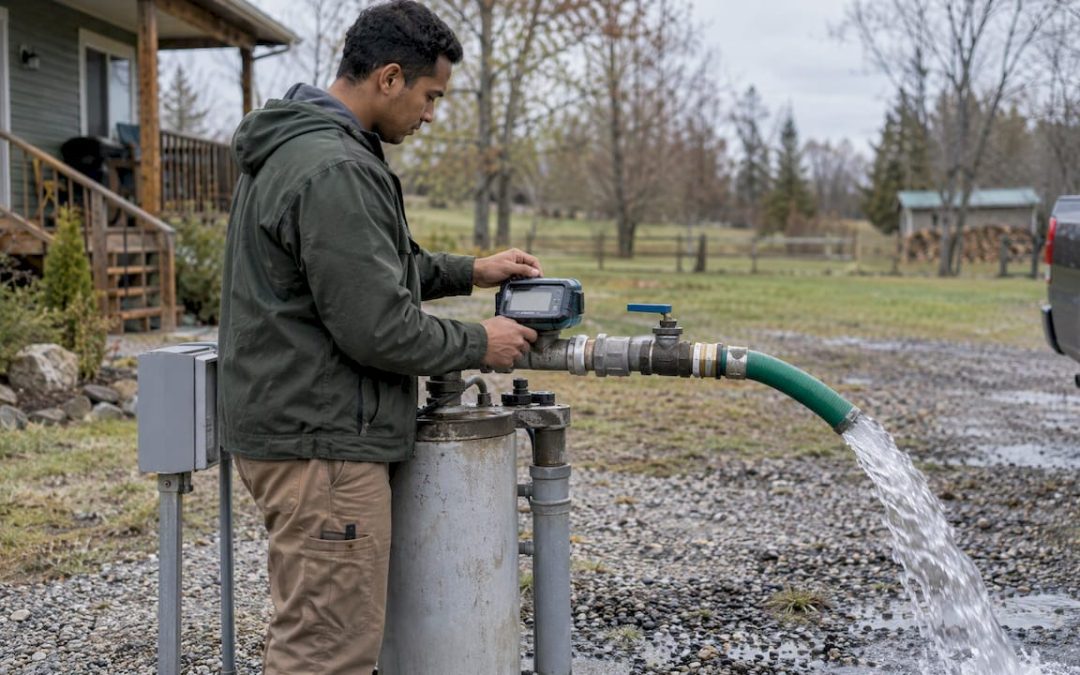
A well flow test, also called a well yield test, measures how many gallons per minute (GPM) a private well can deliver and how quickly the water level comes back after pumping. If you are buying a home on well water, it tells you whether the well can keep up with a real household, which a clean water sample alone cannot. Most buyers should plan for a pumping test of one to several hours, a result of at least 5 GPM as a common benchmark, and a cost in the low hundreds of dollars.
TL;DR
- A flow test measures yield (GPM) and recovery. A water-quality lab test measures safety. A home purchase needs both, plus a visual inspection of the well.
- About 5 GPM is widely treated as adequate for normal household use, but recovery time and storage matter as much as the headline number.
- Test length depends on who sets the rules: some agencies call for one hour, some lenders for four, and extended tests run 24 hours or more.
- Costs vary by region. A county in California publishes $600 to $1,000 for a 3-hour test, so ask for a quote locally.
- Order the test early in your inspection period so a weak result can still change your negotiation.
Table of Contents
- What a well flow test actually measures
- Yield, drawdown and recovery: three terms, one test
- How the test is done, step by step
- What counts as a good result
- Where the flow test fits in a well inspection checklist
- What a well flow test costs
- Timing the test inside your inspection period
- Our perspective
- Get the well side of your purchase handled
- FAQ
- Sources
What a well flow test actually measures
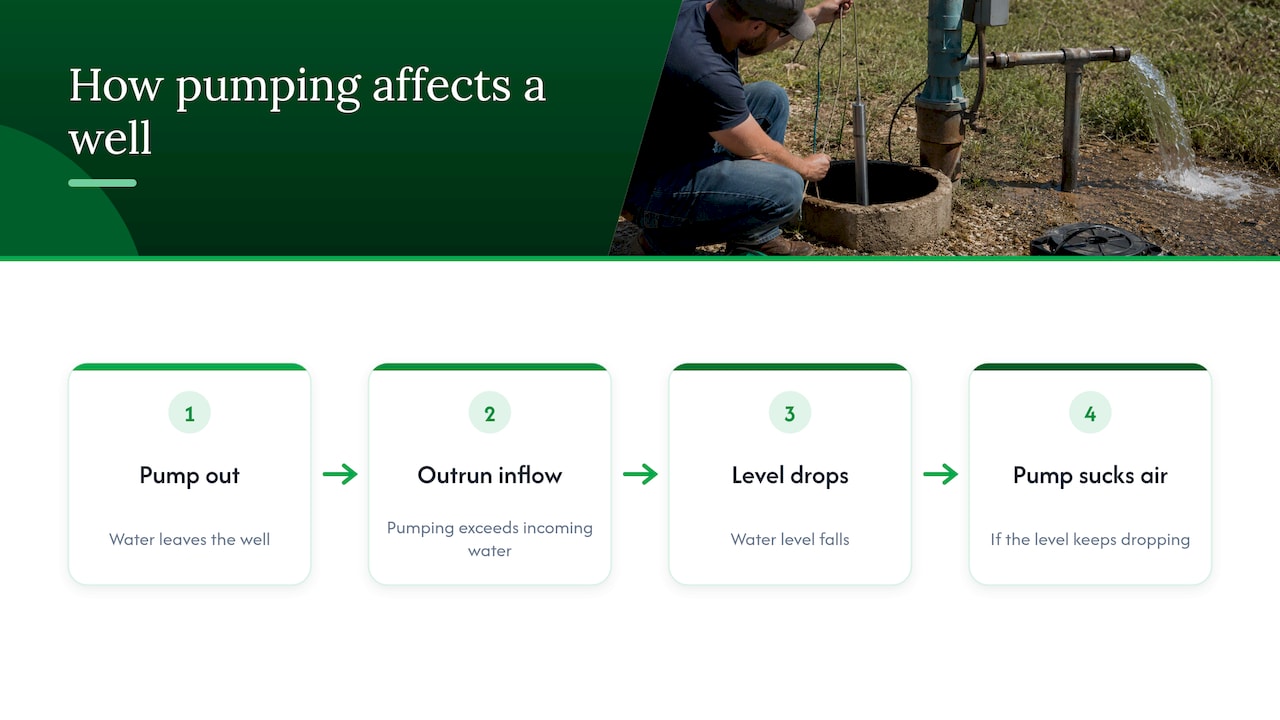
A private well is a hole in the ground connected to an aquifer. Water moves into the well from the surrounding rock or soil at a limited rate. If you pump out faster than it flows in, the water level drops until the pump sucks air.
The University of Rhode Island explains that the safe yield is the point where the amount pumped out balances the amount entering the well, otherwise the well runs dry. Well professionals use that number to confirm the well is deep enough and the pump sits at the right level.
That is why a flow test is about capacity, not quality. A well can give you clean water and still fall short on a Saturday morning with laundry, showers and a dishwasher all running. The Alabama Cooperative Extension notes that yield is shaped by aquifer characteristics, well construction, maintenance, drought and community demand. Two of those, drought and nearby demand, can change after you sign, which is one reason a test during a dry stretch tells you more than one after heavy rain.
Yield, drawdown and recovery: three terms, one test
People search for “well yield test,” “well drawdown test” and “well recovery test” as if they were different tests. They are three readings taken during the same procedure.
- Yield is the pumping rate the well sustains, in gallons per minute.
- Drawdown is how far the water level falls while pumping. The USGS defines it as the water-level decline caused by pumping.
- Recovery is how far the level rises once pumping stops, which the same USGS report describes as the water-level rise after pumping ends.
Pumping also lowers groundwater around the well. The USGS describes this as a cone of depression that can affect nearby wells, and the cone gets deeper in low-yielding aquifers for the same pumping rate.
Penn State Extension gives a handy figure for older wells: specific capacity is pumping rate divided by drawdown in feet, and a yield drop of 25% or more generally signals the well needs rehabilitation. If the seller has an older test on file, comparing it with a new one can show that kind of decline.
How the test is done, step by step
Procedures differ by state and county, but the sequence is consistent. A licensed well contractor typically runs it.
- Rest the well. Los Angeles County’s procedure requires no production from the well for 24 hours before testing, so the starting water level is a true static level.
- Record the static level. The tester measures the depth to water before the pump runs.
- Pump at a steady rate. Montana’s rule asks for discharge as uniform as possible and requires the pump rate, the pumping level at one hour, and the recovery level and time to be recorded.
- Discharge water away from the well. The Los Angeles County procedure requires pumped water to go at least 50 feet away so it does not soak back in and skew the results.
- Measure recovery. Once the pump stops, the tester logs how fast the level climbs back. Los Angeles County counts full recovery as a return to within 90% of the starting level, and a British Columbia government guide likewise treats at least 90% recovery as the point to aim for.
- Get the written numbers. You want static level, pumping rate, drawdown, duration and recovery in a report, not a verbal “it’s fine.”
How long does a well flow test take?
There is no single national standard. Montana requires at least one hour. The British Columbia guide, which is Canadian and useful here only for explaining concepts, says domestic pumping tests commonly last 4 to 12 hours, while traditional tests commonly run 24 to 72 hours. The Water Systems Council’s homebuyer guidance, which I cover below, describes testing as a licensed well contractor task.
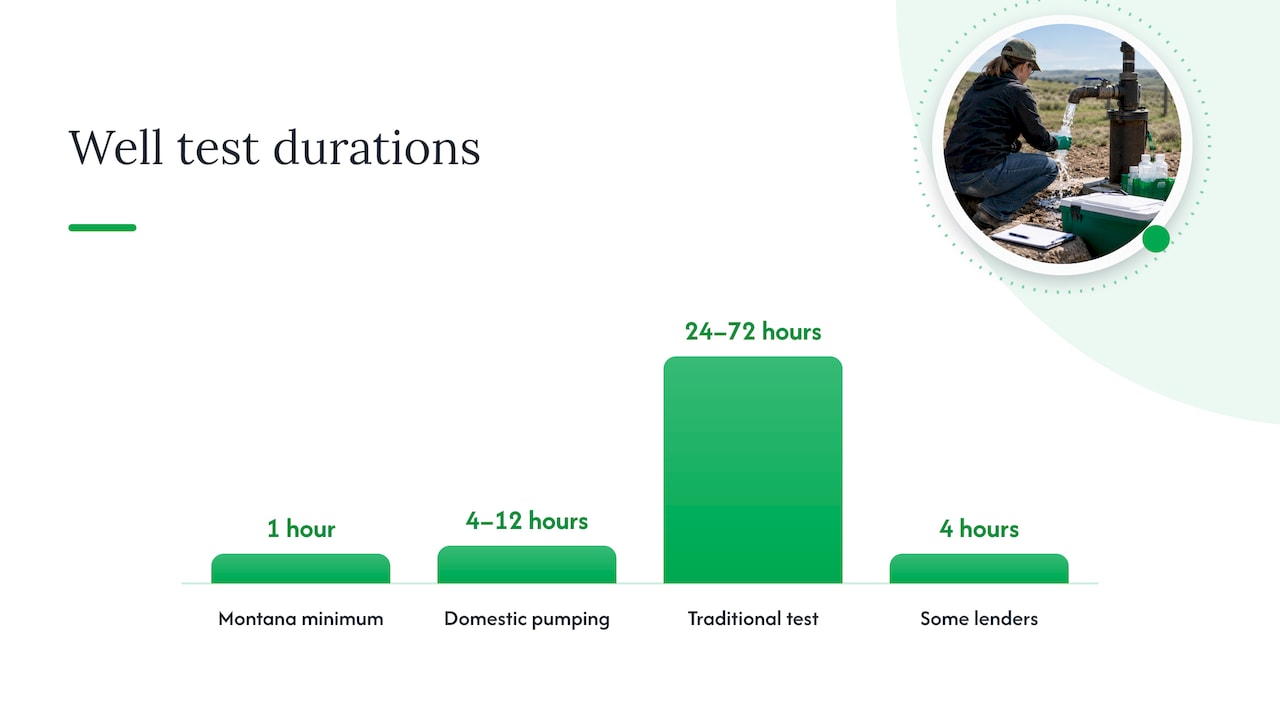
For your purchase, the practical answer is: ask your lender and local health department which duration they accept, then book that. Some lenders ask for a four-hour test, and a shorter one will not satisfy them.
What counts as a good result
Is 10 gallons per minute a good flow rate for a well?
Yes. Ten GPM is comfortably above the thresholds most agencies cite for a single household. Oregon State University’s Well Water Program says 5 GPM is generally accepted as adequate for normal daily use, and that low-producing wells may need conservation, a holding tank or another water source.
The New Hampshire Water Well Board suggests a minimum for indoor household use of 600 gallons within two hours, which works out to 5 GPM for two hours. The state’s well association points to 4 GPM for four hours as an optimum for a private domestic supply.
Here is how I read the numbers when a buyer asks:
| Result | What it usually means for a household |
|---|---|
| Under about 3 GPM | Likely needs storage, such as a holding tank, and careful water use |
| About 3 to 5 GPM | Workable for many homes, especially with good recovery and storage |
| 5 GPM or more, sustained | Meets the commonly cited benchmark for normal use |
| 10 GPM or more | Ample for most single-family homes |
This table is my own reading of the benchmarks above, not a regulation. Your state or lender sets the rule that applies to you.
Why recovery matters as much as the number
A single GPM figure hides how the well behaves over a day. The Well Guide’s homebuyer material makes the point that flow and recovery are two different measurements that both matter. A well pumping 5 GPM that needs many hours to recharge can leave you with dry faucets after a long shower and a dishwasher cycle. A smaller well with fast recovery and enough storage can serve the same house better.
Where the flow test fits in a well inspection checklist
A flow test is one of three evaluations a home purchase on well water needs. A visual inspection of the wellhead and equipment and a state-certified lab test of the water are the other two. The Water Systems Council states that a detailed inspection of well components and yield testing should be done by a licensed well contractor, and notes that mortgage lenders and local agencies usually require inspections and tests before settlement.
A solid checklist covers:
- Records. The Iowa State Hygienic Laboratory recommends asking for construction, maintenance, water-quality and repair records.
- Well basics. The USGS advises buyers to get the well depth, water level, pump type, pump-intake setting and yield, and notes that some lenders require a bacterial analysis and a yield test.
- Capacity and treatment. The Florida Department of Health tells buyers to assess well capacity and yield, ask about treatment equipment and have drinking-water testing done alongside the home inspection.
- Water quality. Our guide to the three lab tests to order for well water before closing explains what the lab side adds.
- Septic system. Wells and septic systems share a lot, so read what to expect in the septic inspection process.
- The rest of the property. Plumbing materials matter too. Our partner-style reading on cast iron pipes in Florida homes shows why older piping deserves its own look during a purchase.
For a broader view of the well portion of a purchase, see what every homeowner must know about well water inspection.
What a well flow test costs
Prices swing with region, depth, test length and how far the contractor drives. Treat any national number as a rough anchor.
The clearest published figure comes from a county health agency. Santa Cruz County, California, lists a 3-hour flow test at $600 to $1,000, with extended tests adding $165 to $185 per hour. That is a high-cost coastal market. Many rural areas will quote less for a shorter test, so get at least two local quotes.
A few things push the price up:
- Longer pumping durations, especially 24-hour tests
- Deep wells or hard-to-reach wellheads
- Bundling with a lab water-quality panel, which is a separate charge
- Rush scheduling during a tight inspection period
We break down the wider picture in our well inspection cost guide.
Timing the test inside your inspection period
The order matters more than most buyers realize. Here is the sequence we suggest:
- Ask the seller for well records and any earlier yield test as soon as your offer is accepted.
- Book the well contractor and lab sampling in the first days of the inspection window. Rest periods and lab turnaround eat time.
- Schedule the general home inspection and any septic work so the findings land together. Our home inspection day walkthrough shows what that day looks like.
- If the numbers come back low, use them. You can ask for repairs, a storage tank, a price change, or you can walk away under your contract terms.
If you plan to use an FHA-backed loan, ask your lender early what documentation they want. Our HUD compliance certification work is built for that kind of file, and we hold HUD 203k credentials.
Our perspective
We see well questions come up late in a lot of purchases. A buyer gets a clean lab result, relaxes, and only later learns the well runs short in August. We think the fix is simple: treat the well as three jobs, visual inspection, yield and recovery, and water quality, and start all three early.
We built our process around the buyers who feel the most pressure at this stage: first-time buyers, low-income families and veterans. They are often stretching to close and cannot afford a surprise after move-in. That is why we return reports within 24 hours, offer evening and weekend appointments, and can walk you through the home by video or in person.
Our Create Request List™ tool exists for the next step. Once the findings are in, it helps you and your agent turn them into a clear request to the seller instead of a long, confusing email thread.
Our view: a well result is a negotiating tool, and the earlier you have it, the more it can do for you.
JOHN
Get the well side of your purchase handled
We serve buyers, sellers, investors, lenders and agents across the St. Louis Metro area and Southern Illinois. Our septic and well inspection sits alongside the general inspection, sewer camera inspections, radon testing, termite inspections and environmental testing, so you can line up the property’s major systems with one team. Our discounts for veterans and first-time buyers are part of how we try to keep that within reach.
See everything we offer on our inspection services page, or visit Hunt Home Inspection to schedule.
FAQ
How do I perform a well flow test?
The basic method is to rest the well, record the static water level, pump at a steady rate for the required time, and then track recovery. Because a proper test needs a pump rate and water-level readings, buyers typically hire a licensed well contractor. Ask for written results covering rate, drawdown, duration and recovery.
What is the difference between a flow test and a water quality test?
A flow test shows how much water the well delivers and how fast it recovers. A water quality test, done at a state-certified lab, shows what is in that water. A home purchase on well water generally needs both, plus a visual inspection of the wellhead and equipment.
Can a well pass a flow test and still run dry?
It can. A short test captures one moment, while drought, heavy neighborhood use or a declining aquifer can lower yield later. Recovery data and storage capacity help show how the well handles peak demand, and an older test on file lets you compare for decline.
Who pays for the well flow test when buying a house?
It depends on your contract and local custom. Often the buyer orders and pays during the inspection period, but some sellers cover it, especially with a pre-listing inspection. Settle it in writing before booking. Our seller’s guide to pre-listing inspections covers why some sellers get ahead of it.
Sources
- University of Rhode Island: Your Well Produces (Well Yield)
- Alabama Cooperative Extension: Private Well Program Handbook
- USGS: SIR 2018-5096, Single-Well Aquifer Tests
- USGS: Ground Water and the Rural Homeowner
- Penn State Extension: Water Well Maintenance and Rehabilitation
- Los Angeles County: Well Yield Test Procedures for Private Wells
- Montana Administrative Rule 36.21.664: Tests for Yield and Drawdown
- Oregon State University: Purchasing a Home with a Well
- New Hampshire DES: Determining the Reliable Capacity of a Private Well
- The Well Guide: Buying a House With a Well
- Water Systems Council: Buying a Home with a Well
- Iowa State Hygienic Laboratory: A homebuyer’s guide to private well water
- Florida Department of Health: Homeowner’s Guide to Your Well
- County of Santa Cruz: Water Yield and Quality Testing FAQ
- Cast iron pipes and selling a Florida home
Recent Comments