
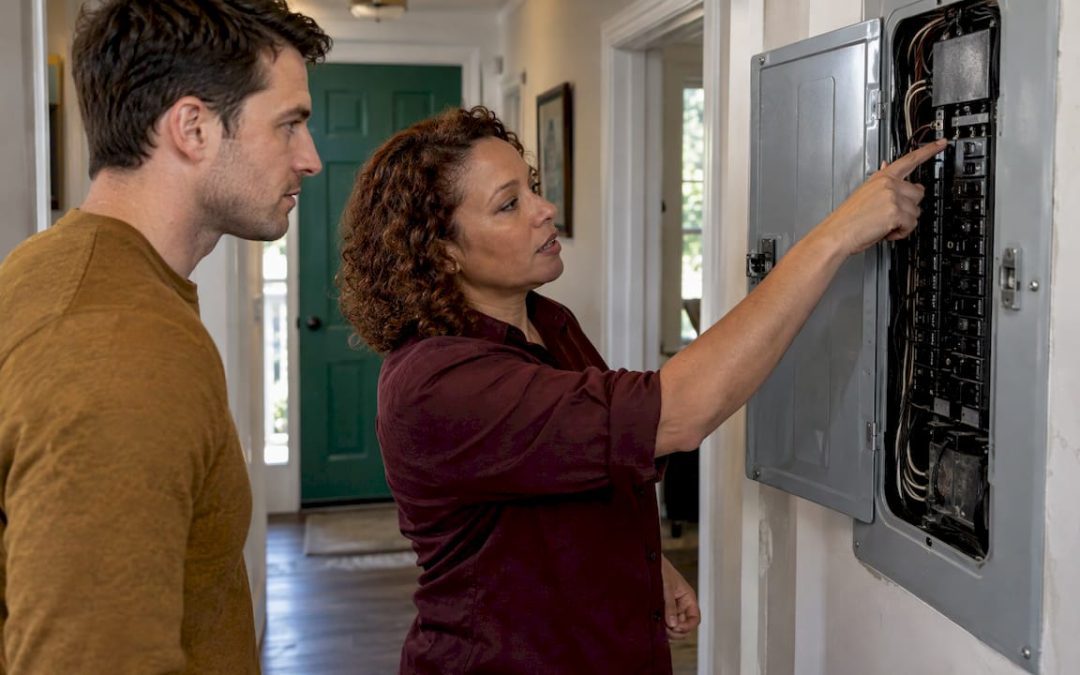
Yes, attend your home inspection if you can. No law or standard contract makes you, but the inspection is the one time you can walk through the house with a trained professional, see problems with your own eyes and ask questions on the spot. If you truly can’t be there, you still have good options, and we cover them below.
TL;DR
- Buyer attendance is recommended, not generally required. The CFPB advises buyers to attend if they can.
- Plan to be there for the whole visit or at least the final walkthrough. Inspections often take 2 to 4 hours.
- Follow the inspector, ask questions, take photos and notes, and leave the technical work to them.
- If you can’t attend, send your agent, ask for photos or video, and get a call or video walkthrough with the inspector.
- Time matters: schedule the inspection early so you have days left to bring in specialists and decide.
Table of Contents
- Do you have to attend a home inspection?
- Why attending is worth your time
- Who else usually attends
- How long it takes and when to show up
- Timing: book early so the findings are useful
- How to behave at the inspection
- What to ask before you leave
- If you can’t attend
- After the inspection: repairs, negotiation and walking away
- Choosing an inspector who welcomes you
- Book your inspection with Hunt Home Inspection
- FAQ
- Sources
Do you have to attend a home inspection?
No. The National Association of REALTORS® notes that a home inspection is not required at all, though buyers often make one a contingency in the purchase agreement. PNC’s guide says no one is required to be present during the inspection, while buyers and agents often attend to look more closely and ask questions.
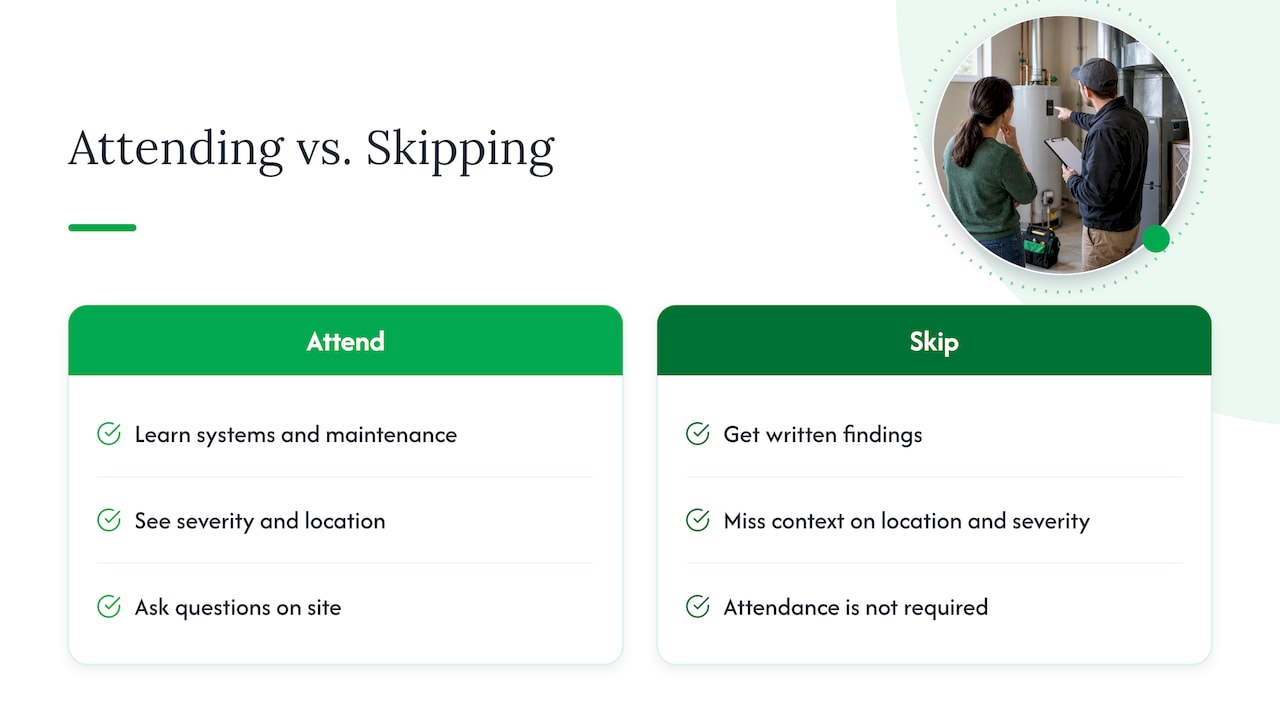
So the real question isn’t “must I?” but “what do I lose if I don’t?” The answer is mostly context. A written report tells you what the inspector found. Standing next to the inspector tells you how serious it is, where it is and what to do about it.
InterNACHI’s buyer FAQ goes further. It says buyers should attend and should reconsider hiring an inspector who doesn’t allow attendance, because following along teaches you about the home’s systems, defects and maintenance.
Why attending is worth your time
You see the problem, not just a sentence about it
A line in a report that reads “evidence of past moisture at basement wall” can mean a stain the size of a coaster or a wall that has been wet for years. In person, you see which it is. NAR says attending helps buyers learn where plumbing and electrical details are located and understand the scope of potential problems.
That knowledge pays off after closing. Knowing where the main water shutoff, the electrical panel and the furnace filter are on day one beats hunting for them during your first leak.
You can ask questions while the answer is in front of you
The CFPB says being present helps you interpret the report, understand issues and ask questions. “Is that crack new?” “How hard is this to fix?” “Is this something a handyman can do, or do I need a licensed pro?” Those questions are far easier to answer at the foundation wall than by email three days later. If you want a head start, our list of questions to ask a home inspector is built for first-time buyers.
You learn what is routine and what is serious
Every home has findings. Consumer Reports treats the inspection as a chance to examine the house yourself, and it reminds buyers that the inspector doesn’t tell you whether to buy or walk away. That decision is yours, and it is much easier when you have watched the inspection and can tell a loose handrail from a failing roof.
You get a maintenance education
A good inspector explains how the house works as they go: how to test GFCI outlets, where to clean the dryer vent, how old the water heater is. Freddie Mac says inspectors commonly examine the roof, plumbing, electrical, heating and cooling, foundation, attic, basement and more. Following along turns that checklist into a home-ownership tutorial you couldn’t buy otherwise.
Who else usually attends
The inspector is the only person who has to be there. Beyond that, a typical inspection includes some mix of the following people.
| Person | Usually there? | What they do |
|---|---|---|
| Inspector | Always | Examines the home and writes the report |
| Buyer (you) | Recommended | Follows, asks questions, takes notes |
| Buyer’s agent | Often | Provides access, supports you, helps with repair requests |
| Listing agent | Sometimes | Provides access, may answer questions about the property |
| Seller | Rarely | Generally stays away from a buyer-ordered inspection |
HomeLight’s 2026 guide says the buyer’s agent commonly provides access and supports the buyer, though whether an agent attends can depend on state rules and local practice. Inman’s Troy Palmquist argues that both agents and the buyer should be present, so agents learn the findings first-hand and can better help with the repair request process.
As for sellers, PNC says they generally don’t attend a buyer-ordered inspection, which lets you talk about the property openly with the inspector and your agent. If you are on the other side of the deal, we wrote a short piece on whether the seller should stay or go.
How long it takes and when to show up
Consumer Reports says inspections typically take 2 to 4 hours. Larger or older homes take longer, and add-ons such as radon, sewer camera or termite checks add time or are done separately.
The same source notes that some inspectors prefer to work alone at first and do a buyer walkthrough near the end. Both styles are normal. When you book, ask how your inspector likes to run things, and plan around it:
- If the inspector welcomes you throughout: arrive at the start, introduce yourself and stay within earshot.
- If the inspector prefers a final walkthrough: arrive for the last hour or so, when findings are fresh and the inspector can show you each one.
Either way, the closing walkthrough is the part not to miss. It is where the inspector summarizes what matters most.
Timing: book early so the findings are useful
Inspections usually happen after an offer is accepted and before closing, according to InterNACHI’s FAQ. Freddie Mac says the buyer should hire and schedule the inspector after making an offer and before closing, and should still arrange an independent inspection even if the seller had one done before listing.
The CFPB recommends scheduling as soon as possible, so you have time to find major problems, order additional inspections and decide whether to go ahead. Your contingency window is set by your contract, so every day counts. Getting offer paperwork signed fast, for example with real estate offer signature software, helps you start the clock on inspections sooner and leaves more room to act on what they find.
How to behave at the inspection
Attending doesn’t mean supervising. A few habits make the visit smoother and more useful.
- Arrive on time and introduce yourself. Tell the inspector what worries you most about the house.
- Follow, don’t lead. Stay close enough to see what the inspector points out, but give them room at the panel, the attic hatch and the crawl space.
- Take photos and notes. Photograph each issue the inspector shows you, with a wide shot and a close-up, so you can match them to the report later.
- Save big discussions for the walkthrough. Quick questions are welcome. Long debates about repairs are better at the end, when the inspector has seen everything.
- Keep conversation focused. Measure rooms and plan furniture on another day. The inspection is for the house’s condition.
- Don’t ask the inspector to decide for you. Ask for context: how serious, how urgent, what kind of professional should look next.
For a full picture of how the day unfolds, read our guide to what to expect on home inspection day. It also helps to understand the role of a home inspector before you arrive.
What to ask before you leave
Realtor.com suggests asking the inspector to clarify unfamiliar findings, identify major concerns, explain how hard repairs are and say whether a specialist should look. Add a few of your own:
- Which three findings matter most?
- What needs attention soon after move-in, and what can wait?
- Which items should a specialist, such as an electrician, roofer or HVAC pro, evaluate?
- Are there conditions here you’d keep an eye on over time?
That last question matters. NAR says reports describe current conditions along with maintenance recommendations and items to monitor, including issues that could grow after move-in. Realtor.com adds that the general inspector generally doesn’t provide repair cost estimates, so specialists are the ones to price major findings.
When you read the report, Consumer Reports suggests watching for phrases like “major,” “significant,” “immediate repair” and “get estimates”. Those are the items to prioritize.
If you can’t attend
Life happens: work, travel, a sick kid. You still have ways to get most of the value, based on HomeLight’s 2026 guidance:
- Send your agent or a trusted representative. Brief them on your concerns first.
- Ask for photos or video of every significant finding.
- Schedule a phone or video call with the inspector to go through the report.
- Review the report with your agent soon after delivery.
- Attend a follow-up visit if something needs a second look.
We built our scheduling around this reality. We offer in-person and video walkthroughs, evening and weekend appointments for busy professionals, and reports returned within 24 hours, so you can review findings quickly while your decision window is open.
Our perspective
We have one firm view: buyers who attend make better decisions. Not because they catch things the inspector missed, but because they understand what the inspector found. A report is information. A walkthrough is understanding.
Many of the people we work with are first-time buyers, low-income families and veterans. For them, the purchase may be the biggest financial step of their lives, and the inspection is the cheapest protection in the whole process. We’d rather you spend two hours in the house and walk away confident than read forty pages alone at midnight.
That is why we offer video inspections when you can’t be on site, evening and weekend appointments, and a report within 24 hours. It is also why we created the Create Request List™, a tool designed to make communication between buyers and agents clearer once the findings are in. Our inspectors hold NACA, ASHI and HUD 203k credentials, and we offer discounts for veterans and first-time buyers.
Show up, ask questions, take photos. Then use what you learned to negotiate, plan or, if the contract allows, walk away on solid ground.
JOHN
After the inspection: repairs, negotiation and walking away
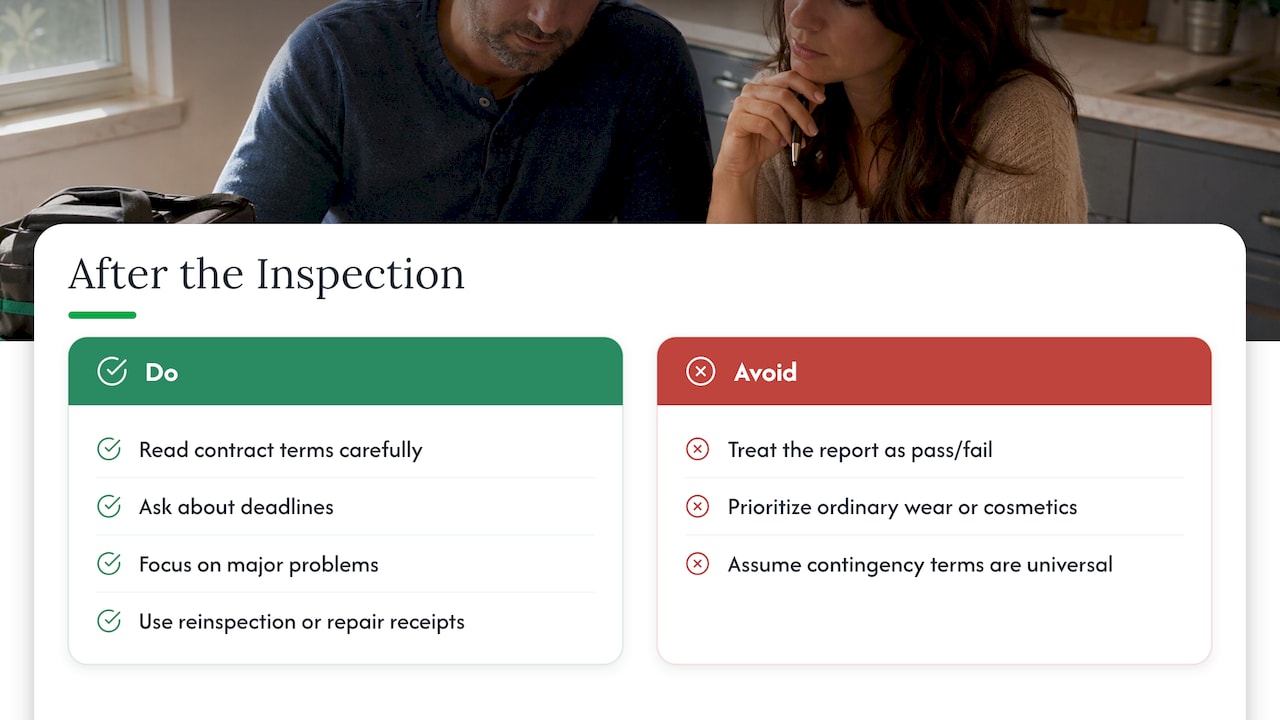
Once you have the report, you have choices. If your purchase contract is contingent on a satisfactory inspection, the CFPB says you have the right to cancel without penalty if you’re unsatisfied, and you can also negotiate with the seller about who makes or pays for repairs. NAR’s contingency guide adds that how the contingency works depends on your contract, so read yours carefully and ask your agent or attorney about deadlines.
The inspector won’t pass or fail the house. Freddie Mac explains that an inspector points out conditions that may need repair or replacement and leaves the verdict to you.
For negotiation, NerdWallet recommends focusing on major structural, roof, plumbing, electrical, HVAC, water, pest, environmental and safety problems rather than ordinary wear or cosmetic items. It also suggests a reinspection or repair receipts to verify agreed work. Attending helps here because you can speak about specific items you saw, not just report line numbers.
NAR notes that some buyers waive inspections to make offers stand out in competitive markets. If you are considering that, remember that the inspection is what shows you what you are buying. Even when the contingency is gone, an inspection you attend can still tell you what to budget for and fix first.
Choosing an inspector who welcomes you
The CFPB advises choosing an inspector with a reputation for honesty and thoroughness, checking references and confirming any state or county licensing requirements. Add one practical test: does the inspector invite you to come along? If the answer is a warm yes, that’s a good sign. Our inspection company selection criteria walk through what else to compare.
To get the most from the visit, you can also review our walkthrough preparation guide for buyers.
Book your inspection with Hunt Home Inspection
We serve the St. Louis Metro area and Southern Illinois with residential and commercial inspections. For buyers, that means a buyer’s home inspection plus add-ons when the house calls for them, such as radon testing, mold inspection, sewer camera lateral inspection, WDO/termite inspection and septic or well inspection. You are welcome to attend in person, or we can arrange a video walkthrough.

See everything we offer on our inspection services page, then contact us to schedule. Tell us when you can be there and we will work around your calendar, including evenings and weekends.
FAQ
Should a buyer attend the home inspection?
Yes, if at all possible. It isn’t required, but the CFPB says attending helps you understand the report and ask questions. Even if you can only make the final walkthrough, you will learn far more than from the report alone.
Who typically attends a home inspection?
The inspector is always there, and the buyer is recommended to be. The buyer’s agent often joins, the listing agent sometimes does, and sellers generally stay away from a buyer-ordered inspection. Local practice and state rules can change who shows up.
Can a buyer walk away after an inspection?
If your contract includes an inspection contingency and you are unsatisfied, the CFPB says you can cancel without penalty. You can also negotiate repairs with the seller. Your contract sets the deadlines, so check them with your agent or attorney.
What if I can’t attend?
Send your agent or another trusted person, ask for photos or video, and book a phone or video call with the inspector. Review the report with your agent soon after you receive it, and schedule a follow-up visit if something needs a closer look.
Can attending slow down the inspection?
Not if you follow the inspector’s lead. Stay out of the way at the panel and attic, save longer questions for the walkthrough, and let the inspector finish each system. Some inspectors prefer a walkthrough at the end, which works just as well.
Sources
- CFPB: Schedule a home inspection
- NAR: Consumer Guide: Home Inspections
- NAR: Consumer Guide: Real Estate Sales Contract Contingencies
- InterNACHI: Home Inspection FAQ for Home Buyers & Sellers
- PNC Insights: What Is a Home Inspection?
- HomeLight: Do You Know Who Attends a Home Inspection?
- Inman: Who Should Attend Home Inspections?
- Consumer Reports: How to Get the Most From a Home Inspection
- Freddie Mac: What to Expect with a Home Inspection
- Realtor.com: 16 Questions To Ask a Home Inspector
- NerdWallet: The Home Inspection: Do’s and Don’ts for Home Buyers
Recent Comments