

When a seller refuses repairs after the inspection, you still have choices, and most of them are won or lost in the contract you already signed. In most U.S. sales the seller is not required to fix anything, but you can ask for a credit, a lower price, or a different repair, accept the home as it is, or cancel if your contract has an inspection contingency. The right move depends on what the inspector found, how many days you have left, and what your lender will allow.
This guide is written for buyers who are watching a budget: first-time buyers, families stretching to afford a home, veterans using a loan benefit, and the agents who guide them. It explains the rules in plain words and then walks you through the steps.
TL;DR
- A seller can usually say no to repairs. An inspection report does not create a legal duty to fix anything unless your contract, your lender or local rules say so.
- Your leverage is your inspection contingency (a contract clause that lets you cancel or renegotiate after the inspection). Check its deadline today.
- You have five realistic paths: renegotiate, ask for a credit or price cut, accept as-is, make the repair yourself after closing, or cancel.
- Put every request in writing, with the scope of work, who does it, and a contractor estimate for each item.
- Focus on safety, structure and major systems. Skip cosmetic items so your strongest requests get attention.
Table of Contents
- Why a seller can say no
- What a refusal does to your contract
- Your five options when the seller won’t fix anything
- Write the repair request so it is hard to refuse
- Decide which findings are worth a fight
- Know your state’s rules
- Why the inspection you hire matters in a standoff
- Our perspective
- FAQ
- Sources
Why a seller can say no
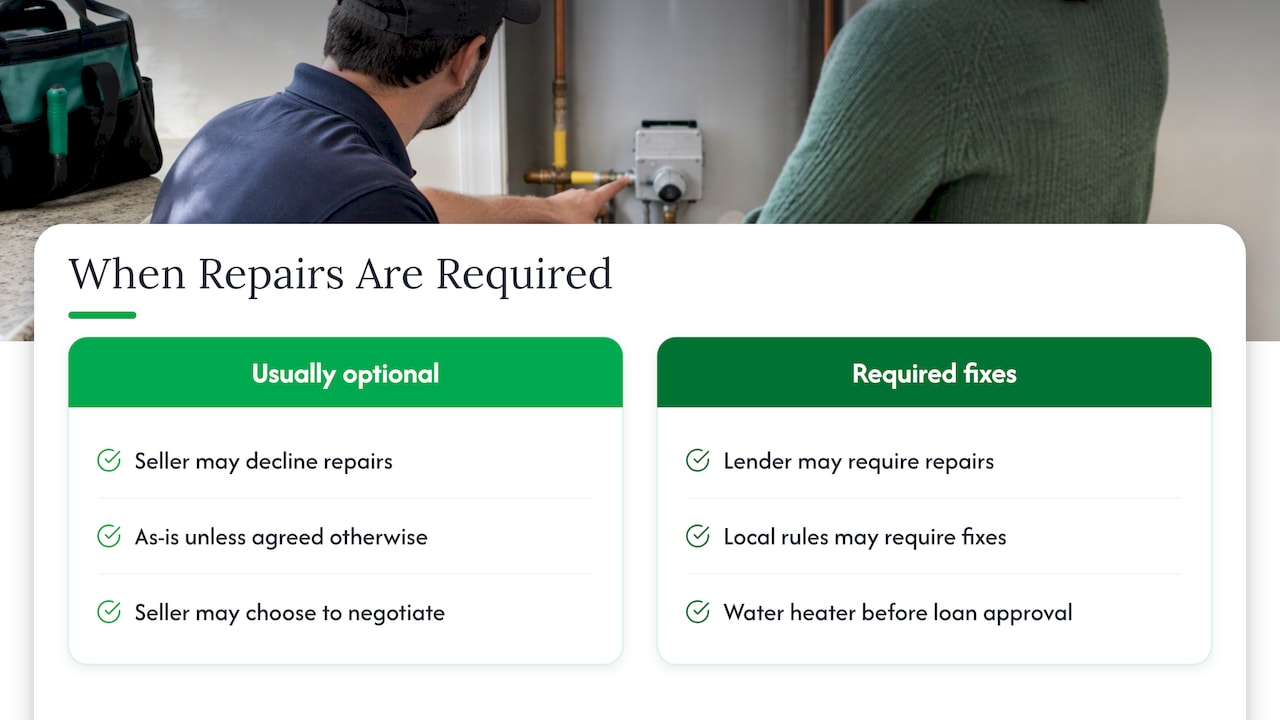
A home inspection is an information tool, not a pass-or-fail test. Texas REALTORS® states that there is no requirement for a seller to make any repairs after an inspection. The North Carolina REALTORS® consumer guide says the same thing in contract terms: under the standard form, the seller has no obligation to make requested repairs unless the parties agreed otherwise, and the home is sold in its present condition, although the seller may choose to negotiate.
Sellers decline for ordinary reasons. They may have priced the home with its condition in mind. They may think the items are cosmetic or routine maintenance. They may be selling in a market where another buyer will take the house as-is. A refusal is often an opening position, not a final answer.
There are exceptions where fixes stop being optional. Redfin reports that repairs become mandatory mainly when a lender, an insurer or a local rule requires them. Realtor.com says a lender may require something like a broken water heater to be fixed before approving a loan, and some fixes are needed to meet building codes or safety regulations. In those cases the seller is negotiating with the lender’s conditions, not just with you.
What a refusal does to your contract
The seller saying no does not end the deal, and it does not automatically free you either. What happens next comes from your contract.
The Consumer Financial Protection Bureau (CFPB), the federal agency that publishes homebuyer guidance, says that if your contract is contingent on a satisfactory inspection, you can cancel without penalty when you are dissatisfied with the results. The American Bar Association describes two common inspection riders: one that gives the buyer the right to cancel within a set time if defects are found, and one that gives the seller time to repair or reduce the price by the cost of repairs. If the seller does nothing under that second rider, the buyer can cancel and seek return of the earnest money.
Three details decide how safe you are:
- The deadline. Your right to cancel or renegotiate runs on a clock. The North Carolina Real Estate Commission advises buyers to finish their investigation by the contract deadline, early enough for the seller to respond to repair requests. Miss the window and your leverage shrinks.
- What cancelling costs. In some states you pay a fee for the right to investigate. North Carolina’s regulator notes that a seller refusing to pay for repairs is not a breach of contract, and that the buyer’s due diligence fee is generally non-refundable even when the inspection finds material defects, while the buyer keeps the right to terminate during the due diligence period. Read your own contract for what is refundable.
- What closing means. The same commission notes that most contracts treat closing as acceptance of the property in its existing condition unless something is agreed in writing. Anything the seller promises must be in the contract.
If you waived your contingency to make a competitive offer, your options narrow sharply. Redfin warns that buyers who waive it may lose their earnest money if they back out over the home’s condition. We explain the risk in why waiving an inspection contingency is risky, and the basics in our guide to the buyer inspection contingency.
Your five options when the seller won’t fix anything
The Colorado Division of Real Estate lists several ways to resolve inspection issues short of ending the contract. Combined with the CFPB and Zillow guidance, they give you this menu.
1. Come back with a revised request
A flat “no” to a long list often turns into a “yes” to a short one. Cut the list to the findings that affect safety, structure or major systems, and re-send it with estimates. Zillow’s negotiation guide recommends being specific and backing requests with quotes, for example citing a contractor’s $8,000 roof-repair estimate when asking for a credit or a price reduction.
2. Ask for a credit or a price reduction instead of repairs
Sellers who dislike managing contractors often prefer to give money. Zillow identifies three main post-inspection requests: repairs, a price reduction, or a closing credit. Realtor.com’s seller-side guidance suggests credits make more sense than seller-performed work for larger items such as a leaky roof or a faulty electrical panel, because the buyer controls the contractor and the quality. A seller who won’t touch the roof may still agree to a credit toward it.

Colorado’s regulator also lists a seller concession, a negotiated sales-price change, and funds held in escrow or paid to a contractor at closing if the lender allows it. Ask your loan officer first. The same position advises buyers to check with their mortgage loan originator before negotiating any repair resolution, because a change can affect loan approval or delay funding.
3. Accept the home as-is
This is a sound choice when the findings are modest, the price is already fair, and you have a budget for the work. Colorado’s list includes making the repair yourself after closing without any help from the seller. Before you commit, get estimates so that your first-year budget includes the actual cost, not a guess.
4. Ask the seller to extend time or share the work
If the seller agrees in principle but needs time, put the repair deadline, the standard of work and the proof required in writing. The North Carolina guide notes that a good-faith seller who needs more time can get up to a 14-day settlement delay under its standard form. Other states have different rules, so use this as an example of the kind of term to negotiate, not as a universal right.
5. Cancel under your contingency
For serious flaws, cancelling is the protection you paid for. The CFPB says that for something like a cracked foundation, a buyer with an inspection-contingent contract should be able to cancel without penalty. Zillow adds that if the seller refuses to negotiate or the issues are too significant, you may be able to walk away depending on your contingencies. Cancel in writing, inside the deadline, and have your agent confirm how the earnest money is released.
| Situation | Usually the best path |
|---|---|
| Several small items, fair price | Accept as-is, budget for the work |
| One large item (roof, panel, HVAC) | Request a credit or price reduction with an estimate |
| Safety or structural defect, seller silent | Revised request, then cancel if there is no answer by the deadline |
| Lender requires the repair | Negotiate who pays; the repair may be a condition of the loan |
| Contingency waived | Talk to your agent and a real estate attorney before acting |
Write the repair request so it is hard to refuse
A vague request invites a vague refusal. The North Carolina Real Estate Commission recommends a written request that says which repairs you want, how they should be made, whether licensed professionals should do them, and whether you want copies of receipts at or before closing.
A practical version looks like this:
- Lead with the report. Attach the pages for the items you are asking about, with photos.
- List only priority items. Aim for a handful, ranked from most to least important.
- Choose the remedy for each. Repair by a licensed contractor, or a credit of a stated amount, never “fix whatever is needed.”
- Attach estimates. A number from a contractor is harder to wave away than your opinion.
- Set the standard and proof. Ask for receipts and work by a licensed professional where the trade requires it.
- Give a response date that leaves you time before your contingency ends.
- Put the agreement in the contract. Zillow notes that all agreements should be documented in writing in the purchase agreement. A verbal promise at the walkthrough does not protect you.
Speed matters here. Your report is the foundation of the request, and every day you wait for it is a day off your contingency. Our guide on the home inspection report timeline shows how the report date fits against the contract clock.
Decide which findings are worth a fight
Not every line in a report deserves a negotiation. Buyers who ask for everything often get nothing. Redfin reports that structural movement, outdated or overloaded wiring, and moisture problems are the findings most likely to change a deal, and that buyers should prioritize significant safety hazards, structural concerns and major system deficiencies over minor cosmetic issues.
A useful way to sort the report:
- Safety and health: active leaks, mold growth, radon, electrical hazards, gas or carbon monoxide risks. These are the strongest requests. Our pages on mold inspection and radon test duration explain what a test can and cannot tell you.
- Structure and big systems: foundation, roof, HVAC, electrical panel, plumbing and sewer lines. They are costly and may also concern your lender or insurer.
- Lender and insurer items: if a failing item could block your loan or your homeowners policy, raise it first. The CFPB says that for major repairs such as a new roof, a lender can require the repair before closing or require you to deposit enough money in a special account to pay for it right after closing.
- Maintenance and cosmetic items: worn paint, loose handles, minor caulking. Handle them yourself and leave them off the request.
Our home inspection red flags list gives a longer view of the findings that tend to be worth negotiating. If your list also includes locks, lighting or alarms for the new house, this overview of home security upgrades shows what to fix first and what to add later, which helps you separate must-do work from nice-to-have.
Missing special inspections can also hold up a decision. Where the report points to a sewer line, septic system, well, termites or radon, a specialist test puts a number or a photo on the problem, and a number is far easier to negotiate than a worry.
Know your state’s rules
Contract forms and laws differ by state, so treat the examples below as illustrations, not a promise about your home.
- Arizona: the standard inspection response form lets a buyer request repairs, a seller credit, a price reduction, or cancel and recover earnest money after the 10-day inspection period. The seller has 5 calendar days to respond, and the buyer then has 5 days to accept, counter or cancel.
- Massachusetts: a regulation that applies to sales after October 15, 2025 bars conditioning a sale on waiving the inspection and requires a separate written disclosure. The Massachusetts Association of REALTORS® notes that failure to provide the disclosure is an unfair or deceptive practice under state law.
- Iowa: a law signed in 2026 lets a seller request, at no charge, only the portions of the buyer’s inspection report that relate to repair requests. If the buyer or agent fails to provide them on request, the seller can cancel without penalty.
- Texas: a buyer who cannot get the seller to agree to repairs can terminate within the option period, and a seller who receives an inspection report is charged with knowledge of its contents even if they refuse to open it.
In Missouri and Illinois, where we work, read the inspection and response deadlines in your own contract, and ask your agent or a real estate attorney to confirm them before you send anything. Disclosure matters too: Redfin notes that in many states sellers must disclose known material defects, including problems found in an earlier buyer’s inspection, to later buyers.
Why the inspection you hire matters in a standoff
When a seller says no, your report becomes your evidence. A thorough report with clear photos and a short turnaround gives you time to get estimates, talk with your agent and send a focused request before the deadline.
We return inspection reports within 24 hours, and we offer both in-person and video inspections, with evening and weekend scheduling for buyers who work during the day. We serve the St. Louis Metro area and Southern Illinois, and we offer discounts for veterans and first-time buyers. Our Create Request List™ is built to streamline communication between buyers and their agents, which helps when you need to turn findings into a repair request quickly. Our team holds NACA, ASHI and HUD 203k certifications.
If you are still before your inspection, book it early enough to leave room for negotiation. See our inspection services, including radon, mold, sewer camera, septic and well, and termite inspections, each of which can give you a clear finding to negotiate with.

Our perspective
Most buyers who call us after a seller says no are not upset about the repair itself. They are upset because they thought the inspection report would settle the question. It does not. The report tells you what is wrong, and the contract tells you what you can do about it.
We see the best outcomes when buyers treat the inspection as the start of a plan. Know your contingency deadline before inspection day. Get the report quickly. Sort the findings into safety, structure and cosmetic. Then make a short, specific request. That is why we focus on returning reports within 24 hours and on tools like the Create Request List™ that help buyers and agents work from the same page.
For first-time buyers, veterans and families on a tight budget, a single large repair can change the whole purchase. A thorough inspection with the right add-on tests, such as radon, mold, sewer or termite, turns a vague worry into a documented finding you can negotiate, price in or walk away from with confidence.
JOHN
FAQ
Can a seller refuse repairs after an inspection?
Yes. In most U.S. sales the seller has no duty to make repairs just because an inspection found problems. Exceptions are repairs required by your lender, an insurer, a building code, or your signed contract. If the seller refuses, you can renegotiate, accept the home, or cancel if your contingency allows it.
Can I walk away if the seller won’t make repairs?
Often you can, if your contract has an inspection contingency and you cancel within its deadline. The CFPB says buyers with that protection can cancel without penalty when dissatisfied with the results. If you waived the contingency, you could lose your earnest money, so check with your agent or a real estate attorney first.
What if the seller won’t negotiate at all?
Send one final written request that is short and specific, with estimates and a response date. If the seller still says no, decide between accepting the home with a budget for the work and cancelling under your contingency. Do not let the deadline pass while you wait.
Is a credit better than asking for repairs?
For larger items, often yes. A credit lets you pick the contractor and control quality, and many sellers find it easier than managing work before closing. Ask your lender first, because some loans limit how credits or escrowed funds can be used.
Does the seller have to pay for repairs the lender requires?
Not automatically. The lender can require the repair before closing, but who pays is negotiable. Under some forms, such as the Texas paragraph 7E, a buyer can terminate if the parties cannot agree on who pays for lender-required repairs. Check your own contract.
Sources
- Prior Inspection Reports, Texas REALTORS®
- Repair requests consumer version, North Carolina REALTORS®
- What Fixes Are Mandatory After a Home Inspection?, Redfin
- Mandatory Fixes After a Home Inspection, Realtor.com
- Schedule a home inspection, Consumer Financial Protection Bureau
- Home purchase inspection rider, American Bar Association
- Due Diligence for Residential Buyers, North Carolina Real Estate Commission
- When Should Due Diligence Fees Be Refunded?, NCREC Bulletins
- Commission Position 25, Colorado Division of Real Estate
- How to Negotiate After an Inspection, Zillow
- BINSR in Arizona: What You Can Ask Sellers to Fix
- Home inspection policy for homebuyers, Mass.gov
- Home Inspection Regulations, Massachusetts Association of REALTORS®
- Home Inspection Reforms Signed by Governor, Iowa REALTORS®
- Home Security Upgrades: What to Fix First and What to Add
Recent Comments