

Book the inspection the day your offer is accepted, use an online scheduler or your agent’s request list, add likely specialist tests at booking, lock a morning slot, and confirm a 24-hour report delivery. That single sequence is what separates buyers who negotiate from a position of knowledge from those scrambling at the end of their contingency window.
Do these four things the moment your offer is accepted:
- Call or book online immediately. Don’t wait for your agent to prompt you. Calendar slots fill fast in competitive markets, and a one-day delay can push your inspection past your contingency deadline.
- Add likely specialist tests at booking. If the home is older than 1978, pre-book radon and lead testing. If there are mature trees near the foundation, add a sewer scope. Scheduling these later means waiting for separate availability windows.
- Confirm a 24-hour report turnaround. Ask directly: “Will the written report be ready within 24 hours of the inspection?” If the answer is vague, keep looking.
- Send the access packet to the listing agent today. Lockbox code, utility status, tenant notification, and any known access quirks — get this to the seller’s agent before 5 PM on Day 0.
Jhunthomeinspections offers online scheduling and 24-hour report delivery for buyers and agents in the St. Louis Metro area and Southern Illinois.
Key Takeaways
Booking your inspection on Day 0 and confirming a 24-hour report turnaround is the single most effective way to protect your contingency window and negotiate from a position of full information.
| Point | Details |
|---|---|
| Book on Day 0 | Contact the inspector the same day your offer is accepted to protect your contingency window. |
| Request a morning slot | An 8–9 AM start allows same-day report delivery and full-daylight exterior work. |
| Pre-book specialists | Add radon, sewer, or mold tests at booking; cancel within 24 hours if the walkthrough clears them. |
| Confirm 24-hour turnaround | Ask directly before booking; a vague answer on timing is a reason to keep looking. |
| Jhunthomeinspections | Serves the St. Louis Metro area and Southern Illinois with 24-hour reports, online scheduling, and full add-on services. |
Table of Contents
- What does a fast home inspection scheduling guide actually look like?
- How do you pick an inspector fast without second-guessing yourself?
- When should you book specialist add-ons, and which ones?
- What should you do before the inspector arrives?
- What should buyers and agents do on inspection day?
- What does a fast, professional inspection report look like?
- How do you act fast after the report arrives?
- What tools and templates speed up scheduling and follow-up?
- Speed matters, but not more than the right call
- Jhunthomeinspections gets you scheduled fast and reporting within 24 hours
- Sources
What does a fast home inspection scheduling guide actually look like?
The efficient home inspection process runs on a tight, predictable sequence. Here is the day-by-day timeline that keeps your contingency window intact.
-
Day 0 (offer accepted, same day): Contact your inspector and lock a time slot. Confirm the inspection address, access method, and that all utilities will be on. Ask for a written confirmation of the turnaround promise. The CFPB advises scheduling a home inspection as soon as you choose a home so you have time to resolve problems and keep contingency options open. Every hour you wait on Day 0 is negotiating runway you are giving away.
-
Day 0 (same evening): Send the consolidated access packet to the listing agent. Include the property address, lockbox code, gate codes, tenant notification status, utility confirmation, and any add-ons you have pre-booked.
-
Day 1–2 (inspection day): The inspection typically runs 2–4 hours. Prefer a morning start (8–9 AM) so the inspector works in full daylight and can deliver the written report the same evening. Attend the final 30–45 minutes for the verbal walkthrough.
-
Day 1–2 (same evening or within 24 hours): Receive the written report. Read the summary section first. Flag safety items and major system findings for immediate follow-up.
-
Day 2–7 (specialist window): If the initial report flags concerns, or if you pre-booked specialists, coordinate those appointments now. Radon lab results typically take 48–72 hours after the test device is retrieved. Sewer camera appointments often have 1–3 day lead times depending on local demand.
Pro Tip: Morning inspection slots (8–9 AM) are the single best scheduling move you can make. The inspector works in natural light, finishes before early afternoon, and can write and deliver the report the same day. Weekend slots fill faster than weekday mornings, so book those first if your timeline is tight. For weekend-specific strategies, see how to book a weekend home inspection appointment.
HomeGauge reports that roughly 90% of clients prefer to book online, many customers book outside typical business hours, and a significant fraction of millennial buyers will only book through an online system. If your inspector does not offer online scheduling, you are already starting with friction.
How do you pick an inspector fast without second-guessing yourself?
Time pressure does not mean skipping due diligence. It means knowing exactly what to check and in what order. Run through these five criteria before you commit.
- Verified credentials. Confirm the inspector holds a current state license and a recognized certification such as InterNACHI or ASHI. In Missouri and Illinois, state licensing is required. A credentials page on the inspector’s website should list both.
- Turnaround promise. Ask directly: “When will the written report be in my inbox?” Same-day or 24-hour delivery is the standard for a professional operation. Anything beyond 48 hours creates real risk inside a 7–10 day contingency window.
- Online booking availability. If you cannot book at 10 PM on a Tuesday, you are dependent on someone else’s business hours. Online scheduling protects early calendar slots and eliminates phone tag.
- Sample report quality. Request a sample report or look for one on the website. A quality report has annotated photos, a prioritized summary, safety items called out separately, and clear next-step language. A two-page PDF with no photos is a red flag.
- Clear communication and agent-friendly scheduling. Agents who regularly work with an inspector know the process runs smoother. Ask whether the inspector sends confirmation emails, accepts consolidated access packets, and communicates directly with listing agents when needed.
When you call or fill out the online scheduler form, ask three questions: “What is your report turnaround time?” “Do you offer radon, sewer, or mold add-ons at the same appointment?” “What is your cancellation policy if my offer falls through?” Those three answers tell you almost everything you need to know about how the operation runs. For a structured comparison of what to look for, the inspection company selection criteria page walks through the key factors.
When should you book specialist add-ons, and which ones?
The short answer: book likely specialists at the same time you book the general inspection, then cancel if the initial walkthrough clears them. Waiting until after the report means waiting for separate scheduling windows, which can add 3–5 days to your timeline.
Book at the same time as the general inspection when:
- The home is 1978 or older (radon, lead paint, asbestos risk)
- There are large trees near the foundation or a history of slow drains (sewer scope)
- There is visible staining on walls or ceilings, or a musty odor (mold inspection)
- The home has a septic system or private well (septic and well inspection)
Wait for the initial report before booking when:
- The inspector finds no visible evidence of the concern during the walkthrough
- The property is newer construction with no flagged systems
Here is a practical timing reference for common specialist add-ons:
For air quality and radon testing specifics, Simon Air Quality provides detailed guidance on what professional testing involves and how results are processed.
Pro Tip: Pre-book the sewer scope and radon test at the time of your general inspection booking, then cancel within 24 hours if the walkthrough clears them. Most inspectors allow cancellations with reasonable notice. The cost of canceling is zero. The cost of scrambling for a sewer scope appointment three days into your contingency window is real.

What should you do before the inspector arrives?
A well-prepared property moves faster and produces a more complete report. The most common causes of delayed or partial inspections are utilities that are off, locked access points, and items blocking panels or crawlspace entries. Fix those before Day 1.
Utilities and access:
- Electricity, water, and gas must be on and active, not just switched at the meter
- Confirm the lockbox code with the listing agent the evening before
- Gate codes, garage door openers, and any secondary entry points should be documented in the access packet
- If the property is tenant-occupied, written notice to the tenant is required in most states; confirm this is done
Clearances and documentation:
- Move stored items away from the electrical panel, water heater, furnace, and HVAC equipment
- Clear attic hatch and crawlspace entry points of boxes or stored items
- Gather available maintenance records (HVAC service, roof repairs, appliance manuals) and leave them on the kitchen counter
- Label any tricky access points with a sticky note so the inspector does not lose time searching
Redfin’s buyer guidance emphasizes exactly this: utilities on, access clear, and a plan to attend the final walkthrough so issues can be clarified on the spot. Use the DIY pre-inspection checklist to confirm nothing is missed before the inspector arrives.
Quick email template for the listing agent:
What should buyers and agents do on inspection day?
Showing up for the entire inspection is not necessary and can actually slow things down. The inspector needs space to work methodically, and a buyer hovering in every room creates distraction.
- Arrive for the final 30–60 minutes of the inspection, not the start. InspectorData advises attending the final 30–45 minutes specifically to get a clear, prioritizing walkthrough from the inspector rather than a running commentary on every minor finding.
- Let the inspector complete their process uninterrupted. Save your questions for the summary walkthrough at the end.
- During the walkthrough, ask: “What are the two or three items you would address first?” and “Is there anything here that would make you recommend a specialist?”
- Agents should plan to spend 60–90 minutes reviewing the report with the buyer the same evening the report is delivered. The faster that conversation happens, the more negotiating runway you preserve.
Pro Tip: Bring a notepad to the walkthrough and write down the inspector’s verbal priorities. Reports are thorough by design, and a long, photo-rich report is a sign of quality, not a sign of a problem-riddled house. The verbal summary is your fast-triage tool.
Morning slots (8–9 AM) give the inspector full daylight for roof and exterior work and typically allow same-day report delivery. A 2 PM start on a complex property often pushes the written report to the following morning.
What does a fast, professional inspection report look like?
A quality report delivered within 24 hours is not a short report. It is a well-organized one. Zillow notes that inspectors review major systems including the roof, foundation, plumbing, electrical, and HVAC, and recommends using the report as a negotiation tool rather than a reason to panic.
A professional report should include:
- Prioritized executive summary at the front, separating safety items from maintenance items from cosmetic observations
- Room-by-room findings with annotated photos for each flagged item
- Safety items called out clearly, not buried in the middle of a section
- Suggested next steps for each major finding (specialist referral, contractor estimate, monitor over time)
- System condition ratings for roof, HVAC, plumbing, electrical, and foundation
| Report Element | What to Look For | Red Flag |
|---|---|---|
| Executive summary | Prioritized, safety items first | No summary; findings listed alphabetically |
| Photos | Annotated, showing exact location | No photos or generic stock images |
| Findings language | Clear severity levels | Vague language with no recommended action |
| Report length | 30 pages for a typical home | Under 10 pages for a full inspection |
| Turnaround | Same day or within 24 hours | “We’ll send it in a few days” |
For a deeper look at report formats, the types of inspection summary reports guide explains what each format covers and how to read one quickly.
How do you act fast after the report arrives?
The report lands in your inbox. Here is the sequence that preserves your negotiating position inside your contingency window.
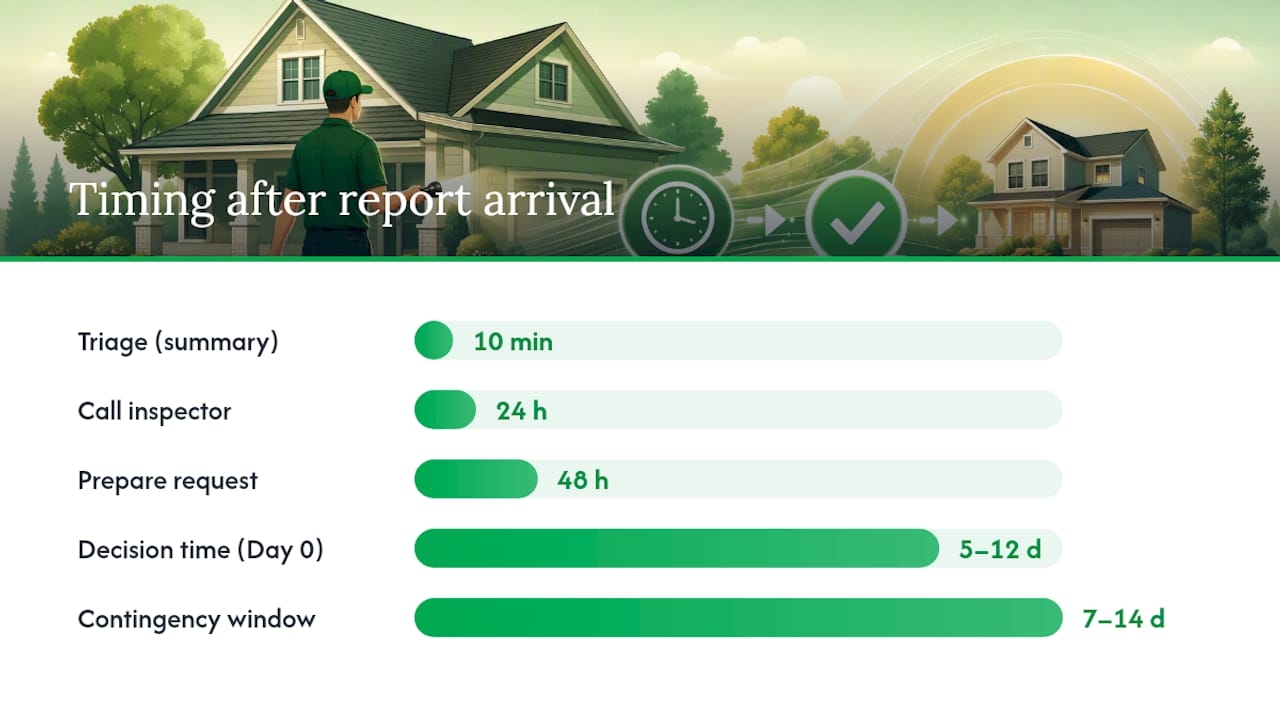
- Read the executive summary first. Do not start on page one of the full report. The summary exists to give you the triage view in 10 minutes.
- Separate safety items from maintenance items. Safety issues (faulty wiring, active water intrusion, structural movement) require immediate specialist follow-up. Maintenance items (aging water heater, worn caulk) are negotiating points, not emergencies.
- Call the inspector for clarifications within 24 hours. Most inspectors will take a 10-minute call to explain findings. Do not guess at severity from a photo alone.
- Decide on specialist orders the same day. If the report flags a concern that warrants a structural engineer, sewer scope, or mold test, book it that afternoon. Every day of delay is a day off your contingency clock.
- Prepare your repair request or credit request within 48 hours. Use the inspection report findings directly. Zillow’s guidance is clear: the report is a negotiation tool, not a reason to walk away from a deal.
Agent script for requesting additional inspections quickly:
Contingency windows in most U.S. transactions run 7–14 days from the inspection date. Booking on Day 0 and receiving the report within 24 hours gives you 5–12 days of actual decision-making time. Booking on Day 3 cuts that window nearly in half.
What tools and templates speed up scheduling and follow-up?
Experienced agents do not reinvent the wheel for every transaction. They use a consistent set of templates and tools that eliminate back-and-forth and protect the timeline.
Appointment request email template:
SMS confirmation template (morning of inspection):
One-page agent access checklist (paste into MLS notes or transaction file):
- Property address and MLS number
- Lockbox code and location
- Gate or secondary entry codes
- Tenant notification status (yes/no, date notified)
- Utility confirmation (electric, water, gas: on/off)
- Likely add-ons pre-booked (radon, sewer, mold, termite)
- Maintenance records location (kitchen counter, garage shelf)
- Inspector contact and report turnaround confirmation
The Create Request List™ from Jhunthomeinspections centralizes all of this into a single tool that agents and buyers use to communicate requests without multiple email chains. Instead of the inspector, the buyer, and the listing agent each holding a different version of the access information, the Create Request List™ puts it in one place, reducing the morning-of confusion that delays inspections. For agents managing multiple transactions, the top inspection request list tools page covers how to use these tools across a full pipeline.
For air quality add-ons, the DIY vs. professional air quality guide from Simon Air Quality is a useful reference when advising clients on whether a professional test is warranted.
Speed matters, but not more than the right call
Speed in home inspection scheduling is genuinely important. A buyer who books on Day 0, gets the report within 24 hours, and orders specialists the same day has real leverage. A buyer who waits three days to book is negotiating with a shorter runway and less information.
But speed is not the same as rushing. There is a difference between moving fast and cutting corners, and it shows up most clearly in two situations.
The first is when an inspector flags something that warrants a specialist. A 24-hour general inspection report is the right pace. Skipping the structural engineer follow-up because it might delay the timeline is not. The report is the starting point, not the finish line.
The second is report quality. A report delivered in four hours that covers a 3,000-square-foot home in eight pages is not fast. It is incomplete. A thorough report on a typical home runs 30 pages or more, with annotated photos and prioritized findings. That report, delivered within 24 hours, is what you are looking for.
The best inspectors move quickly because they are organized and experienced, not because they are skipping steps. When you find one who offers online booking, a morning slot, and a 24-hour turnaround on a detailed report, that combination is worth protecting. Book them early in your search, before you are under contract, so you already know who to call on Day 0.
Jhunthomeinspections gets you scheduled fast and reporting within 24 hours
For buyers and agents in the St. Louis Metro area and Southern Illinois, Jhunthomeinspections delivers what this guide describes: a 24-hour written report, online scheduling, and a full menu of add-ons booked in a single call.

Book your inspection through the inspection services page and confirm your morning slot, your add-ons (radon, sewer scope, mold, termite, septic, well), and your report turnaround in one step. Agents managing multiple transactions can use the Create Request List™ to consolidate access details and eliminate the back-and-forth that delays reports. Buyers who need flexible payment timing can use the Pay at Close option, which aligns the inspection fee with your closing date. Call, email, or book online today.
Sources
- Why Home Inspectors Need an Online Scheduler | HomeGauge
- Schedule a home inspection | Consumer Financial Protection Bureau
- 26 Home Inspection Tips For Buyers | Redfin
- Home Inspection Tips: Pro Advice From 11 Years in the Field | InspectorData Blog
- House inspection checklist: what do home inspectors look for? | Zillow
Recent Comments