
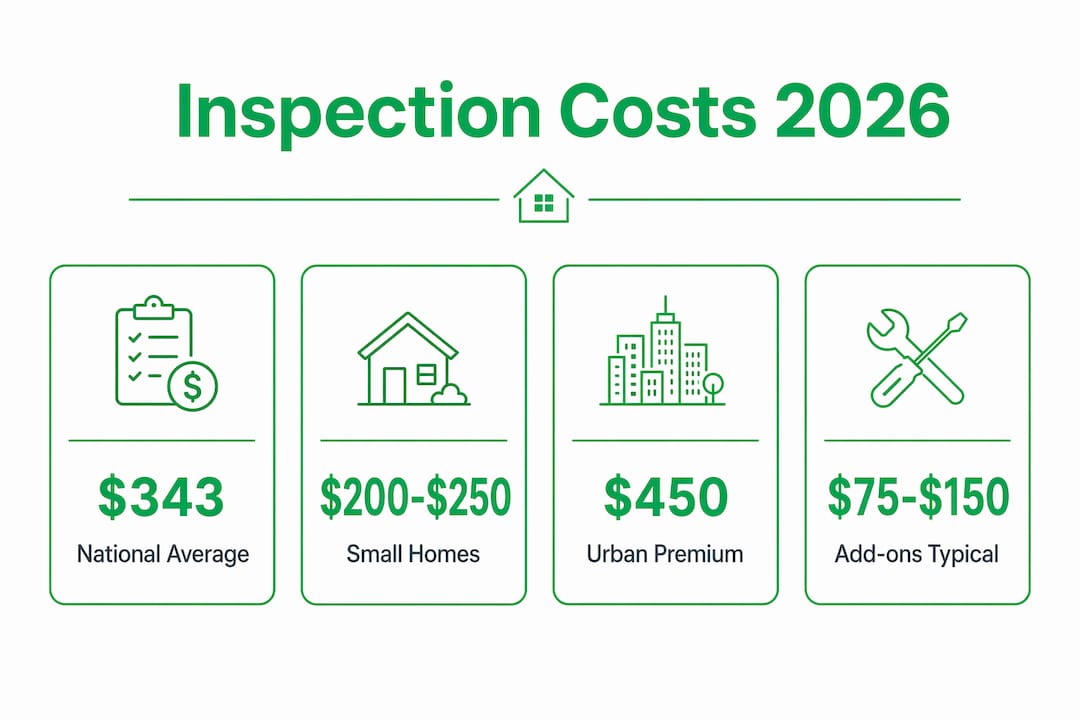
A home inspection is a professional visual assessment of a property’s condition, and its cost is one of the most misunderstood line items in the homebuying process. Typical inspection fees range between $296 and $424 nationally, with an average of $343. That number shifts based on home size, location, property age, and the scope of testing you order. Understanding home inspection cost explained in full means knowing not just the base fee, but every variable that can push your total higher before you close.
What factors influence the cost of a home inspection?
Home inspection pricing is not arbitrary. Fees combine time, scope, and local market conditions, which explains why two buyers in different cities can pay vastly different amounts for what looks like the same service on paper.
How home size drives the base price
Square footage is the single biggest lever on your base inspection fee. A home under 1,000 square feet typically costs between $200 and $250 to inspect. That range climbs to $300 to $500 for homes in the 2,500 to 3,000 square foot bracket, according to size-bracketed pricing data from Angi. The logic is straightforward: more square footage means more systems to evaluate, more time on site, and a longer written report.
| Home size (sq ft) | Typical inspection fee |
|---|---|
| Under 1,000 | $200 to $250 |
| 1,000 to 2,000 | $250 to $350 |
| 2,000 to 2,500 | $300 to $400 |
| 2,500 to 3,000 | $300 to $500 |
| Over 3,000 | $400 and up |
How location changes what you pay
Geography matters as much as square footage. New York City averages $450 for a standard inspection, while Los Angeles averages $330. Markets with higher labor costs, denser housing stock, or stricter licensing requirements for inspectors tend to push fees up. Rural areas often run lower, but inspector availability can be limited, which creates its own scheduling risk during a tight contingency window.
Property age and inspector credentials
Older homes carry more complexity. A 1920s craftsman with knob-and-tube wiring, a cast iron drain stack, and a converted attic takes longer to assess than a 2015 build with standard systems. Inspectors certified through organizations like InterNACHI or ASHI typically charge more than uncertified competitors, and that premium is worth paying. A credentialed inspector’s report carries more weight in repair negotiations and is less likely to miss a material defect.

Pro Tip: Ask your inspector for their license number and verify it with your state’s licensing board before booking. In Missouri and Illinois, inspectors must meet specific education and testing requirements.
How much do specialized add-on inspections cost?
The base inspection fee covers what an inspector can see. It does not cover what requires a separate test, a lab sample, or a camera run through a pipe. Specialized add-on fees range from $125 for a pest inspection up to $660 for mold testing. These costs are not optional when the property or region warrants them.
| Add-on inspection type | Typical cost range |
|---|---|
| Pest/termite inspection | $75 to $150 |
| Radon testing | $100 to $200 |
| Sewer scope | $100 to $250 |
| Lead paint testing | $200 to $400 |
| Mold testing | $300 to $660 |
| Chimney inspection | $100 to $250 |
When add-ons are not optional
Regional triggers matter here. Radon testing is strongly recommended in the Midwest, including Missouri and Illinois, where the EPA identifies elevated radon zones. Homes built before 1978 warrant lead paint testing under federal guidelines. A sewer scope is standard practice on any home older than 30 years with clay or cast iron drain lines. Mold testing becomes necessary when you see water staining, smell musty odors, or the inspection report flags moisture intrusion.
The critical timing issue is that add-ons must be ordered within the inspection contingency window to preserve your buyer protections. Scheduling a mold test after your contingency expires means you lose the right to negotiate repairs or credits based on the results. Many buyers learn this the hard way.
Pro Tip: Order all add-ons on the same day as your standard inspection when possible. It saves a second trip fee and keeps everything within your contingency timeline.
Bundling add-ons for due diligence
A buyer purchasing a 1960s home in St. Louis should budget for the base inspection plus radon, sewer scope, and potentially lead paint testing. That combination can run $600 to $900 total. Treating each test as a separate decision wastes time and risks missing the contingency deadline. Think of the full inspection package as one due diligence event, not a series of optional upgrades.
How does the inspection contingency protect your investment?
The inspection contingency is the contractual clause that gives buyers the right to inspect a property and respond to findings without losing their earnest money. Contingency periods typically run 7 to 14 days after contract acceptance. Every inspection dollar you spend must be spent within that window to count.
Here is how to use the contingency period effectively:
- Schedule the standard inspection immediately. Do not wait until day five of a ten-day window. Book within 24 to 48 hours of contract acceptance to leave room for add-ons and report review.
- Order all specialized tests at the same time. Radon tests take 48 hours minimum. Mold lab results can take several days. Starting late means results arrive after your deadline.
- Review the report with your agent before responding. A professional inspector’s report is a negotiation document. Identify which defects are safety issues, which are maintenance items, and which are deal-breakers.
- Submit your repair request or credit demand in writing. Use a tool like the Create Request List™ from Jhunthomeinspections to organize findings and communicate them clearly to the seller’s agent.
- Know your exit option. If findings are severe, missing the contingency deadline can waive your right to terminate without penalty. Deadlines are enforced strictly in most purchase contracts.
The inspection contingency is your leverage period. It is the only time in the transaction when the buyer holds the most power. Spending $400 on an inspection that reveals $15,000 in deferred maintenance is not a cost. It is a return on investment.
What should you budget for a home inspection?
Budgeting for a home inspection means accounting for more than the base fee. A realistic budget for most buyers covers the standard inspection, one to three add-ons based on property age and region, and a small buffer for specialist follow-ups if the report flags a suspected issue.
Here is what to factor in when building your inspection budget:
- Base inspection fee: $296 to $424 for most homes nationally, higher in major metro areas
- Regional add-ons: Radon in the Midwest, sewer scope on older homes, lead paint on pre-1978 properties
- Specialist follow-ups: A standard inspection report shows visible defects at the time of inspection but does not replace a licensed electrician or structural engineer when a deeper problem is suspected
- Investor-specific costs: Real estate investors should understand that a home inspection is not the same as a Property Condition Assessment
Investors: know the difference between an inspection and a PCA
Investors often confuse home inspections with Property Condition Assessments, or PCAs. A standard inspection identifies visible defects. A PCA goes further, projecting capital reserve needs over a 12-year horizon and modeling the financial risk of deferred maintenance. For a single-family rental or small multifamily purchase, a standard inspection may be sufficient. For a larger commercial or mixed-use acquisition, a PCA is the correct tool. Confusing the two can lead to serious miscalculations in your post-acquisition cash flow.
Pro Tip: If you are buying a property as a rental investment, ask your inspector whether they offer a PCA or can refer you to a firm that does. The upfront cost difference is small compared to the financial clarity it provides.
Choosing the right inspector also affects your budget indirectly. An underpriced inspector who misses a failing HVAC system or a cracked heat exchanger costs you far more than the $50 you saved on the fee. Check reviews on Google and the Better Business Bureau, verify credentials, and confirm the inspector carries errors and omissions insurance.
Key takeaways
A home inspection is one of the highest-return expenditures in the homebuying process, and knowing what drives the cost puts you in control of both your budget and your negotiating position.
| Point | Details |
|---|---|
| National average fee | Standard inspections average $343, ranging from $296 to $424 depending on size and location. |
| Size and location are primary drivers | Larger homes and high-cost cities like New York push fees significantly above the national average. |
| Add-ons can double your total | Specialized tests like mold ($300 to $660) and sewer scopes ($100 to $250) must be budgeted separately. |
| Contingency timing is critical | All inspections and add-ons must be completed within the 7 to 14 day contingency window to protect buyer rights. |
| Investors need more than a standard inspection | A Property Condition Assessment provides capital reserve forecasting that a standard home inspection does not. |
What I’ve learned after years of watching buyers get this wrong
Most buyers treat the home inspection as a checkbox. They schedule it, receive the report, and either panic or shrug. Neither response is correct. The inspection report is a prioritized list of financial risks, and reading it that way changes everything about how you negotiate.
The most common mistake I see is buyers skipping add-ons to save $150, then discovering a radon level of 8 pCi/L or a collapsed sewer line after closing. At that point, the $150 they saved costs them $3,000 to $12,000 in remediation. The math is not close.
The second mistake is waiting too long to schedule. A buyer who books the inspection on day six of a ten-day contingency has no room for add-ons, no time for specialist follow-ups, and no leverage. The contingency window is not a suggestion. It is a countdown.
For investors specifically, I want to be direct: a $350 home inspection on a rental property you plan to hold for ten years is not due diligence. It is a starting point. A Property Condition Assessment that models capital reserves over a 12-year horizon gives you the data to price the deal correctly. The inspection tells you what is broken today. The PCA tells you what will break and what it will cost.
The buyers who get the most value from their inspection are the ones who show up, walk through with the inspector, ask questions, and then use the inspection report as a negotiation tool. That is the full return on a $400 investment.
— JOHN
Schedule your inspection with Jhunthomeinspections
Jhunthomeinspections serves homebuyers, first-time buyers, veterans, and investors across the St. Louis Metro area and Southern Illinois, including St. Peters and University City. Every inspection is completed with a detailed report delivered within 24 hours, and the proprietary Create Request List™ makes it easy to communicate findings directly to your agent. If upfront cost is a concern, the pay-at-close option lets you defer the inspection fee until settlement so it does not compete with your earnest money or down payment. View the full range of available inspection services and book your inspection before your contingency clock starts.
FAQ
What is the average cost of a home inspection in 2026?
The national average home inspection fee is $343, with most buyers paying between $296 and $424 depending on home size and location. High-cost cities like New York average $450, while markets like Los Angeles average closer to $330.
What does a standard home inspection not cover?
A standard inspection covers visible defects at the time of the visit but does not include radon testing, mold sampling, sewer scoping, or pest inspections. Those require separate add-on tests, each with its own fee.
How long does a buyer have to complete a home inspection?
The inspection contingency period typically runs 7 to 14 days after contract acceptance. All inspections, including specialized add-ons, must be completed within this window to preserve the buyer’s right to negotiate repairs or exit the contract.
Is a home inspection required to buy a house?
A home inspection is not legally required in most states, but lenders and real estate professionals strongly recommend it. Skipping it means accepting the property’s condition without independent verification of its systems and structure.
What is the difference between a home inspection and a Property Condition Assessment?
A home inspection identifies visible defects at the time of the visit. A Property Condition Assessment, used primarily by investors, projects capital reserve needs and financial risk over a 12-year period, providing a deeper picture of long-term ownership costs.
Recent Comments