
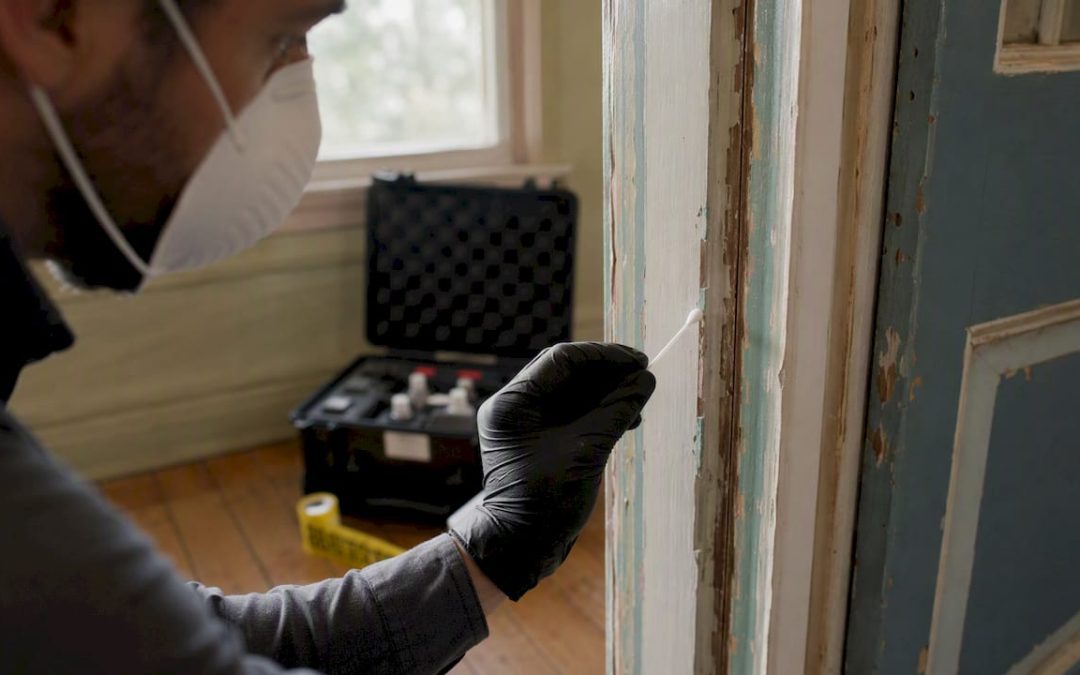
If your home was built before 1978, assume lead paint may be present. Test before any project that will disturb painted surfaces, keep children and pregnant people away from peeling or chipped paint, and call the National Lead Information Center at 1-800-424-LEAD (1-800-424-5323) if you suspect recent exposure. The U.S. Environmental Protection Agency (EPA) and Centers for Disease Control and Prevention (CDC) both treat pre-1978 housing as a presumptive risk until testing proves otherwise.
Two steps you can take right now:
- Keep children and pregnant people away from any peeling, chipping, or chalking paint. Do not dry-sand, scrape, or heat-strip painted surfaces yourself. Wet-wipe horizontal surfaces and mop hard floors with a damp mop to capture settled dust.
- If you see deteriorated paint, have a renovation planned, or a child under 6 may have been exposed, call a certified lead inspector or the National Lead Information Center before doing anything else.
Key Takeaways
Pre-1978 homes should be treated as presumptively containing lead paint until professional testing proves otherwise, and any disturbance of painted surfaces without certified lead-safe practices creates a serious, preventable health risk.
| Point | Details |
|---|---|
| Assume risk in pre-1978 homes | Homes built before 1978 likely contain lead-based paint; pre-1950 homes carry higher concentrations. |
| Children face the greatest danger | Children absorb 4–5 times more lead than adults; effects on developing brains can be irreversible. |
| Test before any renovation | Hire a certified lead inspector or risk assessor; EPA-recognized kits screen but cannot replace professional documentation. |
| RRP Rule applies to paid work | Any contractor disturbing paint in pre-1978 housing must be EPA-certified; prohibited practices include dry sanding and open-flame burning. |
| Jhunthomeinspections provides local testing | Environmental testing add-ons with 24-hour reports and video or in-person options serve the St. Louis Metro area and Southern Illinois. |
This article is general information, not a substitute for advice from a qualified doctor. Consult a qualified healthcare professional about your own circumstances before acting on anything here.
Table of Contents
- What is lead paint and how common is it in U.S. homes?
- How does lead affect health, and who is most at risk?
- Does your home likely have lead paint, and where would it be?
- How do you test for lead paint, dust, soil, and water?
- What should you do if testing finds lead paint or contamination?
- What does the EPA RRP Rule require for renovations?
- What can you do right now to reduce lead exposure at home?
- When should you get blood lead testing, and what happens next?
- What do testing, inspection, and abatement typically cost?
- Why hire a certified inspector, and how does Hunt Home Inspection, LLC help?
- Trusted federal resources and where to find local help
- What are the legal disclosure requirements for homeowners and landlords?
- What inspectors actually see that most homeowners miss
- Jhunthomeinspections offers fast lead testing with same-day reports
- Sources
What is lead paint and how common is it in U.S. homes?
Lead-based paint is paint that contains lead compounds, historically added to improve durability, speed drying, and resist moisture.
Manufacturers used lead in paint for centuries because it genuinely worked. It dried faster than alternatives, held color longer, and resisted mildew. The federal government banned lead from residential paint in 1978, but the decades before that ban left a substantial legacy. Approximately 29 million housing units in the U.S. still have lead-based paint hazards, and about 2.6 million of those house young children.
Prevalence at a glance: A large majority of U.S. homes built before 1978 contain some amount of lead-based paint. Homes built before 1950 tend to have higher concentrations and more layers of lead paint than those built in the 1960s or early 1970s.
Lead paint also still appears on bridges, steel structures, and some industrial facilities, which is worth knowing if you work in construction or live near older infrastructure. For residential purposes, the 1978 cutoff is the practical line.
How does lead affect health, and who is most at risk?
Even low-level lead exposure can harm a developing brain. There is no blood lead level that researchers have identified as completely safe for children, which is why the CDC and EPA treat any detectable exposure as worth addressing.
Children absorb roughly 4–5 times more lead from an ingested dose than adults because their gastrointestinal tracts are more efficient at uptake and their brains and nervous systems are still forming. A dose that causes no measurable harm in an adult can produce lasting cognitive and behavioral effects in a toddler. Children under 6 and infants are at the highest risk, followed by pregnant people, whose absorbed lead crosses the placenta.
Health effects by population
In children, elevated blood lead levels are linked to developmental delays, lower IQ scores, learning disabilities, shortened attention span, and behavioral problems. These effects can be irreversible. In adults, chronic exposure is associated with hypertension, kidney damage, reproductive problems, and cognitive decline.
CDC clinical guidance notes that chelation therapy may be recommended when blood lead levels reach approximately 45 micrograms per deciliter (μg/dL). Any elevated level, however, merits follow-up with a physician, because harm occurs well below that threshold.
Red-flag symptoms to watch for:
- Irritability or unusual behavior changes in a child
- Fatigue, headaches, or difficulty concentrating
- Abdominal pain, nausea, or loss of appetite
- Developmental regression (loss of skills a child previously had)
The critical caveat: most people with elevated blood lead levels show no symptoms at all. Lead poisoning is largely silent, which is exactly why testing matters more than waiting for a child to seem sick.
Does your home likely have lead paint, and where would it be?
If your home was built before 1978, the answer is probably yes. If it was built before 1950, the probability is higher and the concentrations are likely greater. Recent testing that shows no lead is the only reliable way to rule it out.
The EPA notes that the mere presence of lead-based paint is not automatically an emergency. The hazard is most acute when paint is deteriorating or will be disturbed. Intact, well-adhered paint on a surface that children cannot reach or chew poses far less immediate risk than peeling paint on a window sill a toddler touches daily.
Where lead paint tends to concentrate
Friction and impact surfaces accumulate the most wear and generate the most dust. Focus your attention on:
- Window sills and window channels (the most common source of lead dust in older homes)
- Door frames and door edges where surfaces rub together
- Stair rails, balusters, and newel posts
- Porches, exterior trim, and fascia boards (often painted with high-lead exterior formulas)
- Kitchen and bathroom cabinets in pre-1950 homes
- Baseboards and radiator covers
Household dust from deteriorating lead paint and soil tracked indoors is the most common exposure route for children, not paint chips directly. A child does not need to eat a chip to be exposed; hand-to-mouth contact with contaminated dust is enough.
Visual clues that suggest a hazard
Peeling, chipping, chalking, or cracking paint on any surface is a warning sign. So is paint that has been sanded or scraped in the past without proper containment. Look for worn edges on window sills, paint that has bubbled from moisture, and any surface where layers of old paint are visible at the edges.
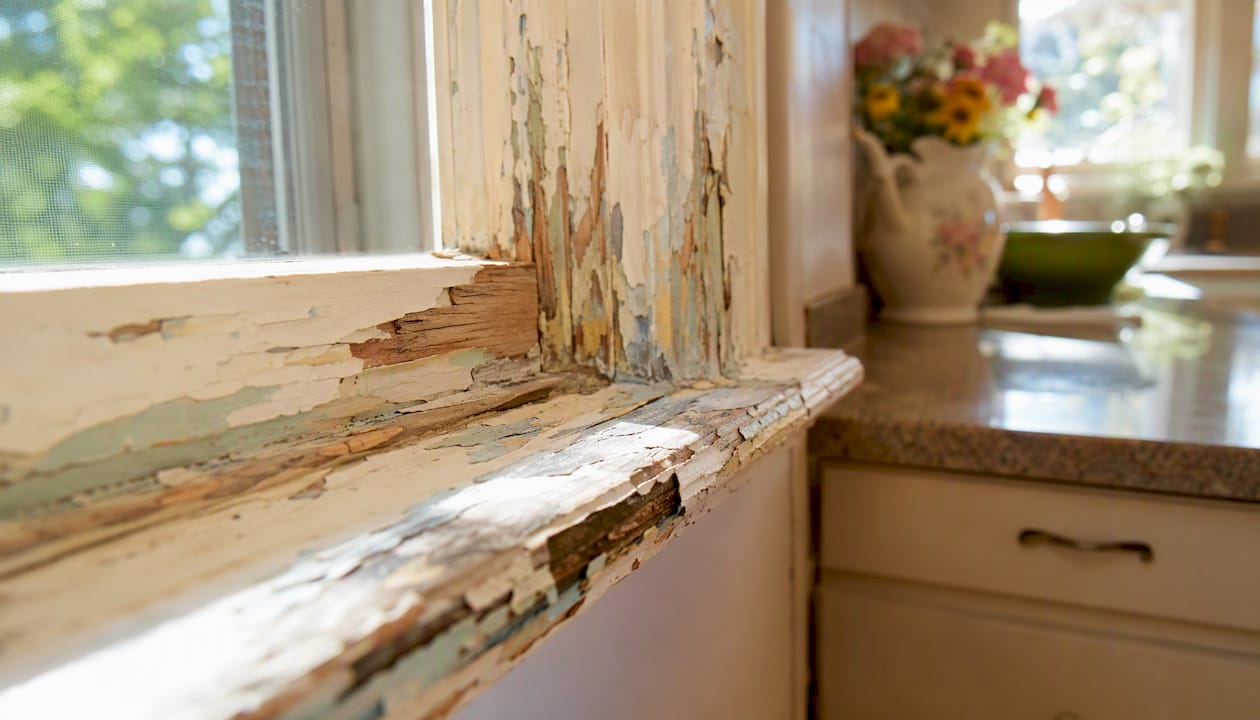
Pro Tip: Before calling an inspector or contractor, photograph every area of concern with your phone. Capture the full surface and a close-up. These images help a remote consultant or inspector prioritize which surfaces to test first and can be shared during a video inspection.
How do you test for lead paint, dust, soil, and water?
For a reliable hazard assessment, hire a certified lead inspector or risk assessor. EPA-recognized test kits and XRF machines each have a role, but they differ in accuracy, documentation value, and what they can tell you.
| Test Method | What It Tests | Accuracy / Limitations | Best Used When |
|---|---|---|---|
| EPA-recognized paint spot kits | Paint surface | Detects presence/absence; can miss low-level lead; no quantification | Quick screening; pre-1978 home, no renovation planned |
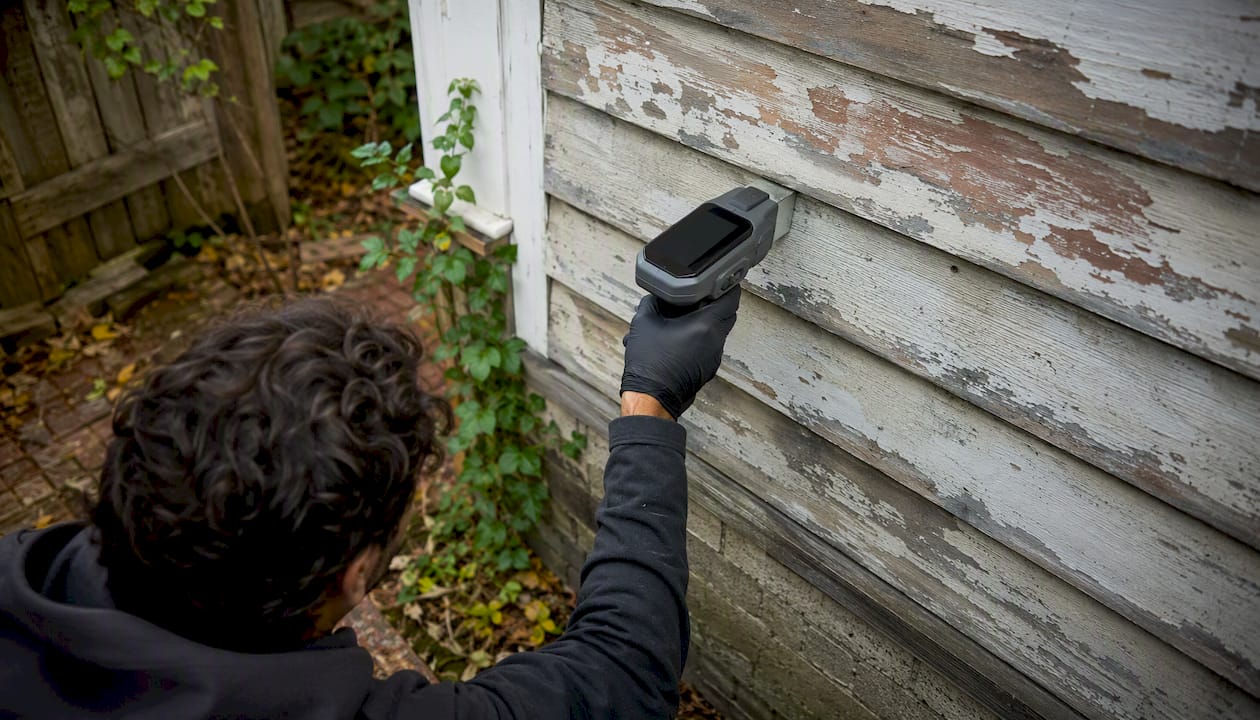
| XRF (X-Ray Fluorescence) | Paint in place, all layers | High accuracy; non-destructive; requires certified operator | Comprehensive inspection; pre-purchase; pre-renovation |
| Lab paint-chip analysis | Paint sample | Quantitative; lab-confirmed; requires surface disturbance | Confirming XRF results; specific surface testing |
| Dust wipe sampling | Horizontal surfaces, floors, sills | Quantitative; lab-analyzed; gold standard for post-work verification | After renovation; child with elevated BLL; rental compliance |
| Soil sampling | Yard, play areas | Quantitative; lab-analyzed | Exterior paint deterioration; near older painted structures |
| Water testing | Tap water | Quantitative; lab-analyzed | Older plumbing with lead solder or pipes |
A homeowner can reasonably use an EPA-recognized test kit for a quick screen if no renovation is planned and no child under 6 lives in the home, but for professional hazardous-material removal planning, consider Safe & Professional Asbestos Removal Services Kitchener. Escalate to a certified professional when:
- You are planning any renovation that will disturb painted surfaces
- A child under 6 or a pregnant person lives in the home
- You are a landlord with disclosure obligations
- A child has received an elevated blood lead result
Practical testing order: Start with friction surfaces (window sills, door frames), then high-traffic floors, then any visibly deteriorated paint. If hiring a dust-wipe sampler, label each sample with the exact room and surface so results can be mapped back to specific locations.
Pro Tip: A written report from a certified lead inspector or risk assessor is not just a piece of paper. It creates a legally defensible record that can satisfy disclosure requirements, support insurance claims, and qualify you for HUD-funded remediation assistance. A DIY kit result cannot do any of those things.
Professional inspectors and risk assessors provide a surface-by-surface evaluation using XRF or lab analysis and produce a documented plan that helps homeowners avoid creating dangerous dust during projects.
What should you do if testing finds lead paint or contamination?
Small, intact areas with no children present may be managed with interim controls. Deteriorated or widespread hazards, or any situation where a child under 6 lives in the home or has an elevated blood lead level, usually require professional abatement.
- Secure the area immediately. Close off the room or surface. Post a barrier if needed. Do not let children or pregnant people enter until the area is cleaned and assessed.
- Limit access. Keep children and pregnant people out of any room with deteriorated lead paint until a certified professional evaluates it.
- Clean dust with wet methods. Wet-wipe horizontal surfaces and wet-mop floors. Use disposable cloths. Do not dry-sweep.
- Post temporary barriers. Cover deteriorated surfaces with heavy-duty plastic sheeting and tape if abatement cannot happen immediately.
- Schedule a certified assessment. Contact a certified lead inspector or risk assessor to determine whether interim controls are sufficient or whether abatement is required.
- Get blood lead testing for children. If a child under 6 has had any exposure, contact your pediatrician for a blood lead test before waiting for inspection results.
Do and don’t list for immediate response
Do: Wet-clean all horizontal surfaces. Use HEPA-filter vacuums for final dust removal. Wash children’s hands frequently. Remove shoes at the door.
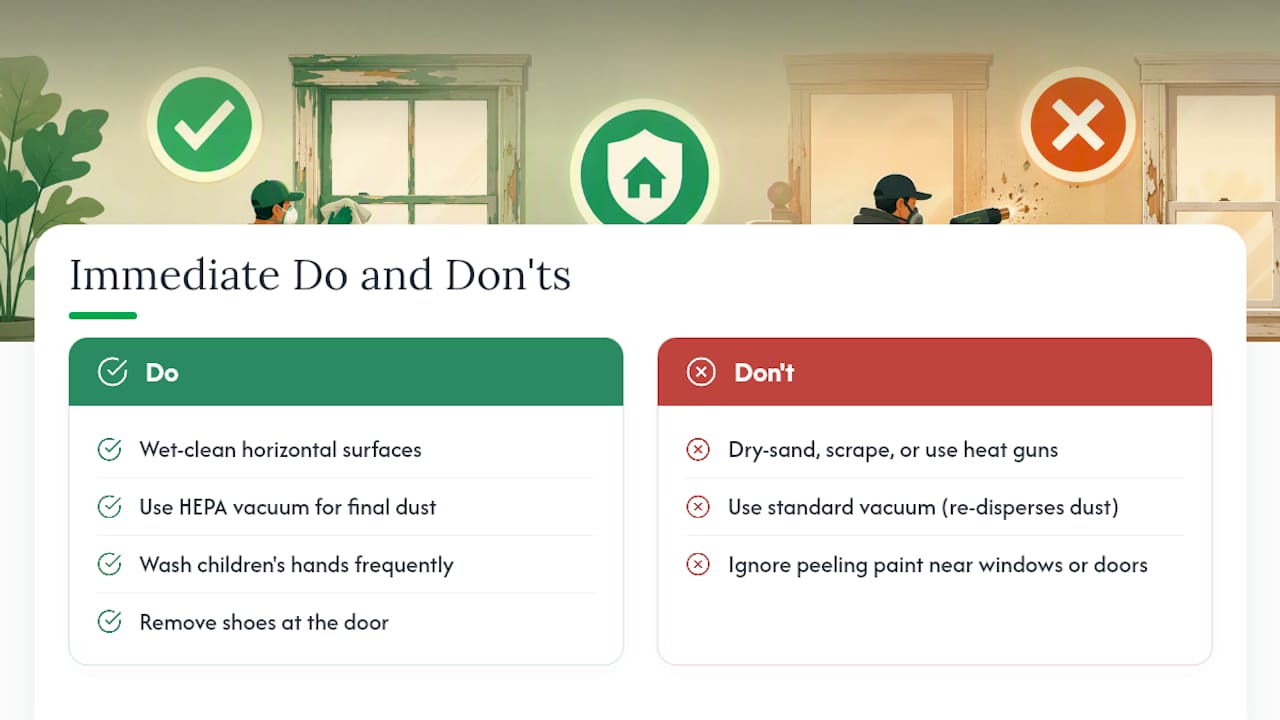
Don’t: Dry-sand, scrape, or use a heat gun on painted surfaces. Use a standard household vacuum (it re-disperses fine lead dust back into the air). Ignore peeling paint near windows or doors.
Cleaning verification matters after any work. Post-renovation dust-lead testing, performed by a certified dust sampling technician, confirms that surfaces meet EPA clearance standards before children re-enter a space.
What does the EPA RRP Rule require for renovations?
Any paid work that disturbs painted surfaces in pre-1978 homes or child-occupied facilities must comply with the EPA’s Renovation, Repair and Painting (RRP) Rule. Hire a certified firm and verify certifications before any contractor touches a wall.
The RRP Rule requires:
- Firm certification: The contracting company must be EPA-certified for RRP work.
- Certified renovator on-site: A trained, certified renovator must be assigned to and present at each job.
- Containment: Interior work requires plastic sheeting extending at least 6 feet from the work area; exterior work requires at least 10 feet of ground cover.
- Cleaning verification: After work is complete, the certified renovator must perform a visual inspection and cleaning verification, or post-renovation dust-lead testing when required.
- Worker training: All workers on the job must be trained in lead-safe work practices.
Prohibited practices under the RRP Rule
- Open-flame burning or torching of lead-based paint
- Using a heat gun above 1,100°F on painted surfaces
- Dry sanding or dry scraping without HEPA-equipped controls
- Machine sanding or grinding without HEPA exhaust control
- Using a chemical stripper containing methylene chloride in a poorly ventilated space
These practices are prohibited because they generate fine lead particles that travel far beyond the work area and can remain airborne for hours.
Pro Tip: When hiring a contractor for any work in a pre-1978 home, ask for their EPA RRP firm certification number before signing anything. You can verify it on the EPA’s online certification database. If they cannot provide it, find someone who can.
EPA recommends hiring a lead-safe certified contractor for RRP projects in pre-1978 homes; if you proceed as a DIYer, use lead-safe work practices and test first.
What can you do right now to reduce lead exposure at home?
Prioritize cleaning dust and preventing hand-to-mouth contact in children. Simple steps can meaningfully reduce exposure while you plan testing or repairs.
- Wet-wipe all horizontal surfaces. Window sills, countertops, and door ledges collect the most dust. Use a damp disposable cloth and discard it after each surface.
- Wet-mop hard floors. Dry sweeping stirs dust into the air. A damp mop captures it.
- Wash hands frequently. Before meals, after outdoor play, and after touching windows or doors. This is the single highest-impact habit for children.
- Remove shoes at the door. Soil tracked in from outside can carry lead from deteriorating exterior paint or contaminated ground.
- Use doormats inside and outside every entry. Double-mat systems capture a significant amount of tracked-in contamination.
- Wash soft toys and stuffed animals regularly. They collect dust from floors and surfaces.
- Use a HEPA-filter vacuum for final cleanup. Standard vacuums without HEPA filters re-disperse fine lead dust back into the air rather than capturing it. Use wet-cleaning first, then HEPA vacuum.
Pro Tip: Clean in order: high-touch surfaces first (window sills, door frames, counters), then floors. Wear disposable gloves and avoid shaking or fluffing cleaning cloths, which releases captured dust. Bag used cloths immediately and dispose of them in an outdoor trash container.
When should you get blood lead testing, and what happens next?
Blood lead testing is the only definitive way to confirm exposure. See a pediatrician or your local health department if you suspect exposure or your child has known risk factors. Do not wait for symptoms; lead poisoning is often silent, and most exposed people show no immediate signs.
Who should be tested:
- Children under 6 who live in or regularly visit a pre-1978 home, especially one with deteriorated paint
- Pregnant people after any confirmed or suspected lead exposure
- Any household member after a confirmed lead hazard is identified in the home
- Children whose blood lead level was elevated at a previous test (confirmatory venous testing is required after an elevated capillary screen)
What to expect from testing and follow-up
A capillary (finger-stick) test is the common screening method for young children. An elevated result requires confirmation with a venous (vein) blood draw, which is more accurate. Results are typically reported to the local public health department when they exceed reporting thresholds, which triggers case management services in most states.
For very high blood lead levels, CDC guidance notes that chelation therapy may be recommended at approximately 45 μg/dL. Below that threshold, the primary intervention is identifying and eliminating the source of exposure, not medication.
Who to contact:
- Your child’s pediatrician for routine screening and follow-up
- Your local health department for case management and home visit services
- The National Lead Information Center at 1-800-424-5323 for guidance on testing and resources
- Poison Control at 1-800-222-1222 for urgent clinical questions
What do testing, inspection, and abatement typically cost?
Testing and inspection usually take a few days to a week from scheduling to results. Abatement timelines range from a single day for a small, targeted job to several weeks for a whole-house project.
These are ballpark figures; actual costs vary by region, home size, and the extent of contamination. HUD’s Lead Hazard Control Grant Program and state-level assistance programs can offset costs for qualifying homeowners, particularly those with low incomes or children with elevated blood lead levels. Documentation from a certified professional is typically required to apply.
Get at least two written estimates for any abatement work. Ask each contractor to specify their EPA certification numbers, the scope of work, how they will handle waste disposal, and whether cleaning verification or post-work dust testing is included in the quote.
Why hire a certified inspector, and how does Hunt Home Inspection, LLC help?
Certified inspectors and abatement firms provide accurate testing, legally defensible reports, and lead-safe work practices that prevent dust from spreading. That combination lowers long-term health risk and limits liability for homeowners and landlords.
Credentials and services to look for:
- EPA-certified lead inspector (conducts inspections and produces written reports)
- Certified risk assessor (evaluates hazards and recommends controls or abatement)
- Lead dust sampling technician (collects and documents dust wipe samples)
- EPA-certified renovator (oversees RRP-compliant renovation work)
- XRF testing capability (non-destructive, comprehensive surface analysis)
- Post-job cleaning verification and dust-lead clearance testing
Hunt Home Inspection, LLC brings local knowledge of the St. Louis Metro area and Southern Illinois to every job. Their environmental testing add-ons cover lead, radon, and mold in a single visit, with reports delivered within 24 hours. Both in-person and video inspection options are available, which is useful when a buyer or caregiver cannot be on-site. That quick turnaround matters when you need documentation fast for a real estate transaction or a funding application.
Before contacting any inspector, have the following ready:
- Year the home was built (check the deed or county records if unknown)
- Photos of any deteriorated paint or areas of concern
- Any prior inspection reports or test results
- Whether children under 6 or pregnant people live in the home
- Whether any renovation is planned and what surfaces it will affect
Ask about EPA certification numbers, insurance coverage, waste handling procedures, and whether cleaning verification is included in the scope. Skipping any of those questions is one of the most common home inspection mistakes buyers make.
Trusted federal resources and where to find local help
Primary federal resources:
- EPA lead pages (epa.gov/lead): RRP Rule details, certified firm locator, DIY guidance, and the EPA-recognized test kit list
- CDC lead prevention pages (cdc.gov/lead-prevention): Clinical blood lead thresholds, health effects, and guidance for healthcare providers
- HUD lead resources (hud.gov/program_offices/healthy_homes): Rules for federally assisted housing, disclosure requirements, and grant program information
- National Lead Information Center: 1-800-424-5323 (weekdays, 8 AM–6 PM ET): Guidance on testing, certified professionals, and local resources
The EPA’s certified firm locator (available at epa.gov/lead) lets you search by state and ZIP code for firms certified under the RRP Rule. For specialized environmental testing and assessment beyond a standard home inspection, certified environmental testing providers offer laboratory-grade sampling and analysis for complex contamination scenarios.
To schedule a local inspection in the St. Louis Metro area or Southern Illinois, contact Jhunthomeinspections directly through their inspection services page.
What are the legal disclosure requirements for homeowners and landlords?
Federal law requires sellers and landlords of pre-1978 housing to disclose known lead-based paint hazards before a sale closes or a lease is signed. This obligation applies to virtually all residential properties built before 1978, with limited exceptions for housing sold at foreclosure, zero-bedroom units, and housing for the elderly or disabled where children are not expected to reside.
Under the Residential Lead-Based Paint Hazard Reduction Act (Title X), sellers must:
- Provide buyers with any known information about lead-based paint or lead hazards in the home
- Give buyers an EPA-approved lead hazard information pamphlet (“Protect Your Family From Lead in Your Home”)
- Allow buyers a 10-day window (negotiable) to conduct a lead inspection before the sale is finalized
- Include a lead-based paint disclosure addendum in the sales contract
Landlords face the same disclosure obligations before a tenant signs a lease. They must also provide the EPA pamphlet and disclose any known hazards in writing.
Failure to disclose is not a minor paperwork issue. Sellers and landlords who knowingly violate Title X can face civil penalties and triple damages in lawsuits brought by buyers or tenants. The EPA and HUD jointly enforce these rules.
State and local laws often go further than federal minimums. Some states require sellers to test for lead before listing, mandate specific remediation standards for rental units, or impose stricter timelines for addressing hazards in homes where children with elevated blood lead levels live. Check with your state’s housing or health agency for requirements that apply in your jurisdiction.
For landlords managing properties in federally assisted housing programs, HUD’s Lead Safe Housing Rule adds additional requirements, including mandatory testing and remediation in units where children under 6 reside and where lead hazards are identified.
A practical note for buyers: The 10-day inspection window is a right, not a formality. Use it. A pre-purchase inspection that includes environmental testing for lead can reveal hazards the seller may not have known about, and the written report gives you negotiating leverage and a baseline for any future remediation funding application.
What inspectors actually see that most homeowners miss
The most common misconception I encounter is that lead paint is only a problem if you can see it peeling. That is wrong in two important ways. First, intact lead paint on a friction surface, like a window channel that slides up and down every day, generates fine dust continuously without ever looking visibly deteriorated. Second, past renovation work done without lead-safe practices can leave contamination embedded in flooring, carpet fibers, and wall cavities that looks perfectly clean on the surface.
The second thing homeowners consistently underestimate is the window. Window sills and channels are the single most common source of elevated lead dust in older homes, and they are also the surfaces most people clean least carefully. A child who plays near a window in a pre-1950 home and then touches their mouth has a meaningful exposure pathway even if the paint looks fine.
What I tell every client preparing for an inspection: photograph your windows, door frames, and any surface where paint is worn at the edges before we arrive. Clear the areas around windows and baseboards so we can access them easily. Keep children and pets out of the home during the inspection and for a few hours afterward while any dust from testing settles. And if you have any prior test results or inspection reports, bring them. Continuity of documentation speeds everything up, including applications for remediation funding.
The inspectors and risk assessors who do this work well are not just collecting samples. They are building a documented record that protects you legally, helps you prioritize repairs, and in many cases unlocks grant funding that would otherwise require starting from scratch.
Jhunthomeinspections offers fast lead testing with same-day reports
When you need answers about lead paint quickly, the difference between a reliable result and a guess comes down to who does the testing. Jhunthomeinspections provides environmental testing add-ons for lead, radon, and mold as part of a single inspection visit in the St. Louis Metro area and Southern Illinois. Reports are delivered within 24 hours, so you are not waiting a week to make a decision about a renovation, a purchase, or a child’s safety.

Both in-person and video inspections are available, which means a caregiver or out-of-town buyer can participate in real time without being on-site. The inspection scope covers what a certified professional needs to document for disclosure, funding applications, and contractor guidance. When findings indicate that permanent abatement is needed, Jhunthomeinspections will tell you plainly and point you toward certified abatement firms for that next step.
To schedule an inspection or add lead testing to an existing appointment, visit the inspection services page or call directly. Have your home’s build year, any prior reports, and a list of surfaces you are concerned about ready when you reach out.
Sources
- Protect Your Family from Sources of Lead | US EPA
- Lead poisoning and health | WHO
- Preventing lead exposure from paint | CDC
Recent Comments