
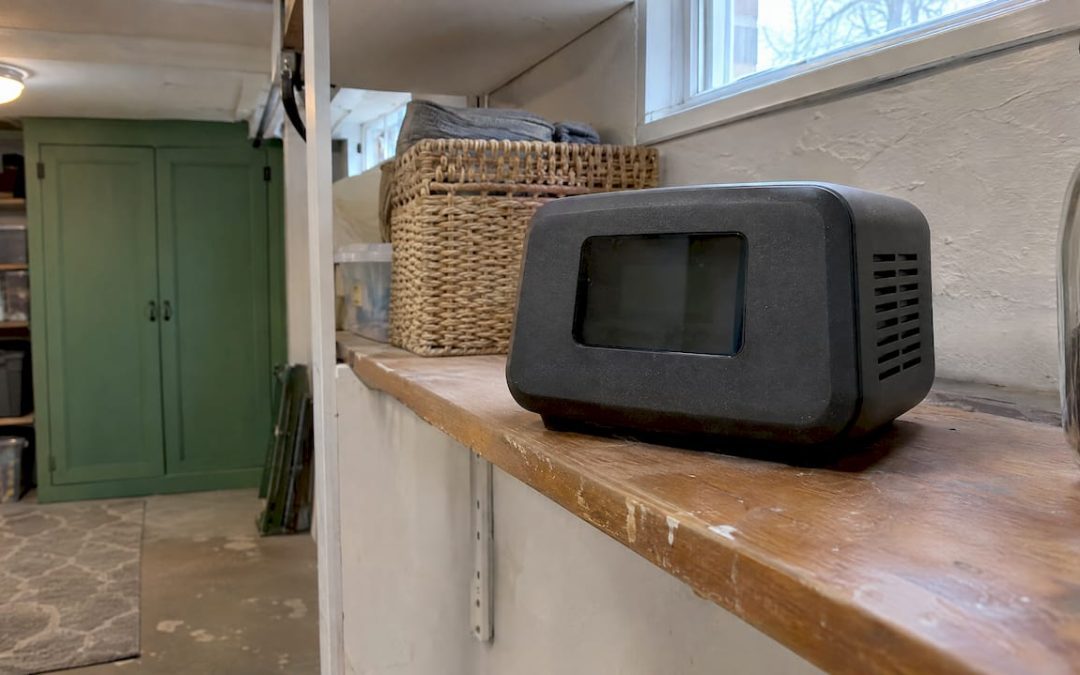
If you are buying a home, test for radon during your inspection period, using a short-term test that follows the EPA’s real estate protocol and is run by a qualified tester. Radon is a radioactive gas that seeps up from the soil into houses, and you cannot see or smell it. A test is the only way to learn a house’s level, and the result can be used in your negotiation before you close. At Hunt Home Inspection, we offer radon testing in the St. Louis Metro area and Southern Illinois, and we return reports within 24 hours so the result reaches you and your agent while there is still time to act.
TL;DR
- Order the radon test with your general inspection. Short-term tests need at least 48 hours, so book them early in your inspection window.
- The EPA says to fix a home when the average result is 4 pCi/L or more, and to consider action between 2 and 4 pCi/L.
- A valid test needs closed-house conditions, the right location (the lowest level you will use as living space) and no tampering with the device.
- Illinois sellers must hand you a radon pamphlet and disclose known elevated levels, but nobody is required to test or fix anything. Your contract decides that.
- Mitigation in an existing home usually runs about $800 to $2,500, so a result is worth knowing before you close.
Table of Contents
- Why test for radon before you close
- How a real estate radon test works
- What the results mean
- How long it takes and how to fit it into your timeline
- What it costs
- Radon rules in Illinois and Missouri
- Evaluating a seller’s old test
- What to do if the result is high
- New builds and other tests worth pairing
- How we run radon testing for buyers
- Our perspective
- FAQ
- Sources
Why test for radon before you close
Radon forms when uranium in soil and rock breaks down. It enters a house through foundation cracks, sump openings, gaps around pipes and similar paths, and it collects in the lowest levels. The CDC recommends testing when you are preparing to buy or sell a home, before and after renovations, and before you start spending more time in a basement. It also says a qualified tester should do the job in a purchase or sale.
The timing matters for money. Before closing, a high result is a negotiating point: you can ask the seller to install a system, share the cost or adjust the price. After closing, the full bill is yours. Typical mitigation in an existing home is about $800 to $2,500, according to Pennsylvania’s environmental agency, which is a small number next to a purchase price but a real one for a first-time buyer on a tight budget.
You also cannot guess a level from the neighborhood. The EPA warns that radon cannot be predicted from state, local or neighborhood measurements, and neighboring houses can differ widely. A clean result next door tells you nothing about the house you are buying.
For more on what the gas does and why it matters, see our guide to the dangers of radon in the home.
How a real estate radon test works
A test done for a purchase is stricter than a kit you leave on a shelf for a weekend. The EPA’s March 2024 Home Buyer’s and Seller’s Guide to Radon accepts three short-term approaches for a transaction:
- Two passive tests (such as charcoal canisters) placed side by side in the same spot at the same time, for at least 48 hours.
- One passive test followed immediately by an identical second test in the same location.
- A continuous monitor, which records readings through the test period, run for at least 48 hours.
The doubling up is deliberate. Two results let you check one against the other and average them, so one bad reading does not drive a major decision.
Where the device goes
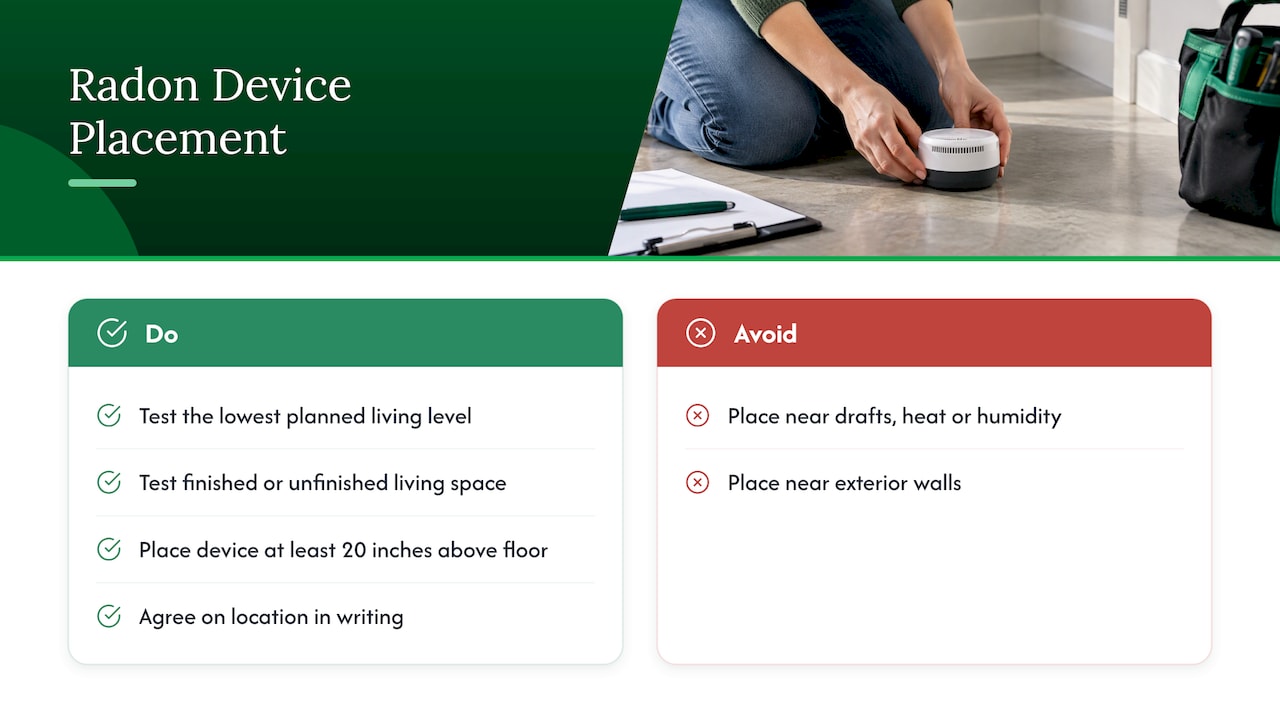
The EPA says to test in the lowest level you will use as living space, finished or not. If you plan to turn the basement into a bedroom or office, test there. NACHI’s radon guidance adds that buyer and seller should agree on the location in writing, and that the device should sit at least 20 inches off the floor, away from drafts, heat, humidity and exterior walls.
Closed-house conditions
Windows and exterior doors stay closed for at least 12 hours before the test starts and throughout any test shorter than four days. Normal coming and going through doors is fine. Minnesota’s health department also requires closed-house conditions for any real estate test and recommends testing the lowest occupiable level of each foundation type. Severe storms and high winds can skew a short test, so a good tester watches the forecast.
Preventing interference
Moving, covering or unplugging a device, or opening windows, can invalidate the result, and tampering is illegal in some states. Continuous monitors and proper protocols include ways to detect interference. This is one reason buyers pay for a professional: the person who sets the test up has no stake in the number it produces.
What the results mean
Radon is measured in picocuries per liter of air (pCi/L). The CDC, citing the EPA, says:
| Result | What it means |
|---|---|
| 4 pCi/L or higher | Contact a licensed professional to install a radon reduction system |
| 2 to 4 pCi/L | Take action to reduce radon |
| Below 2 pCi/L | No known safe level exists, so lower is better |
If a short-term test comes in above 4 pCi/L, a second test (short or long term) follows. If the average of two short-term tests, or any long-term test, is 4 or higher, mitigation is recommended. After a system goes in, retest a few months later to confirm it works.
The EPA’s real estate protocol treats the average of the paired results as the figure to act on. Do not average in a neighbor’s number, a seller’s old number or a reading from a different level of the house.
How long it takes and how to fit it into your timeline
Every radon test, DIY or professional, runs at least 48 hours. According to the EPA guide, short-term tests stay in place from 2 to 90 days, and long-term tests run longer than 90 days to better reflect the yearly average. Some devices, such as 7-day charcoal canisters, need more time. A real estate deal rarely allows a 90-day wait, which is why the transaction protocols rely on short-term tests. Our page on radon test duration walks through short- and long-term options in more detail.
Plan the calendar like this:
- Day 1 or 2 of the inspection window: Schedule the radon test with the general inspection so the device is set up during the walkthrough.
- Next 48 hours: Keep the house closed up. Tell the seller and listing agent so no one airs it out.
- After pickup: Lab-analyzed devices need processing time. Continuous monitors give results sooner.
- Before your window ends: Use the result in your repair request, along with everything else the inspection found.
Inspection windows are short, and missing one can cost you leverage. Appraisal and inspection timing mistakes are common when buyers start scheduling late, so book the tests the day your offer is accepted. We offer evening and weekend appointments, which helps if you are working full time while house hunting.
What it costs
Prices vary by region and by test type, so use ranges as a guide. The American Lung Association’s Oregon real estate letter says a professional short-term test completed in as little as 48 hours usually costs about $100 to $250. Denver7 reports that a licensed professional test usually starts around $150.
Our radon testing is one of the add-ons you can book alongside a buyer’s inspection, and some of our services can be paid at closing to match the timing of a real estate transaction. Call us for a quote for your property, and ask about our discounts for veterans and first-time buyers.
Radon rules in Illinois and Missouri
Laws differ by state, so check yours. Here is what applies to our service area.
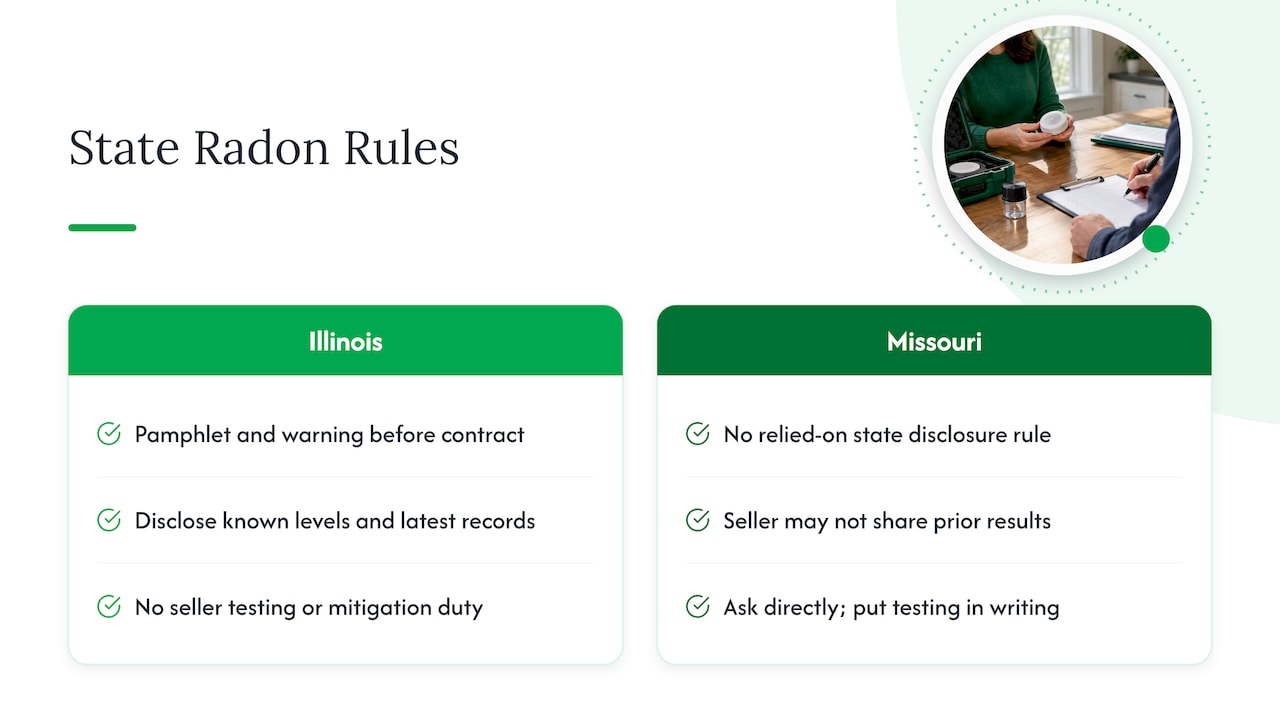
Illinois. Under the Illinois Radon Awareness Act, the seller must give the buyer the state’s radon pamphlet and a Radon Warning Statement before the buyer is obligated under the contract. The seller must also disclose known elevated radon levels and provide the most recent records. The law does not require the seller to test or mitigate. The Illinois Emergency Management Agency publishes the radon testing guidelines for real estate transactions and notes that radon testing and mitigation professionals must be licensed with the state.
Missouri. Missouri lawmakers have considered a radon awareness act for real estate sales, but we do not rely on a state disclosure rule here. That means a seller may have no obligation to share a prior result, so ask directly and put testing terms in writing.
In every state, the practical step is the same: put radon testing in your purchase contract or inspection addendum, and agree on who pays for a retest and for mitigation if the number is high.
Evaluating a seller’s old test
Sellers sometimes hand over an earlier result. Minnesota’s health department suggests buyers look at several details:
- Was the result close to the 4.0 pCi/L action level?
- Did the test run the minimum time?
- Was it done in the last two to five years?
- Was the livable basement tested?
- Was it performed by a homeowner or a licensed professional?
Renovations, new foundation cracks or a different heating and ventilation setup can change levels. A test result that does not fit those questions is better replaced with a fresh one that you control.
What to do if the result is high
A high number is a repair item, not a reason to panic, and radon systems are a routine fix. Work through it in this order:
- Confirm the result with the second test the protocol calls for.
- Ask your agent to request that the seller install a mitigation system, split the cost or give a credit, in line with your contract.
- Hire a licensed radon mitigation professional for the system. In Illinois, this work requires a state license.
- Retest after the system is running, as the CDC advises.
Ask your lender early if the deal involves a loan with its own repair requirements. We also handle loan draw inspections and HUD compliance work, so ask us if your financing has special conditions.
New builds and other tests worth pairing
New construction is not exempt. See our guide to radon in new construction for what to ask the builder. Buyers who are bundling environmental checks should also read about testing radon and lead first, and rural buyers on a well should look at lab tests for well water before closing.
How we run radon testing for buyers
We are Hunt Home Inspection, LLC, serving the St. Louis Metro area and Southern Illinois. Radon testing is one of the services listed on our inspection services page, alongside buyer’s inspections, mold, sewer camera, well and septic and termite inspections. Our reports are returned within 24 hours, and you can join your inspection in person or by video. Our Create Request List™ tool is built to streamline communication between you and your agent, so the radon result and the other findings go into one clear repair request.
If you are in the middle of a contract, book your buyer’s inspection and radon test early in your window.
Our perspective
Most of the buyers who come to us are first-time buyers, many on tight budgets, and veterans using their benefits. They are making the biggest purchase of their lives in a few days. We think radon should never be the thing they learn about after closing.
That is why we put radon testing next to the general inspection and not as an afterthought. One visit, one schedule, and a report within 24 hours that your agent can use right away. Our Create Request List™ turns findings into a request your agent can send, so a radon number becomes a negotiation point instead of a worry.
We offer evening and weekend appointments because buyers work, and video or in-person walkthroughs because not every buyer can be on site. Our certifications through NACA, ASHI and HUD 203k reflect the kind of buyers we serve and the kind of loans they use.
Test early, follow the protocol, and let the number guide the deal.
JOHN
FAQ
Is radon testing required when you buy a house?
Usually not. In Illinois, the seller must provide the radon pamphlet and disclose known elevated levels, but no one has to test or fix anything. Your purchase contract decides whether testing is done and who pays for a fix, so ask your agent to add it.
Can I use a store-bought kit for a home purchase?
Kits are sold at retail, but the CDC recommends a qualified tester for a purchase or sale, and the EPA protocol includes steps to prevent or detect interference with the device. A professional test gives your agent a result the seller is more likely to accept. We can include radon testing with your buyer’s inspection.
How long does a radon test take?
Short-term real estate tests run at least 48 hours. Allow extra time for lab results if a passive device is used. Book the test early in your inspection window so the answer arrives before your deadline.
What is a safe radon level?
The CDC says no safe level is known. The EPA recommends fixing a home at 4 pCi/L or more and taking action between 2 and 4 pCi/L. Mitigation is routine and can be negotiated with the seller before closing.
Does opening windows get rid of radon?
Opening windows is not a fix, and it ruins a test. A test needs closed-house conditions, and a lasting solution is a mitigation system installed by a licensed professional.
Sources
- EPA Home Buyer’s and Seller’s Guide to Radon
- CDC: Testing Your Home for Radon
- Minnesota Department of Health: Radon in Real Estate
- NACHI: Radon
- Pennsylvania DEP Home Buyer’s and Seller’s Guide to Radon
- Vermont Radon Program: Buying or selling a home
- American Lung Association: Oregon Radon Real Estate Letter
- Denver7: High radon common in Colorado homes
- Illinois Radon Awareness Act, 420 ILCS 46
- IEMA: Real Estate radon guidelines
Recent Comments