
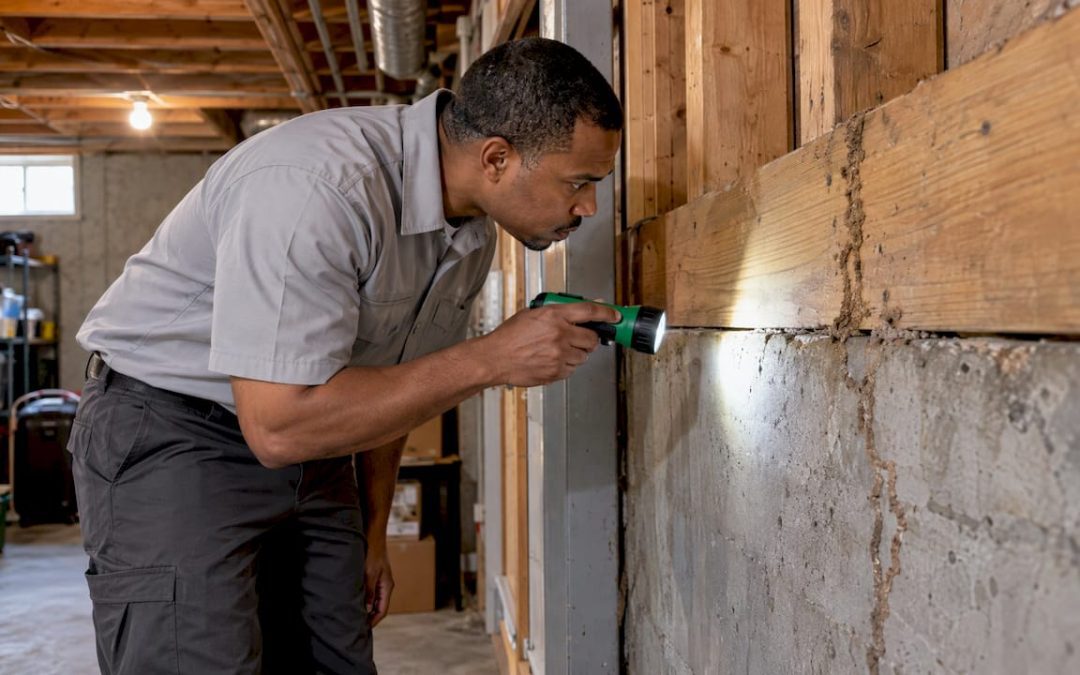
If you are buying a home, order a wood-destroying organism (WDO) inspection, commonly called a termite inspection, early in your option period, while you can still negotiate. It costs a small fraction of the price of the house, and it is the only way to learn what a standard walkthrough cannot show: whether insects have been eating the wood that holds the home up. In Missouri and Illinois, VA-backed loans require this information, and many other lenders ask for it too. We offer WDO/termite inspections alongside our buyer’s inspections in the St. Louis Metro area and Southern Illinois, with reports returned within 24 hours.
TL;DR
- No federal law requires a termite inspection on every home sale, but lenders, state rules and local custom often do. VA loans in Missouri and Illinois require wood-destroying-insect information.
- The inspection is a visual exam of the accessible parts of the home and property. The report shows visible activity, past treatment and damage, and conditions that invite insects.
- Order it early in your inspection or option period so you have time to negotiate repairs or treatment.
- Veterans can be charged the inspection fee when the VA requires it, and should ask for an itemized invoice.
- A report is not a guarantee that no insects are present. Ask the inspector to explain every finding before you decide.
Table of Contents
- Do you need a termite inspection when you buy a home?
- What happens during a termite inspection
- What the termite inspection report tells you
- When to order it
- Who pays for the termite inspection?
- What to do if the report finds termites or damage
- Why add it to your inspection, not run it separately
- Book your termite inspection with your home inspection
- FAQ
- Sources
Do you need a termite inspection when you buy a home?
There is no national rule that says every home sale needs one. What exists is a patchwork:
- Lenders. HUD’s archived reference guide for FHA loans says a pest inspection is required when there is evidence of infestation, when state or local law requires it, when it is customary in the area, or when the lender requires it. You can read the details in HUD’s FHA pest control guide.
- VA loans. The VA’s Local Requirements page lists the states where wood-destroying-insect information is required. Missouri and Illinois are both on it, which covers our entire service area.
- USDA loans. The USDA’s Applicant Orientation Guide tells purchase-loan applicants they are responsible for the inspections needed to protect their own interests, and notes that a pest inspection may be separate from a whole-house inspection.
- Cash buyers. Nobody makes you order one. That is exactly why it is easy to skip, and why a cash buyer carries the whole risk of a hidden problem.
Even where no rule applies, state real estate guidance points the same way. California’s Department of Real Estate, in its first-time buyer guide, tells buyers to consider a termite or pest inspection before purchase. For a first-time buyer on a tight budget, an unexpected structural repair is the kind of bill that hurts most, and the inspection is the cheapest way to see it coming.
What happens during a termite inspection
The process is simpler than most buyers expect. It is a visual examination, not a demolition. The inspector looks for three things:
- Signs of current activity. Live insects, shed wings, droppings, and the mud tubes termites build to travel between soil and wood.
- Signs of past activity or treatment. Old damage, previous repairs, and evidence that a treatment was done.
- Conditions that invite insects. Excess moisture, wood touching the soil, leaky plumbing, and stored lumber against the foundation.
The visit usually follows this order:
- Arrival and paperwork. The inspector confirms the address and the type of report your lender needs.
- Exterior walk-around. Foundation, siding, porches, decks, fences and woodpiles, the places where soil and wood meet.
- Interior. Baseboards, window frames, door frames, and any visible wood in the basement or garage.
- Crawl space or basement and attic. These are the accessible areas where hidden problems often show. Check that the seller has cleared access before the appointment, because areas that cannot be reached cannot be inspected.
- Debrief and report. You get the findings, any areas that could not be accessed, and what to do next.
If you want to see how a full inspection day flows, our guide on what to expect on home inspection day walks through it. Our guide to what inspectors look for in a home covers the rest of the house, including the roof and structure that termite damage can affect. And since moisture is a common thread, a roof inspection before buying is worth understanding too, because a leaking roof feeds the damp wood that insects like.
You do not have to take a day off for this. We offer evening and weekend scheduling, and video or in-person walkthroughs, which helps busy professionals who cannot be on site.
What the termite inspection report tells you
The report is the document your lender, agent and seller will read, so it helps to know what it is and what it is not.
The Arizona Department of Agriculture explains that a wood-destroying insect inspection report describes visible termite presence or past treatment history. It is not a general structural-damage report, and it is not a guarantee that insects are absent. Treat it as a record of what a trained inspector could see and reach on the day.
For FHA loans, HUD’s guide says a clear report, when one is required on an existing property, uses form NPMA-33 or the state-mandated form. It must cover all improvements within the property lines, and the guide states a 90-day validity period. If your closing slips, ask your lender whether the report will still be valid on the day you sign.
When you read yours, look for:
- Active infestation. Live insects found. Usually this means treatment before closing.
- Previous treatment. Not necessarily a problem, but ask for the paperwork and any transferable warranty.
- Damage. Where it is and how far it appears to go. A termite report does not replace a structural opinion. If damage looks significant, have a structural engineer or a licensed contractor look at the area.
- Conducive conditions. Moisture and wood-to-soil contact. These are the cheapest problems to fix and the most useful to fix first.
- Inaccessible areas. Anything the inspector could not see should be named in the report. Ask whether it can be reopened for a re-inspection.
When to order it
Order it as soon as your offer is accepted, at the same time as your general inspection. Lender-ordered appraisals and loan timelines leave little room, and a finding on day nine of a ten-day window gives you no time to negotiate. A lender-focused article from AmeriSave makes the same point: order early in your due-diligence period so there is time to request treatment, negotiate, or use a contingency if the findings are bad.
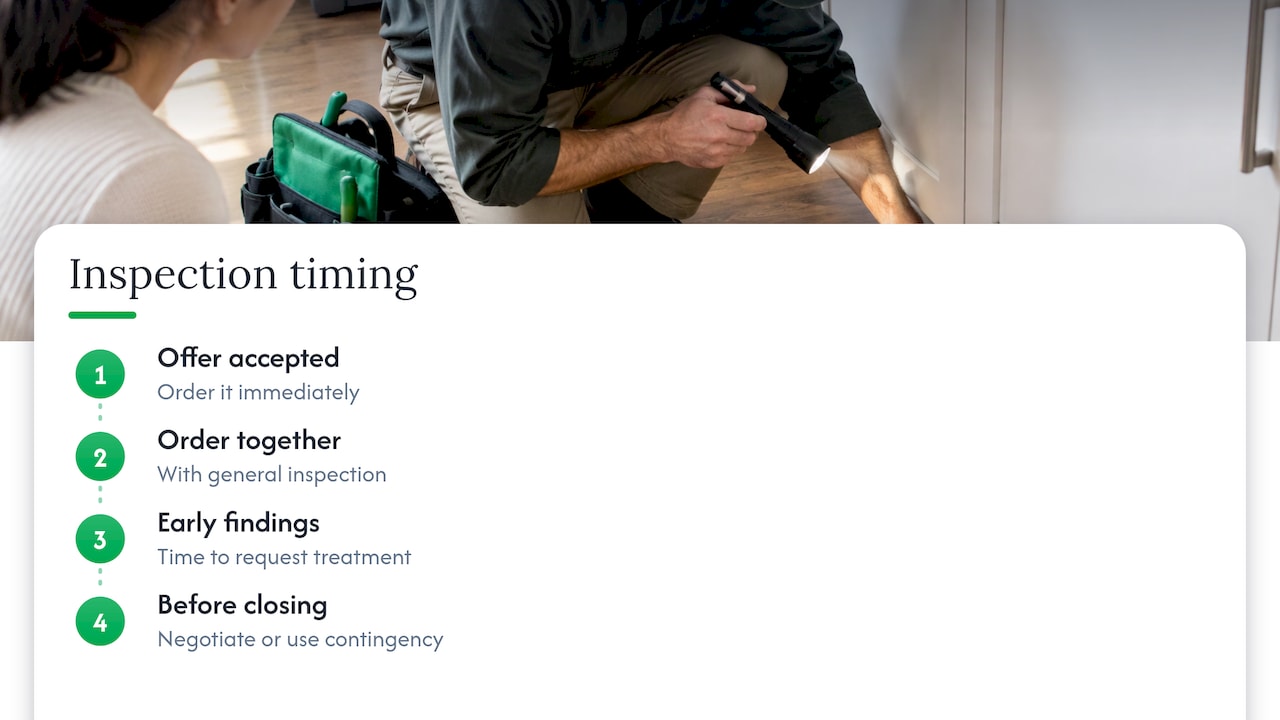
The California Department of Real Estate notes that inspection contingencies can be written into an offer and that findings can be used to negotiate repairs with the seller. In practice, a contingency is what turns a bad report into leverage instead of a surprise after closing.
Who pays for the termite inspection?
In many conventional purchases the buyer orders and pays for it, but this is negotiable, and local custom varies. Your purchase contract and your agent are the first places to check. Because your price and your timeline depend on it, ask for the cost to be settled in writing before you book.
Veterans have a specific rule to know. VA Circular 26-22-11, issued June 15, 2022, permits a veteran to be charged for a WDI inspection when the Notice of Value requires it, and to pay for the associated Minimum Property Requirement repairs. The same circular encourages veterans to negotiate inspection and repair costs with the seller. It also requires an itemized invoice identifying the veteran and the property, so the cost can be verified on the Closing Disclosure. Ask for that invoice when you book. We have a separate VA termite inspection loan requirement guide that goes deeper, and we offer service discounts for veterans.
For the cost itself, prices vary with the size of the home, its foundation type and the area. We explain the factors in our termite inspection cost guide, and our inspection savings tips for homebuyers cover how first-time buyers can keep the total inspection bill down.
What to do if the report finds termites or damage
A finding is not the end of the deal. It is information you are paid to have before closing. Work through it in this order:
- Get the specifics. Ask the inspector exactly where activity or damage was found and whether any area could not be reached.
- Get a treatment or repair estimate. Collect written bids so your request to the seller is a number, not a guess.
- Talk to your agent. Your choices are usually to ask the seller to treat and repair, ask for a credit or price reduction, or, if you have a contingency, walk away.
- Check your loan rules. A VA or FHA loan may require treatment or repairs before closing. Your lender will tell you what has to be cleared.
- Re-inspect after treatment. We offer re-inspections, so you can confirm the work was done before you sign.
Our Create Request List™ tool is built to make this step easier. It streamlines communication between you and your agent, so the items you want addressed reach the other side in a clear list.
Why add it to your inspection, not run it separately
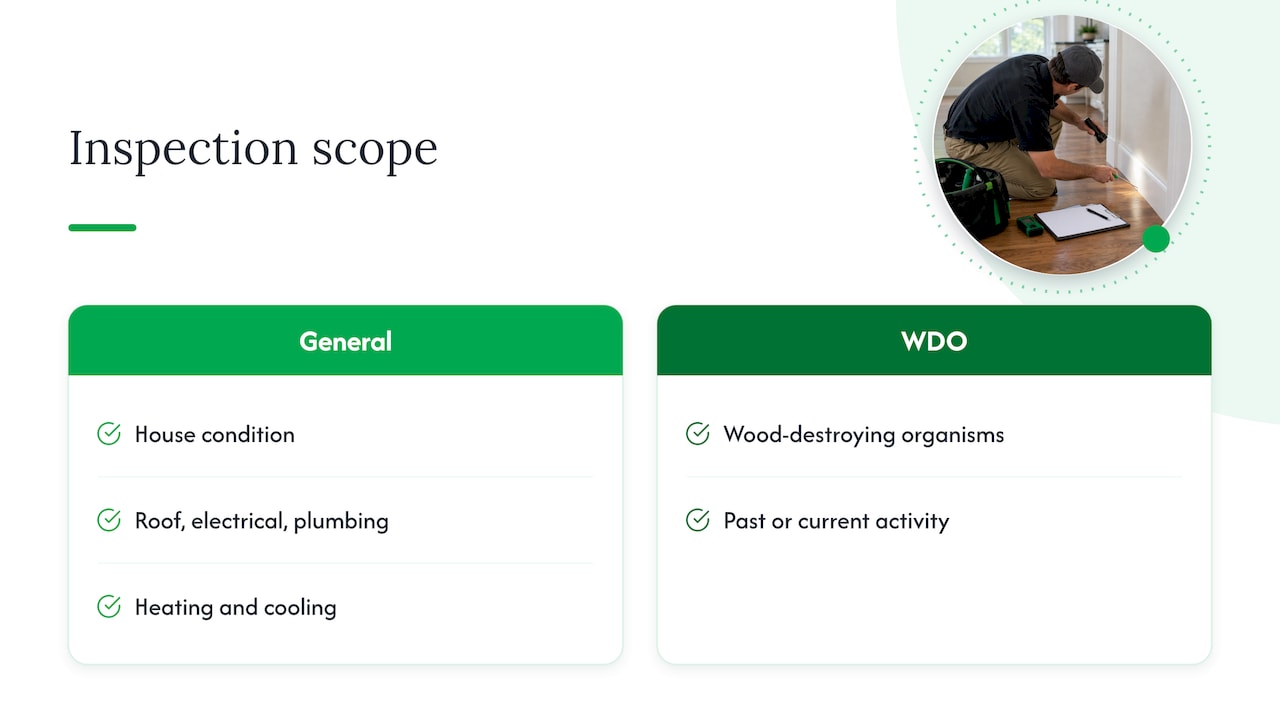
A general home inspection and a WDO inspection answer different questions. The first covers the condition of the house: roof, electrical, plumbing, heating and cooling, and more. The second asks only whether wood-destroying organisms have been, or are, at work. Hiring them together keeps one point of contact, one schedule and one set of reports, which matters when your option period is short.
The same logic applies to other buyer add-ons in our area: radon testing, mold inspection, and a sewer camera inspection of the lateral line. Our guide to why a home inspection matters before you buy explains how the pieces fit together, and our first-time buyer inspection guide shows how a missed problem can turn into a five-figure repair.
Our point of view
Most buyers think of termites as a worst-case scenario. We see the inspection as a way to keep a purchase calm. When you know before closing what is in the wood, you can negotiate, plan a budget and sign without second-guessing.
We built our service around people who feel the cost of surprises most: first-time buyers, low-income families and veterans. That is why we offer discounts to veterans and first-time buyers, evening and weekend appointments, and video or in-person walkthroughs. It is also why every report is returned within 24 hours: the clock on your contract does not stop for a late report.
Our team holds NACA, ASHI and HUD 203k credentials, and we treat the termite inspection as part of one buyer package, not an afterthought. Book it with your general inspection, read the report with your agent, and use what it says.
JOHN
Book your termite inspection with your home inspection
We serve buyers, sellers, investors, lenders and agents across the St. Louis Metro area and Southern Illinois. Our WDO/termite inspection is available with the buyer’s inspection, with reports returned within 24 hours and scheduling for video or in-person walkthroughs. Some services can be paid at closing, to match the timing of your transaction. See all inspection services and request your appointment.

FAQ
Is a termite inspection required to buy a house?
Not by federal law for every sale. Requirements come from your lender, state or local rules and local custom. VA loans require wood-destroying-insect information in Missouri and Illinois, and FHA loans require an inspection when evidence of infestation is found or the lender asks for it.
How long does a termite inspection take?
Times vary with the size of the home and how easy the crawl space, basement and attic are to reach. Clear access for the inspector speeds it up. Ask when you book, and plan to be reachable for questions on the day.
Does a clean termite report mean the house is safe from termites?
It means the inspector saw no evidence in the areas that could be reached that day. It is not a guarantee that insects are absent in the future, which is why fixing moisture and wood-to-soil contact matters after closing.
Can I ask the seller to pay for treatment?
Yes. Findings are commonly used to negotiate treatment, repairs or a credit with the seller. Your agent can write the request, and a contingency in your contract gives you the strongest position.
Sources
- HUD Archives: HOC Reference Guide, Pest Control
- VA Home Loans: Local Requirements
- USDA Applicant Orientation Guide
- California Department of Real Estate: First Home guide
- Arizona Department of Agriculture: Wood Destroying Insect Inspection Reports
- Veterans Benefits Administration Circular 26-22-11
- AmeriSave: Termite Inspections for Home Buyers
Recent Comments