

What is InterNACHI certification and the CPI® credential?
The InterNACHI certification is the Certified Professional Inspector (CPI)® credential awarded by the International Association of Certified Home Inspectors to inspectors who complete a structured set of training, testing, and experience requirements. It is not a participation badge. The CPI® mark is a federally registered certification on the Principal Register at the U.S. Patent and Trademark Office, awarded to InterNACHI on November 24, 2009 after a four-year approval process.
InterNACHI itself is a Colorado nonprofit corporation. The training behind the credential runs through InterNACHI School, which is accredited by the Accrediting Council for Continuing Education and Training (ACCET), a national accrediting agency recognized by the U.S. Department of Education. That accreditation matters because it places InterNACHI’s training on the same footing as other accredited post-secondary institutions.
Holding the CPI® credential signals to clients and real estate professionals that an inspector has met verified industry standards. Here is what the certification confirms about any inspector who carries it:
- Passed the InterNACHI Online Inspector Examination
- Completed InterNACHI’s Code of Ethics course
- Completed the Standards of Practice course
- Submitted mock inspection reports demonstrating field readiness
- Signed a formal affidavit committing to professional standards
- Maintains active InterNACHI membership in good standing
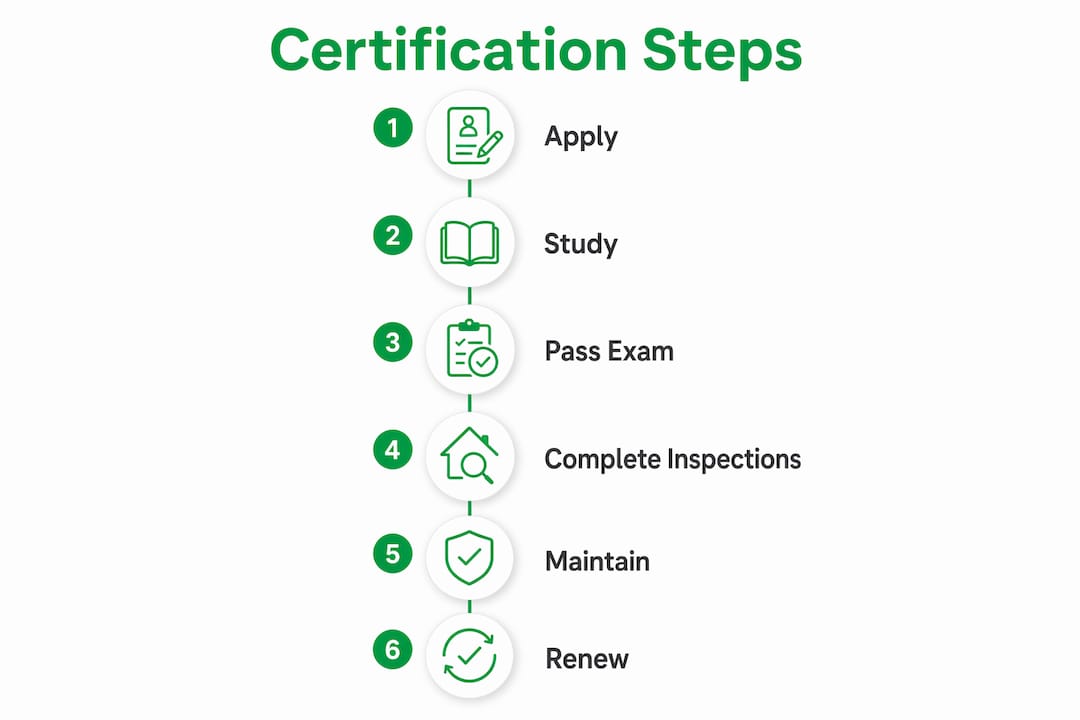
How to get InterNACHI certified: the six-step process
The six-step certification process does not require a fixed sequence. Candidates can complete most steps in any order, though the exam is a logical starting point since it is free and open to everyone, including non-members.
-
Pass the Online Inspector Examination. The exam is free, fully online, and available to anyone before or after joining InterNACHI. A proctored version is also available for those who need it for state licensing purposes. Passing gives you a concrete benchmark of your knowledge before investing further.
-
Join InterNACHI as a member. All-Access Membership is the gateway to nearly every benefit InterNACHI offers, including free access to over 4,600 hours of continuing education, more than 80 inspector certifications, and business development tools. Certification itself costs nothing beyond the membership fee.
-
Complete the Code of Ethics course. This course is not a formality. It establishes the professional conduct standards every CPI® holder agrees to follow, and it is required before the credential is awarded.
-
Complete the Standards of Practice course. This course defines what a home inspection must cover and how it must be performed. Together with the ethics course, it forms the professional backbone of the certification.
-
Submit four mock inspection reports. Candidates use InterNACHI’s free online home inspection checklist to complete and submit four simulated inspection reports. This step bridges the gap between coursework and actual field work, giving candidates a chance to practice documentation before they inspect real homes for paying clients.
-
Sign the enrollment agreement (affidavit). The affidavit is a formal declaration that the candidate has completed the required training and agrees to uphold InterNACHI’s standards. Once signed, the CPI® credential is awarded. Candidates can begin performing inspections at this point, though continuing education requirements must be met within the following year to maintain full membership status.
Pro Tip: The entire CPI® program typically takes anywhere from 4 to 12 months depending on how many hours per week you dedicate to it. If you are already working in a related trade, the coursework will feel familiar and you can move through it faster.
How to maintain your InterNACHI certification
Earning the CPI® credential is the start, not the finish. InterNACHI requires certified members to meet ongoing obligations to keep their certification active.
- Maintain continuous InterNACHI membership. Canceling your membership terminates your certification immediately. There is no grace period.
- Adhere to the Standards of Practice. Inspectors must follow InterNACHI’s Standards of Practice or the standard required by law in their jurisdiction, whichever applies.
- Abide by the Code of Ethics. Ethical violations can result in loss of certification, not just a warning.
- Complete 24 hours of continuing education according to InterNACHI’s Continuing Education Policy.
- Maintain an online continuing education log to document completed coursework.
- Pass the Online Inspector Examination every three years with a score of 80% or better.
The continuing education requirement keeps certified inspectors current with evolving building practices, new materials, and updated codes. InterNACHI provides the coursework free to members, so the barrier is time, not cost.
How state licensing requirements interact with InterNACHI certification

Licensing requirements for home inspectors vary considerably across the United States. Some states have no licensing requirement at all. Others require passing a state-approved exam, completing a set number of training hours, or carrying errors and omissions insurance. InterNACHI assists members in understanding and meeting the specific requirements in their state or province.
The table below summarizes how InterNACHI certification aligns with licensing requirements in a selection of U.S. states.
| State | Licensing required? | InterNACHI certification accepted? | Notes |
|---|---|---|---|
| Texas | Yes | Partially | State exam and specific hours required; InterNACHI courses may count toward training hours |
| Florida | Yes | Partially | Must pass state exam; InterNACHI coursework may satisfy education requirements |
| California | No | Yes | No state license required; InterNACHI CPI® serves as primary credential |
| Illinois | Yes | Partially | Requires state exam and continuing education; InterNACHI courses may apply |
| New York | Yes | Partially | State-specific requirements apply; InterNACHI training supports preparation |
| Missouri | No | Yes | No state license required; CPI® credential is the primary professional standard |
| Arizona | No | Yes | No state licensing; InterNACHI certification widely recognized by real estate professionals |
| Virginia | Yes | Partially | Requires state licensing exam; InterNACHI membership supports compliance |
In states without a licensing requirement, the CPI® credential often functions as the primary proof of competency that clients and real estate agents look for. In licensed states, InterNACHI’s coursework frequently satisfies part or all of the required pre-licensing education hours, though the state exam itself is always a separate step. Checking your state’s specific requirements before starting the certification process saves time and prevents surprises.
Why InterNACHI certification is worth it for your inspection business
The CPI® credential does more than verify competency. It comes with a set of business tools that most independent inspectors would otherwise have to pay for separately.

InterNACHI members receive access to millions of leads through more than 750 partner websites and lead generation programs. They also get free logo and marketing design services, contract templates, and access to the $25,000 Honor Guarantee™, which provides negligent-referral protection for real estate agents who recommend certified inspectors. That last benefit is a genuine differentiator when pitching to real estate offices.
Beyond the core CPI® credential, InterNACHI offers over 60 specialized certifications covering areas like mold inspection, radon testing, commercial property inspection, pool and spa inspection, and more. Each one is free to members and adds a billable service to your menu.
- Credibility with clients: The CPI® mark signals verified training and ethical commitment, which matters to first-time buyers who have no other way to evaluate an inspector’s qualifications.
- Credibility with agents: The Honor Guarantee™ and negligent-referral protection give real estate professionals a concrete reason to refer CPI® holders over uncertified inspectors.
- Business development: Free marketing materials, lead generation, and contract templates reduce startup costs for new inspectors.
- Specialization: Adding certifications in niche areas like commercial inspections or environmental hazards lets you charge more and serve a broader client base.
- Accredited education: Training through InterNACHI School carries ACCET accreditation, which reinforces the credential’s legitimacy with both clients and regulatory bodies.
Pro Tip: If you are entering a market with established competition, pick two or three specialized certifications that address local demand. A mold certification in a humid climate or a radon certification in a high-risk region can set you apart faster than general marketing ever will.
Certification is also a signal to homebuyers about what kind of inspector they are hiring. When someone is deciding how to choose a home inspector, the CPI® credential gives them a concrete, verifiable standard to rely on rather than guessing based on a website or a neighbor’s recommendation.
At Jhunthomeinspections, the inspectors serving the St. Louis Metro area and Southern Illinois carry InterNACHI certification as part of their commitment to thorough, trustworthy inspections. Whether you are a first-time buyer, a veteran, or an investor, working with a certified inspector means your inspection is backed by verified training and professional accountability. You can explore the full range of inspection services Jhunthomeinspections offers to see how certification translates into real-world results for buyers and sellers alike.
Key Takeaways
InterNACHI certification, specifically the CPI® credential, is a federally registered mark awarded to inspectors who complete a six-step process including examination, ethics training, mock reports, and an affidavit, with ongoing education required to maintain it.
| Point | Details |
|---|---|
| CPI® is federally registered | The USPTO awarded InterNACHI the CPI® certification mark on November 24, 2009. |
| Six steps to certification | Candidates must pass an exam, join InterNACHI, complete ethics and practice courses, submit mock reports, and sign an affidavit. |
| Ongoing education required | Certified inspectors must complete 24 hours of continuing education and pass the exam every three years. |
| State licensing varies | Some states accept InterNACHI coursework toward licensing; others require a separate state exam regardless of CPI® status. |
| Business tools included | CPI® members gain access to lead generation, marketing design, the Honor Guarantee™, and over 60 specialized certifications. |
Recent Comments