
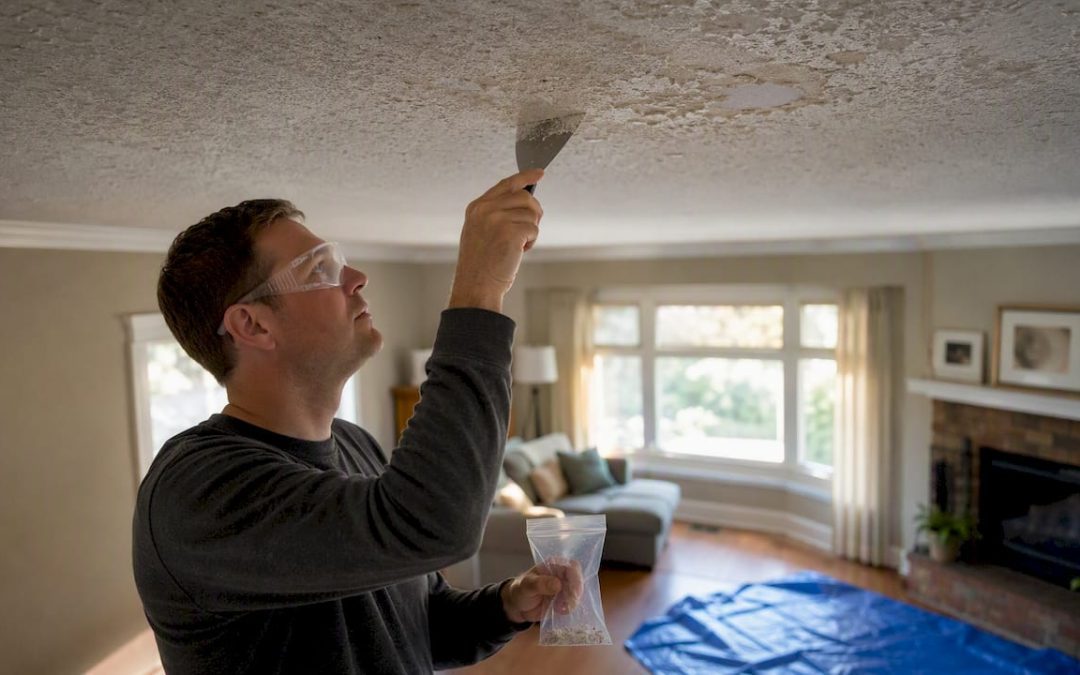
If your home’s popcorn ceiling was installed before 1980 or you’re planning any work that disturbs it, test it through an NVLAP-accredited lab — and for safety and chain-of-custody purposes, hire a professional to collect the sample.
Here’s when you need to act:
- Pre-1980 home: Asbestos was commonly added to popcorn ceiling texture as a binder and fire retardant through the late 1970s. Treat it as suspect until tested.
- Planned renovation or scraping: Any work that breaks the surface releases fibers. Test before you touch it.
- Water damage, flaking, or sagging: Degraded material is already releasing particles. Stop work, restrict access, and test immediately.
- Buying or selling: Lenders, buyers, and contractors increasingly require documented, chain-of-custody testing. A verbal “I think it’s fine” won’t hold up.
One important principle before anything else: if the ceiling is intact and you have no plans to disturb it, leaving it alone is often the safest choice. Undisturbed asbestos-containing material poses minimal risk. The danger comes from disturbance. Jhunthomeinspections offers professional asbestos sampling and testing as part of its environmental inspection services in the St. Louis Metro area and Southern Illinois — a practical option when you want documentation done right.
Key Takeaways
Professional sampling with NVLAP-accredited lab analysis is the safest, most defensible path for asbestos popcorn ceiling testing — especially for any home built before 1980 or any ceiling that will be disturbed.
| Point | Details |
|---|---|
| Test if pre-1980 or disturbing | Any ceiling installed before 1980 or scheduled for renovation should be tested before work begins. |
| Hire a pro for chain-of-custody | Professional sampling is required for real-estate transactions, contractor protection, and legal documentation. |
| NVLAP lab report is the standard | Confirm the lab is NVLAP-accredited and that the report states method (PLM or TEM), percentage, and detection limits. |
| 1% by weight triggers federal ACM rules | Results at or above 1% asbestos by weight are regulated under OSHA; trace results below 1% may still matter in some states. |
| Jhunthomeinspections covers it locally | Jhunthomeinspections provides professional sampling, NVLAP lab coordination, and written reports in the St. Louis Metro area and Southern Illinois. |
Table of Contents
- When does your popcorn ceiling actually need asbestos testing?
- What are your options for testing a popcorn ceiling?
- How to collect a safe, representative sample yourself
- How labs test samples and what your report actually means
- How much does asbestos testing cost, and how long does it take?
- What to do after a positive asbestos result
- How to choose a trustworthy lab or licensed asbestos inspector
- Why visual identification is never enough
- What the field actually teaches you about popcorn ceiling testing
- Jhunthomeinspections handles the sampling so you don’t have to
- Sources
When does your popcorn ceiling actually need asbestos testing?
The short answer: age and planned activity are the two biggest triggers. But the decision tree has a few more branches than most homeowners expect.
Age thresholds. Popcorn ceilings installed before 1980 carry the highest probability of containing asbestos. The EPA banned most asbestos uses in spray-applied surfacing materials in 1978, but manufacturers were allowed to use existing stockpiles, so ceilings installed into the early 1980s can still test positive. Post-1989 ceilings are unlikely to contain asbestos, though not impossible if older materials were used in a repair.
Condition triggers. Flaking, bubbling, water staining, or visible sagging are signs the material may already be releasing fibers. You don’t need a renovation planned to have a problem. If the texture is visibly deteriorating, home asbestos inspection by a licensed professional is the right call.
Activity triggers. Scraping, sanding, drilling, or installing ceiling fixtures all disturb the texture. So does a contractor cutting into the ceiling for electrical or HVAC work. Any of these activities on an untested pre-1980 ceiling is a risk you shouldn’t take.
Transaction triggers. Real-estate contracts increasingly include asbestos contingencies. Buyers want documentation. Contractors want liability protection. A chain-of-custody lab report from an accredited facility is the only document that satisfies all three.
Pro Tip: If you’re buying a home built before 1980, add asbestos testing to your inspection checklist before closing. Skipping it can mean inheriting an abatement bill — and losing negotiating leverage. See the risks of skipping a home inspection for more on what buyers miss.
What are your options for testing a popcorn ceiling?
Three paths exist for asbestos popcorn ceiling testing, and they differ significantly on safety, legal weight, and cost.
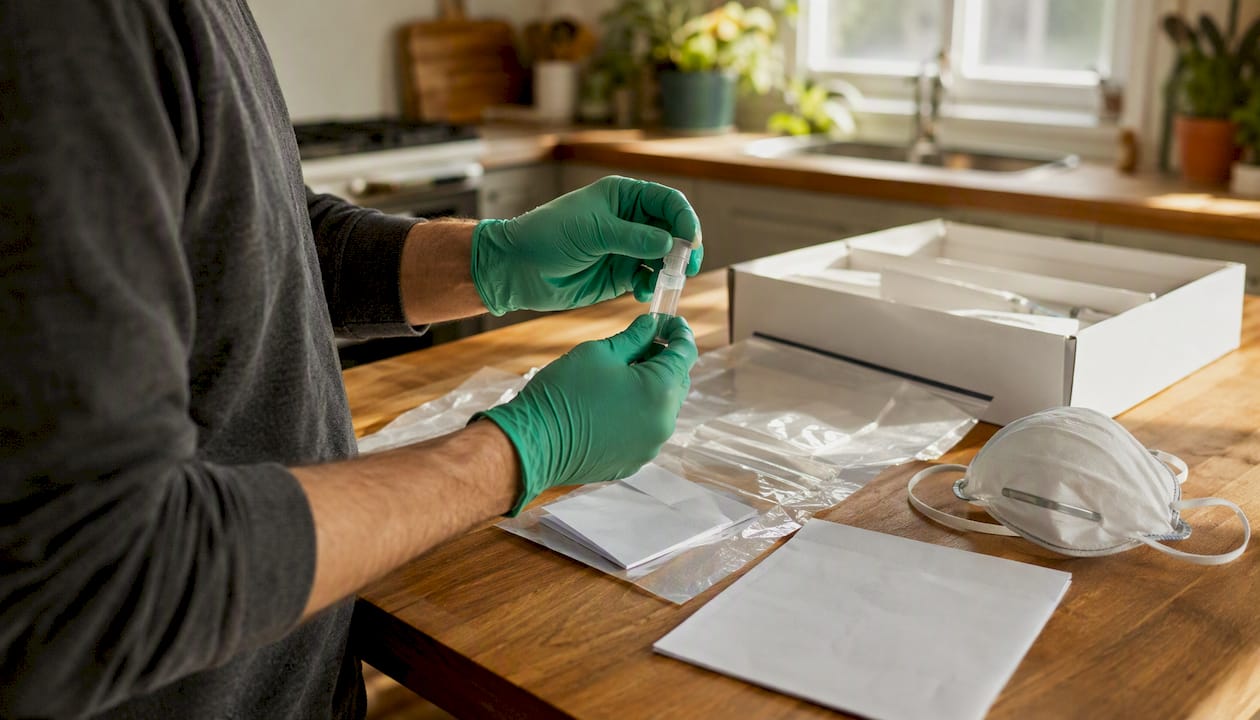
DIY mail-in kit. You buy a kit costing a moderate amount, collect the sample yourself, and mail it to the included lab. The lab fee may be bundled or added separately. Total cost is generally affordable. The upside is price. The downside is real: you are the one disturbing the material, without professional containment, and the resulting sample has no formal chain-of-custody documentation. For a simple peace-of-mind test in a stable ceiling with no transaction or legal stakes, it’s a workable option. For anything else, it’s the wrong tool.
Homeowner-collected sample mailed to an NVLAP-accredited lab. You collect the sample yourself using proper PPE and wet-sampling technique, then ship it directly to an accredited lab of your choosing. Lab fees typically run $25–$50 per sample. This costs less than professional sampling and gives you access to a credentialed lab, but the chain-of-custody gap remains. The sample’s integrity depends entirely on how carefully you collected and packaged it.
Professional sampling by a licensed inspector or industrial hygienist. A trained sampler handles collection with proper PPE, containment, and documentation. The sample goes to an NVLAP-accredited lab with a formal chain-of-custody form. This is the standard for real-estate transactions, contractor protection, and any situation where the results may be disputed. Cost is higher (more on that in the costs section), but the documentation is defensible.
The decision comes down to four factors:
- Safety: Are you comfortable with the exposure risk during collection?
- Legal need: Will this result be used in a real-estate transaction, permit application, or contractor dispute?
- Sample count: Multiple rooms may require multiple samples, which changes the cost math.
- Budget: Professional sampling costs more upfront but can prevent far larger costs downstream.
How to collect a safe, representative sample yourself
If you’ve weighed the options and decided to collect your own sample, do it carefully. The EPA is direct: sampling disturbs the material and can release fibers. This is the highest-risk step in the entire process.
- Clear the room completely. Remove furniture, cover anything that can’t be moved with plastic sheeting, and seal HVAC vents with tape and plastic. Turning off the HVAC system before you start prevents fibers from circulating through the house. (See HVAC and ventilation considerations for why this matters.)
- Put on full PPE. A P-100 respirator (not a dust mask), disposable gloves, eye protection, and disposable coveralls. This is non-negotiable.
- Lay plastic sheeting on the floor directly below the area you’ll sample. Overlap edges and tape seams.
- Mist the sample area thoroughly with water from a spray bottle before touching it. Wetting the texture is the single most effective way to limit fiber release during collection, according to standard wet-sampling procedures.
- Scrape a quarter-sized sample (roughly 1–2 tablespoons of material) into a clean, sealable plastic bag. Use a clean knife or putty knife. Don’t generate dust.
- Seal the bag immediately, label it with the room location and date, and place it inside a second sealed bag.
- Wipe down the sampling area with a damp paper towel and seal the towel in a bag. Fold up the plastic sheeting carefully, seal it in a heavy garbage bag, and dispose of it according to your local solid waste rules. If asbestos is confirmed, that waste may require special handling.
- Remove PPE carefully — peel off coveralls and gloves without shaking them, seal in a bag, and wash hands thoroughly.
Pro Tip: A negative result from one room does not clear the whole house. Different rooms may have been textured at different times or with different material batches. Sample every distinct ceiling area, especially if repairs were made at different points in the home’s history.
Stop and call a professional if you find the texture is heavily flaking, if there’s visible water damage, or if you need the result for a real-estate transaction or legal purpose.
How labs test samples and what your report actually means
PLM vs. TEM: the two main methods
NVLAP-accredited labs use two primary analytical methods for bulk asbestos samples.
Polarized Light Microscopy (PLM) is the standard method for bulk material analysis. The lab prepares a thin section of your sample and examines it under polarized light to identify asbestos fiber types by their optical properties. PLM is cost-effective, widely available, and sufficient for most homeowner and regulatory purposes. Turnaround from accredited labs is typically 3–10 business days for standard service.
Transmission Electron Microscopy (TEM) provides higher sensitivity and is used when PLM returns a low or trace result, when the stakes are high (legal proceedings, large-scale renovation permits), or when courtroom-quality analysis is required. TEM can detect fiber concentrations that PLM may miss. It costs more and takes longer, but for a contested result or a major transaction, it’s the right call.
What NVLAP accreditation actually means
NVLAP (National Voluntary Laboratory Accreditation Program), administered by NIST, sets the technical standard for asbestos-testing labs in the United States. An accredited lab has demonstrated proficiency in sample handling, analytical method, and reporting. When you see NVLAP accreditation on a lab report, it means the result was produced under a verified quality system. For real-estate and legal contexts, it’s the baseline expectation.
Reading your lab report
A complete lab report from an accredited facility should include:
- Material description: what was submitted (bulk ceiling texture, color, form)
- Analytical method: PLM or TEM, clearly stated
- Asbestos type(s) detected: chrysotile, amosite, crocidolite, or others
- Percentage by weight: the number that triggers regulatory classification
- Detection limits: the lowest concentration the method can reliably detect
- Chain-of-custody stamp: confirming sample integrity from collection to analysis
Interpreting the numbers. Per OSHA’s asbestos standard (1926.1101), materials containing 1% or more asbestos by weight are classified as regulated Asbestos-Containing Material (ACM). A result at or above 1% triggers federal regulatory requirements for handling, removal, and disposal. A result below 1% is often reported as “trace” and is not regulated at the federal level, though some states apply stricter thresholds. A result of “none detected” means the method found no asbestos fibers above its detection limit — not necessarily that zero fibers exist, but that the concentration is below what PLM can reliably identify.
If your result comes back as trace or at a borderline percentage, and the situation involves a real-estate transaction or a large renovation, request TEM reanalysis or a second-lab confirmation before making decisions.
| Factor | PLM | TEM |
|---|---|---|
| Best use | Standard bulk screening | Low-level detection, legal/high-stakes |
| Detection sensitivity | Moderate | High |
| Typical cost | Lower | Higher |
| Turnaround | 3–10 business days | Longer |
| Chain-of-custody | Required for legal use | Required for legal use |
How much does asbestos testing cost, and how long does it take?
Asbestos testing cost varies by collection method, number of samples, and whether you need rush processing.
DIY mail-in kits typically run $30–$80 total, including the kit and lab fee. Turnaround is generally 3–10 business days after the lab receives the sample. Some kits offer rush processing for an additional fee.
Homeowner-collected samples mailed to an NVLAP lab cost roughly $25–$50 per sample in lab fees alone. You save on collection costs but absorb the exposure risk yourself. This path works when you have one or two samples, proper PPE, and no chain-of-custody requirement.
Professional inspector sampling involves a field-collection fee plus lab analysis. Per-sample professional collection fees vary by region and provider; combined with lab costs, professional asbestos testing typically runs meaningfully higher than DIY but delivers documentation that holds up in real-estate negotiations and contractor disputes. Some inspectors bundle multiple samples at a reduced per-sample rate.
Rush lab services are available from most NVLAP-accredited labs for an additional fee, often cutting turnaround to 24–48 hours. If you’re working against a real-estate contingency deadline or a contractor’s start date, ask about rush options when you book.
A few practical planning notes:
- Budget for multiple samples if you have multiple textured rooms or if repairs were done at different times.
- Factor lab turnaround into renovation schedules — a 5-business-day wait can push a contractor start date by a week or more.
- For real-estate transactions, get testing done during the inspection contingency window, not after.
What to do after a positive asbestos result
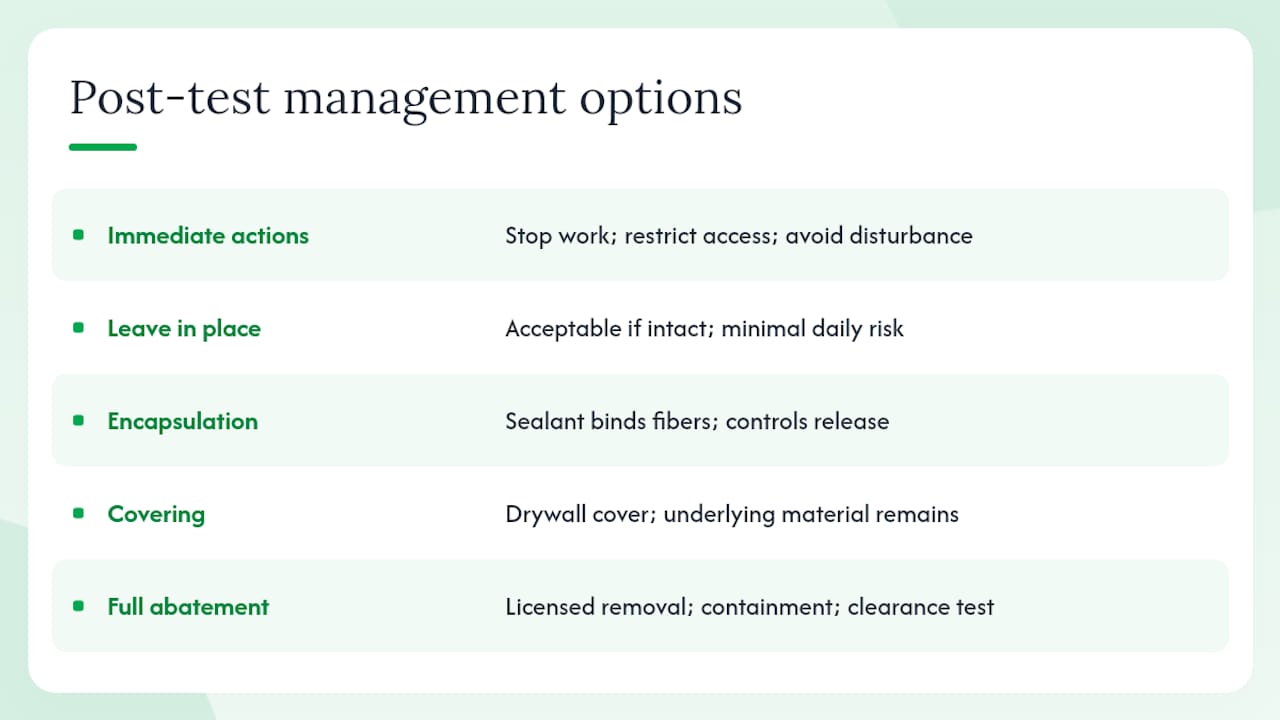
A positive result is not an emergency — but it does require a clear-headed next step. As trained inspectors note, a positive result does not automatically require removal. Your options depend on the material’s condition and your plans for the space.
Stop all work immediately. Restrict access to the area. Don’t vacuum, sweep, or disturb the ceiling further until you’ve consulted with a licensed professional.
Leave it in place. If the ceiling is intact, not flaking, and you have no plans to disturb it, leaving it alone is often the most practical choice. Intact asbestos-containing material that isn’t being disturbed poses minimal day-to-day risk.
Encapsulation. A licensed contractor applies a penetrating sealant that binds fibers and prevents release. This is less expensive than removal and appropriate when the material is in reasonably good condition. It does not eliminate the asbestos — it controls it. Future disturbance (a renovation, a repair) will still require precautions.
Covering. Installing new drywall over the existing ceiling is another management-in-place option. It’s cost-effective and keeps the material sealed, but adds ceiling height and weight, and the underlying material still needs to be disclosed and managed if the home is sold or renovated later.
Full abatement. Licensed removal by a certified asbestos abatement contractor is required when the material is severely damaged, when a major renovation will disturb it, or when local regulations mandate it. Abatement involves containment, negative air pressure, licensed disposal, and a clearance air test after completion. It’s the most expensive option but the only permanent one. Encapsulation or covering costs materially less than full abatement and remains acceptable when the material is intact and future disturbance is unlikely.
Disclosure and real-estate implications. A positive test result is a material fact in most states. Sellers are generally required to disclose known asbestos-containing materials. A documented test result with chain-of-custody paperwork actually strengthens your position — it shows you tested responsibly and gives the buyer a clear picture of the material’s condition and management options. Undisclosed asbestos discovered after closing is a much bigger legal problem than a disclosed, managed result.
Local and state regulations on permits, disposal, and contractor licensing vary. Check with your state environmental agency or a licensed industrial hygienist for requirements specific to your jurisdiction.
How to choose a trustworthy lab or licensed asbestos inspector
Credentials matter here more than price. A cheap test from an unaccredited lab, or a sample collected without proper chain-of-custody, can leave you with a result that’s worthless in a real-estate negotiation or a contractor dispute.
For labs, verify:
- NVLAP accreditation (searchable on the NIST NVLAP directory)
- The report states the analytical method (PLM or TEM) and detection limits
- The lab provides a chain-of-custody form and tracks sample integrity
- Turnaround time and rush options are clearly stated upfront
For inspectors and samplers, verify:
- State licensure as an asbestos inspector or asbestos contractor (requirements vary by state)
- Certification from a recognized body such as ACAC (American Council for Accredited Certification) or equivalent industrial hygiene credential
- They provide written chain-of-custody documentation with every sample
- They can explain the difference between PLM and TEM and recommend the right method for your situation
Questions worth asking before you hire:
- What accreditation does your lab hold, and can you provide the certificate?
- Will the report show the method, asbestos type, percentage by weight, and detection limits?
- What’s your standard turnaround, and what does rush service cost?
- How do you handle containment during sampling?
- Do you provide a written report I can share with a real-estate agent or contractor?
Red flags to walk away from:
- A lab that won’t provide its NVLAP accreditation number on request
- A sampler who dismisses chain-of-custody as unnecessary
- An unusually low flat-price quote that doesn’t include written documentation
- Anyone who offers a visual-only assessment and calls it a test
Jhunthomeinspections handles asbestos sampling with proper PPE, containment, and NVLAP lab coordination, and delivers written reports within 24 hours. Their inspection company selection criteria page walks through what to look for when comparing providers.
Pro Tip: Ask any inspector for their state license number and verify it with your state environmental or labor agency before booking. Legitimate professionals expect the question and answer it immediately.
Why visual identification is never enough
This point deserves emphasis because it’s the one homeowners most often underestimate. A ceiling can look perfectly smooth and still contain chrysotile fibers woven into the texture binder. A ceiling can look old and crumbly and test negative. Appearance tells you nothing.
The American Lung Association documents that asbestos-related lung disease develops from inhaled fibers — and that there is no safe level of exposure established for asbestos. The risk isn’t theoretical. It’s the reason NVLAP accreditation, documented chain-of-custody, and trained samplers exist as a standard, not a premium option.
Age and condition are indicators, not proof. The only proof is a lab report from an accredited facility, produced from a properly collected sample.
What the field actually teaches you about popcorn ceiling testing
Most homeowners who call about a popcorn ceiling have already made one of two mistakes: they’ve either scraped a sample with no PPE and no containment, or they’ve done nothing for years because the ceiling “looks fine.” Both are understandable. Neither is the right call.
The practical reality is that professional sampling costs more than a DIY kit, but it’s rarely as expensive as homeowners fear — and it’s almost always cheaper than the downstream problems it prevents. A real-estate deal that falls apart over undocumented asbestos, or a contractor who walks off a job because there’s no test on file, costs far more than a professional sampling appointment.
The other thing the field teaches: one sample is almost never enough. Homes with multiple textured rooms, or ceilings that were patched or retextured at different times, need samples from each distinct area. A single negative result doesn’t clear a whole house.
The path that works for most homeowners in the St. Louis Metro area and Southern Illinois is straightforward: schedule a professional sampling appointment, get the NVLAP lab report in hand, and make decisions from documented facts rather than guesses. That’s the approach Jhunthomeinspections recommends, and it’s the one that holds up when it matters.
Jhunthomeinspections handles the sampling so you don’t have to
Popcorn ceiling testing done right means professional collection, proper containment, and a lab report that actually holds up. Jhunthomeinspections provides exactly that for homeowners and property owners across the St. Louis Metro area and Southern Illinois.
Every asbestos sampling appointment includes PPE and containment during collection, sample drop-off or courier to an NVLAP-accredited lab, chain-of-custody documentation, and a written report with results and interpretation. Reports are delivered within 24 hours where applicable. For buyers working against a contingency deadline, Jhunthomeinspections also offers pay-at-close options so testing doesn’t stall your transaction. Schedule your professional asbestos sampling appointment today and get a documented answer before you make any decisions about your ceiling.
Sources
These primary and authoritative sources are worth bookmarking for verification, lab accreditation checks, and deeper procedural detail.
- EPA — Protect your family from exposures to asbestos
- NIST NVLAP
- OSHA Asbestos Standard (1926.1101)
- Popcorn Ceiling Asbestos: How to Tell, How to Test, and What to Do – InspectandTest
This article is general information, not a substitute for advice from a qualified doctor. Consult a qualified healthcare professional about your own circumstances before acting on anything here.
Recent Comments